The best anti-corrosive lighting for coastal applications is not simply the fixture with the highest IP number. It is a weatherproof LED fixture whose housing, lens, fasteners, cable entry, gasket compression, coating, driver compartment, and mounting hardware are all matched to salt air, humidity, wind-driven rain, and the service routine. In coastal projects, the weak part is often not the LED board. It is the metal clip, screw, gland, bracket, or coating edge that starts corrosion after repeated wet and dry cycles.
According to IEC ingress protection guidance, IEC 60529 ratings describe enclosure protection against dust, water, and access to hazardous parts, with 2 digits separating solid and liquid protection. That helps buyers compare IP65, IP66, and IP67 claims, but it does not prove corrosion resistance by itself. The practical insight is simple: a coastal lighting RFQ should name the salt, water, cleaning, and service path before asking a supplier to quote the fixture.
Key Takeaways
- For coastal sites, anti-corrosive lighting starts with the exposure map: salt mist, direct spray, humidity, cleaning chemicals, wind-driven rain, and service access.
- IP65 or IP66 can be necessary, but the rating does not replace material, coating, fastener, gland, and bracket evidence.
- Salt spray testing can be useful as a comparative sample screen, but the buyer should not read a 500-hour or 1000-hour test as a universal lifetime guarantee.
- Fanxstar is most relevant when the buyer needs a weatherproof, vapor tight, aluminum, or custom LED platform with application-specific corrosion controls.
Choose Corrosion Protection by Exposure Zone
Choose the fixture around the corrosion path
A coastal luminaire should be selected by the route corrosion will take. Salt can land on the outside surface, enter through a poor cable gland, sit around screw heads, wick into a gasket joint, or attack a bracket that was never included in the product test. A buyer who only asks for an IP66 light may still receive a product that sheds rain during a short water test but ages poorly when salt, heat, ultraviolet exposure, and maintenance handling repeat for years.
According to NEMA enclosure type guidance, enclosure type definitions are separate from complete product selection and users are pointed to NEMA 250 for detailed scope. That is a useful warning for coastal buyers: IP, NEMA type, salt spray hours, material grade, and surface finish are different pieces of evidence. They should support each other instead of being treated as interchangeable labels.
The practical answer is to shortlist anti-corrosive LED lights with a sealed body, corrosion-aware housing material, protected fasteners, suitable lens, controlled gasket compression, documented cable entry, and a bracket that matches the same exposure. If the site is close to seawater, near fish processing, or inside a coastal parking or logistics facility, the RFQ should ask for evidence for every metal and plastic part that remains exposed after installation.
Do not let salt spray hours replace field logic
According to ASTM B117 salt spray practice information, ASTM B117 is a practice for operating salt spray apparatus. That makes it useful for screening sample consistency, but it is not a magic lifetime label. A 500-hour or 1000-hour salt spray claim should trigger follow-up questions: which product version was tested, whether the test included clips and screws, whether the coating edge was cut, whether the bracket was included, and whether the sample matches the production bill of materials.
Buyers should also ask whether the test was done on the complete luminaire or only on a material coupon. A coating coupon may look good while a real fixture fails around a punched hole, threaded fastener, cable entry, or folded edge. In coastal lighting, the difference between coupon evidence and full-fixture evidence can decide whether maintenance teams see stable performance or a line of rust points within the first service cycle.
| Coastal condition | What usually fails first | Evidence to request |
|---|---|---|
| Covered coast-side loading bay | fasteners, clips, and cable glands | IP file, material list, stainless hardware, and gasket detail |
| Open pier or marine walkway | coating, lens seal, and mounting bracket | salt-fog screen, coating thickness, bracket material, and drainage plan |
| Food or fish processing near coast | chemical cleaning plus salt humidity | washdown rating, cleaning-agent boundary, and sample cleaning cycle |
| Outdoor canopy near seawater | wind-driven rain and connector corrosion | IP66 path, gland type, drip loop, and service closure check |
How Coastal Exposure Changes the Product Choice
Salt humidity is different from ordinary rain
Ordinary outdoor rain mostly asks whether water can enter the enclosure. Coastal humidity adds a second problem: conductive or corrosive residue can remain after the visible water has dried. That residue can concentrate around crevices, screw heads, clips, and cable glands. A fixture that survives a rain shower in a standard outdoor yard may not be the right choice for a harbor, coastal warehouse, seafood plant, seaside parking structure, or canopy where air circulation brings salt mist every day.
According to IEC IP ratings, the 2 IP numerals answer different questions, so a buyer should not treat the first digit and second digit as one generic quality score. A typical coastal anti-corrosion brief should state whether the product needs dust resistance, rain resistance, jet resistance, temporary immersion resistance, or washdown resistance. Then the corrosion brief should add salt exposure, chemicals, ultraviolet exposure, ambient temperature, and maintenance frequency.
The highest risk projects are usually mixed-exposure sites. A seafood processing plant near the coast may combine salt humidity, washdown chemicals, condensation, and impact risk. A coastal car park may combine salt air, vehicle exhaust, wind-driven rain, and vibration. A canopy project may combine rain splash, heat cycling, and service access from below. The best anti-corrosive lighting choice changes when these exposure paths are combined.
Material selection should cover small parts
Housing material gets the most attention, but small parts often decide the service story. Buyers should ask about aluminum grade or body material, lens material, clips, screws, end caps, cable glands, mounting brackets, coating, sealant, and label durability. If a supplier cannot identify the material of exposed fasteners, the coastal suitability claim is weak. If the bracket is sourced separately, it should not be outside the corrosion review.
A good RFQ also names the cleaning routine. Will maintenance wipe the fixture with a damp cloth, use pressure spray, use alkaline cleaner, or work around fish oil or food residue? Even when the light is not directly washed, the cleaning chemistry around the installation can migrate onto the fixture. That is why coastal food, cold storage, and washdown sites need a combined conversation about corrosion resistance and cleanability.
According to DLC solid-state lighting technical requirements, commercial LED product qualification is organized around defined product categories and performance evidence. Coastal buyers can use the same discipline: ask what exact luminaire category, wattage, CCT, lens, driver, housing, and accessory set was tested. If production changes any exposed material after approval, the corrosion evidence should be reviewed again.
According to FEMP purchasing guidance for commercial and industrial LED luminaires, buyers should evaluate commercial and industrial LED luminaires as finished products rather than isolated components. That matters for coastal projects because corrosion risk is carried by the finished luminaire, including its clips, glands, brackets, and labels. According to ENERGY STAR lighting upgrade guidance, commercial LED upgrades can reduce electricity use, but in coastal applications the energy benefit should be protected by a fixture that can survive the environment long enough to deliver it.
What to Ask Suppliers Before Approving a Coastal Sample
Turn the RFQ into an evidence request
A coastal RFQ should not start and end with best anti-corrosive light, IP66, and cheapest price. It should state the installation zone, distance from direct spray if known, cleaning method, mounting orientation, ambient range, target lifetime, required certificate market, and whether the fixture will be opened during service. That gives the supplier enough context to decide whether a standard weatherproof LED light is suitable or whether the platform needs a material, gland, coating, or bracket change.
According to International Trade Administration import documentation guidance, import files can include invoices, bills of lading, packing lists, insurance proof, and certificates of origin, which means buyers already manage several documents for one shipment. The lighting evidence file should be just as consistent. The approved sample, quotation, BOM, test report, label, packing list, and invoice should describe the same coastal luminaire version.
According to International Trade Administration special document guidance, some products may need certificates related to standards, safety, or other special requirements. Coastal LED lighting buyers can apply that discipline before shipment: if the market, site, or end customer requires a special material, coating, or certificate file, the request should be written into the RFQ before sample release.
Useful supplier questions include: Which parts are exposed after installation? Which parts are stainless, aluminum, coated steel, plastic, or gasket material? What IP evidence applies to this exact body? What salt spray or corrosion screen was used, and what parts were included? Can the cable gland and bracket be changed? What happens if the buyer needs a longer cable, sensor, emergency function, or different CCT?
Use a 3-stage sample gate
The first stage is drawing and BOM review. Confirm dimensions, housing, lens, clips, screws, gasket, cable entry, driver, bracket, coating, and mounting orientation. The second stage is sample inspection. Check fit, closure force, cable strain relief, bracket contact points, surface finish, and whether there are crevices where salt solution can sit. The third stage is evidence review. Confirm IP file, corrosion screen, photometric data, electrical safety path, and production change control.
This 3-stage gate is slower than asking for a catalog link, but it is faster than replacing failed coastal fixtures. It also protects the supplier because the factory can quote the correct material and process before mass production, instead of absorbing a warranty dispute caused by an underspecified environment.
For high-volume coastal projects, the buyer can request a golden sample with photographs of critical details: gasket route, gland assembly, screw material, coating edge, bracket interface, and label location. Those photos are simple, but they make later production audits much easier because the inspector can compare the shipped product against visible evidence, not only paperwork.
Where Fanxstar Fits Coastal Anti-Corrosive Lighting
Match the platform to the exposure
Fanxstar’s relevant starting points include weatherproof LED lighting platforms, IP65 and IP66 waterproof LED lights, vapor tight LED light fixtures, and aluminum weatherproof LED luminaires. A buyer should not choose among these by name alone. The right platform depends on whether the site is mostly rain, washdown, salt humidity, chemical exposure, or a mixed coastal environment.
For a covered coastal logistics site, an aluminum weatherproof platform with suitable fasteners and cable gland may be the right starting point. For seafood, cold storage, or washdown areas, a vapor tight or waterproof platform may be more relevant because cleaning and gasket behavior matter. For a custom canopy or marine-side equipment room, the buyer may need a modified cable entry, bracket, sensor, emergency option, or private-label housing detail.
If the project needs a nonstandard material, cable, lens, sensor, mounting, or evidence file, Fanxstar custom LED lighting ODM service can start from a defined sample brief. The useful input is not a broad request for anti-corrosion. It is a practical exposure map with wattage, length, CCT, control requirement, target market, cleaning method, and the part of the fixture most likely to fail.
Use a soft release checklist before buying volume
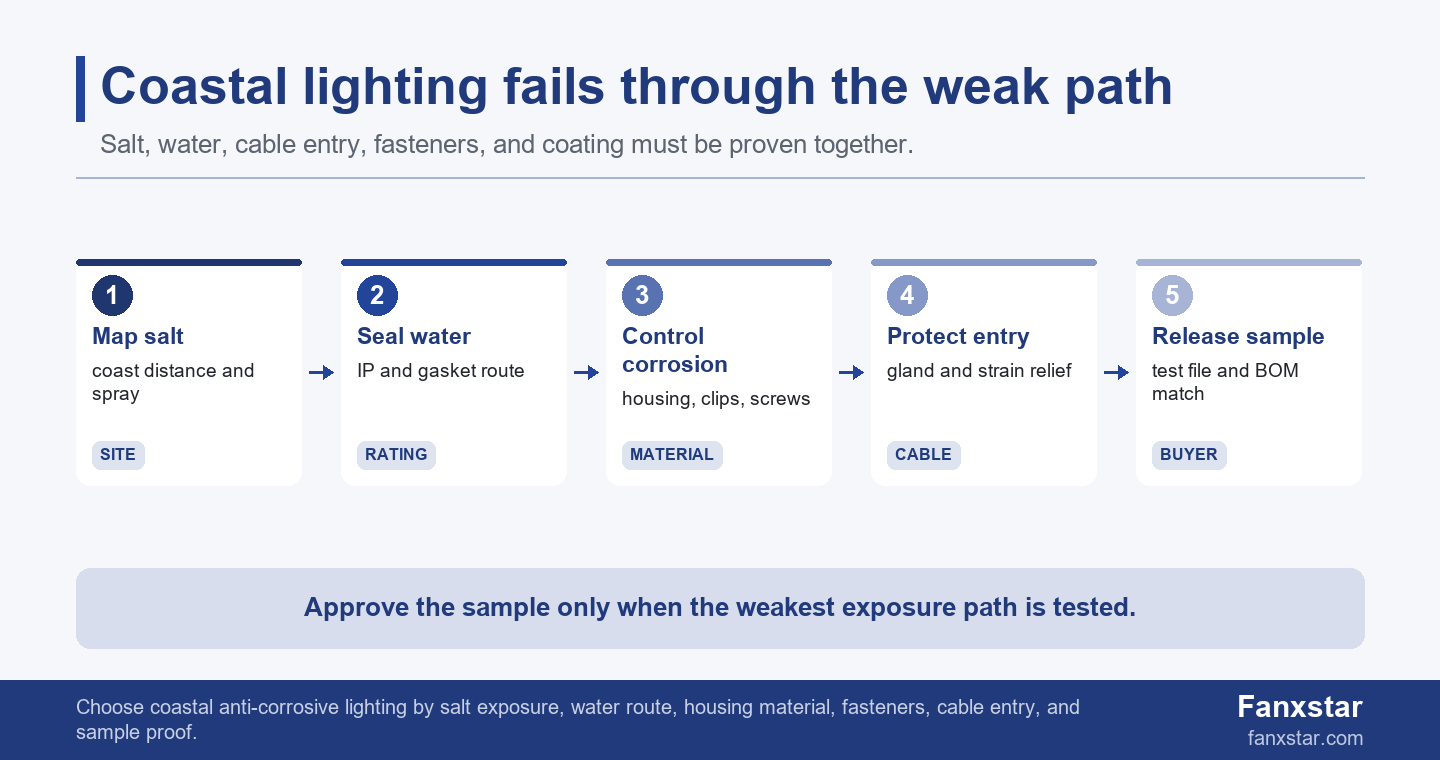
Before volume purchase, the buyer should ask Fanxstar or any shortlisted supplier to confirm 8 items: enclosure rating, material list, exposed fasteners, cable gland, bracket, corrosion screen, photometric file, and production change rule. If any one of those 8 items is missing, the coastal suitability claim is incomplete. That does not always mean the fixture is wrong, but it means the risk has not been priced honestly.
A strong coastal LED lighting quote should be boring in the best way. It should show the exact product, exact material, exact evidence, and exact boundary of use. When the exposure is mapped and the sample evidence matches the production file, the buyer can compare price with much more confidence.
FAQ
Is IP66 enough for coastal lighting?
IP66 can be useful for dust-tight and strong water-jet protection, but it does not prove corrosion resistance by itself. Coastal buyers should also check housing material, coating, fasteners, cable entry, bracket material, gasket behavior, and salt or corrosion sample evidence.
Is stainless steel always the best anti-corrosive material?
Not always. Stainless hardware can help, but the full fixture still depends on housing material, lens, coating, gasket, galvanic contact, cleaning chemicals, and installation detail. A mixed-material design can still fail if the bracket, screw, or cable gland is not matched to the environment.
How many hours of salt spray testing should coastal LED lights have?
There is no universal hour number that proves field lifetime. Buyers often request 500-hour or 1000-hour screens, but the important question is whether the tested sample matches the final fixture, including clips, screws, brackets, coating, and cable entry.
What should be included in a coastal lighting RFQ?
Include the installation zone, salt exposure, rain or washdown path, cleaning routine, mounting orientation, ambient range, target market, IP target, material preference, cable length, control needs, and evidence required before sample approval.