
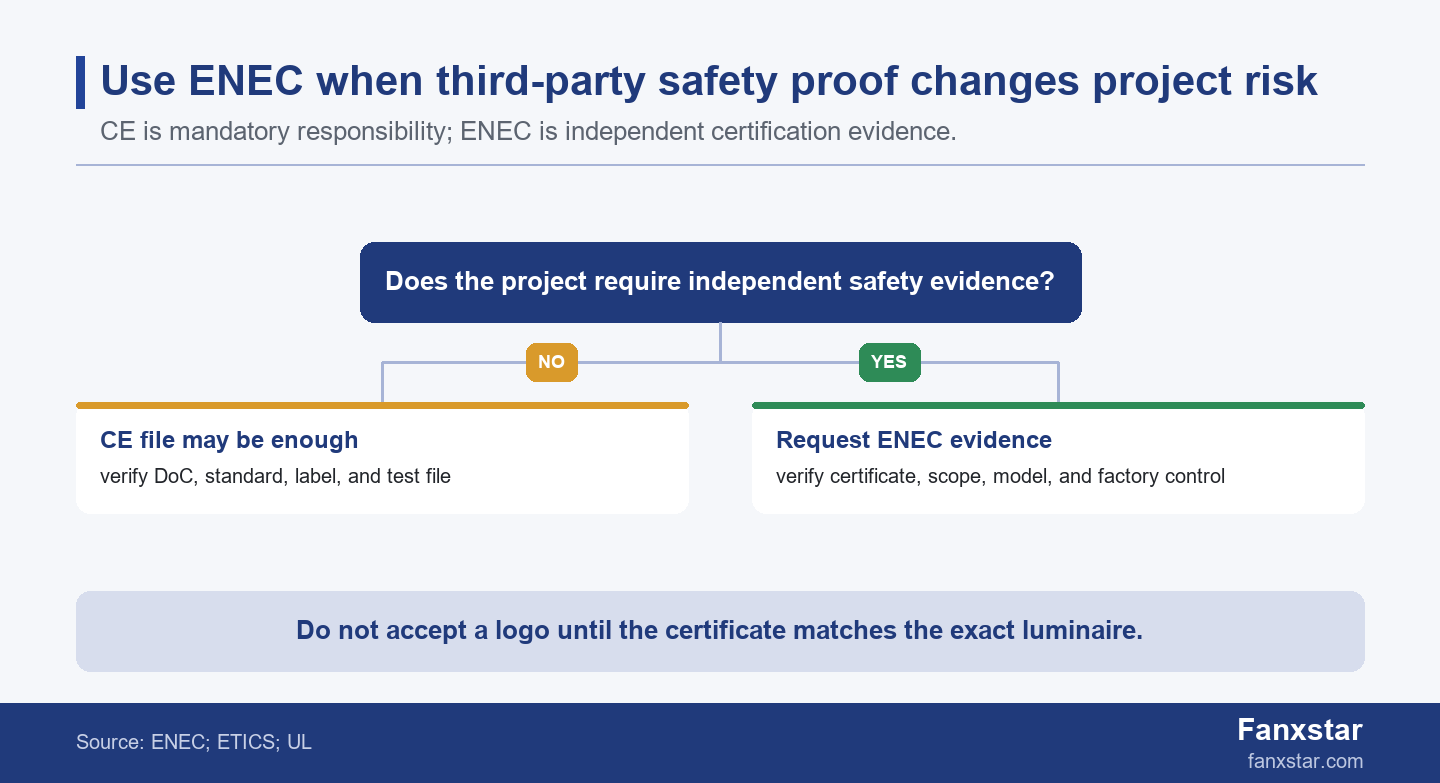
ENEC does not replace CE marking, but it can reduce buyer risk when a European project needs independent safety evidence for the exact luminaire. The buyer should not treat ENEC as a decorative logo. The practical value is a verifiable third-party safety file that matches the model, certificate scope, factory control, and project requirement.
According to the official ENEC site, ENEC is a European mark for electrical products that demonstrates compliance with European safety standards. According to UL guidance on ENEC and CE marking, the ENEC Mark demonstrates compliance with European standards and can support compliance with relevant European directives. Those 2 facts show why ENEC can strengthen a buyer file, but does not replace the buyer’s CE responsibility check.
Key Takeaways
- CE marking is mandatory for many EU electrical products; ENEC is voluntary third-party certification evidence.
- ENEC is most useful when a project owner, consultant, distributor, or tender wants independent safety proof.
- A buyer should verify the certificate, model identity, standard scope, label, and production version before trusting the mark.
- Fanxstar buyers should request ENEC or ENEC-ready evidence before ODM changes, not after sample approval.
What ENEC Proves and What It Does Not Prove
ENEC is independent safety evidence, not a replacement for CE
According to the ENEC network overview, ENEC certification bodies test and certify electrical products and issue licenses through recognized certification and laboratory routes. This is why ENEC matters in professional lighting projects: it gives buyers a third-party safety signal beyond a supplier’s self-declared marketing statement.
The mistake is assuming ENEC replaces CE marking. CE is still the manufacturer’s legal route for placing relevant products on the EU market. ENEC can support confidence in the safety file, but the buyer should still verify Declaration of Conformity, applicable directives, standards, technical documentation, label, and product identity.
ENEC value depends on exact model identity
According to ENEC certificate verification page, the official ENEC site provides a tool to verify ENEC or ENEC+ certificates. That verification step is essential because a catalog logo is weak evidence. The certificate should match the exact luminaire model, rated power, construction, standard, certificate holder, and mark use condition.
Buyers should be especially careful with product families. A supplier may have ENEC on one driver, one luminaire version, or one model range while quoting a changed ODM product. A different driver, emergency module, sensor, cable, housing, diffuser, or label can make the old certificate less relevant. The certificate must describe the product being bought.
CE, ENEC, and ENEC+ in Lighting Procurement
Separate legal entry from third-party confidence
| Buyer question | CE file answers | ENEC evidence answers |
|---|---|---|
| Can it be placed on EU market? | manufacturer responsibility and DoC | third-party safety certification support |
| Was the exact model certified? | technical file and label | certificate scope and model identity |
| Who tested it? | supplier or lab evidence | ENEC CB and testing laboratory route |
| Does performance matter? | separate performance data | ENEC+ may add performance validation |
According to ENEC network overview, ENEC certification bodies test and certify electrical products and issue ENEC licenses, while ENEC testing laboratories perform necessary tests with their own equipment and facilities. This network is the reason ENEC can carry more procurement weight than a supplier-only statement.
The buyer should ask a simple sequence. Is CE documentation complete? Is ENEC required by the tender, project owner, distributor, or internal risk policy? Does the ENEC certificate match the exact model? Does the project also need performance evidence such as lumen output, lifetime, emergency function, or energy data? Each question points to a different file.
Use ENEC+ only when performance claims are part of the risk
According to official ENEC+ mark guidance, ENEC+ was created with LightingEurope for products where performance becomes a significant aspect. According to ENEC+ process guidance, ENEC+ can be requested after obtaining the ENEC mark. That makes ENEC+ relevant when a lighting project needs stronger performance validation, not only safety confidence.
For many standard projects, ENEC safety certification plus a complete performance file may be enough. For higher-risk tenders, premium luminaires, public projects, or distributor programs, ENEC+ can help reduce arguments about long-term performance claims. The buyer should decide this before RFQ, because certification path affects sample timing and document cost.
Evidence to Request Before Approving a Luminaire
Ask for certificate scope, not only a logo
According to ENEC official certification mark explainer, ENEC has operated since 1992 and around 17,000 certificates covering 80,000 products have been granted the licence to display the ENEC mark. The scale of the scheme does not remove the buyer’s verification job. A logo on a PDF is not enough; the certificate and model scope must be checked.
The evidence packet should include certificate number, certification body, standard, model list, rated power, product photo or description, certificate holder, mark use condition, factory surveillance or control reference where applicable, and any limitation. The buyer should compare those fields with the quotation, sample label, technical datasheet, and order file.
Check components and final luminaire separately
A certified driver or component can support a luminaire file, but it does not automatically certify the final luminaire. The housing, wiring, diffuser, cable entry, emergency function, sensor, thermal condition, and final assembly can change safety risk. Buyers should ask whether the final luminaire is ENEC certified or only uses certified components.
This distinction matters in ODM work. A supplier may propose an ENEC-approved platform, then change a cable, driver, label, CCT, or sensor for the buyer. The buyer should ask whether the change stays within certificate scope, needs engineering review, or requires a new certification step before mass production.
Where Fanxstar Buyers Should Use ENEC in RFQs
State the EU project requirement before tooling
For emergency lighting, weatherproof LED lighting, linear lighting, or public infrastructure projects, buyers should state whether ENEC is mandatory, preferred, or only a future option. If ENEC is required, the RFQ should specify target market, product family, standards, label expectation, and whether ENEC+ performance evidence is also relevant.
Fanxstar should receive the tender document, target model, rated power, driver, emergency function, sensor need, installation environment, and certificate expectation through Fanxstar customization. The team can then recommend an existing platform, an ENEC-ready route, or a product boundary that avoids unnecessary certification rework.
Do not change the certified version casually
When a project also needs CE, ENEC, UL, IP, warranty, or market-specific label evidence, Fanxstar’s LED lighting certification checklist for ODM buyers helps buyers convert those marks into a release file. The useful rule is to freeze safety-critical changes before sample approval. Changing driver, wiring, cable entry, housing, or emergency module after certification discussion can reopen the evidence file.
A buyer can still customize, but the customization should have a certification impact note. The note should say whether the change is cosmetic, electrical, mechanical, thermal, optical, or label-related. It should also say who decides whether the ENEC file remains valid. That protects the buyer from approving a product that no longer matches the evidence.
Illustrative Cost of a Certificate Mismatch
A valid certificate can still fail the buyer decision
Use a realistic procurement scenario. A distributor asks for 1,200 weatherproof luminaires for an EU public-site project and receives an ENEC logo on the supplier brochure. The certificate is real, but it covers a different driver version and a lower wattage model. The buyer notices the mismatch only after sample approval, so the team must reopen the technical file, label artwork, installation instruction, and customer approval package. The certificate was not fake; it was simply not the certificate for the exact product being purchased.
That scenario explains why ENEC verification should happen before tooling, packaging, and final artwork. The cost is not only a certification fee. It can include delayed sample approval, revised labels, repeated safety review, distributor questions, tender document correction, and lost confidence from the project owner. A five-minute certificate-scope check at RFQ stage can prevent a multi-week evidence dispute after the order is already moving.
The release file should describe the product in one voice
A strong EU lighting release file makes the quotation, datasheet, label, certificate, installation instruction, and sample photo describe the same luminaire. If the certificate says one model, the label says another, and the quotation adds an emergency option, the buyer does not have a clean evidence path. The supplier may still be able to explain the relationship, but the project team has inherited avoidable uncertainty.
For Fanxstar ODM work, the safest practice is to keep a change log beside the certificate discussion. Each change should be classified as electrical, mechanical, optical, thermal, label, or packaging. The buyer can then ask whether the change remains within the existing evidence boundary or needs a new review. That habit protects both compliance and schedule because it prevents small customization requests from becoming silent certification changes.
Final Buyer Checklist
Verify before ordering, not after shipment
Before ordering, verify certificate number, exact model, certificate holder, certification body, applicable standard, label, rating, and product photo or description. Then compare the certificate to the sample and quotation. If the buyer cannot match the certificate to the sample, the order should be held until the supplier explains the connection. The verification should happen before deposit when the buyer still has leverage to correct the evidence file.
For projects with strict tender documentation, keep CE file, ENEC certificate, datasheet, label artwork, installation instruction, and change log together. If a later substitution occurs, the project team can immediately see whether the safety file still describes the product. This is especially important for emergency lighting, public sites, and distributor programs where the final paperwork may be reviewed by people who never saw the sample.
Choose the evidence level by project risk
A small private project may accept CE documentation and standard test evidence. A public project, distributor program, school, hospital, tunnel, emergency route, or premium EU tender may benefit from ENEC because independent certification reduces uncertainty. The buyer should match evidence level to project risk instead of asking for every mark on every product.
The strongest procurement habit is specific language: ENEC required for final luminaire model X, certificate to be verified before production, ODM changes to be reviewed before shipment. That language is far better than a vague request for European quality because it tells engineering, purchasing, and the supplier exactly when the order must pause for evidence. It also creates a clean audit trail if the distributor, consultant, or project owner later asks why one model was accepted and another similar model was held.
FAQ
Is ENEC certification mandatory for EU lighting?
ENEC certification is not generally mandatory in the same way CE marking is required for many EU electrical products. ENEC is a voluntary third-party certification mark. It can still be valuable when a tender, distributor, consultant, or buyer wants independent safety evidence for a luminaire, especially when the project team needs confidence beyond supplier self-declaration.
Does ENEC replace CE marking?
ENEC does not replace CE marking because CE is the manufacturer’s legal declaration route for relevant EU products. ENEC can support buyer confidence by showing independent assessment against European safety standards. Buyers should verify both the CE file and the ENEC certificate scope when project risk is high, then confirm that both describe the same final model.
How should buyers verify an ENEC lighting certificate?
Buyers should verify the certificate number, model list, certification body, applicable standard, certificate holder, rating, and product description. They should compare those fields with the quotation, label, datasheet, and physical sample. A logo alone is not enough evidence for an EU project because the certified scope may not match the purchased version.
When should Fanxstar discuss ENEC during ODM work?
Fanxstar should discuss ENEC before sample approval when the buyer changes driver, emergency function, sensor, cable entry, housing, label, or target EU project requirement. Early discussion helps decide whether an existing platform is suitable, whether ENEC-ready evidence is enough, or whether certification work must be planned before tooling and packaging decisions become expensive.








