Explosion-proof lighting zones describe how often a hazardous atmosphere can appear, so the buyer should start with area classification before comparing luminaire price, wattage, or appearance. Zone 1, Zone 2, Zone 21, and Zone 22 are not product quality grades. They are classifications of how likely and how long explosive gas, vapour, mist, or dust atmospheres may be present. A buyer should therefore ask for the site classification first, then match the luminaire marking and certificate to that classification.
According to HSE hazardous area classification guidance, Zone 0 means continuous or long-period gas atmosphere, Zone 1 means likely in normal operation, and Zone 2 means unlikely or short duration. HSE also states that dust zones 20, 21, and 22 correspond to gas and vapour zones. According to HSA ATEX guidance, the same frequency and duration logic applies to gas and dust zoning.
Classification, equipment selection, installation, inspection, and maintenance must comply with local hazardous location rules and qualified engineering judgment. The procurement value is to help buyers avoid comparing explosion-proof luminaires before the hazard and certificate scope are defined.
Key Takeaways
- Zone 1 and Zone 2 refer to gas, vapour, or mist risk; Zone 21 and Zone 22 refer to explosive dust cloud risk.
- The lower zone number usually means more frequent or longer hazardous atmosphere presence, but the exact equipment choice depends on classification and local rules.
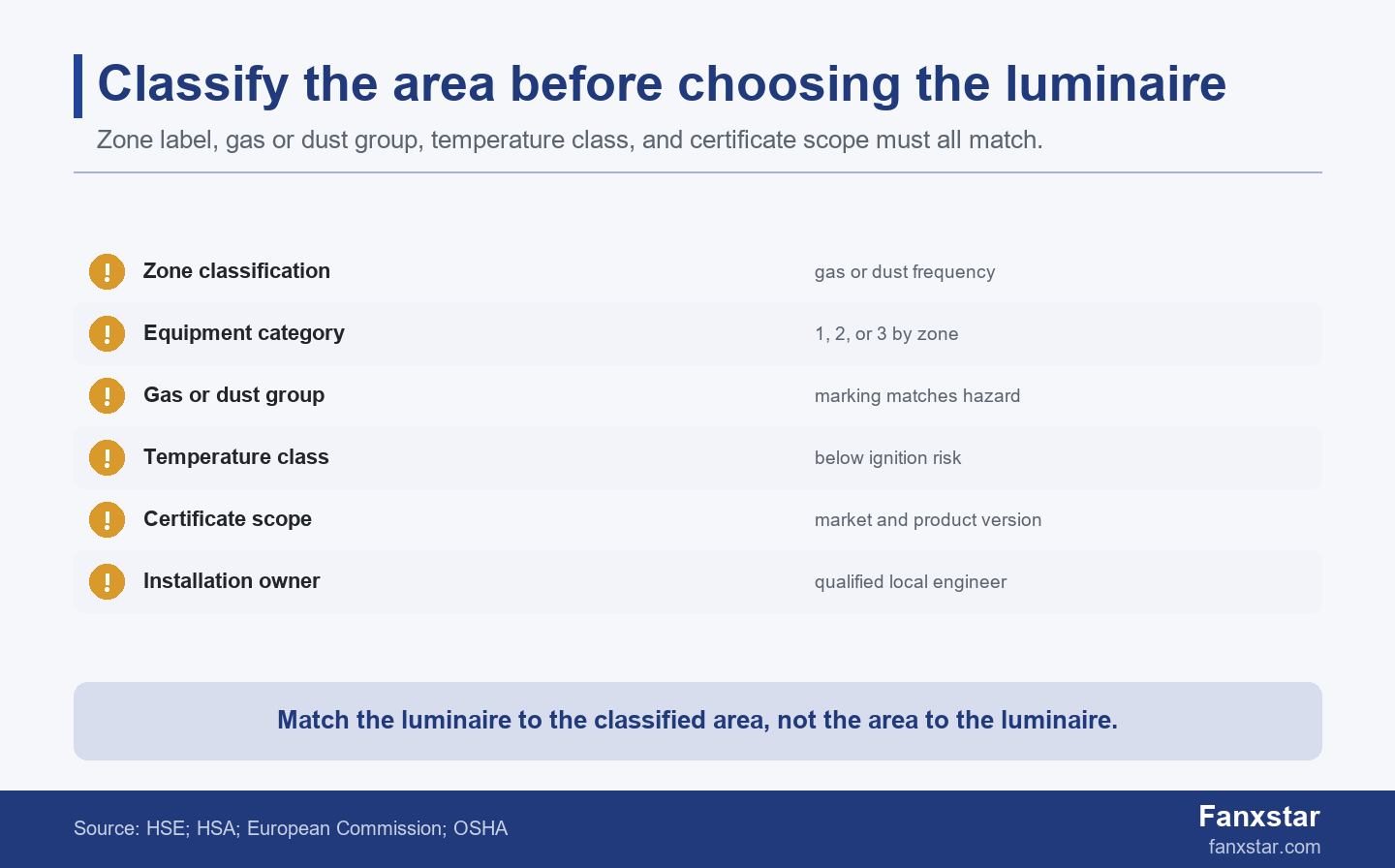
- ATEX equipment category, gas or dust group, temperature class, certificate scope, and installation method must all match the classified area.
- Buyers should not accept a generic explosion-proof claim without model-specific marking and certificate evidence.
- Fanxstar hazardous-location inquiries should include zone classification, gas or dust type, ambient conditions, voltage, mounting, and target certification route.
Zones 1, 2, 21, and 22 Explained Without the Shortcut
Gas zones and dust zones answer different hazard questions
Zone 1 and Zone 2 are used for explosive atmospheres involving gas, vapour, or mist. Zone 21 and Zone 22 are used for explosive dust clouds. The number describes likelihood and duration, not how bright the luminaire should be or whether a fixture looks industrial. A Zone 2 gas area and a Zone 22 dust area may both be lower-frequency risk categories, but they are not the same hazard.
According to European Commission ATEX page, potentially explosive atmospheres can involve gases, vapours, mists, or dusts mixed with air. That is why the buyer must identify substance type before comparing product markings. A luminaire suitable for one gas group, dust condition, or temperature class may be wrong for another even if both are described as hazardous locations.
The zone label is only the first decision gate
The common buying error is to ask for a Zone 1 light or Zone 2 light as if the zone alone selects the product. The zone is necessary, but it is not sufficient. Buyers also need gas or dust group, temperature class, ambient temperature, ingress protection, corrosion exposure, cable entry method, mounting location, maintenance access, and certificate market.
This is why a generic explosion-proof catalog can be dangerous. It may show a rugged housing and a broad claim, but it may not match the actual classified area, installation method, or certificate route. The buyer should request a marking explanation and certificate scope before discussing wattage or price.
| Zone | Hazard type | Plain buyer meaning |
|---|---|---|
| Zone 1 | Gas, vapour, or mist | Explosive atmosphere is likely during normal operation. |
| Zone 2 | Gas, vapour, or mist | Explosive atmosphere is not likely in normal operation and would be short if it occurs. |
| Zone 21 | Dust cloud | Explosive dust cloud is likely occasionally in normal operation. |
| Zone 22 | Dust cloud | Explosive dust cloud is not likely and would be short if it occurs. |
ATEX Equipment Category and Certificate Scope
Zone and equipment category have to line up
According to Directive 1999/92/EC, workplace zones are linked to equipment categories. In simplified buyer terms, Zone 1 and Zone 21 generally require equipment category 1 or 2, while Zone 2 and Zone 22 can use category 1, 2, or 3 depending on the assessment. The buyer should not rely on this summary alone; the project engineer and local rule path must confirm the actual requirement.
The procurement point is still clear: equipment category is not a decoration. It is part of the protection match. A supplier quote that says explosion-proof but does not state the category, marking, certificate, and scope is not ready for a hazardous-location comparison. The buyer needs the exact model and variant because a change in driver, cable entry, housing, gasket, or battery can affect the evidence.
A good RFQ asks: what is the classified zone, what is the hazardous substance, what equipment category or protection concept is required, which certificate applies, and does the offered model match that certificate without unapproved modification? If any answer is unknown, the buyer should pause the product comparison.
Directive 2014/34/EU keeps the focus on equipment intended for explosive atmospheres
According to Directive 2014/34/EU, ATEX equipment rules apply to equipment and protective systems intended for use in potentially explosive atmospheres. The directive also reflects integrated explosion safety principles: prevent explosive atmospheres where possible, prevent ignition, and mitigate effects. That hierarchy matters because lighting is only one element of a broader safety system.
Buyers sometimes treat explosion-proof lighting as a single protective solution. It is not. Ventilation, process control, cleaning, equipment selection, cable entries, grounding or insulation strategy, inspection, and maintenance all matter. The luminaire must fit the classified area, but the area classification and safety system cannot be repaired by buying a tougher-looking fixture.
For a lighting RFQ, certificate scope should be read against the exact configuration. Does the certificate cover the wattage, housing material, lens, cable entry, emergency option, control gear, and ambient temperature requested? If the buyer asks for a custom change, the supplier should state whether the change remains inside scope or needs new assessment.
Marking, Group, and Temperature Class Are Not Optional Details
OSHA marking language shows why labels matter
According to OSHA 1910.307, hazardous-location equipment must be marked for class, group, and operating temperature or temperature range unless an exception applies. OSHA also permits zone classification as an alternative to division classification for Class I Zone 0, Zone 1, and Zone 2 locations. The key buyer lesson is that markings exist because the hazard match must be visible and verifiable.
If a supplier offers an explosion-proof luminaire without clear marking information, the buyer cannot confirm whether the product matches the classified area. The problem is not paperwork formality. The marking tells the buyer whether the equipment has been evaluated for the relevant hazard type, group, temperature behavior, and protection approach.
| Evidence item | Buyer question | Why it matters |
|---|---|---|
| Area classification | Who classified the zone and hazard type? | The luminaire cannot choose the zone for the site. |
| Equipment marking | Does the marking match gas or dust group and temperature class? | A generic explosion-proof label is not enough. |
| Certificate scope | Which model, variant, and market does the certificate cover? | Custom changes can move outside the tested scope. |
| Installation method | Who owns glands, cable entries, seals, and inspection? | A certified fixture can fail through wrong installation. |
| Maintenance plan | How will cleaning, inspection, and replacement preserve protection? | Dust, corrosion, and damage can change real risk. |
Temperature class prevents a hidden ignition risk
A luminaire can look sealed and rugged while still being unsuitable if its surface temperature can exceed the ignition threshold for the hazardous atmosphere. Temperature class and ambient temperature are therefore part of the selection, not after-sale details. A buyer should ask whether the offered model’s rating applies at the intended ambient condition and mounting position.
Dust adds another practical layer. Dust can accumulate on surfaces, reduce heat dissipation, and change maintenance needs. A Zone 21 or Zone 22 dust environment is not only a question of whether dust exists; it is also a question of cleaning, enclosure, heat, and inspection. The buyer should ask how the luminaire is maintained in the actual dust environment.
- 4 named zones: Zone 1, Zone 2, Zone 21, and Zone 22 describe frequency and duration categories
- 2 hazard families: gas or vapour zones and dust zones should not be mixed
- 3 category levels: ATEX equipment categories 1, 2, and 3 connect to risk level
- 1 exact marking: must match group, temperature, and certificate scope
- 0 generic claims: explosion-proof wording alone is not release evidence
- 1 qualified owner: classification and installation must be confirmed locally
Why Zone 21 and Zone 22 Are Often Misread
Dust risk is not simply dirty air
Dust zones are easy to underestimate because many facilities have dust without explosive dust cloud risk. The classification depends on the material, concentration, process, ventilation, housekeeping, and how often an explosive dust cloud may occur. A buyer should not assume that any dusty warehouse is Zone 22 or that any powder process is automatically Zone 21.
According to HSE hazardous area classification, dust zones 20, 21, and 22 correspond to gas and vapour zones 0, 1, and 2. That correspondence helps memory, but it does not replace a site assessment. The buyer still needs the classified area document and hazardous substance information.
Lighting selection should follow that document. If the site engineer says Zone 21 for a process area and Zone 22 for surrounding space, the buyer should not average the requirement into one cheaper fixture type. Each area should receive equipment suited to its own classification, environment, mounting, and maintenance conditions.
Cleaning and inspection can affect long-term suitability
A dust-rated hazardous-area luminaire is not a set-and-forget item. Accumulated dust, damaged seals, incorrect cable glands, corrosion, impact, or unapproved replacement parts can undermine the protection strategy. The buyer should therefore ask how the luminaire will be inspected and maintained, not only whether it has an initial certificate.
This is especially relevant in food processing, chemical storage, agricultural processing, woodworking, and powder handling environments. A lighting fixture may need dust protection, corrosion resistance, washdown suitability, or a particular mounting form. Those needs should be described together instead of forcing the supplier to guess from the zone label alone.
Fanxstar’s related application pages, including hazardous location LED lighting solutions and food processing plant LED lighting solutions, should be treated as starting points for RFQ discussion rather than substitutes for site classification. The classified area file remains the controlling input.
How to Ask Fanxstar for Explosion-Proof Lighting Evidence
Send the hazard file before asking for wattage and price
According to International Trade Administration import regulations page, importers need to understand destination-market requirements before shipping regulated products. A strong inquiry for explosion-proof LED lighting should include zone classification, gas or dust type, group if known, temperature class or ignition-temperature concern, ambient temperature, voltage, mounting height, cable entry requirement, corrosion or washdown exposure, emergency function if needed, and target market or certificate route.
This file lets the supplier decide whether an existing platform may fit, whether a certificate scope is relevant, or whether the request is outside the product boundary. It also helps prevent a common failure: the buyer receives a price for a rugged industrial light, then later discovers that the certificate, marking, or cable entry does not match the classified area.
The first supplier response should not only be a wattage table. It should state which offered models may match the classification, what evidence is available, which assumptions were used, and which points must be confirmed by the project engineer. That response is slower than a catalog price, but it is much safer for hazardous locations.
Treat customization as a certificate-scope question
Use Fanxstar custom LED lighting ODM service carefully for hazardous-location projects. Customization may be possible in some platform-based ways, but any change to housing, driver, lens, battery, cable entry, gasket, marking, or thermal behavior must be checked against certificate scope. The buyer should ask what can change without invalidating evidence.
The same rule applies to emergency functions in hazardous locations. Adding battery backup, sensors, or controls can change internal heat, wiring, enclosure, and marking implications. A buyer should not merge an emergency lighting requirement with an explosion-proof requirement unless the supplier and local engineer confirm the combined configuration is valid.
The decision rule is short: classify first, select second, customize only inside evidence. If the classification is missing, the product comparison is premature. If the certificate scope is unclear, the quote is not decision-ready. If installation ownership is not assigned, the procurement file is incomplete.
FAQ
Is Zone 1 more dangerous than Zone 2?
Zone 1 describes a hazardous gas, vapour, or mist atmosphere that is likely in normal operation, while Zone 2 describes one that is not likely in normal operation and would be short if it occurs. The zone suggests different frequency and duration, but final product selection still depends on the classified area, substance, group, temperature class, and local rules.
What is the difference between Zone 21 and Zone 22?
Zone 21 and Zone 22 concern explosive dust clouds rather than gas or vapour. Zone 21 generally means the explosive dust cloud is likely occasionally in normal operation, while Zone 22 means it is not likely and would be short if it occurs. The buyer should use the site classification document, not visual dustiness, to choose equipment.
Can one explosion-proof light cover all zones?
No universal assumption is safe. A product may cover certain zones, groups, temperature classes, ambient temperatures, and installation conditions, but the certificate scope decides the actual boundary. Buyers should request the exact marking and certificate for the offered model and variant before treating it as suitable.
Can Fanxstar customize explosion-proof lighting?
Fanxstar can discuss platform fit and possible customization boundaries, but hazardous-location changes must stay within certificate scope and local engineering approval. Buyers should send classification, gas or dust information, temperature concern, market, voltage, mounting, and cable-entry requirements before requesting changes to housing, driver, lens, emergency function, or wiring.