
An LED light price breakdown should not be used to squeeze every component to the lowest number. It should show which cost layer protects the installation: housing strength, LED and optical output, driver reliability, assembly sealing, testing, documentation, and packing. A cheap quote is useful only when the buyer can see what changed and why the remaining evidence still matches the project risk.
According to FEMP purchasing guidance for commercial and industrial LED luminaires, commercial and industrial LED purchasing guidance works at the luminaire level, not only at the chip or lamp level. According to DLC solid-state lighting technical requirements, qualified LED products are evaluated through defined product categories and technical requirements. That is the correct frame for price: the buyer is not buying a chip, a driver, or a shell; the buyer is buying a finished luminaire that must keep working in a real environment.
Key Takeaways
- The main LED light cost layers are housing, LED board and optics, driver, assembly, testing, documentation, packing, and supplier margin.
- A lower quote is not automatically better; it may remove housing mass, driver margin, sealing labor, inspection time, or evidence for the final version.
- The buyer should compare cost breakdowns against environment, service life, certification, MOQ, warranty boundary, and customization scope.
- Fanxstar is most relevant when a price discussion involves weatherproof, linear, emergency, sensor-ready, or custom ODM fixtures rather than catalog-only replacements.
What an LED light price breakdown actually includes
Housing cost is the cost of thermal and environmental margin
Housing is easy to treat as metal or plastic weight, but in a finished LED luminaire it does more work than the spreadsheet suggests. It carries heat away from the LED board and driver, provides the gasket seat, protects cable entry, holds the diffuser or lens, resists impact, and determines whether service access damages the seal. A buyer who asks only for a lighter housing may also be asking for less thermal mass, less rigidity, and a weaker sealing surface.
According to IEC ingress protection guidance, IP ratings describe enclosure protection against dust, water, and hazardous part access. According to NEMA enclosure type guidance, enclosure language has defined scope rather than a loose marketing meaning. The price implication is direct: a housing for a dry stockroom and a housing for washdown, cold storage, parking, or outdoor exposure should not be priced as the same shell with a different label.
The housing line should therefore name material, wall thickness expectation, finish, gasket path, clips or screws, cable entry, mounting method, and service access. If one supplier is 12 percent cheaper, ask whether the saving comes from thinner housing, different diffuser, fewer clips, less gasket compression, lighter packaging, or a shorter inspection routine. The answer tells the buyer whether the saving is engineering efficiency or deferred risk.
Chips and optics decide usable light, not only lumen claims
LED chips matter, but buyers should avoid a chip-only price discussion. Usable light also depends on board layout, drive current, diffuser loss, lens distribution, thermal design, glare control, color consistency, and whether the fixture count was based on a real layout. A cheaper LED board may look attractive when a datasheet shows enough raw lumens, then become expensive when the project needs more fixtures to fix dark zones or glare complaints.
According to DLC product eligibility and primary-use designations, product category and primary-use language shape evaluation. A high bay, vapor tight, linear batten, emergency luminaire, and downlight can all use LED chips, but the optical and housing requirements are not interchangeable. A price breakdown should separate LED package cost from the optics and mechanical design that turn output into usable task light.
| Cost layer | What it pays for | Buyer risk when it is cut too far |
|---|---|---|
| Housing | aluminum or PC body, clips, gasket seat, cable entry, corrosion margin | weaker thermal path, poor sealing, lower impact margin, service damage |
| LED chips and optics | LED board, diffuser, lens, beam, glare control, color consistency | higher glare, uneven output, color drift, or more fixtures needed |
| Driver | input range, surge margin, power quality, dimming, thermal life | flicker, early failure, nuisance trips, controls mismatch |
| Assembly and testing | gasket compression, screw torque, burn-in, label, packing check | sample looks fine but production drift creates field failures |
| Evidence and documentation | photometric file, certificates, drawings, BOM freeze, inspection record | the quote cannot prove the exact shipped version |
Where driver and assembly cost change long-term reliability
Driver cost hides inside power quality, heat, and control compatibility
The driver line is often where a quote looks cheaper without changing the visible fixture. The buyer may see the same wattage, same CCT, and similar housing while the driver input range, surge margin, power factor, dimming behavior, thermal rating, inrush current, or warranty boundary changes. This is why driver cost should be reviewed with the control strategy and site voltage, not only with the fixture price.
According to GSA LED and controls guidance, LED and controls choices should be framed around life-cycle cost and energy efficiency. According to ENERGY STAR commercial lighting guidance, lighting upgrades can reduce electricity use in commercial buildings. For industrial projects, that means a lower driver cost must be tested against flicker, dimming, sensor behavior, breaker loading, heat, and replacement access.
A practical RFQ should ask for the driver model, input voltage, rated current, power factor, dimming protocol, surge or protection notes, emergency compatibility if relevant, and whether the quoted driver is locked for production. If the answer is a generic brand category rather than a model and approval rule, the price breakdown is not yet safe enough for a serious comparison.
Assembly cost is where the approved sample becomes repeatable production
Assembly cost includes labor, fixture sealing, wiring, screw torque, gasket placement, labeling, burn-in, inspection, packing, and the discipline of keeping production aligned with the approved sample. It is tempting to push this line down because it is less glamorous than chips or drivers. In practice, many field problems start here: twisted gasket, wrong cable gland, loose clip, mislabeled driver, damaged diffuser, or a production unit that no longer matches the sample.
According to International Trade Administration import documentation guidance, trade files may include invoices, bills of lading, packing lists, insurance proof, and certificates of origin. According to International Trade Administration special documents guidance, some products may need certificates tied to standards, safety, or other conditions. For LED buyers, the lesson is that documentation cost is not paperwork decoration; it is how the buyer proves which version was shipped.
Assembly and documentation should be priced together when a project involves waterproofing, emergency backup, sensor integration, private label, or market certification. The buyer should know what inspection is included, what is sampled, what is tested on every unit, and what evidence is supplied with shipment. A quote that omits these details is often a quote for a weaker buying process, not only a cheaper fixture.
A scenario model for comparing quotes without being misled
Use percentage ranges as a risk map, not a market price
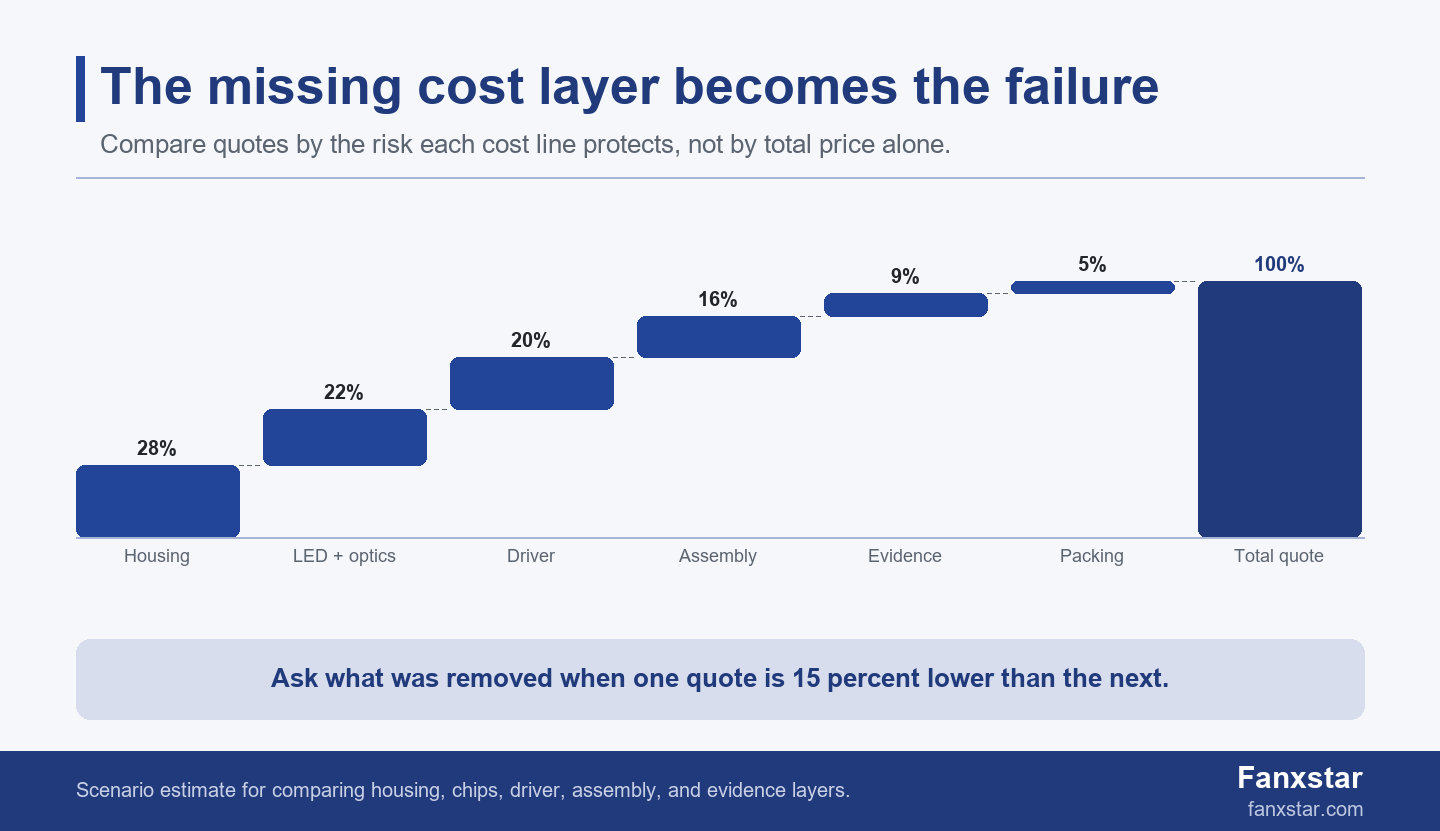
As an illustrative scenario, imagine 3 suppliers quoting a sealed industrial LED fixture. Supplier A spends roughly 28 percent of the quote on housing, 22 percent on LED board and optics, 20 percent on driver, 16 percent on assembly and test, 9 percent on evidence, and 5 percent on packing. Supplier B is 15 percent cheaper. The useful question is not whether B is cheap. The useful question is which line moved.
A second scenario makes the risk visible. If 1,000 units save 3 percent by removing a driver margin, the factory saving may look good on day 1. If 2 percent of those units fail within 12 months and each service visit takes 2 hours, the buyer has converted a component saving into labor, downtime, and reputation cost. The numbers are illustrative, but the release logic is real: cost reduction should name the risk it transfers.
If B reduced packing or overhead through better process control, the saving may be real. If B reduced driver quality, gasket labor, housing mass, or evidence, the saving can become a warranty, delay, or replacement cost. If B cannot explain the saving, the buyer should treat the discount as unknown technical debt. This is not a universal price formula; it is a way to force quotes to reveal their risk structure.
International Trade Administration import regulations guidance reminds buyers that imported products can require documentation, safety, quality, and conformity checks that vary by country. That reinforces the cost model: the final landed risk includes technical proof, not only the factory unit price. A quote can be cheaper at the factory gate and more expensive by the time the buyer handles retesting, rejection, delay, or field service.
Compare the cost layer to the application severity
The same cost cut has different consequences by application. A cheaper diffuser in a dry storage room may create a visual complaint. The same diffuser in a food processing area, freezer, parking garage, tunnel, emergency route, or chemical washdown area can create a reliability or safety problem. Price should be compared against exposure severity, service access, replacement cost, and the buyer’s tolerance for downtime.
A useful scoring rule is to mark each cost layer as protect, optimize, or flexible. Protect means do not cut without new evidence; examples include emergency battery system, driver, IP sealing, certified component, or chemical-resistant housing. Optimize means the supplier can reduce cost through process, platform reuse, or packaging. Flexible means the buyer can trade finish, accessory, or cosmetic detail if the performance file remains intact.
SBA import and export laws guidance encourages businesses to understand import and export rules before international sales. The LED procurement equivalent is to understand the risk file before treating a quote as final. The cost breakdown should show what is technically locked, what can be substituted, and what must be retested if changed.
How Fanxstar uses cost breakdowns in ODM quoting
Platform-based customization changes the cost conversation
Fanxstar’s relevant starting points include weatherproof LED lighting product platforms, IP65 and IP66 waterproof LED lights, LED linear lighting, emergency lighting products, and custom LED lighting ODM service. In those projects, the cost question is usually not how to make one generic fixture cheaper. It is which proven platform can be adapted without creating unnecessary tooling, retesting, or production drift.
A buyer should send Fanxstar the application, target market, mounting method, input voltage, CCT, optics, control or sensor need, IP or emergency requirement, sample target, and price range. Fanxstar can then separate what is already platform-ready from what needs engineering review. That distinction is where cost control becomes practical. A platform adaptation can save time and tooling; a true new structure needs a different evidence and sample plan.
The most useful supplier answer is not a single number. It is a cost explanation that names the locked components, acceptable substitutions, sample gate, certificate boundary, and what will happen if the buyer requests a cheaper version. If the cheaper version weakens the evidence file, the buyer should know before the purchase order, not after a field complaint.
Ask for the evidence file that matches the quoted version
Before approving the price, ask for the product drawing, driver model, LED board or chip family, diffuser material, housing material, gasket or sealing detail, cable entry, photometric file if needed, certificate scope, warranty boundary, packing method, and inspection checklist. For private label or custom versions, add label artwork, BOM freeze, and change-control rule.
The RFQ should also ask what change would trigger a new sample. Driver substitution, diffuser change, cable gland change, emergency pack change, lens texture change, and housing material change can all alter risk. If the supplier says those changes do not matter, the buyer should ask which evidence proves that. A strong cost breakdown is a change-control document as much as a price explanation.
For a serious ODM program, the buyer should compare at least 2 versions: a target-cost version and a risk-protected version. The gap between them is useful. It tells procurement which features are driving cost and which risk the buyer is accepting if those features are removed.
RFQ wording that produces a clearer price breakdown
Send the application file before asking for the lowest price
A good RFQ starts with environment and evidence. Name the installation type, mounting height, temperature range, cleaning method, corrosion or dust exposure, voltage, control method, target certification, order quantity, sample deadline, and service access. Then ask the supplier to split the quote by housing, LED board, optics, driver, assembly, testing, packing, documentation, tooling if any, and optional upgrades.
The buyer should also state which lines cannot be reduced without approval. For example: do not change driver, do not change gasket material, do not change cable gland, do not change LED board, or do not change IP evidence without written review. This prevents the classic problem where a supplier meets a target price by substituting a component that the buyer assumed was fixed.
Use Fanxstar’s LED lighting certification checklist when the quote includes UL, ENEC, CE, IP, warranty, or market-specific proof. The certificate file should follow the same logic as the cost file: it must describe the version being shipped, not a cousin product from the same family.
Use the final breakdown as a negotiation map
Once the supplier provides a breakdown, do not negotiate each line mechanically. Start with the lines that have low risk in the application. Packing format, finish option, accessory bundle, MOQ, payment terms, and platform reuse may offer safer savings than reducing driver, gasket, housing, thermal design, or inspection. If the buyer needs a lower price, ask for 2 quote paths: no-evidence-change savings and evidence-change savings.
The first path should preserve performance and documentation. The second path should clearly state what must be retested, reapproved, or accepted as risk. That makes procurement more honest. It also helps engineering and purchasing speak the same language, because the argument is no longer about expensive versus cheap. It is about which risk belongs in the product and which risk belongs in the buyer’s decision.
FAQ
What is the biggest cost in an LED light?
There is no universal biggest cost because fixture type changes the answer. In many industrial luminaires, housing, driver, LED board, optics, assembly, and evidence all matter. The buyer should ask which line protects the application risk instead of assuming the chip cost explains the whole price.
Why are two LED lights with the same wattage priced differently?
They may use different housing materials, drivers, LEDs, lenses, gaskets, cable entries, testing routines, certificates, warranties, packing, and inspection standards. Same wattage only describes input power. It does not prove the same thermal design, optical result, reliability, or market evidence.
Can a supplier reduce LED light cost without reducing quality?
Yes, if the saving comes from platform reuse, better tooling, efficient assembly, MOQ planning, packing optimization, or removing unnecessary options. It is risky when the saving comes from unapproved driver changes, thinner housing, weaker sealing, missing inspection, or evidence that no longer matches production.
What should buyers ask before approving a cheaper ODM quote?
Ask what changed from the higher quote, which components are locked, whether certificates still apply, what will be tested on the sample, what is inspected in production, and which substitutions require written approval. The answer should connect price to a specific finished luminaire version.








