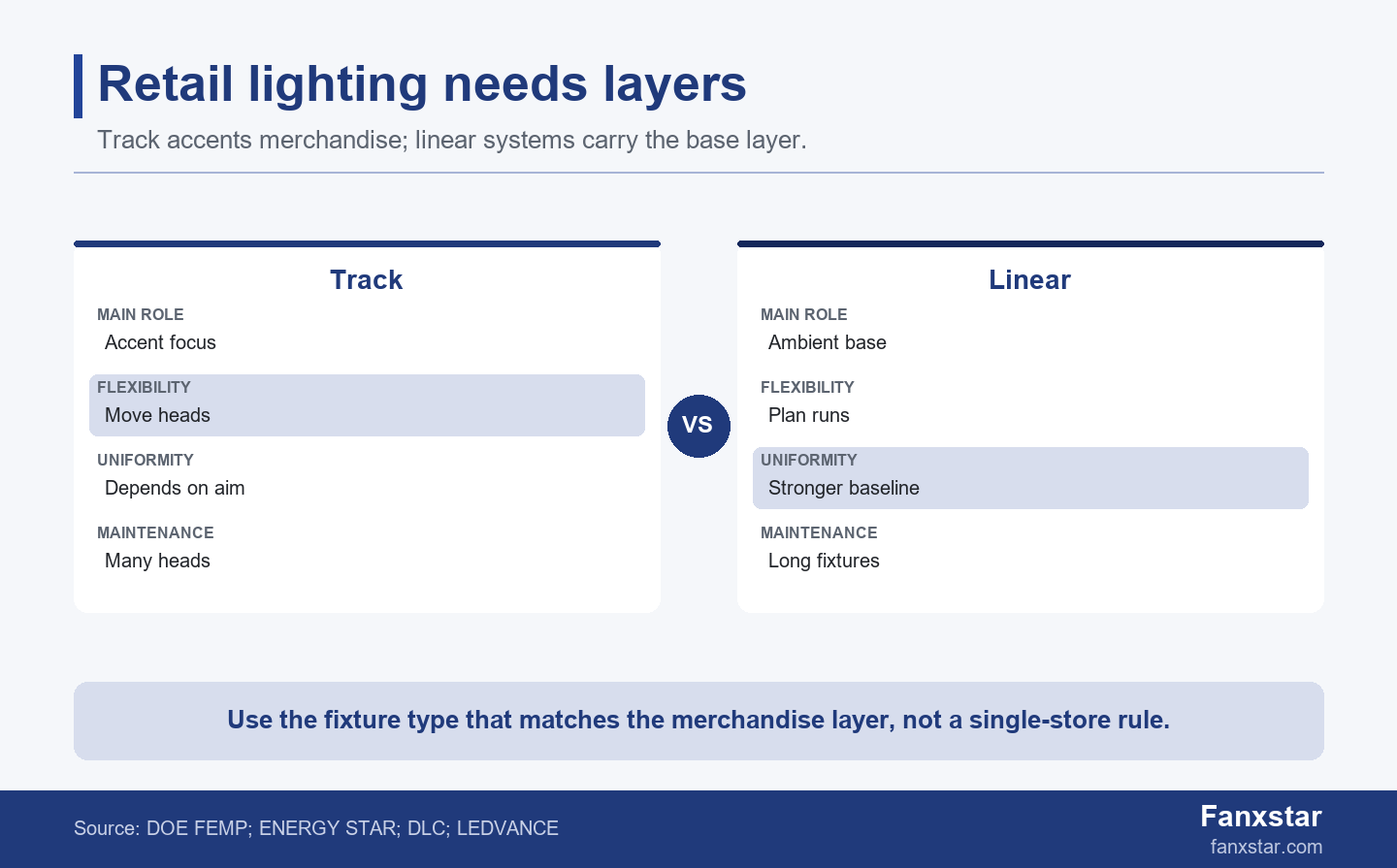
Track lighting and linear lights are not enemies. In most retail stores they are different layers. Track lighting is usually the flexible accent and merchandising tool. Linear lighting is usually the ambient, aisle, backroom, fresh retail, and operational layer. The best answer depends on what the store needs the light to do.
DOE FEMP fixture guidance separates product categories such as line-voltage track accent lights, shelf-mounted display and task lights, and indoor linear ambient luminaires. That category split is the buyer’s clue: compare track and linear by role, not as if every fixture performs the same retail job.
Key Takeaways
- Use track lighting when the store needs aimable accent light for changing displays, feature walls, seasonal products, or boutique merchandising.
- Use linear lighting when the store needs a stable ambient base, aisle uniformity, backroom task lighting, fresh retail coverage, or lower-maintenance long runs.
- Many stores need both: a linear base for comfort and operation, plus track or display lighting for focal contrast.
- The RFQ should include layer map, ceiling height, merchandise type, CRI/CCT target, glare check, controls, maintenance access, and sample views before final fixture selection.
Choose by Retail Lighting Layer
Track lighting is the flexible accent layer
Track lighting is strongest when merchandise changes. A retailer can reposition heads, adjust beam angle, highlight a new promotion, or create contrast on a wall without rewiring every point. That flexibility is useful for fashion, boutique, electronics, seasonal displays, showrooms, and promotional islands.
The risk is overusing track as the whole lighting plan. Too many heads can create hot spots, shadows, glare, and a busy ceiling. If each display change requires re-aiming dozens of heads, the maintenance burden rises. Track lighting works best when the merchandising team knows what should be highlighted and when the base layer already provides comfortable orientation.
DOE FEMP fixture guidance separates track accent lights from indoor linear ambient luminaires. That supports a layered decision: the customer should see the merchandise clearly, navigate confidently, and make purchase decisions without visual discomfort.
Linear lighting is the stable ambient and operational layer
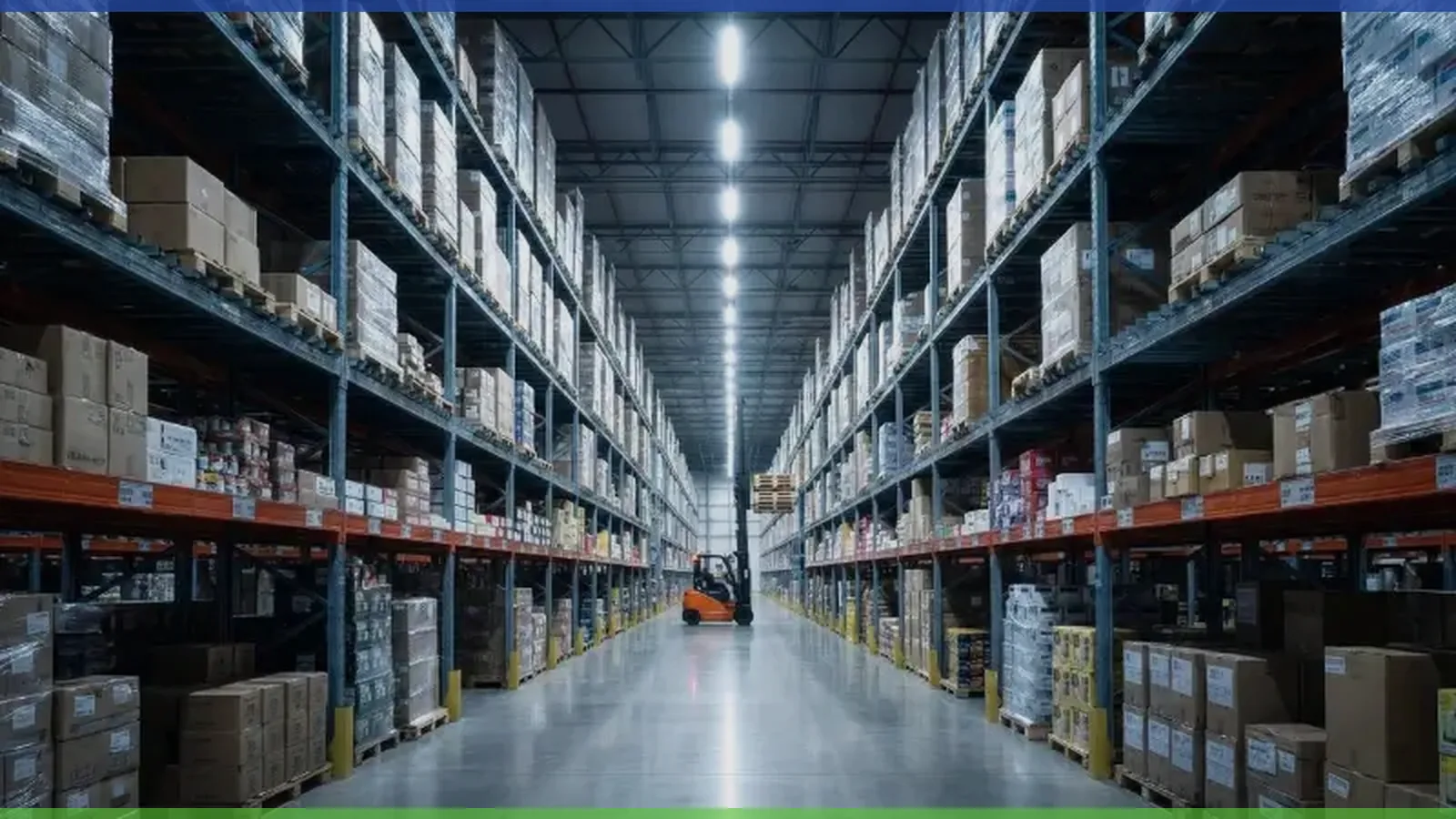
Linear lights are strongest when the store needs consistent light over aisles, shelves, fresh food areas, counters, backrooms, service corridors, and large-format retail floors. They can create clean ceiling lines, predictable spacing, and simpler maintenance in long runs. In grocery, warehouse retail, convenience stores, and service areas, this base layer often matters more than dramatic accent.
LEDVANCE layer guidance separates ambient lighting as a foundation from accent and task lighting. Linear fixtures often carry that ambient layer, but they still need proper optics and CCT consistency. A store can be bright and still look flat, harsh, or color-inaccurate.
| Retail need | Track lighting fit | Linear lighting fit |
|---|---|---|
| Seasonal merchandise | Strong fit because heads can be moved, aimed, or changed. | Works when the shelf or aisle layout is stable. |
| Fresh food aisles | Useful for accent on selected displays. | Strong fit for continuous, uniform shelf and aisle light. |
| Boutique displays | Strong fit for focal contrast and product highlights. | Useful as a soft ambient layer or perimeter line. |
| Big-box aisles | Can become maintenance-heavy if used as the main layer. | Strong fit for long runs, regular spacing, and simple service. |
| Backrooms and service areas | Usually unnecessary unless a task needs aimable light. | Strong fit for efficient, predictable task and circulation lighting. |
How to compare track and linear fixtures without guessing
Map the store before picking fixtures
| Evidence item | Why it matters | Buyer request |
|---|---|---|
| Lighting layer map | Track and linear fixtures often solve different layers. | Plan ambient, accent, task, decorative, and backroom zones separately. |
| CRI and CCT | Retail color trust depends on how products appear. | Ask for CRI data, CCT consistency, and sample views on real merchandise. |
| Glare and contrast | Too much contrast can feel harsh; too little can look flat. | Check aiming, shielding, optic, ceiling height, and customer sightlines. |
| Controls | Retail stores have open hours, cleaning, daylight, and display changes. | Define zones, dimming, schedules, and sensor behavior before installation. |
| Maintenance | Many track heads and long linear runs fail differently. | Ask for driver access, spare parts, cleaning plan, and replacement method. |
Start with a floor plan and merchandising map. Mark the areas that need orientation light, vertical shelf light, checkout clarity, fitting-room comfort, fresh food presentation, backroom task light, and emergency or service routes. Only then decide which zones need track, linear, downlight, display, or decorative fixtures.
ENERGY STAR commercial lighting guidance notes that LED lighting can reduce electricity use and offers many fixture options for different applications. That is helpful, but energy savings should not erase lighting quality. Retailers still need the correct layer, optic, color quality, and maintenance plan.
Use sample views on real merchandise
A fixture comparison should include real products, not only a ceiling photograph. Test fresh produce, packaged goods, apparel, cosmetics, signage, labels, and reflective surfaces under the proposed lights. Look for color shift, glare on packaging, harsh shadows under shelves, and whether the display looks clear from the customer’s normal distance.
Track lighting should be tested for beam spread, aiming range, shielding, and whether staff can maintain the aiming plan. Linear lighting should be tested for uniformity, lens brightness, shelf shadows, and whether the fixture creates a comfortable aisle view. Neither system should be approved from lumen output alone.
Cost, controls, and maintenance considerations
The cheaper fixture may not be the cheaper system
Track lighting can reduce remodel friction because heads move with displays. It can also increase maintenance if there are many heads, many beam angles, or frequent re-aiming. Linear lighting can simplify long-run maintenance, but a poorly planned run may require more fixtures, more wiring, or more difficult access than expected.
GSA LED and controls guidance is useful here because it frames LED choices around life-cycle cost, controls, and distribution. For retail, the same principle applies: compare first cost, energy, controls, installation, cleaning, re-aiming, driver replacement, product availability, and disruption during store hours.
Controls should follow the retail day. Open hours, stocking, cleaning, daylight, display changes, backroom use, and security all need different behavior. A simple zone plan can do more for operations than a complex control system nobody uses.
CRI and CCT are commercial trust signals
Color is commercial evidence. Fresh food must look clean and natural. Apparel must not shift unexpectedly between the shelf and daylight. Packaging labels should read clearly. A retailer should define CRI, CCT, and tolerance, then test samples on real merchandise. The target may differ between fresh food, fashion, electronics, checkout, and backroom areas.
Avoid mixing CCTs accidentally across a store. A warm boutique accent, a neutral fitting room, and a cool service corridor can be intentional. Random fixture substitutions are not intentional. The buyer should freeze CCT, driver, optic, and replacement part rules so the store does not slowly become patchy after maintenance.
DLC technical requirements and DLC product eligibility guidance are useful because they remind buyers to classify the luminaire by use and evidence, not by a casual product nickname. A linear fixture for an aisle, a display task light, and a track accent head can all be LED products, but they do not prove the same retail outcome.
The buyer insight is that color and contrast should be tested with the actual product category. A produce case, a cosmetics shelf, a refrigerated aisle, a folded apparel table, and a checkout counter all expose different risks. One store-wide fixture rule may simplify purchasing, but it can weaken the customer view in the areas that create revenue.
According to ENERGY STAR commercial lighting guidance, LED lighting can reduce electricity used by commercial buildings while offering fixtures for many applications. According to GSA LED controls guidance, new LED fixtures can improve glare control and distribution when paired with the right system choices. According to DLC product eligibility guidance, linear ambient luminaires should be classified by primary use rather than by a broad sales label.
A retail fixture decision workflow
Use a 4-layer map before asking for prices
ConTech retail lighting guide describes general, task, accent, and decorative lighting layers. Whether the buyer uses that exact language or a simpler version, the workflow should start with 4 questions: what provides the base layer, what highlights the merchandise, what supports staff tasks, and what expresses the brand atmosphere?
For a grocery chain, the base layer may be linear fixtures over aisles, task light at service counters, accent light on fresh displays, and decorative or brand lighting near entrances. For a boutique, track accent may dominate the sales floor, while linear light may support perimeter coves or fitting-room circulation. For a warehouse retail store, long linear rows may carry most of the customer and staff experience.
A pricing request sent before this map is finished invites poor comparisons. One supplier may quote track heads for everything. Another may quote linear fixtures for everything. A third may quote the cheapest wattage package. The buyer needs the layer map first so each quote solves the same store problem.
According to LEDVANCE lighting layer guidance, ambient lighting acts as the foundation, accent lighting creates visual focus, and task lighting solves functional needs. According to DOE FEMP fixture guidance, line-voltage track lighting and indoor linear ambient luminaires belong to different acquisition categories. The key insight is that a store can use both systems without treating them as duplicate purchases.
Add numbers to the comparison without pretending they are the whole design
DOE FEMP commercial and industrial LED luminaire guidance includes categories such as indoor linear ambient, high-bay, low-bay, and troffers, while DOE FEMP fixture guidance also references line-voltage track accent lights. That gives buyers a useful 2-part comparison: category fit first, then performance data.
Ask for lumen output, input watts, efficacy, CRI, CCT, beam angle or distribution, dimming method, rated life, warranty, and driver access. Then add the visual questions: where does the light land, what does the merchandise look like, does glare appear from normal shopper height, and can staff maintain the aiming or replacement plan? The numbers narrow the shortlist, but the sample view makes the final decision.
For example, a track head with a narrow beam may create strong product contrast but poor aisle comfort if used as the only source. A continuous linear fixture may create excellent orientation but make a feature wall look flat. The result is not that one fixture is better. The result is that the buyer needs 2 layers or a different optic.
According to DLC technical requirements, LED product evidence should be handled through test and reporting requirements. The decision rule is to compare fixture families only after the retail layer is defined. This means a 90 CRI accent head, a 4000 K linear aisle fixture, and a backroom vapor tight light may all be correct in the same store, even though they answer different buyer questions.
According to ENERGY STAR commercial lighting guidance, LED upgrades make the most financial sense in buildings with long operating hours and high electricity costs. In practice, that pushes retail buyers to compare not just the fixture price, but also open-hour schedules, dimming zones, cleaning access, and the number of replacement parts the store must carry.
How Fanxstar buyers can brief a retail lighting project
Use Fanxstar linear platforms where the store needs stable operational light
Fanxstar is most relevant when the retail project needs linear, fresh retail, backroom, warehouse-style, parking, service, or weather-resistant lighting rather than decorative boutique track heads. Relevant starting points include M4F fresh linear LED fixtures, M4N black linear ceiling lights, supermarket retail lighting applications, and LED linear lighting platforms.
A useful RFQ should include store type, ceiling height, aisle width, shelf height, product categories, CRI/CCT target, target illuminance, control zones, operating hours, cleaning schedule, mounting method, and whether the lighting must support fresh food, parking, backroom, or warehouse-adjacent spaces. That allows the supplier to propose a platform and sample evidence instead of guessing from the word retail.
FAQ
Is track lighting or linear lighting better for retail stores?
Neither is universally better. Track lighting is usually better for flexible accent and changing displays. Linear lighting is usually better for ambient, aisle, backroom, fresh retail, and long-run operational lighting. Many stores need both.
When should a store use track lighting?
Use track lighting when the store needs aimable beams, seasonal display changes, feature walls, product highlights, or boutique-style focal contrast. Check glare, aiming maintenance, beam spread, and ceiling clutter before approving it as the main layer.
When should a store use linear lights?
Use linear lights when the store needs a stable ambient base, long aisle coverage, uniform shelf visibility, fresh retail lighting, backroom task lighting, or simpler service over repeated runs. Check lens brightness, CRI, CCT, and maintenance access.
What evidence should retail buyers request before choosing fixtures?
Request a lighting layer map, layout calculation, CRI and CCT data, sample views on real merchandise, glare review, control-zone plan, maintenance method, warranty, and replacement-part rules.