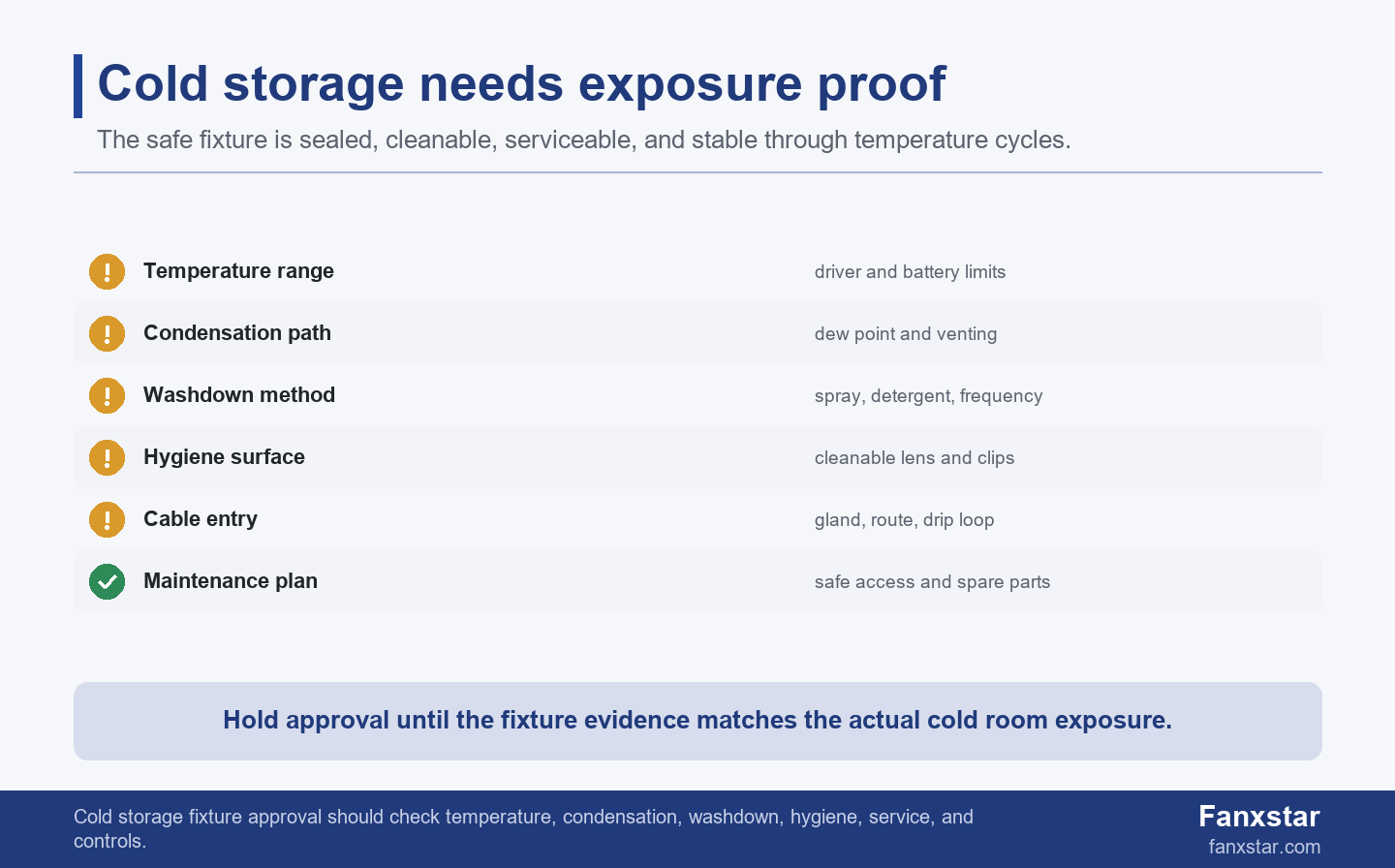
A waterproof light for cold storage should not be chosen by IP rating alone. Freezer and chilled areas combine low temperature, condensation, door cycling, washdown, hygiene rules, impact risk, cable-entry exposure, and difficult maintenance. The reliable fixture is the one whose housing, diffuser, gasket, driver, wiring, and evidence file match that full exposure map.
According to IEC ingress protection guidance, IP ratings describe enclosure protection against dust, water, and hazardous part access. According to 21 CFR Part 117, food facilities operate under current good manufacturing practice requirements. Cold storage lighting buyers should connect those two ideas: a sealed light is not enough if the surface, installation, cleaning, and service process do not support hygienic and reliable operation.
Key Takeaways
- Cold storage lights must handle temperature cycling, condensation, washdown, hygiene, impact, glare, and service access together.
- IP65 or IP66 can be a starting filter, but cable entry, gasket design, diffuser material, venting, and installation orientation decide field reliability.
- Food and freezer areas need cleanable surfaces and evidence for the exact version, not only a catalog waterproof claim.
- Fanxstar is most relevant when the buyer needs weatherproof, vapor tight, cold-storage, food-area, or custom ODM lighting evidence before sampling.
Why cold storage is harder than ordinary wet-location lighting
Temperature and condensation act together
Cold storage lighting fails when the buyer treats cold, water, and cleaning as separate problems. In reality, warm moist air enters when doors open, then meets cold surfaces. The fixture warms during operation and cools during shutdown. The lens, housing, cable entry, screw points, and driver cavity may all see different temperature and moisture cycles. A product can look sealed in a short water test and still struggle with repeated condensation or frost.
According to the National Weather Service dew point explainer, dew point is a direct measure of moisture in air. In a cold room, the buyer does not need meteorology. The buyer needs a simple rule: moisture risk increases when warm humid air, cold surfaces, and enclosure breathing meet. The lighting brief should therefore state door cycle, temperature range, washdown method, and whether the fixture is opened for service.
A reliable fixture may need stronger sealing, careful cable entry, controlled venting, or a design that avoids trapping assembly moisture. A breathable vent can help pressure equalization in some enclosures, but it cannot fix a wrong gasket, cracked lens, loose gland, or poor installation orientation. The diagnosis begins with exposure, not a higher IP number.
Hygiene changes the meaning of waterproof
Food and fresh storage areas care about more than water resistance. The fixture should avoid dirt traps, exposed cavities, fragile surfaces, and service details that are hard to clean. Clips, screws, end caps, diffuser edges, and cable glands should be reviewed as hygiene and maintenance details, not only as mechanical parts.
According to NEMA enclosure type guidance, enclosure type language has defined scope and should not be translated casually into every water or cleaning condition. A cold storage buyer should ask what the product was actually tested or designed for: damp air, occasional spray, hose cleaning, low pressure washdown, chemical detergent, freezing temperature, or a combination.
| Cold storage condition | Fixture risk | Evidence to request |
|---|---|---|
| Freezer or blast-chill temperature | driver, gasket, diffuser, and battery limits may be exceeded | rated ambient range, thermal test note, component limits |
| Door cycling and warm air entry | condensation and frost can form on lens or cable entry | dew point risk review, venting or sealing rationale, photo test |
| Food handling or washdown | contamination and cleaning damage can appear over time | cleanable surface, cable gland, diffuser material, washdown method |
| High storage racks | dark shelf faces and hard maintenance access | photometric layout, mounting height, service plan |
What makes a waterproof cold-storage light reliable
Housing, gasket, and cable entry must be designed as one seal system
The seal system is not only the gasket. It includes housing stiffness, gasket groove, screw or clip pressure, lens edge, cable gland, strain relief, service cover, mounting angle, and installation path. If the housing flexes or the cable entry points upward into water, the rating label cannot protect the buyer. If the service team opens the fixture and compresses the gasket incorrectly, the second installation may be weaker than the first.
According to GORE protective vent information, protective vents can support pressure equalization and enclosure protection. That does not mean every cold room fixture needs a vent. It means pressure, moisture, and sealing should be treated as a design decision. Some applications need a sealed vapor tight structure; others may need venting logic. The supplier should explain which approach fits the exposure.
Ask for cable-entry drawings and installation notes. A gland should fit the cable diameter, maintain compression at low temperature, avoid upward water paths, and preserve the IP evidence. If the project uses through-wiring, emergency battery, sensor, or quick connector, the buyer should ask whether that variation was included in the evidence file.
Diffuser and driver choices affect maintenance more than buyers expect
A cold room diffuser must survive low temperature, cleaning, impact, and glare expectations. A very clear lens can create bright points and discomfort at low mounting heights. A highly diffusing lens can reduce useful output and require more fixtures. A brittle diffuser may crack after repeated cleaning or cold impact. The right choice is a balance of visibility, cleanability, safety, and service cost.
According to FEMP LED luminaire purchasing guidance, buyers should evaluate complete LED luminaires. That matters because cold storage reliability is not a chip decision. The driver, LED board, diffuser, gasket, cable entry, housing, and maintenance routine all influence whether the fixture will survive. The buyer should approve the whole luminaire version.
Use a practical exposure log before sample approval. Record at least 7 days of door cycles if the room is already operating, inspect the sample after a 24-hour cold soak when possible, and photograph the cable entry before and after cleaning. Those numbers are not a lab substitute, but they keep the discussion tied to real site behavior.
Lighting quality, controls, and service access in freezer areas
Reliable illumination still needs a layout check
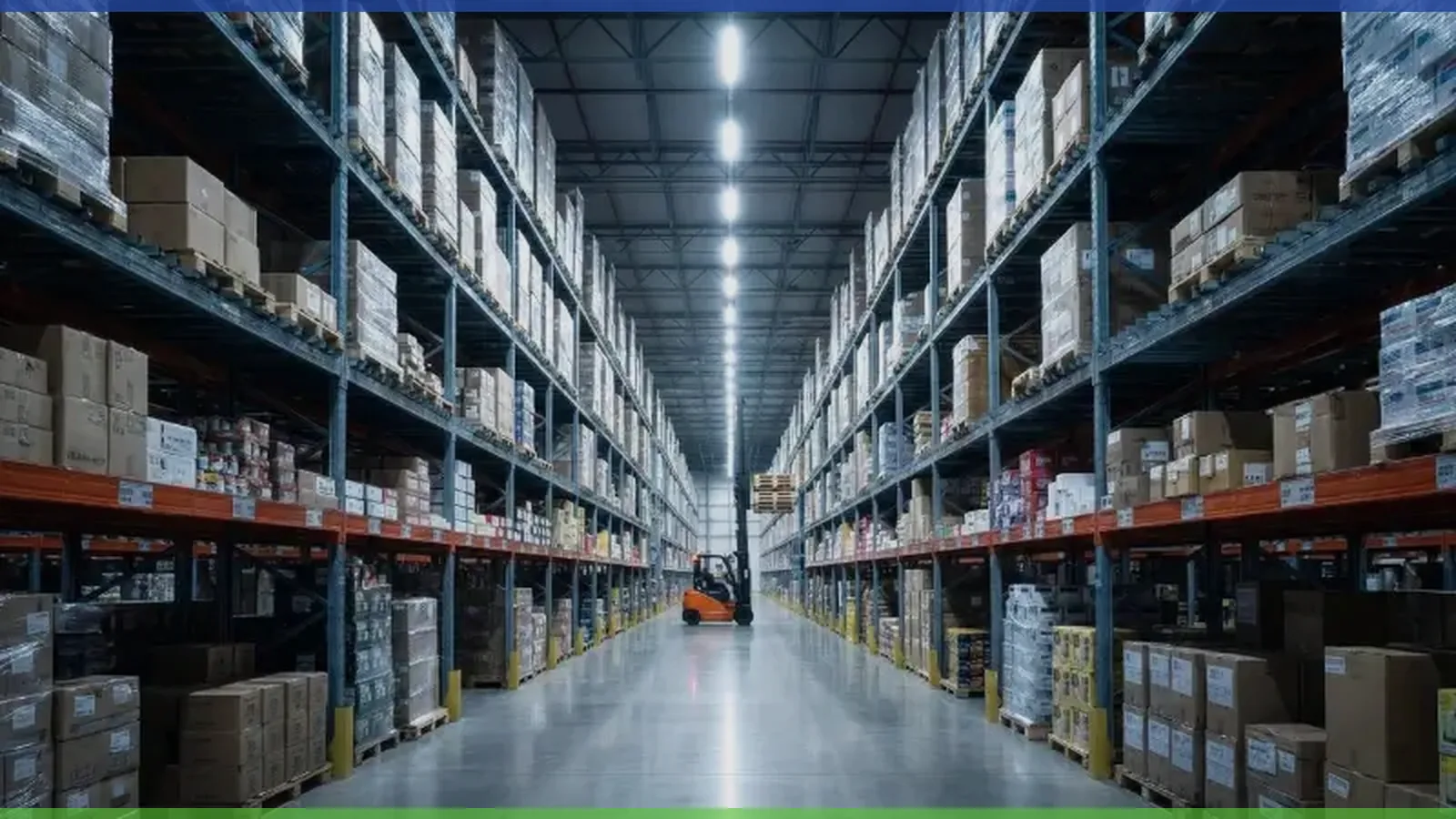
A waterproof fixture can still be a poor cold storage light if the layout leaves dark shelf faces, glare at forklift height, or maintenance crews working from unsafe positions. Buyers should check mounting height, rack geometry, aisle width, door zone brightness, task visibility, and whether light reflects off wet or frosty surfaces. In freezer aisles, glare and uneven light can become safety issues because workers move through narrow routes with equipment.
According to DLC product eligibility and technical requirements, LED products are evaluated through defined technical requirements and categories. A cold room buyer can use that discipline by asking for photometric files, mounting plan, beam distribution, and product category match. Do not select a fixture only because it is waterproof if the optical pattern does not match the room.
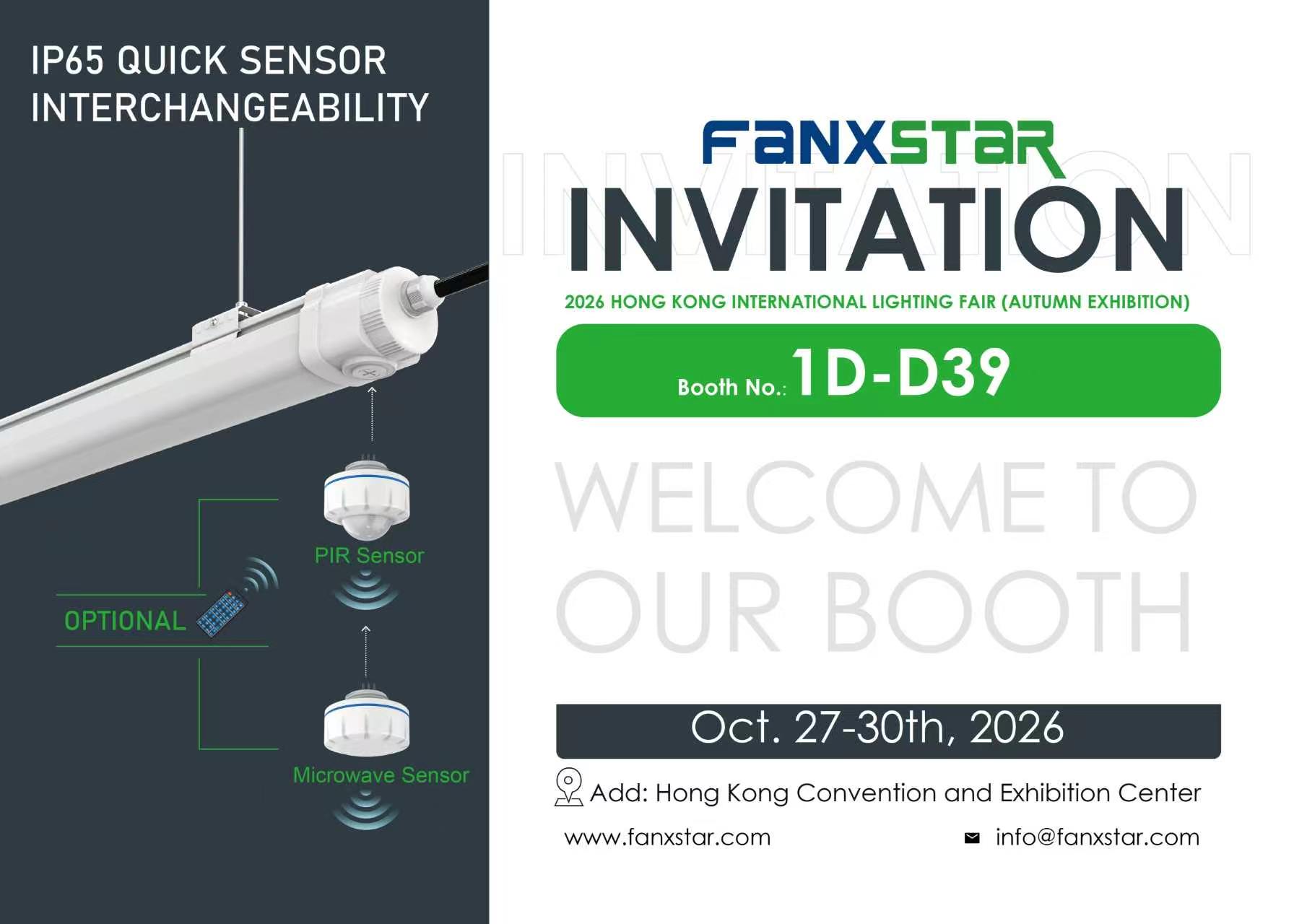
Controls can help when occupancy varies, but sensor placement is harder in cold storage. Door movement, cold air, rack shadows, and worker paths can affect detection. If the fixture uses microwave or PIR sensors, ask for cold-temperature behavior, hold time, grouping, override, and whether the sensor version changes the IP or maintenance file.
Service access should be designed before purchase
Cold storage maintenance is expensive because opening a room, using lifts, or shutting down an aisle can disrupt operations. A cheap fixture that needs frequent replacement becomes costly quickly. Buyers should ask how the diffuser opens, whether the driver is accessible, whether clips can be handled with gloves, whether spare parts are available, and whether a replacement version will match the original evidence.
According to ENERGY STAR commercial lighting guidance, LED lighting can greatly reduce electricity used in commercial buildings. In cold storage, the energy gain must be balanced with service reality. A lower wattage fixture is weak if its driver fails early, sensor misfires, or its lens cannot be cleaned without damaging the seal.
For a 40-unit cold room, even one 4-hour lift visit can make a small unit-price saving disappear. For a 12-month cleaning cycle, the buyer should know whether detergents, spray pattern, and service access were considered. These scenario numbers make the maintenance trade-off visible before the PO is signed.
A practical service plan should name the inspection interval, cleaning method, spare driver or fixture strategy, cable-entry check, gasket condition check, and failure escalation rule. The rule should be different for general storage, food-contact-adjacent areas, emergency routes, and high-traffic dock doors because consequence changes by zone.
How Fanxstar maps product platforms to cold-storage exposure
Start with the cold room exposure map
Fanxstar’s relevant starting points include cold storage LED lighting solutions, weatherproof LED lighting product platforms, vapor tight LED light fixtures, IP65 and IP66 waterproof LED lights, and food processing plant LED lighting solutions. The best platform depends on the exposure map: temperature, condensation, washdown, chemical cleaning, mounting, service access, sensor need, and target market.
The buyer should not simply ask for a waterproof light. A better brief says: freezer minus temperature range, chilled room, dock door, washdown frequency, detergent type if known, cable-entry direction, mounting height, lens impact risk, sensor requirement, emergency requirement, and desired sample gate. This lets Fanxstar identify whether a standard weatherproof fixture, vapor tight platform, aluminum weatherproof body, or custom ODM version fits.
For many B2B buyers, the strongest value is not a custom product from zero. It is platform-based adaptation with a faster evidence path. If the existing platform already solves housing, gasket, diffuser, and driver limits, the buyer may only need optics, CCT, sensor logic, wiring, label, or mounting changes. If the exposure is harsher, the brief should move into a more controlled sample and test plan.
Approve the exact version, not the family name
Cold storage projects often change small details late: cable length, connector, sensor, emergency pack, mounting clip, diffuser material, or label. Each change can affect sealing, cleaning, temperature behavior, or evidence. The buyer should ask whether the final version still matches the evidence file. A product family name is not enough.
According to International Trade Administration import documentation guidance, shipment files can include several document types. Lighting buyers should keep a similar version file: approved sample photos, BOM, driver, diffuser, gasket, cable entry, mounting, IP evidence, photometric file, packing list, and invoice. When those files describe the same fixture, the buyer has a stronger position if field issues appear.
Before a larger order, ask for 2 sample checks. First, a performance and visual sample in the expected mounting condition. Second, a production-representative sample with the final driver, gasket, lens, cable entry, accessory pack, label, and packaging. This prevents a clean prototype from drifting into a weaker production unit.
Evidence packet before approving cold-storage lighting
Use a release checklist, not a catalog screenshot
A release packet should include the product drawing, rated temperature, IP or enclosure evidence, diffuser material, driver data, cable-entry detail, gasket or closure detail, mounting orientation, photometric file, cleaning or service note, and final sample photos. If the project includes food processing, add hygiene and cleaning expectations. If it includes sensors, add detection and grouping logic. If it includes emergency backup, add battery and emergency driver evidence.
According to International Trade Administration special documents guidance, some products may need certificates for standards, safety, or other special conditions. Cold storage lighting may not need the same file in every country, but the buyer should still ask which documents are required for the target market before shipment.
The decision rule is to hold approval when the exposure map and evidence file disagree. If the room has washdown but the fixture evidence only supports damp air, hold. If the freezer has door cycling but no condensation plan, hold. If the cable entry is field changed after testing, hold. A cold room is a harsh place to discover that the quote described a different product.
Turn the evidence into the purchase order
The purchase order should name the final model, CCT, wattage, input voltage, optics, driver, sensor or emergency option, cable entry, diffuser, mounting, IP evidence, temperature range, and sample approval date. It should also state that substitutions require written approval. Without that language, a supplier may treat an equivalent driver or lens as harmless while the buyer loses evidence alignment.
Cold storage lighting is a reliability purchase. If the buyer makes that clear in the RFQ, suppliers respond with better evidence. If the buyer asks only for the lowest waterproof light price, suppliers compete on shortcuts that may appear only after the room is cold, wet, and difficult to service.
FAQ
What IP rating is best for cold storage lights?
IP65 or IP66 is often a practical starting point, but the best rating depends on washdown, condensation, cable entry, mounting orientation, and service conditions. Buyers should ask for evidence tied to the exact fixture version rather than choosing by IP number alone.
Why do cold storage LED lights get condensation inside?
Condensation can occur when warm moist air enters the fixture or room, then contacts a colder surface during temperature cycling. It may also relate to trapped assembly moisture, enclosure breathing, cable entry, or service opening. The fix depends on the moisture pattern.
Can motion sensors work in freezer lighting?
Motion sensors can work in cold storage when the sensor type, placement, grouping, hold time, and temperature behavior fit the site. Buyers should verify detection behavior near doors, racks, and cold air movement because a standard sensor layout may not suit freezer aisles.
What should be in a cold storage lighting RFQ?
Include temperature range, room type, mounting height, rack layout, washdown method, cleaning chemicals if known, IP requirement, cable entry, sensor or emergency need, target market, photometric requirement, sample deadline, and evidence expected before approval.