Key Takeaways
- Motion sensor lighting uses a sensor, control logic, and compatible LED driver to change light output when occupancy changes.
- PIR and microwave sensors detect different conditions; the best choice depends on mounting height, obstruction, aisle shape, and nuisance-trigger risk.
- The real design work is zoning: time delay, standby level, sensitivity, and daylight interaction matter as much as the sensor label.
- Commercial buyers should specify behavior before sampling, then commission the installed zone instead of assuming factory defaults will fit the site.
Motion sensor lighting is automatic lighting control based on occupancy
The system has three parts
Motion sensor lighting is a lighting-control system that changes fixture output when a sensor detects motion, presence, or vacancy. In a commercial LED fixture, the system normally includes a sensor, a control rule, and a driver that can switch or dim the light. The sensor is only the visible part of the system. The result depends on how the fixture is zoned, how long it waits before dimming, and what level it uses when the space is empty.
The GSA lighting guidance page notes occupancy sensors and controls as part of better lighting practice. Energy-code resources such as Energy Code Ace shut-off controls acceptance guidance describe occupant sensors turning lights on and off based on occupancy and time delay. For buyers, that means motion sensor lighting is not a gadget. It is a control behavior that must be specified.
Why a simple on/off definition is not enough
Many basic explanations stop at “the sensor detects movement and turns lights on.” That is not enough for a B2B lighting buyer. The buyer needs to know whether the sensor can see the traffic pattern, whether it can avoid false triggers, whether the fixture can dim instead of only switching, and whether the zone design will save energy without creating safety complaints.
A motion sensor fixture can be excellent in a parking aisle, warehouse corridor, stairwell, cold-room passage, or backroom. The same fixture can behave poorly if mounted too high, pointed at irrelevant movement, blocked by shelving, or programmed with the wrong delay. The installation context decides whether the sensor is a benefit or a nuisance.
How PIR, microwave, and integrated sensors differ
PIR sensors read heat movement
Passive infrared sensors respond to changes in infrared energy, usually caused by people or vehicles moving across detection zones. They are common, efficient, and useful where line of sight is clear. Their weakness is that they can be blocked by partitions, racking, fixture housings, or poor mounting angles.
For aisles and open areas, PIR can work well when the detection lens and mounting height match the space. For enclosed luminaires or complex layouts, buyers should ask for a detection diagram rather than assuming the sensor will see every approach direction.
Microwave sensors read reflected signal changes
Microwave sensors emit a signal and detect changes in reflection. They can be more sensitive and may detect motion through some materials, depending on design and installation. That can be useful in long aisles or sealed fixtures, but it can also create nuisance triggers if the sensor sees movement outside the intended zone.
The buyer should therefore ask not only “PIR or microwave?” but “What should the sensor ignore?” A loading door, moving curtain, adjacent aisle, or passing vehicle can turn a high-sensitivity sensor into wasted energy.
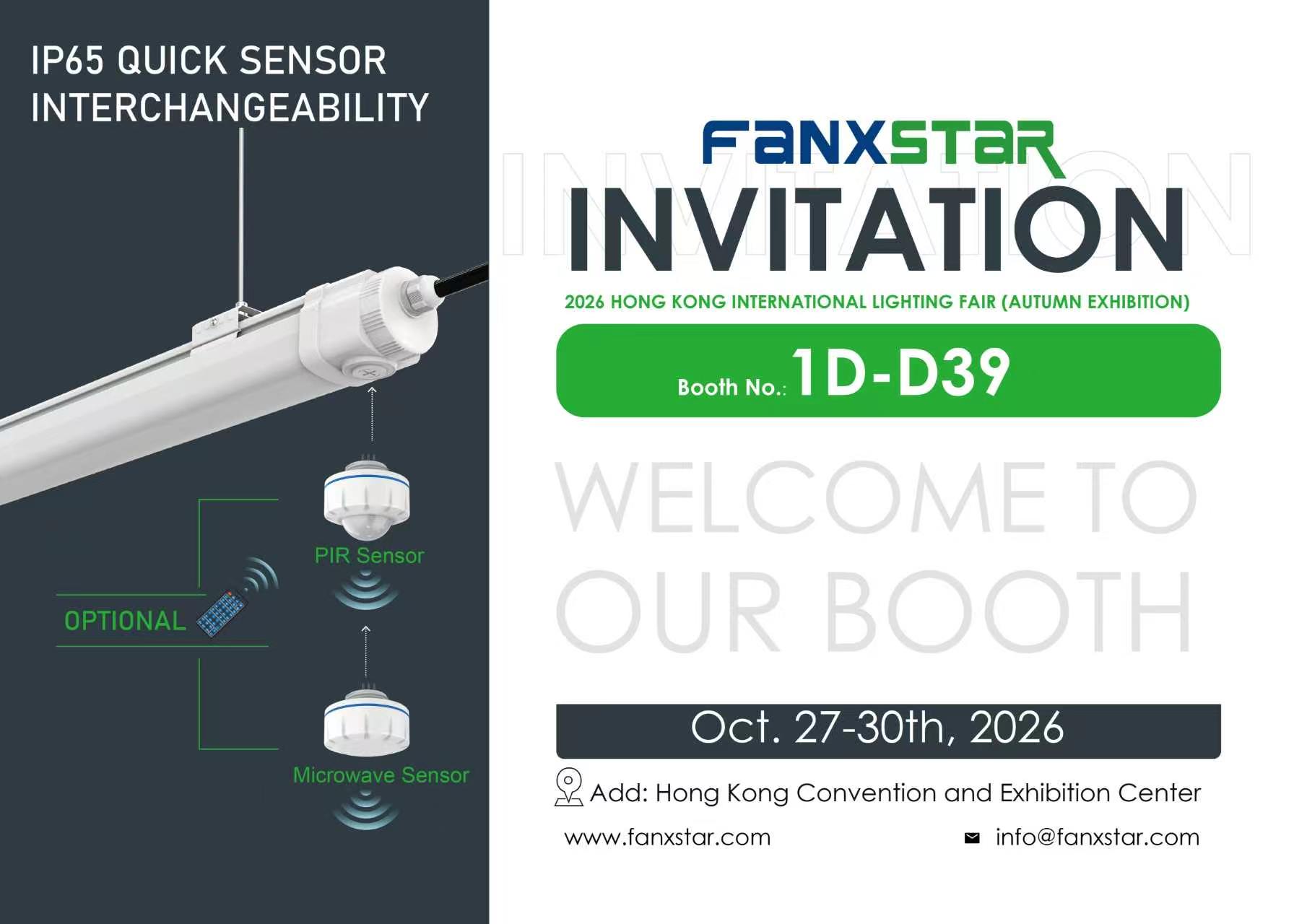
Integrated sensor fixtures simplify wiring but still need commissioning
GSA describes LED fixtures with integrated advanced lighting controls as products that use onboard occupancy and daylight sensors. Integrated sensors can reduce wiring complexity and make fixture replacement easier, but they do not remove the need for commissioning. The default time delay or sensitivity may be wrong for the real traffic pattern.
A buyer should require access to settings, documentation for mounting height, standby levels, and a field test plan. If nobody can change the settings after installation, the project is relying on factory defaults to solve a site-specific problem.
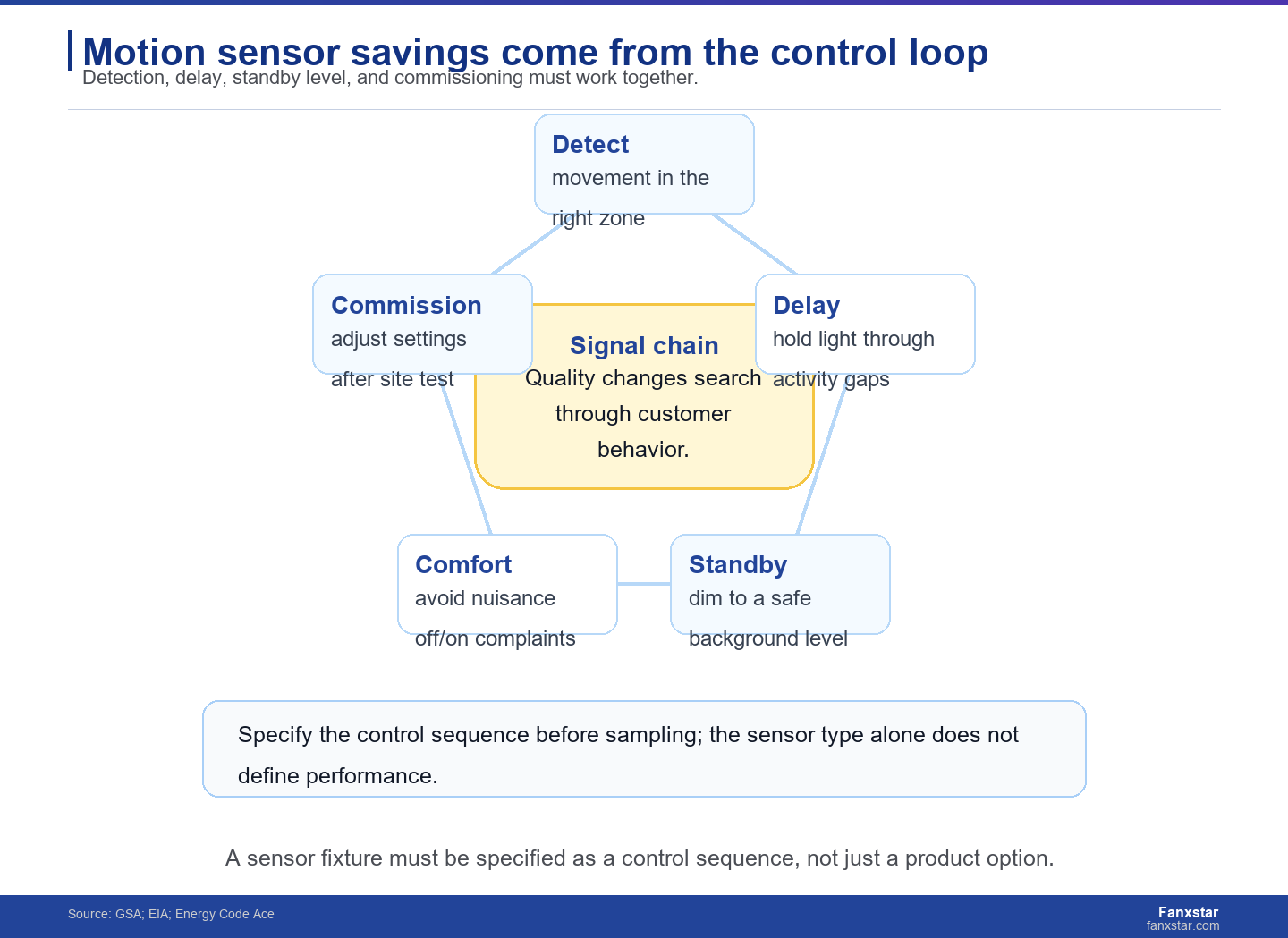
The control sequence that actually determines performance
Detection starts the loop
The sensor first identifies a change that matches its detection method. A person enters a zone, a forklift moves through an aisle, or a vehicle approaches a parking bay. If the sensor sees the event, it sends a signal. If the sensor cannot see it, the fixture may remain dim or off when light is needed.
This is why sensor location is more important than many spec sheets suggest. A perfect sensor installed behind a beam or pointed across the wrong aisle will fail in practice.
Time delay controls comfort and savings
After the last detected motion, the control waits for a programmed delay before dimming or switching. A short delay saves more energy but may annoy workers in areas with intermittent small movements. A long delay feels stable but leaves lights at full output after the space is empty. The correct delay depends on activity pattern, safety need, and the cost of false-off events.
The EIA report on commercial sensors and controls discusses building sensor and control trends and references energy-saving potential from controls. The buyer should interpret that potential as conditional: savings depend on the vacancy profile and the quality of control settings.
Standby level is often better than full off
In commercial lighting, full off is not always acceptable. Parking garages, emergency routes, freezer aisles, and public corridors may need a background level for safety or orientation. A sensor-controlled LED fixture can hold 10%, 20%, or 30% output during vacancy and rise to full output on detection. That strategy often balances savings with safety.
The standby level should be specified in the RFQ. If the buyer simply asks for “motion sensor,” suppliers may quote an on/off product when the site actually needs bi-level dimming.
Where motion sensor lighting saves money
Savings come from vacancy, not from the sensor itself
A sensor saves energy only during the hours when the lights would otherwise remain at a higher level than needed. A storage aisle used ten minutes per hour has a large savings window. A continuously occupied production station has a small savings window. This is the core reason some sensor projects perform well and others disappoint.
GSA’s advanced lighting controls findings report reports substantial additional savings from LED systems with advanced controls in a tested federal building context. The lesson for buyers is to focus on zones with real idle time, not to place sensors everywhere because they sound efficient.
Maintenance and thermal hours matter too
Reduced operating hours can reduce driver heat, light-source hours, and unnecessary maintenance exposure. In spaces where maintenance is difficult, such as high-bay warehouses or cold rooms, that indirect saving may be meaningful. A payback estimate should include energy, labor, lift rental, disruption, and safety requirements.
The best sensor zones are usually low-traffic but safety-sensitive: warehouse aisles, parking decks, backrooms, stairwells, utility corridors, and cold-chain passages. The worst zones are constantly occupied spaces where the sensor adds complexity without meaningful dimming time.
Specification checklist for commercial buyers
Describe the zone before choosing the sensor
The RFQ should state mounting height, aisle width, obstruction, expected traffic, target full-output level, standby level, delay, supply voltage, IP requirement, and whether daylight interaction is needed. If the buyer does not define the zone, the supplier can only guess.
Energy Code Ace’s mandatory lighting controls guidance describes control concepts such as manual area controls, multi-level controls, and shut-off controls. In a B2B lighting project, those concepts should become product requirements: which fixtures are controlled together, what level they use during vacancy, and how users override or commission them.
Ask for detection evidence
A useful supplier response includes detection range, mounting height, sensor type, delay range, dimming method, standby level, wiring diagram, and commissioning instructions. For sealed fixtures, ask whether the sensor is integrated in a way that preserves IP rating and serviceability.
If the project involves high racks, metal shelving, freezer panels, or long parking aisles, request a zone sketch. The detection diagram is often more useful than another catalog lumen number.
How Fanxstar applies sensor logic to LED fixture platforms
The product platform must match the control behavior
Fanxstar’s relevance is strongest when the buyer needs the sensor behavior built into the fixture platform instead of attached as an afterthought. Start from motion sensor LED lighting when the project is about occupancy control, or from parking garage LED lighting solutions when the issue is safety and standby light in vehicle or pedestrian zones.
For ODM projects, Fanxstar should receive the control sequence before sampling: full output, standby output, delay, detection direction, mounting height, and whether the fixture must remain sealed after sensor integration. That lets the sample test real behavior rather than just proving that the sensor turns on.
Use a pilot zone before full rollout
Before ordering a full batch, test one representative zone. Confirm detection, delay, nuisance triggers, standby level, and worker acceptance. If the site includes several traffic patterns, test the hardest one first. Buyers can contact Fanxstar for an ODM lighting quote with a zone sketch, mounting height, and desired control sequence so the first sample is closer to the final installation.
The best motion sensor project does not feel like automation for its own sake. It feels like light appearing where it is needed, staying low where it is not, and avoiding complaints from workers who have to live with the system every day.
Commissioning rules that prevent sensor complaints
The first pilot should test the hardest traffic pattern
A motion sensor project should not begin with the easiest aisle. It should begin with the zone most likely to create complaints: an aisle with intermittent picking, a parking route with cross traffic, a cold-room passage where users wear bulky clothing, or a service corridor with obstructions. If the sensor works there, easier zones can usually be tuned from the same logic. If it fails there, a broad rollout only multiplies the nuisance.
Use a pilot checklist rather than a simple on/off test. Record mounting height, detection direction, false triggers, missed triggers, delay time, standby level, override access, and worker feedback. A sensor that saves energy but makes workers wave their arms for light is not a successful control design.
Specify the control sequence before asking for unit price
For procurement, the control sequence should come before the quote comparison. Ask for full output, standby output, delay range, sensor type, detection pattern, commissioning method, IP rating after sensor integration, and wiring diagram. The unit price means little if one supplier quotes an on/off sensor and another quotes a dimming sensor with standby behavior.
Fanxstar’s motion-sensor lighting work is strongest when the buyer provides the zone sketch before sampling. A motion sensor LED lighting inquiry should include traffic rhythm, target light levels, mounting height, and whether the site needs full-off or dim-down behavior. That allows the sample to test the control loop, not merely the presence of a sensor.
A good RFQ also says who can change the settings after installation. If the facility team cannot adjust delay, sensitivity, or standby level without replacing hardware, the buyer is locked into the factory default. In a real warehouse, parking garage, or service corridor, defaults are only a starting point. The winning specification is the one that gives the site enough commissioning control to protect both energy savings and user confidence.
This is why a sensor pilot should produce a settings record. Keep the final delay, standby level, sensitivity, mounting height, and complaint notes with the project file. When the next zone is ordered, the buyer is not starting again from a catalog description; they are scaling a tested control behavior.
FAQ
What is motion sensor lighting in simple terms?
Motion sensor lighting is a lighting system that changes output when a sensor detects occupancy or movement. In commercial LED fixtures, it may switch, dim, or hold a standby level.
Is PIR or microwave better for LED fixtures?
Neither is universally better. PIR is strong when line of sight is clear, while microwave can work well in some enclosed or long-range situations but may create nuisance triggers if poorly placed.
How much energy can motion sensor lighting save?
Savings depend on vacancy hours, fixture wattage, standby level, and time delay. Low-traffic zones can save much more than continuously occupied spaces.
Should sensor lights turn fully off or dim down?
Dim-down control is often better in parking, corridors, cold rooms, and safety-sensitive spaces because it preserves orientation while still reducing energy use.
What should I send to Fanxstar for a sensor lighting quote?
Send a zone sketch, mounting height, traffic pattern, IP requirement, full and standby output levels, delay preference, voltage, and quantity. Those details define the sample behavior.