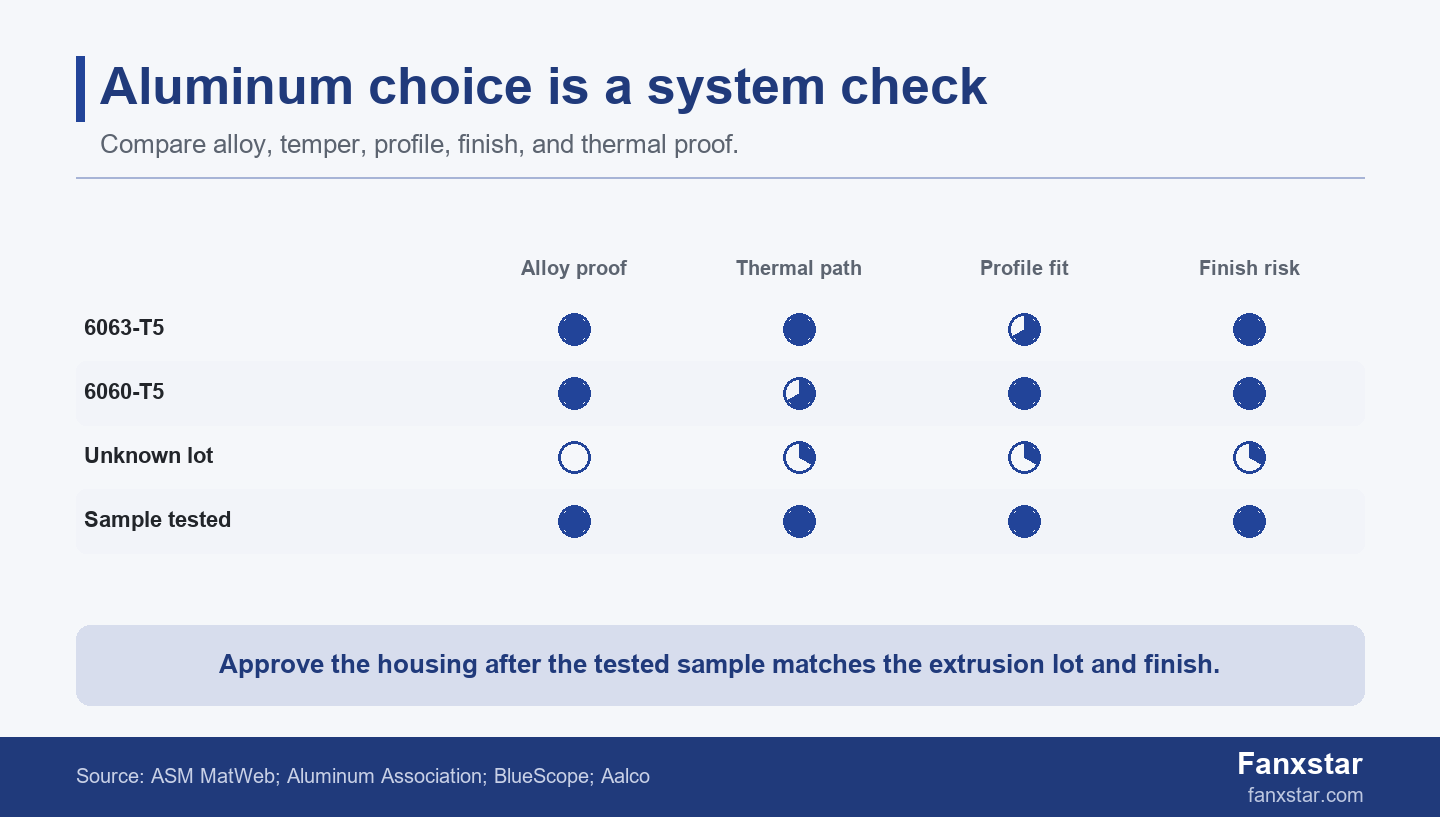
6063-T5 and 6060 aluminum are close enough that a buyer can make the wrong decision in two opposite ways. One mistake is assuming 6063-T5 is always the premium answer for every LED lighting housing. The other mistake is treating 6060 as a cost-cutting alloy that cannot be trusted. For B2B lighting procurement, the better question is whether the alloy, temper, extrusion profile, finish, thermal path, and tested sample all describe the same product.
BlueScope describes 6063 as a heat-treatable medium-strength aluminum alloy, and the Aluminum Association Teal Sheet connects alloy designations to composition limits. Those references are useful, but they do not approve a fixture by themselves. A housing still has to survive LED heat, bracket stress, installation handling, corrosion exposure, cleaning chemistry, and production variation.
Key Takeaways
- 6063-T5 is often a strong choice for LED lighting housings when finish appearance, extrusion consistency, and moderate strength requirements matter.
- 6060 can also be valid for LED housings, especially where the profile is complex, the load is controlled, and the thermal design has enough surface area.
- The alloy number is weaker than the full evidence package: alloy designation, temper, wall thickness, thermal test, anodizing or coating, corrosion assumptions, and production sample match.
- For custom lighting, the RFQ should forbid quiet alloy or temper substitution unless the supplier repeats the affected evidence checks.
Why the alloy name alone is not enough
6063-T5 is not a magic thermal guarantee
LED lighting buyers often hear that 6063 is better because it is widely used for extruded aluminum profiles. That may be true for many housings, but it is still not a complete thermal argument. The LED board temperature depends on board attachment, thermal pad, housing wall thickness, fin area, air movement, driver heat, power setting, ambient temperature, and whether the fixture is surface mounted, suspended, or enclosed.
BlueScope describes 6063 as a heat-treatable medium-strength aluminum alloy. That description helps the buyer understand the material family. It does not replace a fixture-level thermal test. A thin 6063-T5 housing with poor board contact can lose to a better-designed 6060 housing with a wider heat path and lower drive current.
A useful RFQ therefore asks for the thermal report under the intended wattage, ambient temperature, mounting method, and lens configuration. The report should identify the LED board temperature, driver temperature, measuring points, test duration, and sample version. If the supplier later changes the LED board, driver, diffuser, or extrusion wall thickness, the buyer should decide whether the thermal file still applies.
6060 is not automatically a weak housing material
Righton Blackburns describes 6060 T5 as a general commercial aluminum alloy used for extrusions. That point matters for LED lighting because a housing is not a simple bar. It may need lens grooves, PCB shelves, cable channels, clip seats, gasket channels, mounting ribs, and decorative visible surfaces. Extrusion quality and profile control can matter as much as the alloy family.
BlueScope also describes 6060 as a heat-treatable aluminum alloy with corrosion resistance and anodising characteristics. A buyer should not reject 6060 simply because a competitor page says 6063 is more common. The practical check is whether the 6060 profile meets the fixture’s structural and thermal requirements at production tolerance.
The danger is an unknown or undocumented substitution. If the quotation says aluminum housing but does not name alloy, temper, and finish, the buyer has no useful baseline. If the sample uses 6063-T5 and production quietly changes to a different alloy or temper, the certificate, finish, and thermal evidence may no longer describe the shipped goods.
Where 6063-T5 tends to win in LED housings
Visible finish and profile consistency
6063-T5 is a familiar choice for visible aluminum profiles because it is friendly to extrusion and finishing. In a linear light, office fixture, fresh retail fixture, or visible architectural housing, the finish is not just cosmetic. Poor anodizing consistency, streaks, waves, burrs, or profile twist can make a product look cheap even when the LED performance is acceptable.
This is why buyers should combine the material request with a finish standard. Ask for anodizing or coating thickness, color tolerance, surface defect limits, scratch protection, packaging method, and how the supplier handles long-profile straightness. A beautiful sample is not enough if production cartons allow aluminum faces to rub against each other during export shipment.
Moderate strength with predictable fixture loads
For LED lighting housings, the most important mechanical loads are often not dramatic. They are bracket pressure, suspension points, clip force, diffuser insertion, cable gland strain, vibration during shipment, and installer handling. 6063-T5 can be a good fit when the wall thickness, rib design, and mounting hardware are designed around those loads.
The buyer should still avoid vague wording such as strong aluminum body. A better line in the RFQ is: aluminum alloy and temper to be stated on the drawing and material certificate; production lot must match approved sample; bracket pull and clip retention to be checked on the final extrusion; any wall-thickness change requires written approval. This turns a material preference into a release rule.
Where 6060 can be the practical choice
Complex extrusions and controlled-load fixtures
6060 may be attractive where the fixture profile has complex geometry and the structural load is modest. A decorative linear cover, slim ceiling profile, internal LED channel, or small accessory housing may not need the same strength margin as a larger heat-sink body. In those cases, the buyer’s priority may be profile accuracy, surface quality, and assembly fit.
The deciding evidence should be physical. Does the diffuser slide cleanly without rattling? Do end caps seal without forcing the extrusion open? Do clips hold after repeated installation? Does the profile remain straight over the required length? Does the driver compartment stay within temperature limits? Those questions are more useful than arguing alloy names in isolation.
When cost pressure appears, freeze the change path
Cost pressure is normal in custom lighting. The problem is not using 6060. The problem is switching material or temper after sample approval without reopening the evidence file. A supplier may propose a change to reduce extrusion cost, improve availability, or simplify production. That can be acceptable if the buyer knows exactly which evidence must be repeated.
A good change-control rule names the affected checks: material certificate, extrusion dimensions, straightness, lens fit, bracket retention, IP seal, finish sample, thermal test, and carton drop or vibration risk where relevant. If a supplier says the change is equivalent, ask which tests prove equivalence. If there is no test, treat the change as unapproved.
Evidence checks that reduce alloy risk
Use 3 release gates instead of a single material line
A reliable aluminum-housing file has at least 3 release gates: drawing approval, sample approval, and production-lot approval. Drawing approval freezes alloy, temper, wall thickness, length tolerance, lens channel, screw boss, cable entry, and mounting seat. Sample approval checks whether the physical extrusion matches the drawing. Production-lot approval checks whether the material certificate and first-article sample still match the approved version.
DLC solid-state lighting technical requirements and DOE FEMP commercial and industrial luminaire guidance both point buyers toward product-level performance evidence rather than vague marketing language. The practical implication is that aluminum selection should be tied to the final luminaire file: optical data, electrical rating, thermal behavior, mounting instructions, and warranty boundary.
For a long linear LED housing, the buyer can ask for 5 measurable values before mass production: nominal alloy and temper, minimum wall thickness, extrusion length tolerance, finish thickness or coating class, and maximum measured LED board temperature under the approved wattage. Those 5 values make the alloy discussion auditable. Without them, the words 6063-T5 and 6060-T5 may still leave too much room for substitution.
Treat finish and packaging as part of the material decision
An aluminum housing can pass a material check and still fail commercially if the surface is scratched, streaked, unevenly anodized, or bent in transit. This is especially true for 1.2-meter, 1.5-meter, and 1.8-meter linear fixtures where a small bow or dent is visible after installation. The implication is simple: material selection is incomplete until the buyer also checks finish handling and carton protection.
For visible housings, ask for finish samples under the same color and surface treatment that will ship. For wet, dusty, or corrosive projects, ask whether the finish is intended for the actual exposure. For export shipments, ask how many fixtures share a carton, whether aluminum faces touch, whether end caps protect long corners, and whether the sample packaging will be copied in production.
If the project is moving from sample to repeat order, Fanxstar can review the aluminum decision with the fixture drawing, exposure environment, and target market in one file. That keeps the discussion focused on verifiable housing evidence instead of a broad alloy preference.
How to brief Fanxstar on an aluminum housing decision
Send the housing constraints, not only the alloy preference
Fanxstar is most useful when the buyer turns a housing question into a fixture brief. For aluminum linear and weatherproof projects, the starting point can include Fanxstar LED linear lighting platforms, B1 ceiling linear lights, A3 weatherproof lighting fixtures, and custom LED lighting design options.
A practical brief should include target wattage, fixture length, mounting method, ambient temperature, exposure environment, finish color, anodizing or coating preference, IP requirement, lens material, driver position, certificate market, packaging limit, and whether the housing is visible to end users. With that information, the supplier can recommend whether 6063-T5, 6060, or another verified extrusion route fits the project.
For ODM projects, ask Fanxstar to return the recommendation as a sample evidence checklist: alloy and temper, drawing revision, wall thickness, finish sample, thermal test plan, assembly fit check, IP test boundary, and substitution rule. That makes the material decision practical enough for procurement, engineering, and quality teams to approve together.
Buyer checklist before approving production
| Buyer question | 6063-T5 implication | 6060 implication | Evidence to request |
|---|---|---|---|
| Is the housing structural? | Often chosen when profile strength and finish consistency matter. | Can work for many standard extrusions when loads are moderate. | Drawing, wall thickness, bracket load, and temper record. |
| Is heat the main risk? | Check real thermal path, not only alloy name. | May be acceptable when surface area and driver heat are controlled. | Thermal test, LED board temperature, and production sample. |
| Is the profile complex? | Good for many architectural and lighting extrusions. | Often useful for complex shapes and cosmetic extrusion work. | Extrusion tolerance, straightness, and diffuser fit sample. |
| Will it be anodized? | Commonly selected for anodizing and visible finishes. | Also supports anodizing, but the finish process must be proven. | Finish sample, thickness, salt exposure rule, and color tolerance. |
| Can the supplier substitute alloy? | Only with written approval and re-check. | Only with written approval and re-check. | Material certificate and change-control rule. |
The strongest buyer position is simple: do not approve the housing because the alloy sounds familiar. Approve it because the final extrusion lot, temper, finish, thermal path, assembly fit, and sample test all match the version that will ship. When those 6 items are ready, the buyer can send Fanxstar the drawing and target exposure so the sample evidence can be built around the real housing decision.
Implementation Note for Buyers
For a repeatable aluminum housing decision, keep a small approval sheet next to the drawing. The sheet can contain 8 fields: alloy, temper, extrusion revision, minimum wall thickness, finish process, fixture wattage, thermal test condition, and allowed substitution rule. These fields turn the 6063-T5 versus 6060 question into a controlled engineering release rather than a purchasing opinion.
If the housing is part of a private-label or ODM lighting program, connect that sheet with Fanxstar customization before the next sample. Fanxstar can then discuss whether the same extrusion should support standard linear lighting, weatherproof lighting, or a custom profile, and which evidence should be repeated when length, lens, cable entry, or finish changes.
According to BlueScope 6063 material guidance, 6063 belongs in a medium-strength heat-treatable alloy discussion, not a vague premium-material claim. According to BlueScope 6060 material guidance, 6060 also has corrosion-resistance and anodising relevance. According to Righton Blackburns 6060 T5 guidance, 6060 T5 is used as an extrusion alloy, so the real test is whether the profile meets the fixture requirement.
According to the Aluminum Association alloy designation reference, alloy designation should be tied to composition limits. According to DOE FEMP luminaire purchasing guidance, luminaire buying should rely on product-level evidence. According to ENERGY STAR commercial lighting upgrade guidance, lighting upgrades should be evaluated beyond first purchase price, which is why housing finish, thermal life, and service replacement matter.
The decision rule is to approve the alloy only when the material record, extrusion drawing, thermal file, and production sample point to the same fixture. According to GSA LED and controls guidance, LED projects also need controls and commissioning discipline, so an aluminum change should not be reviewed outside the whole luminaire system.
FAQ
Is 6063-T5 better than 6060 for LED lighting housings?
6063-T5 is often preferred for LED housings when finish, extrusion consistency, and moderate strength matter, but it is not always better. 6060 can be suitable when the profile, load, thermal design, and finish evidence are proven.
Does aluminum alloy affect LED heat dissipation?
Yes, but alloy is only one part of the thermal path. Board contact, wall thickness, surface area, driver heat, mounting method, and ambient temperature can matter as much as the alloy designation.
What should an LED housing RFQ say about aluminum?
Name the alloy and temper, drawing revision, wall thickness, surface finish, thermal test condition, corrosion assumption, sample approval rule, and substitution rule. Avoid vague wording such as high quality aluminum.
Can a supplier switch from 6063-T5 to 6060 after sample approval?
Only if the buyer approves the change and repeats the affected checks. Material substitution can affect thermal, finish, mechanical, IP, and certification evidence.