For years, procurement managers shipping from China to Europe had two choices: cheap and slow (sea freight) or fast and expensive (air freight). That binary has been fundamentally changed by the expansion of the China-Europe Railway Express network — the so-called New Silk Road — which now connects major Chinese manufacturing hubs to European distribution centers in 15–22 days at rates 60–70% lower than air. Understanding how all three modes compare on cost, transit time, reliability, and cargo suitability is no longer optional for B2B importers. This guide provides the current data.
Key Takeaways
- Sea freight remains the lowest-cost option for bulk and non-urgent cargo: $1,200–$2,500 per 40ft FCL from Shanghai to Rotterdam, with 25–40 day transit times.
- Air freight is the fastest at 3–6 days China-to-Europe, but costs $4.80–$7.00/kg — suitable for high-value, time-critical, or lightweight cargo only.
- Rail freight is the middle-ground that has reshaped EU procurement strategy: 15–22 days, 60–70% cheaper than air, and significantly more reliable than sea on fixed-schedule routes.
- The “Total Landed Cost” calculation — not just base freight rates — determines which mode is actually cheaper for any given shipment.
The Three Modes: What You’re Actually Choosing Between
Sea Freight — Volume Efficiency at the Expense of Speed
Ocean freight remains the dominant mode for China-to-Europe trade by volume. From major Chinese ports (Shanghai, Ningbo, Shenzhen) to European base ports (Rotterdam, Hamburg, Antwerp), transit times average 28–40 days, with Mediterranean routes to Genoa or Barcelona running 25–30 days. Under adverse conditions — Red Sea disruptions forcing detours around the Cape of Good Hope, port congestion, or seasonal weather — transit times have extended to 45+ days on affected routes.
Cost structure for sea freight includes base ocean freight plus fuel surcharges, port handling fees, documentation, and customs — making the headline container rate an incomplete picture. For a 40ft FCL from Shanghai to Hamburg, total costs typically range from $1,250–$2,500 depending on season and market conditions, per Tonlexing’s 2025 China-to-Europe shipping analysis. LCL (Less-than-Container Load) rates are charged per CBM or per 1,000 kg — whichever yields the higher revenue — adding cost complexity for smaller shipments.
Sea freight’s fundamental advantage is absolute cost efficiency at scale. For bulk cargo, non-urgent inventory replenishment, or commodities where days-in-transit have minimal inventory carrying cost impact, ocean freight remains unbeatable. The critical limitation is schedule unpredictability: according to Artarail’s 2025 Total Landed Cost analysis, a $100,000 shipment spending 35+ days in transit carries substantial inventory holding costs (IHC) that erode the per-kg rate advantage for high-value goods.
Air Freight — Speed Justifies the Premium, Sometimes
Air freight delivers China-to-Europe shipments in 3–6 days. At $4.80–$7.00 per kg for Europe-bound cargo (2025 market rates), a 500 kg shipment costs roughly $2,400–$3,500 in base air freight alone — versus $1,200–$2,500 for an entire 40ft sea container. The economics only work when speed generates corresponding value: emergency restocking, seasonal product launches, high-value electronics where inventory holding costs justify the premium, or situations where sea freight delays would breach contractual delivery terms.
Air freight’s chargeable weight calculation penalizes volumetric cargo. The standard volumetric ratio of 1 CBM = 167 kg means that bulky, low-density cargo — like LED lighting fixtures, housing assemblies, or packaged aluminum profiles — is charged based on volume rather than actual weight, making air freight economically prohibitive for many industrial product categories.
For LED lighting procurement specifically, air freight is a realistic option only for urgent sample shipments, emergency replacement parts, or high-value specialty components (driver electronics, sensors, control modules) where the cargo value-to-weight ratio justifies the rate. Standard fixture orders measured in cubic meters are almost never air freight candidates.
Rail Freight — The Mode That Changed the EU Equation
China-Europe rail freight, operating primarily through the CR Express (China Railway Express) network, has grown from a niche option to a mainstream procurement logistics tool. As of 2025-2026, the network connects Chinese hubs including Xi’an, Chengdu, Chongqing, Zhengzhou, and Yiwu with European destinations including Duisburg (Germany), Hamburg, Warsaw (Poland), and Madrid (Spain) via the Malaszewicze border crossing in Poland.
Transit times average 15–22 days terminal-to-terminal, with door-to-door delivery typically 22–25 days depending on last-mile distance. Xi’an to Duisburg routes run as fast as 15–16 days on the fastest observed schedules. Rail’s punctuality rate exceeds 90% in winter conditions when sea freight faces typhoon-season disruptions, per ShippingWilson’s 2025 sea vs. rail comparison.
Cost: 40ft FCL rates from Xi’an to Hamburg average $3,500–$4,500; Chongqing to Duisburg runs $3,800–$5,000. LCL rail rates average $100–$250 per CBM depending on route and consolidation service. These rates are generally 2–3 times higher than sea freight but 60–70% lower than air — confirmed by multiple freight industry sources including SeaFreightGo’s China-Europe rail guide. A notable 40% surge in rail bookings was recorded in early 2026 as the Red Sea situation extended ocean transit times.
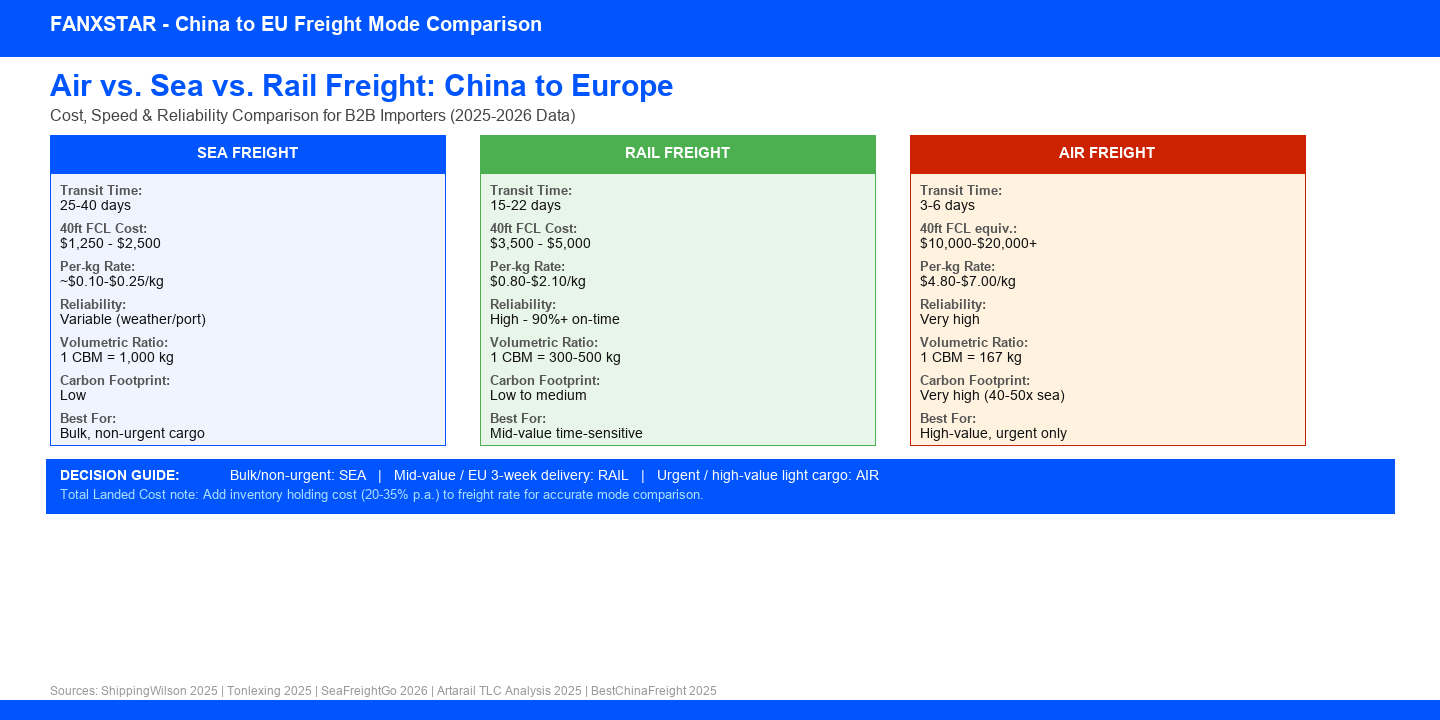
Head-to-Head Comparison: China to EU (Current Data)
| Factor | Sea Freight | Rail Freight | Air Freight |
|---|---|---|---|
| Transit Time (China-EU) | 25–40 days (45+ with disruptions) | 15–22 days (22–25 door-to-door) | 3–6 days |
| 40ft FCL Cost (Shanghai–Hamburg) | $1,250–$2,500 | $3,500–$5,000 | $10,000–$20,000 equiv. |
| Per-kg Rate | ~$0.10–$0.25/kg (FCL) | $0.80–$2.10/kg (LCL/weight) | $4.80–$7.00/kg |
| Schedule Reliability | Variable — weather, port congestion, route changes | High — fixed timetables, 90%+ on-time | Very high — aircraft schedules are predictable |
| Volumetric Ratio | 1 CBM = 1,000 kg (favorable for bulky) | 1 CBM = 300–500 kg (moderate penalty) | 1 CBM = 167 kg (heavy penalty for bulky) |
| Carbon Footprint | Low (per tonne-km) | Low to medium | Very high — 40–50x sea freight |
| Best For | Bulk, non-urgent, low-value-per-kg cargo | Mid-value, time-sensitive, medium volumes | High-value, ultra-urgent, light cargo |
The Total Landed Cost Calculation: Why Base Rates Mislead
What “Total Landed Cost” Actually Includes
The Total Landed Cost (TLC) framework accounts for costs that raw freight quotes omit: insurance premiums (higher for longer transit), inventory holding costs (capital tied up in goods in transit), risk premiums for schedule uncertainty, and the business cost of being out-of-stock during extended transit. According to Artarail’s TLC analysis for 2025, annual inventory holding costs typically range from 20–35% of inventory value — meaning a $100,000 shipment spending 35 days at sea costs $1,900–$3,300 in inventory carrying cost alone, independent of the freight rate.
For high-value B2B goods — LED lighting systems with embedded electronics, certified components, or custom-manufactured fixtures — the TLC calculation frequently shifts the optimal freight mode away from sea freight’s headline rate advantage. A procurement manager optimizing for minimum total cost, not minimum per-kg freight rate, will often find rail freight economically superior to sea freight for medium-value, time-sensitive EU shipments.
The “Chargeable Weight” Trap for Industrial Products
Each freight mode uses a different volumetric calculation — and for bulky industrial products, this changes the effective cost dramatically. Sea freight charges 1 CBM = 1,000 kg equivalence, meaning lightweight, bulky cargo like LED fixture housings ships at actual cubic meter rates with minimal penalty. Rail applies a 1 CBM = 300–500 kg ratio. Air freight applies the harshest ratio of 1 CBM = 167 kg — a pallet of LED weatherproof fixtures that measures 2 CBM but weighs only 180 kg would be charged as 334 kg air freight, effectively doubling the apparent per-kg cost.
This volumetric penalty makes air freight structurally unsuitable for most LED lighting products, and is a key reason rail freight has grown rapidly for electronics and fixture components that balance medium value with moderate density.
Which Mode for LED Lighting Shipments to Europe?
Sea Freight: The Standard for Large Project Orders
For project-scale LED lighting shipments — full specification orders for warehouse lighting upgrades, industrial facility retrofits, or distribution center installations — sea freight FCL remains the appropriate mode. A full container of LED weatherproof fixtures or industrial high-bays is priced and planned months in advance; the 30–40 day transit is built into project timelines, and the per-unit freight cost is negligible relative to product value at full container quantities.
LCL sea freight becomes less attractive for medium-value lighting products. The combination of per-CBM handling fees, port dwell time variability, and consolidation delays often pushes the effective timeline to 35–45 days, making LCL rail competitive on both cost and speed for European-bound lighting orders in the 2–10 CBM range.
Rail Freight: The EU-Bound Middle Market
For EU-bound B2B buyers sourcing industrial LED fixtures — particularly those with EU regulatory compliance requirements (CE/ENEC certification, WEEE registration, ErP compliance) — rail freight has become the preferred mode for replenishment orders and project sample shipments. The 15–22 day transit enables two-to-three inventory cycles per quarter versus one-to-two for sea, improving working capital efficiency for distributors and project contractors.
Rail’s fixed schedule also reduces the buffer stock requirement. A buyer who can predict arrival to within ±2 days requires significantly less safety stock than one managing sea freight with ±10–15 day uncertainty windows. This inventory efficiency improvement is a concrete financial benefit that TLC analysis captures but simple freight rate comparison misses.
LED lighting manufacturers with established European distributor relationships increasingly quote rail-compatible lead times for standard product lines. If you’re evaluating industrial LED weatherproof fixtures or emergency lighting systems for EU projects, Fanxstar’s weatherproof lighting range is engineered to CE/ENEC standards suitable for direct EU market distribution, with lead times compatible with both sea and rail freight planning cycles.
Air Freight: For Emergency and High-Value Components Only
Air freight for lighting shipments is typically limited to: emergency replacement luminaires for critical infrastructure (hospitals, food processing facilities, data centers), high-value drivers and control modules for specialist installations, certification samples for laboratory testing prior to bulk order, and urgent project phase completions where delays carry contractual penalties. For emergency lighting systems where facility managers need quick replacement of failed LED emergency lighting, air freight can be the appropriate procurement decision despite the cost premium.
Practical Decision Framework
Step 1: Assess Urgency Against Inventory
If you have 40+ days of inventory on hand: sea freight. If you have 20–35 days of inventory: rail freight. Under 20 days of inventory on a time-critical line: air freight or accept a stockout risk assessment.
Step 2: Calculate Chargeable Weight for Your Cargo
Measure both actual weight and cubic volume of your shipment. Apply each mode’s volumetric ratio. If your cargo is dense (metal fixtures, heavy components), actual weight drives cost and air becomes more competitive versus the volumetric penalty. If your cargo is bulky and light (packaged luminaires, fixture housings), sea or rail’s favorable volumetric ratios dominate.
Step 3: Apply Total Landed Cost Logic
Add inventory holding cost to the freight rate. For cargo worth over $50,000 per shipment, each additional week of transit costs $200–$700 in carrying costs at standard capital cost rates. For shipments worth $200,000+, this calculation consistently favors faster modes (rail or air) over pure sea freight rate optimization.
Common Questions
Is China-Europe rail freight cheaper than sea freight?
No — as a base rate, rail is 2–3 times more expensive than sea freight per container. However, when Total Landed Cost is calculated (including inventory holding costs, schedule uncertainty buffers, and stockout risk), rail freight is economically superior to sea freight for time-sensitive, medium-value cargo in the 1–15 CBM range destined for European markets.
How reliable is China-Europe rail freight in practice?
Rail’s punctuality rate exceeds 90% on established routes. The primary disruption risk is border crossing processing at Malaszewicze (Poland-Belarus) and Chinese customs procedures. Unlike sea freight, rail is not affected by seasonal weather events, Suez Canal congestion, or Red Sea security situations — which have caused major disruptions to ocean schedules in 2024–2025.
Can I ship LCL by rail to Europe?
Yes. LCL consolidation rail services operate weekly on major routes, with minimum shipments of 1 CBM. LCL rail rates average $100–$250 per CBM, compared to $120–$180 per CBM for LCL sea freight on the same China-to-Germany routes. For medium-value cargo, the additional cost for 7–15 days faster delivery is often justified by the inventory holding cost savings.
What types of cargo are NOT suitable for rail freight?
Oversized or overweight cargo exceeding standard container gauge, hazardous goods requiring special handling, live plants/animals, and perishable cargo requiring controlled-atmosphere transport are typically not suitable for rail freight. Standard industrial lighting, electronics, and manufactured components ship without restriction on rail.
Planning a lighting project for European markets? Understanding freight mode selection is one component of total procurement cost. Contact Fanxstar’s team to discuss lead time planning, freight compatibility of specific fixture ranges, and how our European warehouse partnerships support faster local delivery for urgent project phases.