A 120 degree beam is not automatically better for warehouse aisle lighting, and a 60 degree beam is not automatically premium. Beam angle is a measured distribution clue. The buyer still has to prove mounting height, aisle width, rack-face visibility, glare, spacing, controls, and maintenance state in the real aisle.
According to North Carolina solid-state lighting guidance, beam angle is tied to the directions where intensity falls to 50 percent of maximum. According to CIE TN 010:2019, beam angle and beam axis require defined measurement methods for directional light sources. Those sources make the core point clear: beam angle is not a marketing promise of coverage. It is one photometric descriptor inside a layout decision.
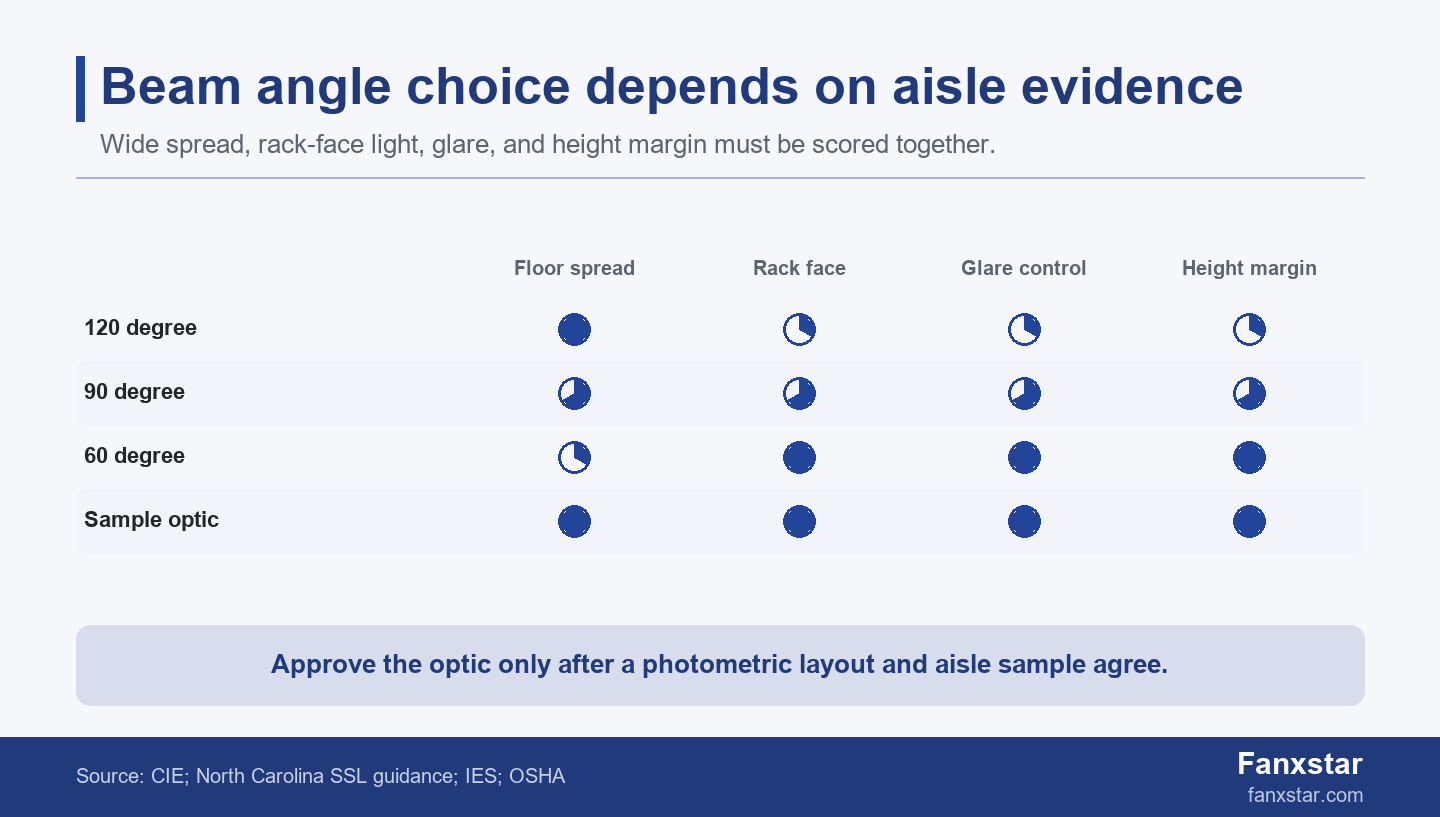
For Fanxstar projects, beam angle should be selected after the buyer names the aisle geometry, fixture height, rack height, target task, traffic route, and required evidence. The same product family may need 120 degree, 90 degree, 60 degree, or asymmetric optics in different zones.
Key Takeaways
- Beam angle is measured from light distribution, so it does not by itself guarantee uniform aisle visibility.
- 120 degree beams often help open areas or low ceilings, while 60 or 90 degree beams can perform better in taller rack aisles.
- The right aisle optic must prove vertical rack-face visibility, not only horizontal floor lux.
- The safest approval path is photometric layout first, sample aisle second, and production release only after the optic and mounting direction are locked.
Why 120 degree beam angle can disappoint in aisles
Wide beam spread can miss the task plane
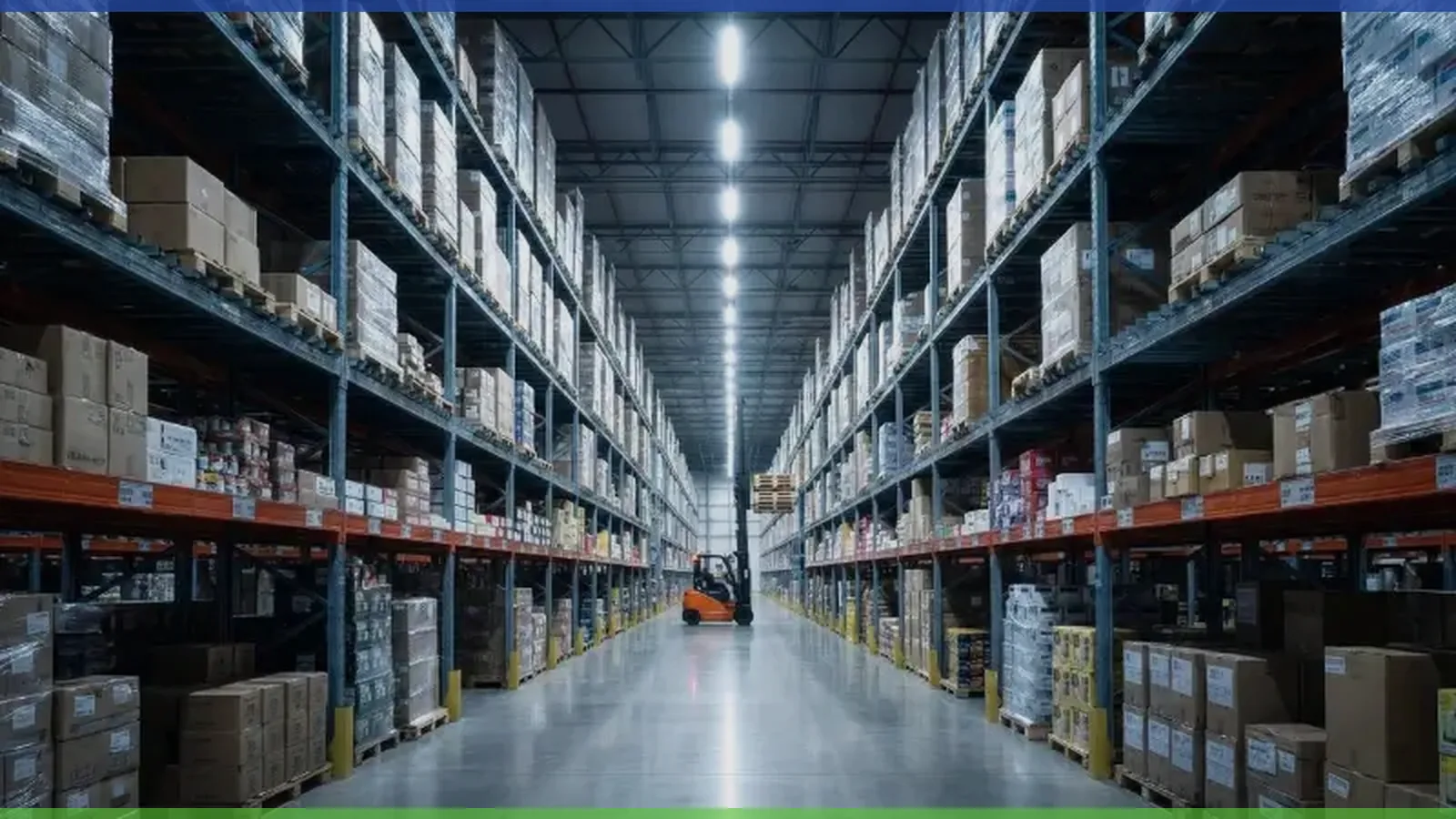
A 120 degree beam spreads light broadly. That can be useful in open areas, backrooms, low ceilings, retail support zones, and general circulation. In a tall warehouse aisle, however, broad spread may send too much light to the top of racks, fixture-adjacent ceiling areas, or the opposite side of the aisle before enough useful light reaches vertical labels and pallet faces. The result can be a floor that looks acceptable while the rack face still feels dark.
The common mistake is measuring only horizontal illuminance on the floor. Many aisle tasks are vertical: reading labels, seeing pallet edges, checking carton codes, and spotting obstructions near rack uprights. If the design ignores those vertical tasks, the lighting can pass a simple average lux target and still feel like a cave to forklift drivers and pickers.
According to IES RP-7-21, industrial lighting should be treated as a facility task and safety problem, not just a fixture purchase. According to OSHA powered industrial truck rules, auxiliary directional lighting is required on trucks when general lighting is below 2 lumens per square foot. These references do not set a universal aisle optic, but they reinforce that route visibility and vehicle work are practical safety concerns.
| Beam choice | Typical strength | Typical weakness | Best evidence to request |
|---|---|---|---|
| 120 degree | Broad floor spread in open or low-height zones. | Can waste light on rack tops or create glare in tall aisles. | Photometric layout showing uniformity and glare at the real height. |
| 90 degree | Balanced spread for many medium aisles. | May still miss rack-face visibility at tall mounting heights. | Aisle layout with vertical task plane and rack-label check. |
| 60 degree | Stronger reach for taller aisles and tighter control. | Can create dark edges if spacing or height is wrong. | Sample view from forklift path plus spacing and glare review. |
| Asymmetric or aisle optic | Can send light toward rack faces instead of general floor. | Requires better product file and layout discipline. | IES or photometric file, mounting orientation, and sample aisle approval. |
The decision rule is simple: if the aisle has tall racks, do not approve a 120 degree beam because it looks bright on a spec sheet. Ask for a layout that shows vertical visibility at the task plane. If the supplier cannot show where the light goes, the beam angle label has not earned the order.
A 60 or 90 degree beam still needs spacing discipline
Narrower beams can help when the fixture is mounted high or the aisle is narrow. A 60 degree or 90 degree distribution may place more useful light down the aisle and onto rack faces. But narrow does not mean safe by default. If fixtures are spaced too far apart, the design can create bright pools under fixtures and dark gaps between them. If the beam is too sharp, drivers can see glare as they approach the luminaire line.
According to CIE TN 010:2019, directional source measurement needs a defined optical axis and beam angle method. That matters because a catalog angle does not tell the whole shape of the distribution. Two fixtures can both be listed as 90 degree while one has a smooth batwing pattern and another has a high center intensity with weaker edges.
The buyer should therefore ask for the IES or photometric file, mounting height assumption, spacing plan, and aisle orientation. For long linear fixtures, orientation matters. A product installed along the aisle can behave differently from one installed across the aisle. A product with a symmetric diffuser can behave differently from one with a corridor optic or rack-facing lens.
The trade-off is reach versus tolerance. A narrow beam may reach the rack face better, but it gives less forgiveness when installation height, fixture spacing, or mounting orientation changes. A wider beam may be easier to install, but it can waste light and increase glare. The best project uses the narrowest distribution that meets uniformity and glare requirements without creating dark edges.
How to choose between 120, 90, and 60 degree optics
Start with aisle geometry before product preference
A buyer can make the optic decision faster by collecting 6 dimensions first: mounting height, aisle width, rack height, fixture spacing, work plane, and viewer path. Add surface reflectance if the warehouse has dark racks, dark floor, or wrapped pallets. Without those numbers, suppliers are guessing. With those numbers, a photometric layout can show whether 120, 90, 60, or an asymmetric optic is a credible starting point.
| Field check | Why it matters | Pass signal |
|---|---|---|
| Floor route visibility | Operators need a readable travel path. | No dark bands along the aisle center and turning area. |
| Rack-face visibility | Labels and pallet edges are often vertical tasks. | Labels are readable at normal picking or driving distance. |
| Glare from approach angle | Narrow beams can be uncomfortable when viewed along the aisle. | The fixture does not distract drivers or staff at eye level. |
| Spacing margin | A good optic can fail when spacing exceeds the useful envelope. | Layout remains uniform at the planned mounting height. |
| Maintenance state | Dirt, aging, and dimming change the result. | Design includes cleaning, lumen maintenance, and control setting assumptions. |
According to FEMP commercial and industrial LED luminaire purchasing guidance, LED luminaires should be evaluated as procurement assets. For aisle lighting, that means optical evidence, controls behavior, maintenance assumptions, and installation risk belong in the buying file. A fixture with the lowest wattage is not the best fixture if it leaves rack faces unreadable.
A useful illustrative rule is to separate open-area optics from aisle optics. If the task is broad floor coverage at low or medium height, a wider distribution may be efficient. If the task is tall-rack visibility, a controlled distribution is usually safer. If the aisle is mixed, the buyer may need 90 degree optics in medium areas and 60 degree or asymmetric optics in taller zones.
The approval should not be based on a single screenshot. Ask for the fixture type, lumen package, beam distribution, mounting height, spacing, maintenance factor, and calculation grid. Then ask for a sample or mockup in the hardest aisle. The hardest aisle is usually the one with the tallest racks, darkest surfaces, narrowest width, or most driver complaints.
Use controls without hiding optical weakness
Sensors and dimming can save energy in aisles, but they cannot fix a bad beam pattern. A dimmed fixture with the wrong optic can become a safety or productivity problem when traffic returns. Controls should be tuned after the optic is correct, not used to compensate for uneven distribution. The design should state what light level or output state is used for occupied, unoccupied, stocking, cleaning, and emergency modes if applicable.
GSA LED and controls guidance connects LED choices with controls and life-cycle value. In aisle lighting, the control question is not only whether the fixture can dim. It is whether dimming keeps enough visibility for the route, whether sensors see around racks, and whether commissioning locks the correct occupied output. A good optic with poor controls can still disappoint.
For smart warehouses, sensor zoning can be aisle-by-aisle, block-by-block, or traffic-route based. Each approach changes how quickly lights return to full output and how much peripheral visibility remains. If the warehouse has forklifts, conveyors, or automated storage systems, the control zones should be reviewed with operations before release.
The practical workflow is optic first, layout second, controls third, sample fourth. Reversing the sequence creates a common failure: the buyer approves a connected lighting system that looks advanced but still places light in the wrong plane.
Fanxstar RFQ checklist for aisle beam angle projects
Ask for an optic recommendation tied to a sample condition
Fanxstar buyers can start with linear LED lighting products, warehouse and logistics LED lighting guidance, smart warehouse lighting applications, and LED lighting controls for industrial facilities. The useful RFQ is not only a request for 60 degree or 120 degree fixtures. It is a request for an optic recommendation based on the real aisle.
Send mounting height, aisle width, rack height, target task, voltage, control plan, certification market, and photos of the aisle. If the project uses existing fixture locations, include spacing and mounting direction. If the buyer wants to compare 120 degree, 90 degree, and 60 degree versions, ask for the same lumen package and the same layout assumptions so the comparison is fair.
For ODM projects, add the change-control question: does changing the diffuser, lens, LED board, driver current, or housing length change the photometric file? If yes, the buyer should request a new file before production approval. Beam angle can change when the optical stack changes, even if the product family name remains the same.
According to International Trade Administration documentation guidance, import and shipment files should stay consistent. For aisle lighting, that discipline means the product label, packing list, model code, optic code, and photometric file should all describe the same fixture. A shipment that replaces a 60 degree optic with a wide diffuser can change the project result even if wattage and length stay the same.
Release the order only when the production optic is locked
The final pre-production approval should show 4 matched items: sample fixture, optic or diffuser code, photometric file, and production label. If any item changes after sample approval, the buyer should ask whether layout evidence remains valid. This is especially important for private-label or project-specific fixtures where a supplier may use an equivalent lens to recover lead time.
A practical sample gate includes 3 views: looking down the aisle, looking at the rack face, and looking toward the luminaire from driver height. The sample should also be checked at the intended dimming state, not only at full output. If the controls plan uses occupancy dimming, the team should check how quickly full output returns and whether adjacent aisles remain readable.
The strongest answer to 120 versus 60 or 90 degree is not a universal winner. It is a documented optic choice for a named aisle condition. That answer is more persuasive to search users and more useful to buyers because it moves the question from catalog preference to project evidence.
FAQ
Is 120 degree beam angle best for warehouse aisles?
A 120 degree beam can work in open or lower-height areas, but it is not automatically best for aisles with tall racks or narrow routes. Tall racks often need controlled distribution to improve vertical rack-face visibility. Buyers should compare the optic with a photometric layout and, when possible, a sample in the hardest aisle.
When should buyers use 60 degree aisle lighting?
A 60 degree optic is often considered when fixtures are mounted high, aisles are narrow, or rack-face visibility needs stronger control than a wide distribution can provide. It still requires spacing discipline because a narrow beam can create dark bands if fixtures are too far apart, mounted incorrectly, or aimed poorly.
Is 90 degree beam angle a good compromise?
A 90 degree beam can be a good compromise for medium-height aisles, but it should not be chosen only because it sounds balanced. The buyer should check floor uniformity, vertical visibility, glare, mounting height, fixture spacing, and the actual rack surface color before release.
What evidence should an aisle lighting supplier provide?
A supplier should provide photometric files, mounting height assumptions, aisle layout, optic code, lumen package, spacing plan, control state, sample photos, and a production label match. If the diffuser, lens, driver current, or mounting direction changes after sample approval, request updated evidence before production.