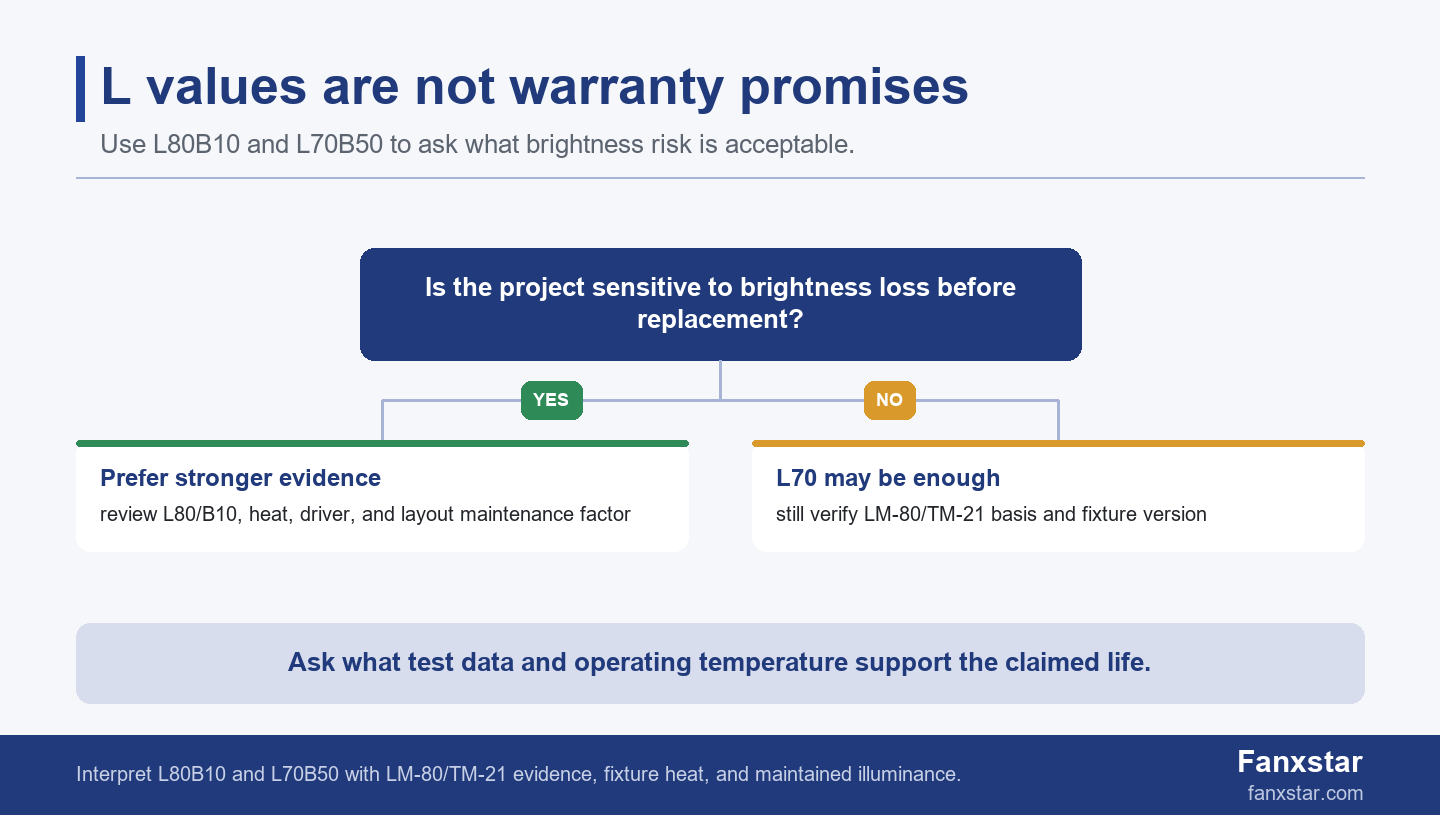
L80B10 and L70B50 do not mean the LED fixture is guaranteed to work perfectly until that hour. They describe lumen maintenance: how much light remains, and what portion of a population is expected to fall below that threshold. Buyers should connect the value to LM-80/TM-21 evidence, fixture temperature, driver reliability, optics, controls, and maintained illuminance.
According to the DOE-hosted LM-80 and TM-21 technical PDF, TM-21 specifies how to extrapolate LM-80 lumen maintenance data beyond the LM-80 test time. According to DOE LED basics, LED performance should be understood through LED technology and system behavior. The buyer conclusion is that L80B10 and L70B50 are evidence questions, not marketing words.
Key Takeaways
- L80 means the LED source or product is projected to retain 80 percent of initial light output at the stated time; L70 means 70 percent.
- B10 means a smaller share of the population is expected to fall below the L value than B50, so it is a stricter consistency signal.
- LM-80 tests LED packages, arrays, or modules; TM-21 projects lumen maintenance from that data, but fixture heat and driver life still matter.
- Fanxstar buyers should request lumen-maintenance evidence for the exact fixture version, especially for warehouses, tunnels, cold rooms, data centers, and emergency routes.
What L80B10 and L70B50 mean in plain English
The L value is the brightness threshold
The L value states the remaining light output threshold. L80 means 80 percent of initial output remains at the claimed time. L70 means 70 percent remains. The higher threshold is stricter because the fixture is allowed to lose less light before reaching the rated point. A project that needs stable visibility may care about L80. A lower-risk storage area may accept L70 if the lighting design has margin.
According to DLC product requirements, LED products are evaluated through defined technical requirements. That matters because an L value should not float alone in a brochure. It should connect to a product category, test data, temperature, drive current, and fixture version.
Use a simple scenario. A fixture delivering 10,000 lumens at installation would be at 8,000 lumens at L80 and 7,000 lumens at L70. If a warehouse aisle was designed with little maintained-light margin, the difference between 8,000 and 7,000 lumens can decide whether shelf labels remain comfortable to read after several years.
The B value is the population risk signal
The B value is often misunderstood. B10 does not mean the product has 10 percent brightness left. It means a specified share of the population is expected to fall below the L threshold by the stated time. B10 is more conservative than B50 because fewer units are expected to fall below the threshold. L80B10 is therefore a stronger brightness-consistency claim than L70B50 if all other evidence is equal.
A buyer should ask what population, test method, temperature, and projection support the B value. If the supplier cannot explain whether the claim is based on LM-80/TM-21 data, actual luminaire testing, or a loose family estimate, the value should not drive a production order. The decision rule is to treat L and B values as questions to verify, not labels to admire.
| Term | Plain meaning | Buyer decision |
|---|---|---|
| L80 | light output has fallen to 80 percent of initial output | use when maintained brightness is important |
| L70 | light output has fallen to 70 percent of initial output | often acceptable for less brightness-sensitive areas |
| B10 | 10 percent of the population is expected to be below that L value | stronger consistency expectation |
| B50 | 50 percent of the population is expected to be below that L value | average-style expectation, not a low-risk promise |
LM-80, TM-21, and why the fixture still matters
LM-80 and TM-21 do not prove the whole luminaire forever
According to the DOE-hosted LM-80 and TM-21 presentation, TM-21 extrapolates LM-80 lumen maintenance data beyond the test time. The same DOE-hosted material also warns that lumen maintenance is not the whole story. Buyers should pay attention to that boundary because a complete luminaire includes driver, optics, thermal path, housing, gasket, and installation environment.
According to DOE solid-state lighting resources, LED technology belongs in a broader system. In practice, an LED package may maintain light well while a driver fails, a diffuser yellows, a gasket leaks, or a control setting changes. Lumen maintenance is important, but it is only one part of useful fixture life.
Temperature and drive current can change the outcome
Lumen depreciation depends heavily on heat and electrical stress. A value tested at one temperature may not describe a fixture installed near a hot ceiling, inside a sealed vapor tight body, above a data hall aisle, in a tunnel, or in a cold room with repeated thermal cycling. The buyer should ask which case temperature, drive current, and product version support the claim.
According to FEMP LED luminaire purchasing guidance, buyers should evaluate complete commercial and industrial LED luminaires. That is the right frame for L80B10 and L70B50. The finished fixture must be evaluated in the environment, not only the LED package in a lab.
A practical 50,000-hour claim should be translated into operating years. At 4,000 hours per year, 50,000 hours is 12.5 years. At 8,000 hours per year, it is 6.25 years. A buyer running 24-hour operations should not read the same hour value the same way as a buyer running one shift.
How lumen maintenance affects lighting design
Maintained illuminance is the real buyer outcome
The site does not experience L80 or L70 directly. It experiences maintained illuminance on the task plane after years of dust, aging, controls behavior, and fixture replacement. A lighting design may include a maintenance factor to make sure the installed system still meets the target later. If the design starts too close to the minimum, lumen depreciation can become a visibility problem before the fixture is physically dead.
According to GSA LED and controls guidance, lighting choices should consider life-cycle cost and controls behavior. For lumen maintenance, life-cycle thinking means asking whether the project needs more initial light, a stricter L value, better thermal design, or scheduled cleaning and measurement.
Use a scenario estimate. A tunnel route, emergency corridor, data hall, or warehouse pick aisle may need 80 percent maintained output to avoid early discomfort or safety complaints. A general storage room may tolerate 70 percent if the original design has margin. The stronger value costs more only if it changes the fixture; the weak value can cost more if it forces early replacement.
Controls can hide or reveal lumen depreciation
Dimming and controls can complicate the interpretation. A fixture that normally runs at 70 percent output may have thermal benefits, but the site may also depend on control settings to maintain light levels. If occupants override controls, if sensors dim too aggressively, or if emergency routes need fixed output, lumen-maintenance planning should reflect the real operating scene.
According to ENERGY STAR commercial lighting guidance, LED upgrades can reduce electricity use in commercial buildings. The buyer should not chase energy reduction so hard that maintained visibility is lost. Lumen maintenance and controls should be planned together.
A 30-60-90 day commissioning review can help. Measure representative points after installation, confirm control scenes, then set a future measurement schedule. If the site begins with 20 percent margin and the fixture claim is L80B10 at the relevant operating condition, the maintenance plan is more defensible than a generic 50,000-hour label.
How to turn L values into a replacement and design policy
Translate hours into site years and inspection dates
A lumen-maintenance claim should be translated into the buyer’s operating calendar. A fixture used 12 hours per day runs about 4,380 hours per year. A fixture used 24 hours per day runs about 8,760 hours per year. A 50,000-hour claim therefore means about 11.4 years in the first case and about 5.7 years in the second. The same datasheet can lead to different maintenance expectations.
This translation helps procurement, facilities, and finance discuss the same risk. If a data hall, tunnel, or warehouse runs long hours, the buyer may need stronger thermal evidence, a stricter L80 threshold, or a planned measurement date before the product reaches the projected maintenance point. If a backroom runs short hours, L70 evidence may be enough if the design has margin.
According to FEMP LED luminaire purchasing guidance, buyers should evaluate complete commercial and industrial LED luminaires. The policy should therefore include the complete fixture, not only LED package data. Driver replacement, lens condition, dirt depreciation, and controls behavior should sit beside L80 or L70 in the maintenance plan.
Connect lumen maintenance to warranty language
Warranty language and lumen-maintenance language are often confused. A 5-year warranty does not automatically mean the fixture will remain above L80 for 5 years, and an L70 projection does not automatically mean every driver, sensor, gasket, or connector is covered until that hour. The buyer should ask what the warranty covers and what the lumen-maintenance claim describes.
A better purchase file separates 4 ideas: expected lumen maintenance, driver warranty, fixture workmanship warranty, and replacement remedy. If the supplier says L80B10 at 50,000 hours, ask whether that claim is tied to the final fixture version and whether the warranty provides any remedy for early lumen loss. If the answer is vague, the value may still be useful for design but weak for commercial risk control.
The final policy should state the accepted L value, B value, operating-hour assumption, inspection method, and warranty boundary. That is the point where a technical abbreviation becomes useful for a B2B buyer.
What evidence Fanxstar buyers should request
Ask for the exact version behind the claim
Fanxstar buyers should connect lumen maintenance to the real product platform: weatherproof LED lighting, LED linear lighting, AI data center LED lighting solutions, tunnel LED lighting solutions, cold storage LED lighting solutions, and custom LED lighting ODM service. The right evidence depends on the environment and fixture version.
A useful request includes LED package or board data, drive current, case temperature, thermal design, diffuser material, driver model, control mode, target ambient temperature, and whether the value applies to the complete luminaire or only to the LED source. If the supplier changes LED board, driver, lens, or housing, the buyer should ask whether the lumen-maintenance claim still applies.
For custom ODM work, the buyer should ask for a change rule. If CCT, CRI, driver, diffuser, sensor, emergency pack, or housing changes, what evidence must be refreshed? This prevents a sample from carrying one L80B10 story while production ships a different thermal and optical system.
Use lumen-maintenance language in the purchase file
According to International Trade Administration import documentation guidance, shipment documentation can include invoices, packing lists, bills of lading, and certificates. Lighting buyers should align the technical file the same way: model, label, photometric file, lumen-maintenance claim, driver, LED board, and packing list should describe the same fixture.
According to International Trade Administration special documents guidance, some products may require special documents related to standards or safety. When a project depends on maintained brightness, the buyer should include lumen-maintenance evidence in the same approval packet as certifications, IP evidence, and warranty boundaries.
The purchase file should state whether the buyer accepts L70B50, requires L80B10, or needs another threshold. It should also state the operating hours assumption. A 50,000-hour claim has different commercial meaning at 2,000, 4,000, or 8,000 hours per year.
FAQ
What does L80B10 mean in LED lighting?
L80B10 means the product is projected to retain 80 percent of initial light output at the stated time, with 10 percent of the population expected to fall below that threshold. Buyers should verify the LM-80/TM-21 basis and fixture conditions behind the claim.
Is L80B10 better than L70B50?
L80B10 is usually a stricter lumen-maintenance signal because it uses a higher light-output threshold and a lower population-failure share. It is not automatically better for every project because the right choice depends on task sensitivity, design margin, cost, heat, and replacement plan.
Does lumen maintenance mean the driver will last that long?
No. Lumen maintenance describes light output depreciation, not full luminaire reliability. A driver, sensor, gasket, lens, or connector can fail before the LED reaches its L value. Buyers should request driver and fixture reliability evidence separately.
What evidence should buyers request for L70 or L80 claims?
Request the LM-80 data basis, TM-21 projection basis, operating temperature, drive current, fixture version, driver model, optics, maintenance factor, and whether the claim applies to the LED package, module, or complete luminaire. Any production change should trigger review.