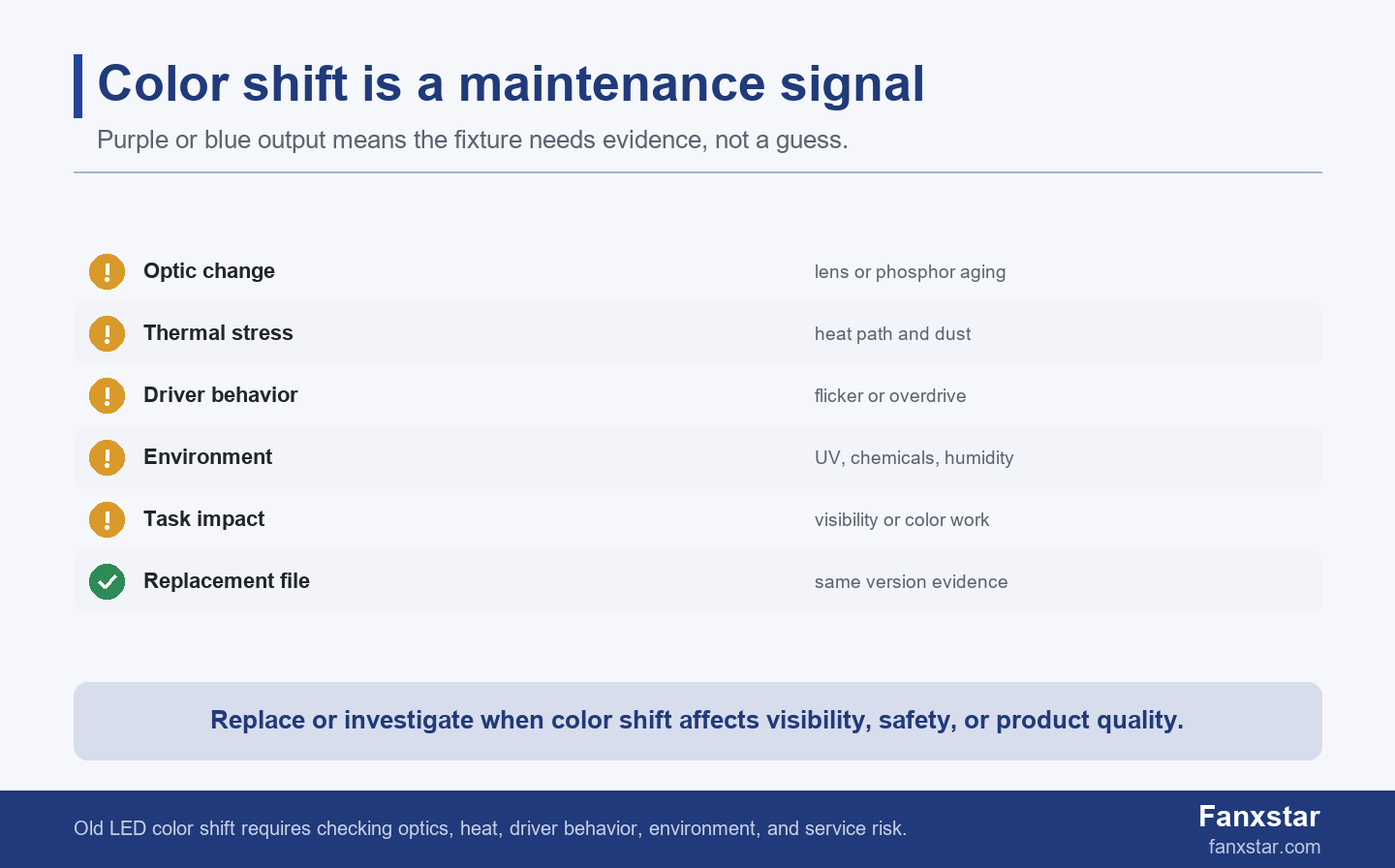
Old LEDs that turn purple or blue should be treated as a maintenance and evidence signal, not as a harmless cosmetic quirk. The visible color shift can come from phosphor or optical material aging, heat stress, driver behavior, environmental exposure, or a product version that no longer matches the original performance file. The buyer’s first job is to decide whether the shift affects visibility, safety, inspection quality, or brand-critical appearance.
According to FEMP commercial and industrial LED luminaire purchasing guidance, LED luminaire purchasing should focus on finished-product performance, not isolated parts. According to DLC solid-state lighting technical requirements, qualified LED products rely on defined technical evidence. The practical insight is that color shift should be investigated at fixture level: LED package, phosphor, lens, driver, thermal path, environment, and installed age all matter.
Key Takeaways
- Purple or blue LED color shift usually means the fixture is no longer delivering the intended white light, so it deserves inspection.
- Common investigation paths include phosphor or lens aging, heat, driver stress, chemical exposure, UV, moisture, and production version changes.
- Color shift is more urgent in aisles, safety routes, food display, inspection, parking, and machine-task areas than in low-risk storage zones.
- Fanxstar buyers should use color shift as a replacement planning signal and request fixture-level evidence before approving a new batch.
Why LEDs Can Turn Purple or Blue Over Time
Color shift is usually a system symptom
White LED light is produced by a system, not by the chip name alone. A blue LED source, phosphor conversion, lens or diffuser material, driver current, heat path, and fixture enclosure all influence the final visible color. When that system changes with age, the output can move away from the original CCT and appear cooler, blue, violet, greenish, or uneven. Phosphor degradation is one possible cause, but it should be verified against heat, optics, driver, and environmental evidence. A purple or blue cast is especially noticeable because it changes how people read the space.
According to ENERGY STAR lighting upgrade guidance, commercial LED upgrades can reduce electricity use, but product quality still depends on the installed product and application. That matters because a fixture that saves energy on day 1 may still become a maintenance problem if heat, optics, or driver selection make the color unstable over time.
The buyer should avoid a single-cause explanation unless the supplier can prove it. Sometimes the LED package is still working but the lens has yellowed or shifted transmission. Sometimes the driver is stressing the LEDs. Sometimes the fixture was installed in a hot, dusty, humid, or chemical environment that the original quote did not consider. The visible color is the symptom; the root cause needs a structured inspection.
One failed fixture and a whole row mean different things
If one fixture in a row turns blue or purple, the problem may be fixture-specific: failed optical material, damaged LED board, water ingress, driver behavior, or a sample from a different production lot. If a whole row shifts together, the buyer should check shared conditions: high ambient temperature, poor ventilation, chemical cleaning, constant high-output operation, or the same product batch aging at the same rate.
According to GSA LED lighting and controls guidance, LED and controls decisions should be evaluated by life-cycle cost and energy efficiency. Color shift belongs in that life-cycle view because it affects the useful life of the installed lighting. A fixture can still turn on but fail the buyer’s task if color quality, visibility, or user confidence is gone.
| Observed symptom | Likely investigation path | Buyer decision |
|---|---|---|
| One fixture turns blue or purple | fixture-specific optic, phosphor, heat, or driver issue | replace sample and inspect batch records |
| Whole row changes color | shared environment, heat, cleaning, or same production lot | review site exposure and production version |
| Color shift with flicker | driver or electrical stress may be involved | remove from critical task area and test |
| Color shift in food or inspection zone | task quality and safety are affected | prioritize replacement and evidence review |
When Color Shift Becomes a Safety or Quality Issue
The same color shift has different risk by zone
A purple cast in a low-traffic storage corner may be mostly a maintenance planning issue. The same shift in a forklift aisle, stair route, parking garage, food display, inspection bench, cleanroom support space, or machine area can be more serious. The question is not whether the LED still emits light. The question is whether the installed lighting still supports the task it was purchased to support.
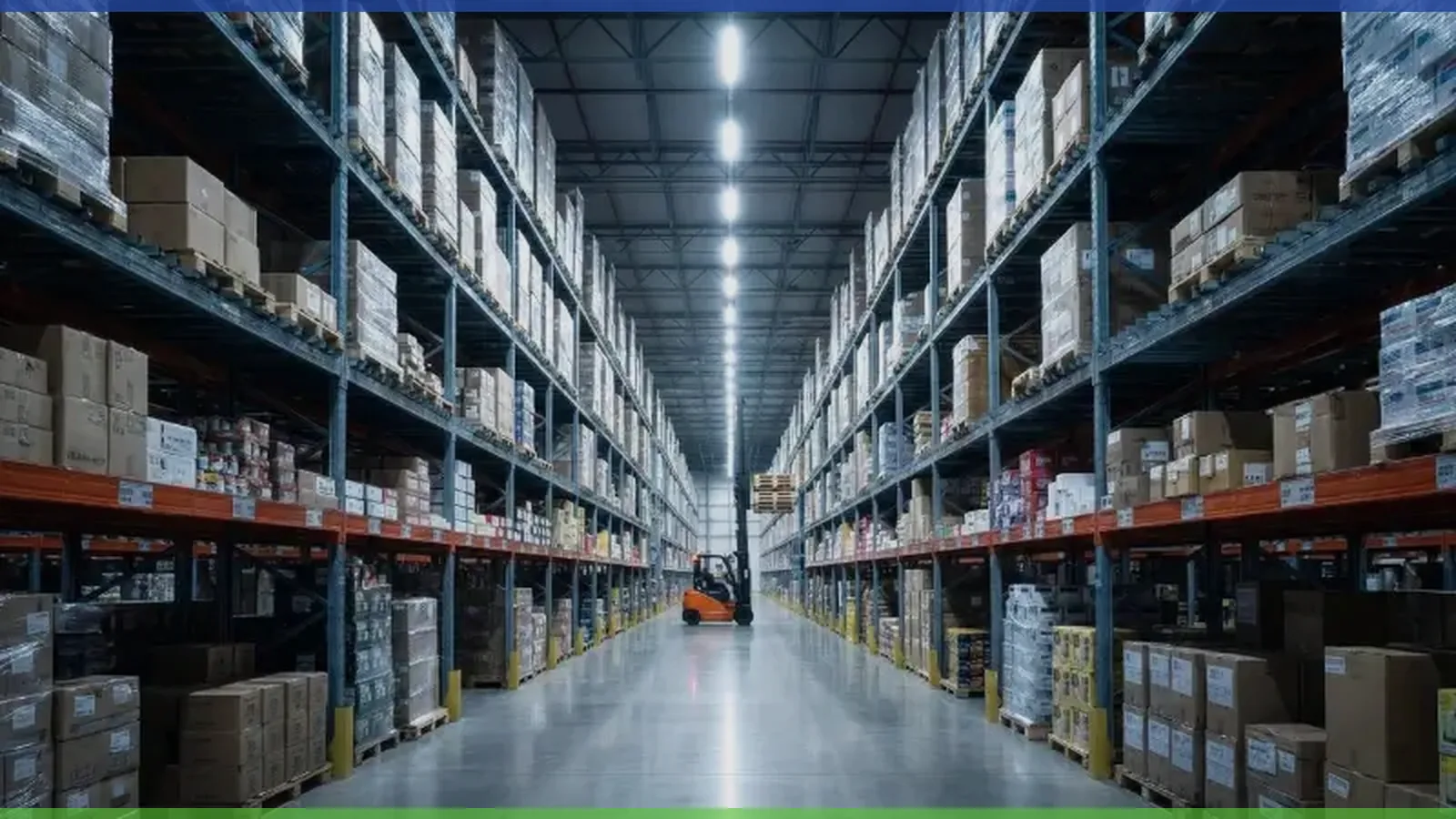
According to FEMP purchasing guidance for commercial and industrial LED luminaires, commercial and industrial LED categories include high-bay, low-bay, and linear applications. That range shows why context matters. In a warehouse high bay, color shift can reduce perceived clarity. In fresh retail, it can change product appearance. In inspection work, it can interfere with color judgments.
Buyers should create a simple triage rule. Replace immediately if the color shift affects safety routes, inspection quality, camera visibility, food display, or customer-facing areas. Schedule replacement if the shift is isolated and low risk. Investigate the full batch if several fixtures from the same order shift together. Keep photographs and installation dates because those records help suppliers diagnose whether the issue is product, environment, or operation.
Flicker, heat marks, or moisture make the issue more urgent
Color shift paired with flicker, dark segments, burnt smell, lens cracks, condensation, or visible heat marks should be escalated faster. These signs suggest the fixture may have electrical, thermal, or enclosure problems, not only cosmetic aging. The buyer should remove suspect products from critical zones and ask the supplier to inspect the driver, LED board, lens, seal, and installation condition.
According to International Trade Administration special document guidance, some products may require certificates or documents related to standards and safety. For LED replacement projects, that means the buyer should keep the evidence file aligned with the actual replacement product. If a supplier changes LED board, driver, lens, or housing to fix color shift, the updated version should have its own evidence boundary.
How to Investigate Old LEDs Before Reordering
Collect the right field evidence
Start with a simple field file: fixture model, order date, installation date, operating hours if known, zone type, ambient temperature, cleaning method, photographs under the same camera settings, and whether the shift appears in one fixture, one row, or one batch. If possible, compare the suspect fixture to an unused spare from the same order. This tells the supplier whether the issue is likely product age, site exposure, or batch variation.
According to International Trade Administration import documentation guidance, shipment records can include invoices, bills of lading, packing lists, insurance proof, and certificates of origin. Lighting buyers should attach the technical evidence in the same disciplined way: old order, model, driver, LED board, CCT, CRI, lens, batch, and replacement proposal should be traceable. Otherwise a replacement can repeat the same mistake under a new item number.
The inspection should also include the environment. Dust on the heat sink, blocked airflow, hot ceiling zones, washdown chemicals, UV exposure, high humidity, or voltage instability can all make color stability worse. A supplier cannot give a useful replacement recommendation if the buyer only sends a cropped photo of a blue-looking lens.
The best field evidence compares the shifted fixture with 2 references: an unaffected fixture from the same installation and, if available, an unused spare from the same purchase. If the spare still looks correct, the site condition and operating history become more important. If the spare also looks wrong or differs from the approved sample, the buyer should investigate production version, storage, or batch consistency before approving a reorder.
Ask for a replacement that solves the root cause
According to International Trade Administration import regulations guidance, import rules and documentation vary by country and product. In replacement lighting projects, the buyer should confirm whether the new product version still matches the target market and certification boundary. A color-shift fix that changes the driver, LED board, or lens can also change the evidence file.
According to the SBA import and export laws guidance, businesses should understand import and export rules before international sales. The practical procurement insight is that color-shift replacement should be treated as a controlled product update, not a casual relamp. The buyer should ask for the exact new CCT, CRI, driver, lens, thermal path, warranty boundary, and whether the supplier changed the product to prevent repeat failure.
A useful replacement approval packet includes a side-by-side sample, color appearance check, photometric or performance file if needed, driver model, LED board version, lens material, operating temperature assumptions, and installation notes. If the old fixture failed in heat, humidity, or chemical exposure, the replacement should be selected for that environment rather than for the original catalog description.
Where Fanxstar Fits Color-Shift Replacement
Use color shift to improve the next fixture
Fanxstar buyers can connect color-shift diagnosis to the LED linear lighting platform, weatherproof LED lighting product platform, vapor tight LED light fixtures, and custom LED lighting ODM service. A warehouse, canopy, parking, food, or industrial site may need a different replacement platform once the actual cause is understood.
If the old fixtures turned purple or blue in a hot warehouse aisle, the new product should be reviewed for thermal path, driver current, optics, and mounting height. If the color shift happened in a damp or washdown area, the replacement should also review sealing, cable entry, and lens material. If the issue affected display or inspection quality, the buyer should define CCT, CRI, and acceptable color consistency before sample approval.
Fanxstar can also tie the issue to LED lighting controls for industrial facilities when overuse or constant full-output operation is part of the story. Better control zoning does not fix a failed LED board, but it can reduce unnecessary operating stress when specified correctly.
Write the replacement RFQ around proof
A strong RFQ does not simply say old LEDs turned blue, please quote replacement. It states the zone, operating hours, old fixture type, visible symptoms, photographs, CCT and CRI requirement, environmental exposure, desired controls, and what evidence is required before sample approval. This allows Fanxstar or any supplier to recommend a controlled product version rather than guessing.
The safest decision is to replace suspect fixtures in critical zones, investigate the cause before buying a large batch, and preserve the technical record. If the old product failed because of heat, choose a replacement with better thermal headroom. If the problem was lens or phosphor degradation, check optical material and color stability evidence. If moisture or chemicals were involved, move to a more suitable weatherproof or vapor tight platform. That approach turns an unpleasant color-shift problem into a better next specification.
FAQ
Why do old LEDs turn purple or blue?
Old LEDs can turn purple or blue when the white-light system changes with age. Possible causes include phosphor or lens aging, heat stress, driver behavior, moisture, chemical exposure, UV, or a product version that no longer matches the original evidence.
Is purple LED color shift dangerous?
The color itself is not automatically dangerous, but it can signal fixture deterioration. It becomes urgent when the affected light is in a safety route, forklift aisle, inspection zone, food display, parking area, or any space where visibility and color judgment matter.
Can blue or purple LEDs be repaired?
Some fixture-level problems can be repaired if the driver, lens, LED board, or seal is replaceable, but many commercial buyers replace the fixture or affected batch. The right decision depends on cause, safety impact, warranty, labor cost, and product evidence.
What should buyers request before replacing color-shifted LEDs?
Request the old order record, replacement model, LED board and driver details, CCT and CRI, lens material, thermal assumptions, warranty boundary, and confirmation that the new product version is supported by the required evidence.