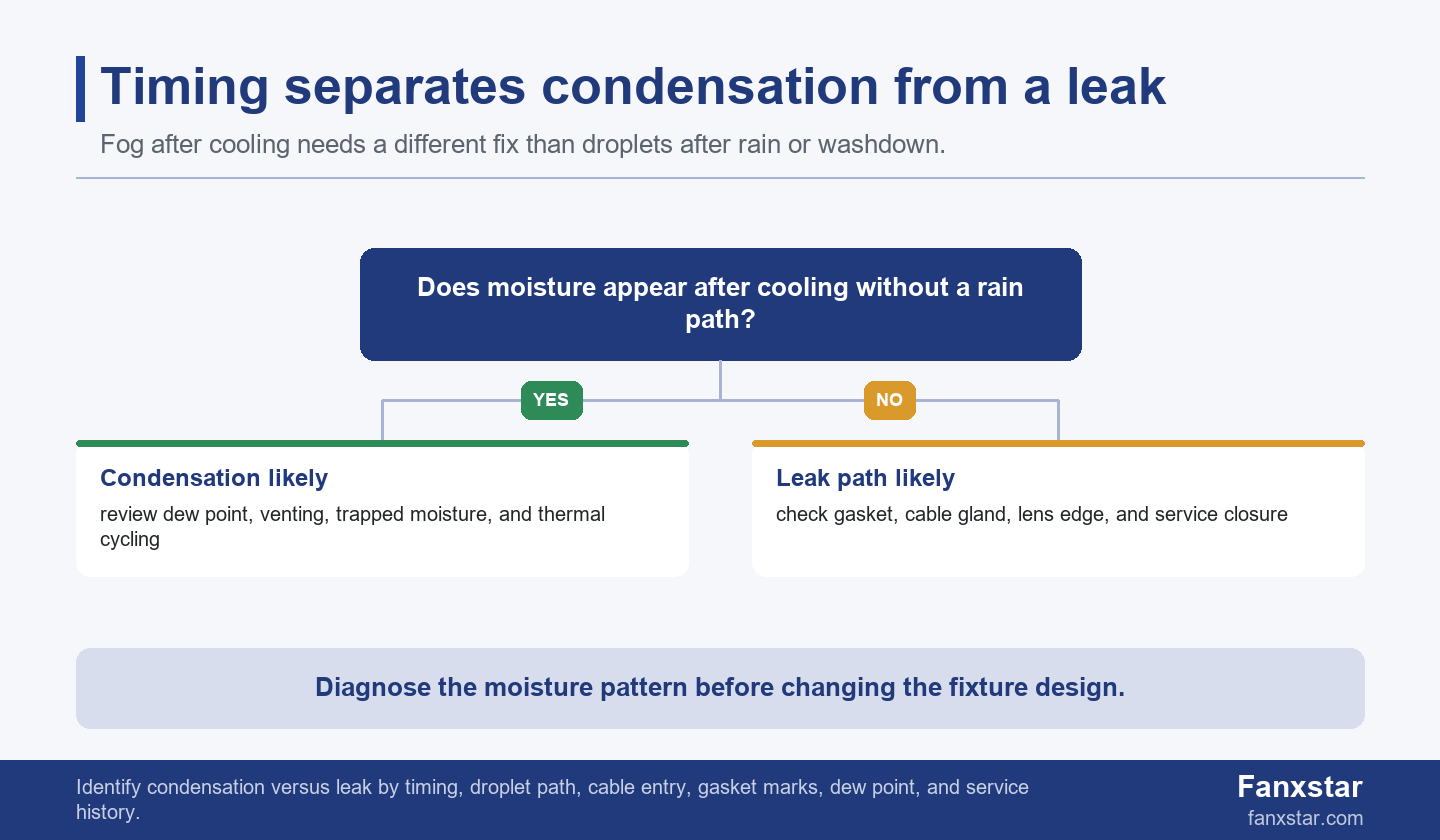
Condensation and leaks can look similar inside an LED light, but they are not the same failure mode. Condensation usually appears when moist air inside the enclosure reaches a cold surface. A leak usually follows a physical water path through a gasket, lens edge, cable gland, screw, crack, or service closure. The correct fix depends on diagnosing the pattern before changing the product.
According to the National Weather Service dew point explainer, dew point is a direct measure of moisture in the air. According to IEC ingress protection guidance, IP ratings describe protection against dust, water, and hazardous part access through defined enclosure tests. The practical insight is that a fogged LED lens does not automatically prove a failed IP rating, and a dry lens after one test does not prove the fixture is safe from field moisture.
Key Takeaways
- Condensation is usually linked to moist air, cooling, trapped assembly humidity, thermal cycling, or enclosure breathing.
- A leak is usually linked to a physical water path through gasket, lens, cable gland, screw, crack, or service closure.
- The buyer should record timing, droplet pattern, location, weather or washdown event, and service history before approving a fix.
- Fanxstar buyers should request IP, venting, gasket, cable-entry, and service evidence for the exact product version.
Diagnose Water Ingress by Timing and Pattern
Condensation often follows the temperature cycle
Condensation is most likely when the fixture warms during operation, then cools after shutoff, rain, night air, or a cold process environment. If the lens shows a fine fog across a broad area and clears when the fixture warms, the issue may be condensation. That does not mean it should be ignored, but it points the investigation toward trapped moisture, dew point, venting, assembly dryness, and thermal cycling.
According to the National Weather Service dew point explainer, dew point helps explain when moisture in air becomes liquid on a cooler surface. In lighting terms, the surface may be the lens, metal body, driver compartment, or screw boss. A buyer does not need a weather model, but the buyer should record whether fogging appears after cooling rather than immediately after rain or washdown.
A condensation diagnosis becomes stronger when there is no clear water trail, no stained entry point, no pooling near a cable gland, and no gasket damage. It becomes weaker when moisture appears right after a direct water event or collects around a specific joint. That is why photographs at different times are more useful than one close-up of a wet lens.
Leaks usually leave a path
A leak tends to leave directional evidence. Water appears near a gland, end cap, screw, lens edge, cracked housing, or service opening. Droplets may collect at the lowest point after rain or washdown. Stains may show where water carried dust or residue through the entry path. A repeated leak at the same location should be treated as a sealing, installation, or service issue until proven otherwise.
According to IEC IP ratings, the second IP digit addresses water protection, while the first digit addresses solid objects and dust. Buyers should therefore ask which water exposure is relevant: rain, spray, jet, temporary immersion, or washdown. A fixture can be suitable for one water condition and still fail in another if the cable entry, mounting angle, or service closure does not match the tested condition.
| Sign | Condensation clue | Leak clue |
|---|---|---|
| Timing | appears after cooling or night cycle | appears after rain, washdown, or service |
| Pattern | fine fog or small droplets across lens | trail, pool, stain, or entry-point droplets |
| Location | cold surface or broad lens area | gasket edge, cable gland, screw, or crack |
| Fix direction | venting, trapped moisture, thermal cycling | seal, gland, gasket, lens, or closure repair |
How to Inspect the Fixture Without Guessing
Start with a photo sequence
Take photographs before operation, during operation, after shutoff, after rain or cleaning, and after 24 hours if the fixture can be safely observed. Use the same angle and distance. Record whether fogging clears, whether droplets move, whether water returns at the same point, and whether the fixture was recently opened. A simple photo sequence can often separate broad condensation from a narrow leak path.
According to NEMA enclosure type guidance, enclosure type definitions have scope boundaries and should be checked rather than assumed. The same caution applies when a buyer compares NEMA type language, IP ratings, wet-location claims, and supplier photos. The installed product, cable entry, accessories, and orientation should match the evidence being used.
The inspection record should avoid vague labels such as waterproof failure or condensation problem until the pattern is clear. Use observable language instead: fog across the lens after night cooling, droplets below the cable gland after rain, water trail from the end cap, or moisture after the fixture was opened. That language helps the supplier diagnose the mechanism instead of defending a rating label.
Do not open the fixture unless it is safe and appropriate. Opening can release evidence, change the moisture pattern, or damage the gasket. If the fixture must be opened, document the gasket, cable gland, screw torque signs, lens edge, vent if present, and any water marks inside the housing. The service event should become part of the diagnostic record.
Look at cable entry and service history
Cable entry is one of the most common water paths because it combines a hole in the enclosure, cable movement, installation skill, and sometimes field changes. A gland can be too loose, too tight, wrong for the cable diameter, angled upward, or missing a drip loop. If water appears near the cable path, do not blame condensation until the gland and cable route have been checked.
According to GORE protective vent information, protective vents can support pressure equalization and enclosure protection. A vented design can help in some condensation cases, but it cannot fix a damaged gasket, wrong gland, cracked lens, or poor service closure. The buyer should not add a vent until the moisture pattern supports that decision.
What Evidence to Request From the Supplier
Ask for the exact tested version
A supplier should confirm the product version, IP rating, test scope, gasket design, cable entry, vent option if any, mounting orientation, and whether the tested sample included the same accessories that will ship. If the buyer changed cable length, connector, sensor, emergency pack, or mounting bracket, the original moisture evidence may not describe the final product.
According to DLC solid-state lighting technical requirements, LED products are evaluated through defined product requirements and reporting. Moisture diagnosis should borrow that discipline. The buyer needs evidence tied to the finished luminaire, not only a generic claim that the product family is waterproof.
A practical evidence request should include at least 6 attachments: the product drawing, IP or enclosure evidence, cable-entry detail, gasket or closure detail, installation orientation note, and photographs of the approved sample. If a vent is proposed, add the vent specification and location drawing. If the fixture is opened for service, add the service closure instruction because the second closing event can be where the moisture path begins.
The supplier should also explain what moisture behavior is acceptable during normal use. Some brief internal fogging may clear after warm-up, but persistent droplets, pooling water, corrosion, repeated lens staining, or driver failure are not normal. A clear boundary helps the buyer decide whether to monitor, repair, replace, or redesign the fixture.
Keep shipment and sample documents aligned
According to International Trade Administration import documentation guidance, import files can include invoices, bills of lading, packing lists, insurance proof, and certificates of origin. LED buyers should align the technical file in the same way: approved sample, BOM, cable gland, gasket, vent, test evidence, label, packing list, and invoice should describe the same fixture version.
According to International Trade Administration special document guidance, some products may need certificates tied to standards, safety, or other special conditions. If the project requires a particular wet-location, IP, or market evidence file, the buyer should request that before shipment. It is harder to solve a water-ingress dispute when the certificate, sample, and production unit do not match.
According to FEMP LED luminaire purchasing guidance, buyers should evaluate complete LED luminaires rather than isolated components. The moisture-control insight is the same: lens, gasket, gland, vent, driver cavity, housing, and service behavior must be reviewed as one system.
Where Fanxstar Fits Water-Ingress Diagnosis
Turn the symptom into an RFQ boundary
Fanxstar’s relevant platforms include IP65 and IP66 waterproof LED lights, vapor tight LED light fixtures, aluminum weatherproof LED luminaires, and custom LED lighting ODM service. The right starting point depends on whether the problem is condensation, direct leakage, chemical cleaning, service closure, or a mixed outdoor exposure.
A useful Fanxstar brief includes photographs, timing, weather or cleaning event, installation orientation, cable entry direction, operating cycle, ambient range, and whether the fixture was opened. If the buyer can identify whether moisture follows cooling or a water path, Fanxstar can recommend a more precise sample boundary: vented design, stronger gasket, different cable gland, alternate housing, or a different product platform.
The buyer should also mark the risk zone. Moisture inside a low-risk storage fixture may allow monitoring while the cause is investigated. Moisture in a food processing area, outdoor canopy, parking garage, emergency route, or electrical service corridor should be escalated faster because the consequence of failure is higher. The same physical symptom can require a different purchasing response depending on the application.
Buyers can also review the IP ratings chart and weatherproof LED lighting product platform before requesting a replacement. That helps prevent a common mistake: replacing a condensation issue with a higher IP label while leaving the real thermal or service issue unchanged.
Approve the fix after the cause is clear
If the evidence points to condensation, the fix may involve assembly dryness, venting, thermal design, installation orientation, or operational cycling. If the evidence points to a leak, the fix may involve gasket compression, gland selection, cable route, lens edge, housing crack, or service instructions. The buyer should not accept a single generic waterproof upgrade until the actual failure mode is known.
A higher IP rating can help when the water exposure is stronger than the old fixture was designed for, but it is not always the best fix. If the issue is trapped humidity or poor service closure, a higher label may leave the same behavior in place. The better question is which part of the moisture-control system failed and what evidence proves the new version is different.
The final approval packet should include the diagnosis, selected fixture, IP or enclosure evidence, cable entry detail, service instruction, optional vent detail, and sample photos. That file protects both buyer and supplier because the next order is based on a defined moisture-control problem rather than a vague complaint.
FAQ
How can I tell condensation from a leak in LED lights?
Check timing, pattern, and location. Condensation often appears as broad fog after cooling and may clear when the fixture warms. A leak usually appears after rain, washdown, or service and often leaves a trail near a gasket, cable gland, screw, crack, or lens edge.
Does condensation mean the IP rating failed?
Not always. Condensation can occur when moist air inside the enclosure reaches a cold surface, even without a direct water path. Persistent droplets, pooling water, corrosion, or repeated fogging still require investigation and may indicate a design or service problem.
Can a breather valve fix condensation?
A breather valve can help when pressure cycling and trapped moisture are the main causes. It cannot fix a damaged gasket, wrong cable gland, cracked lens, poor service closure, or direct washdown path. The vented version should match the final product evidence.
What evidence should buyers request for water ingress issues?
Request IP evidence, gasket and cable-entry details, vent option if any, mounting orientation, service history, sample photos, and confirmation that the tested fixture version matches the product being shipped or replaced.