Emergency battery chemistry is not a contest where Ni-Cd, Ni-MH, or LiFePO4 wins in every fixture. The right chemistry is the one whose battery pack, charger, emergency driver, LED load, temperature range, runtime test, maintenance routine, disposal plan, and approval file move together. A chemistry label without system evidence is a weak buying signal.
According to OSHA exit-route requirements, exit routes must be adequately lighted so an employee with normal vision can see along the route. According to Tridonic emergency lighting battery guidance, emergency lighting battery packs should be evaluated with protection and system behavior in mind. That means the buyer’s first question is not which battery is fashionable; it is which approved battery backup system still delivers emergency light when normal power fails.
Key Takeaways
- Ni-Cd remains relevant when an existing certified emergency product and charger are built around it, but disposal and maintenance burden must be managed.
- Ni-MH can fit some compact or transitional systems, but buyers should be careful with heat, charging method, and replacement continuity.
- LiFePO4 is attractive for new designs only when the pack, BMS, charger, emergency driver, test method, and certificate scope are approved together.
- Fanxstar buyers should brief emergency battery chemistry as part of the fixture platform, not as an accessory chosen after the housing is finished.
Why chemistry alone is the wrong buying question
Emergency lighting is judged at failure time
Normal lighting can be evaluated while the building is operating. Emergency lighting is judged when normal power fails, visibility is stressful, and exit routes must remain understandable. That is why battery chemistry should never be separated from runtime, recharge behavior, driver output, LED load, ambient temperature, and the test routine used by the facility.
According to EPA universal waste guidance, universal waste rules cover certain batteries and other common hazardous wastes. Disposal is not the only decision factor, but it is a real operating cost. Ni-Cd, Ni-MH, and lithium packs all need an end-of-life plan, and the buyer should not ignore replacement records when comparing chemistry.
A useful comparison starts with 5 questions: what runtime must the fixture prove, what charging system is approved, what temperature range will the pack see, what evidence supports the product label, and what replacement pack will be available in year 3 or year 5? If the supplier cannot answer those 5 questions, the chemistry comparison is premature.
Ni-Cd, Ni-MH, and LiFePO4 solve different problems
Ni-Cd is often associated with older emergency lighting platforms. Its strength is not that it is modern; its strength is that many legacy systems were designed, tested, and maintained around it. Ni-MH may appear in compact systems or transitional designs, but it still needs careful charge and temperature review. LiFePO4 can be strong for newer LED emergency fixtures, but only when the battery protection and emergency electronics are designed for it.
The decision rule is practical: keep chemistry that is already proven when the risk of reapproval is higher than the performance gain; switch chemistry when the supplier can prove the new pack, driver, charger, runtime, label, and maintenance rule as one system. This avoids both weak extremes: clinging to an old chemistry because it is familiar, or switching to lithium because it sounds better.
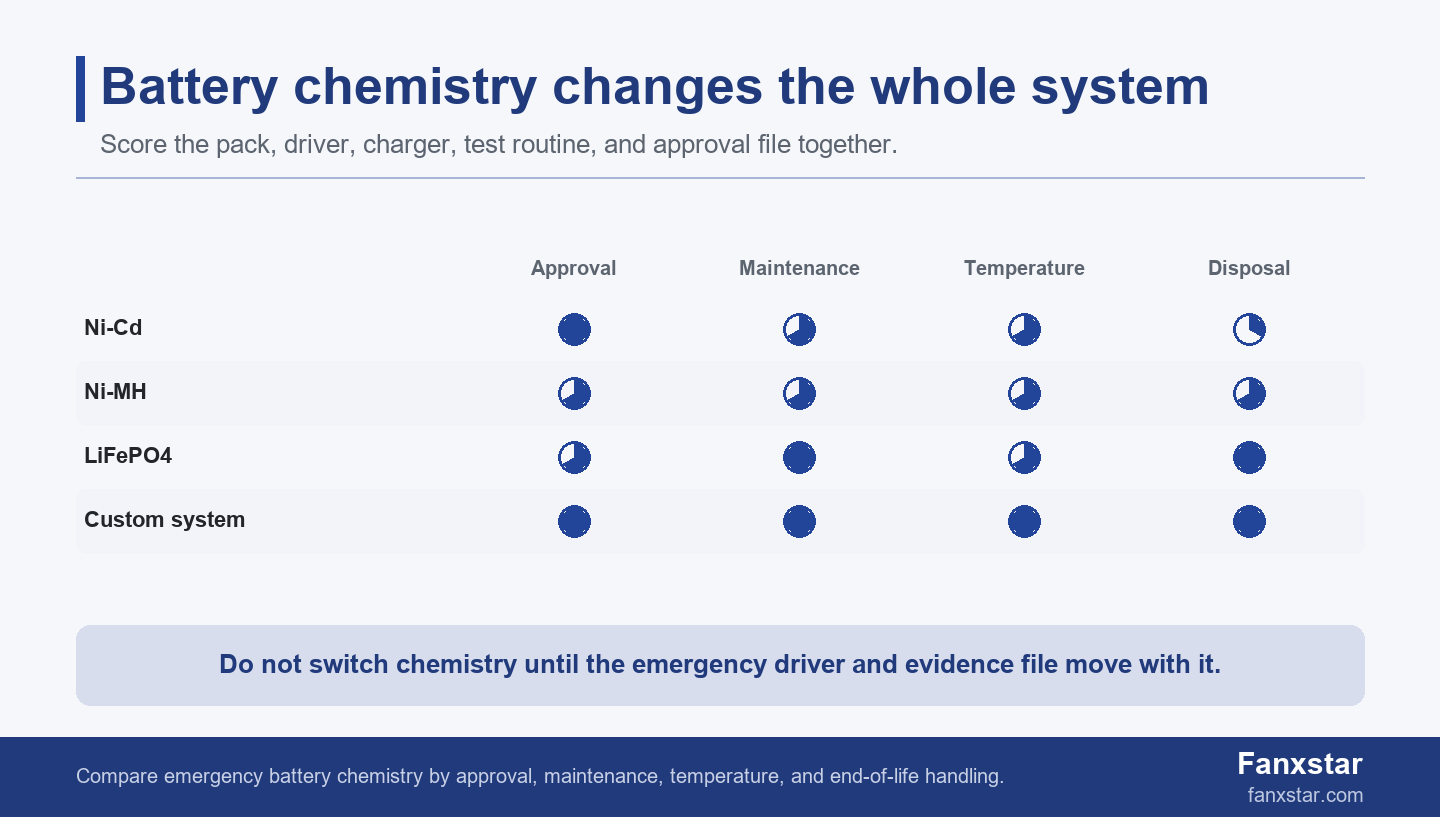
| Chemistry | Where it can fit | Main buyer risk | Evidence to request |
|---|---|---|---|
| Ni-Cd | legacy emergency fixtures and known charger systems | cadmium disposal burden and old platform lock-in | charger match, replacement pack code, disposal plan |
| Ni-MH | some compact packs where legacy lithium is not approved | heat sensitivity and unclear long-term replacement policy | temperature range, charge rule, test routine |
| LiFePO4 | new emergency LED designs with matched electronics | unsafe if treated as a drop-in chemistry swap | BMS, charger, driver, runtime test, approval file |
System evidence before approving an emergency battery pack
Runtime is a fixture-level result, not a pack label
Battery capacity is a starting input, not the emergency lighting result. Runtime depends on LED load, driver efficiency, emergency output setting, battery age, temperature, cut-off voltage, charge routine, and testing method. A pack with a larger printed capacity can still fail if the emergency driver cannot use the energy correctly or if the enclosure overheats the pack.
According to DLC solid-state lighting technical requirements, LED products are evaluated through defined technical requirements and product categories. Emergency battery selection should follow the same discipline: define the finished product, not only the component. A battery pack should be tied to the exact emergency luminaire, driver, and label version.
Use an illustrative 100-unit site scenario. If a buyer saves 4 dollars per pack but creates 2 extra failed annual tests, the saving disappears quickly in labor and retesting time. If a chemistry switch reduces replacement visits from every 3 years to every 6 years but requires a new certificate and new spare-pack inventory, the buyer should compare the 6-year maintenance plan, not only the unit price.
The charger and emergency driver decide whether the switch is real
Ni-Cd, Ni-MH, and LiFePO4 packs do not want the same charging behavior. A compatible charger or emergency driver must control charge current, voltage limits, protection behavior, recharge time, and test response. A chemistry switch without a matching driver can create poor runtime, early battery damage, nuisance failures, or an approval file that no longer describes the shipped product.
According to GSA LED and controls guidance, LED decisions should account for life-cycle cost and controls behavior. Emergency battery chemistry is similar: the product decision is not only the pack cost. It is the way the pack behaves over years of charging, testing, standby operation, and replacement.
How to compare maintenance, disposal, and replacement risk
Maintenance is usually the hidden cost
Emergency lighting maintenance includes function tests, duration tests, recordkeeping, failed-pack replacement, disposal, and sometimes access equipment. In a warehouse or public building, a 1-hour pack swap may become a 3-hour job once lift access, safety shutdown, and retest are included. The chemistry with a lower pack price can become more expensive if it fails more often or creates unclear replacement rules.
According to International Trade Administration import documentation guidance, shipment documentation can include invoices, bills of lading, packing lists, insurance proof, and certificates of origin. Emergency lighting needs a parallel technical file: battery pack code, emergency driver model, wiring diagram, test record, label, maintenance instruction, and replacement rule.
A practical 5-year comparison should include pack price, predicted replacement interval, annual test labor, failure response, disposal, spare inventory, and whether the certificate remains valid after a pack substitution. If a supplier gives only chemistry and capacity, the buyer should ask for the missing operating file before approving production.
Disposal and import files should be included before shipment
According to International Trade Administration special documents guidance, some products may need certificates tied to standards, safety, or other special conditions. Battery-backed emergency products often need more disciplined files than ordinary lighting because the battery, driver, label, and installation instructions are safety-relevant.
According to International Trade Administration import regulations guidance, imported products can face documentation, safety, quality, and conformity checks. The battery chemistry should therefore appear in the order record, not only in a message thread. The invoice, product label, battery pack, emergency driver, certificate, and maintenance file should describe the same version.
The buyer should also define replacement pack availability. A product that looks excellent at first shipment can become painful if the matching pack disappears in year 4. Ask whether the pack code is locked, whether equivalent packs need reapproval, and whether the supplier will provide a replacement rule for future service.
Battery chemistry approval matrix for procurement teams
Separate engineering approval from commercial approval
A buyer should not let one team approve emergency battery chemistry alone. Engineering approval asks whether the pack, driver, charger, LED load, housing temperature, and emergency output behave correctly. Commercial approval asks whether the pack can be sourced, replaced, shipped, documented, and serviced across the warranty period. Both approvals are needed before a chemistry change becomes real.
A useful matrix has 6 rows: electrical compatibility, thermal behavior, runtime evidence, certificate boundary, replacement availability, and disposal or transport handling. Each row should have an owner, an evidence file, and a pass or hold decision. This keeps the discussion concrete. Instead of arguing whether LiFePO4 is better than Ni-Cd in general, the team can see which evidence is missing for the specific luminaire.
According to DLC solid-state lighting technical requirements, lighting products are reviewed through defined technical requirements and categories. Emergency battery approval should borrow that discipline. The final answer should describe a specific product version, not a chemistry family. If the sample uses one pack, the certificate names another pack, and production later substitutes a third pack, the project has lost control.
Use failure scenarios to test the decision before ordering
The approval matrix should include realistic failure scenarios. What happens if the fixture sits in standby for months, then must operate for the rated emergency duration? What happens if ambient temperature is higher than expected? What happens if the pack reaches end of life before the warranty period ends? What happens if a maintenance team replaces the battery with a visually similar pack that has different charge behavior?
These questions are not pessimistic; they are cheaper than discovering the problem after installation. For a 500-fixture site, a 5 percent battery evidence failure can create 25 follow-up inspections, 25 replacement decisions, and a weak audit trail. A small amount of approval work before mass production can prevent many hours of field service later.
The buyer’s final chemistry decision should therefore name the selected pack, the rejected alternatives, the reason for selection, and the conditions that would trigger reapproval. That record protects the buyer when future teams ask why the project used Ni-Cd, Ni-MH, or LiFePO4.
Where Fanxstar fits battery chemistry decisions
Treat battery chemistry as an ODM platform decision
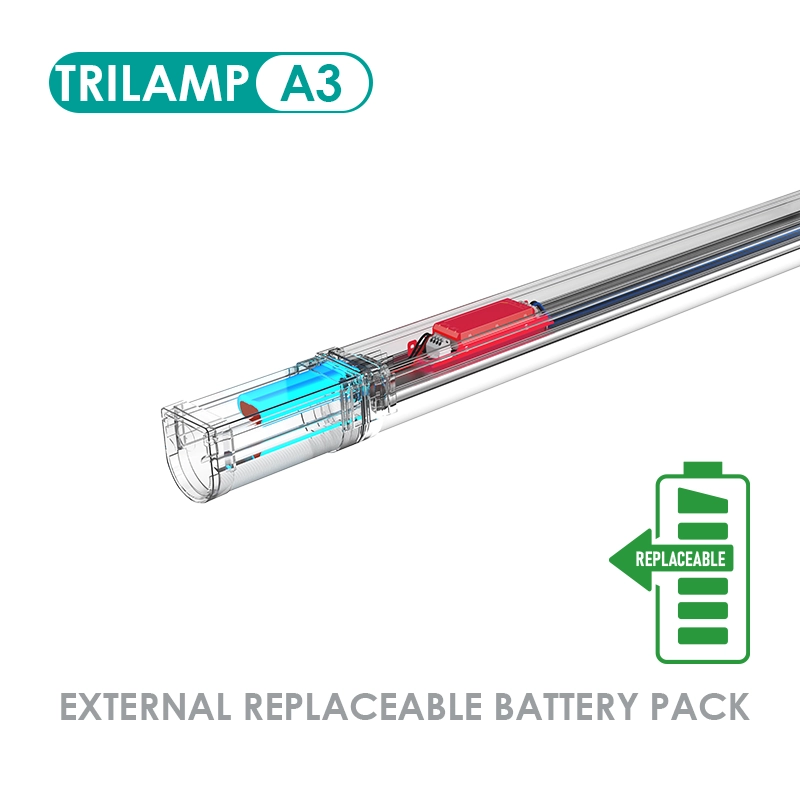
Fanxstar’s relevant starting points include LED emergency lighting product range, LED emergency batten lights, and custom LED lighting ODM service. For these projects, battery chemistry should be discussed together with housing volume, thermal space, wiring, driver choice, emergency output, self-test or manual test logic, and target market.
A useful Fanxstar brief names runtime, voltage, emergency output, installation temperature, product type, target certification, replacement policy, and whether the buyer is adapting an existing Ni-Cd design or creating a new LiFePO4 platform. That lets the engineering team separate a true platform change from a simple battery-pack choice.
The buyer should ask for a 2-gate sample plan. Gate 1 checks electrical function: charging, runtime, emergency output, temperature, and test behavior. Gate 2 checks evidence: label, wiring diagram, certificate boundary, replacement pack code, maintenance instruction, and production BOM. Both gates should pass before the buyer treats the chemistry as approved.
Use the RFQ to prevent unsafe substitutions
The RFQ should state that battery chemistry, pack code, emergency driver, charging method, wiring, label, and test routine cannot change without written review. It should also ask whether Ni-Cd, Ni-MH, and LiFePO4 variants share the same certificate scope or require separate evidence. If the answer is unclear, hold the chemistry decision.
According to SBA import and export law guidance, businesses should understand import and export rules before international sales. Battery-backed emergency products deserve that caution. A battery change can affect safety documentation, transport handling, waste handling, and service records.
The final approval packet should contain the selected chemistry, exact pack, driver, runtime test, charge rule, temperature range, disposal instruction, replacement code, and change-control rule. That file is more valuable than a generic claim that one chemistry is best.
FAQ
Which battery chemistry is best for emergency lighting?
The best chemistry is the one approved with the fixture, charger, emergency driver, runtime test, temperature range, and maintenance file. LiFePO4 is often attractive for new LED designs, while Ni-Cd may remain safer for legacy products whose approval depends on it.
Can Ni-Cd be replaced by Ni-MH or LiFePO4?
Only after compatibility and evidence are confirmed. The charger, emergency driver, battery protection, label, runtime test, and certificate scope may change. A loose chemistry swap can create a safety and documentation problem even if the pack physically fits.
Why does disposal matter in battery selection?
Disposal affects long-term operating cost and compliance discipline. Ni-Cd creates cadmium-related handling concerns, while lithium and Ni-MH packs also need proper end-of-life management. Buyers should include disposal and replacement records in total cost comparison.
What should an emergency battery RFQ include?
Include runtime target, chemistry, pack code, voltage, capacity, emergency driver model, charger method, temperature range, test routine, certificate scope, replacement pack rule, disposal note, and a written rule for any substitution before mass production.