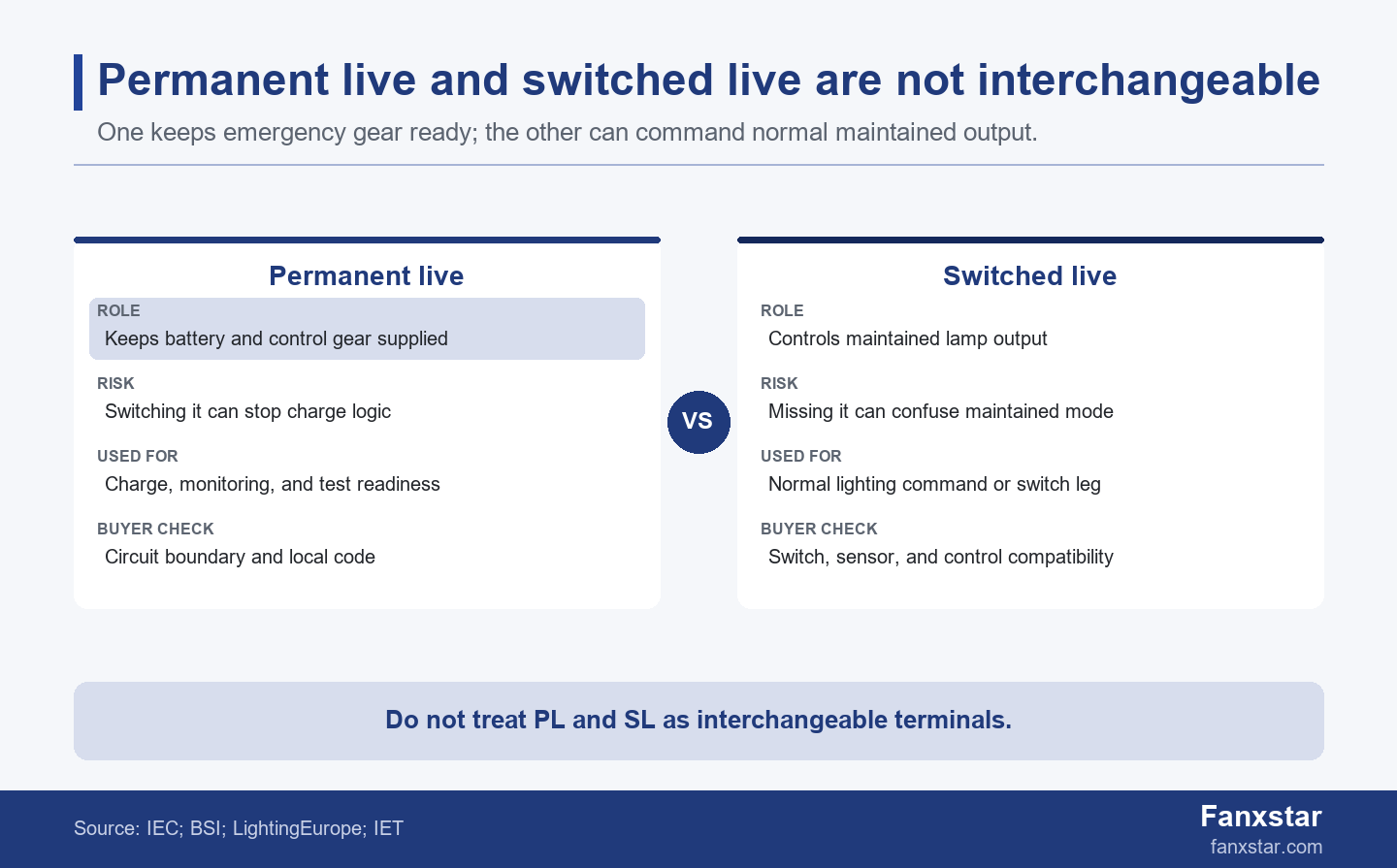
Permanent live and switched live are separate evidence questions in emergency light wiring because charging readiness, maintained operation, switching behavior, and test documentation do different jobs. Permanent live is commonly used to keep the emergency gear supplied for charging, monitoring, and readiness. Switched live is commonly used to control normal maintained light output. They can appear beside each other on the same luminaire, but they should not be treated as interchangeable terminals.
According to IEC 60598-2-22, the standard specifies requirements for emergency luminaires for emergency power supplies not exceeding 1,000 V. According to BS EN 50172:2024, emergency escape lighting systems include installation, verification, operation, maintenance, documentation, and testing. Those sources point to the same buyer lesson: emergency wiring is a system responsibility, not just a product label.
Site wiring should be designed, installed, and tested by qualified professionals under local electrical and fire-safety rules. The procurement value is to help buyers ask the right product, diagram, and test-evidence questions before ordering emergency luminaires.
Key Takeaways
- Permanent live usually keeps emergency charging and monitoring ready; switched live usually controls normal maintained output.
- Maintained and non-maintained emergency lights can require different wiring behavior, so buyers should not rely on product photos alone.
- The exact wiring diagram must come from the specific model, market, testing method, and control strategy.
- Sensor or switch control should never interrupt the emergency function unless the certified design and local code allow the arrangement.
- Fanxstar buyers should send maintained/non-maintained requirement, voltage, test method, circuit plan, and local market before sample approval.
Permanent Live and Switched Live in Plain Buyer Language
Permanent live keeps the emergency side ready
Permanent live is the supply that should remain available so the emergency luminaire can charge its battery, monitor supply condition, and be ready for emergency operation. If the permanent feed is accidentally placed behind a wall switch, occupancy sensor, timer, or control relay, the emergency gear may lose charging time or readiness without the buyer noticing during normal use.
According to LightingEurope emergency lighting guide, emergency lighting decisions include specification, installation, and maintenance. That is the correct procurement frame. A buyer should not only ask whether a product is an emergency light; the buyer should ask how the product remains ready, how it is tested, and what happens when the normal supply fails.
Switched live controls normal output, not emergency readiness
Switched live is usually the control feed that tells a maintained emergency luminaire whether to illuminate during normal conditions. In a corridor, stairwell, or public space, the luminaire may need to operate as part of normal lighting and still provide emergency output during mains failure. The switched live helps achieve that normal control behavior without removing the permanent supply needed by the emergency circuit.
The confusion appears because both wires may carry line voltage and both may enter the same fitting. A rushed installer, buyer, or purchasing team may reduce the difference to color, terminal label, or habit from a previous project. That is unsafe as a procurement assumption. The exact model diagram and local circuit design decide how PL, SL, neutral, earth, and test connections are used.
| Term | Plain meaning | Buyer risk if confused |
|---|---|---|
| Permanent live | Unswitched supply intended to keep emergency gear ready | Battery may not charge or test logic may fail if it is switched off. |
| Switched live | Control feed used for maintained lamp output or normal switching | Maintained behavior may not match the room switch or control plan. |
| Maintained mode | Lamp can operate during normal supply and emergency condition | Spec may require a switched control as well as permanent supply. |
| Non-maintained mode | Lamp is normally off and operates when normal supply fails | Buyer may expect normal lighting from a product not wired for it. |
Maintained vs Non-Maintained Behavior Changes the Wiring Question
Maintained luminaires may need both readiness and normal-control logic
A maintained emergency luminaire can be lit during normal mains conditions and still operate in emergency mode when the supply fails. That makes the wiring question more layered. The permanent live keeps the emergency gear ready; the switched live may control whether the lamp is on during normal use. If the buyer orders maintained behavior but the control plan is unclear, the product can be correct and the installation still behave incorrectly.
According to IET escape lighting guidance, emergency lighting can be described through maintained and non-maintained arrangements. The buyer should not treat maintained mode as a marketing option. It affects terminals, testing, control expectation, and what the installer must verify.
A buyer should ask whether the luminaire is maintained, non-maintained, switchable maintained, combined, self-contained, central battery, or conversion-kit based. Those terms change the wiring evidence needed. They also change how a product should be sampled. A bench sample should demonstrate the normal output behavior, charge indicator or test function, and emergency response under a simulated supply loss.
Non-maintained luminaires still need a correct permanent supply
A non-maintained emergency luminaire is normally off during ordinary conditions and turns on when the normal supply fails. Buyers sometimes assume that because the lamp is normally off, the wiring is less important. The opposite can be true. The permanent supply must still keep the battery and monitoring circuit ready, and the test arrangement must still prove the emergency function.
According to BS EN 50172:2024 scope page, emergency lighting should operate when local normal mains lighting fails. That principle makes the permanent supply and test behavior central to non-maintained products. A non-maintained fitting that is not charged or correctly connected can leave the planned escape route dark when the product is needed most.
For procurement, the safe question is not whether non-maintained is simpler. The safe question is whether the model, wiring diagram, test method, and local circuit plan match the required emergency function. The buyer should request these before ordering quantity, especially when the project includes corridor bulkheads, exit signs, emergency battens, or public-site routes.
What Buyers Should Request Before Approving a Sample
Ask for the exact diagram, not a generic terminal sketch
A generic wiring sketch can help early discussion, but it should not approve a purchase. The buyer needs the diagram for the exact model, voltage, maintained or non-maintained version, test function, battery type, and market. A terminal label from one product family may not carry over to another, especially when emergency conversion kits, sensors, or control options are involved.
The diagram should show permanent live, switched live if used, neutral, earth or Class II boundary, test switch or self-test connection, indicator behavior, and any control interface. If the fixture is part of a larger lighting-control zone, the buyer should ask whether the sensor or switch interrupts only normal light output or also affects emergency readiness.
| Buyer check | What to request | Who should verify |
|---|---|---|
| Terminal diagram | Manufacturer wiring diagram for the exact model | Supplier and licensed electrician |
| Circuit relationship | Whether permanent live and switched live share the required supply boundary | Project electrical designer |
| Test method | Manual, self-test, or central test behavior | Specifier and installer |
| Control interface | Switch, sensor, dimming, or BMS impact | Controls engineer or qualified electrician |
| Emergency function | Maintained, non-maintained, combined, or conversion kit | Buyer, supplier, and local authority pathway |
Testing evidence should be part of the order file
According to BS EN 50172:2024 scope page, documentation and testing are part of emergency escape lighting systems. For buyers, that means wiring evidence is incomplete without a test plan. The order file should show how the luminaire is commissioned, how routine testing is triggered, and what indicator or report proves readiness.
A sample test should include at least three observations: normal supply present, switched command changed if the product uses SL, and normal supply failed. The buyer should record which lamp operates, which indicator changes, and whether charging resumes after restoration. This is not a substitute for site commissioning, but it catches many procurement misunderstandings before hundreds of units are ordered.
- 3 states: normal supply, switched command, and supply failure should be observed
- 2 live roles: permanent live and switched live answer different functions
- 1 exact diagram: must match the model and market before purchase
- 0 shortcuts: sensor control should not be assumed safe without verification
- 5 evidence items: diagram, function, circuit plan, test method, and documentation
- 1000 V scope: IEC 60598-2-22 covers emergency luminaires for emergency power supplies not exceeding this value
Controls, Sensors, and Smart Buildings Add Another Layer
A sensor should not silently disable emergency readiness
Motion sensors, timers, daylight controls, and BMS interfaces can be useful in normal lighting, but emergency function must remain available under the approved design. The buyer should not assume that a sensor-ready fixture and an emergency fixture can be combined without checking circuit logic. The question is whether the control device switches normal output only or also interrupts the permanent supply.
Related Fanxstar topics include motion and dimming controls for industrial facilities and LED emergency lighting product range. The control plan should state which part of the luminaire is controlled and which part remains available for emergency operation. That is especially important in warehouses, parking garages, tunnels, data-center service corridors, and public circulation areas.
A buyer should ask for a controls compatibility note when ordering emergency products for smart facilities. The note should name the control signal, switching device, sensor type, test method, and whether emergency operation is independent of the normal lighting command. If the answer is unclear, the sample should not be approved for mass production.
Local code and qualified design remain the final authority
Emergency lighting wiring is not a place for universal internet instructions. Circuit arrangements can vary by country, product type, building code, fire-safety requirement, and inspection practice. A buyer can use product documentation to avoid wrong orders, but a licensed professional must decide the installation detail and verify the final system.
According to IEC 60598-2-22 emergency luminaire scope and LightingEurope emergency lighting guide, emergency lighting has to connect the luminaire with specification, installation, maintenance, and testing. Product conformity, installation, maintenance, and testing have to work together. A correct luminaire can be made unsafe by incorrect wiring, and a well-designed circuit can fail if the purchased model does not support the required behavior.
For RFQ language, the buyer can write: provide the exact emergency wiring diagram, identify permanent live and switched live functions, state maintained or non-maintained behavior, confirm test method, and flag any restrictions for sensors or switching devices. That sentence is simple, but it prevents most of the confusion that causes wrong samples.
How to Use Fanxstar for Emergency Lighting Samples
Define the emergency function before choosing the fixture body
Fanxstar offers emergency exit signs, emergency bulkhead lights, and LED emergency batten lights. The fixture body matters, but the first sample question should be function: maintained or non-maintained, battery duration target, voltage, mounting location, test method, and local market expectation.
If the project is a corridor, stairwell, tunnel, station, parking garage, or public site, the buyer should also define visibility and placement needs before ordering. Emergency lighting is purchased as a safety system even when the procurement file looks like a product order. The body shape, lens, battery, indicator, terminal layout, and documentation should match that system purpose.
According to ITA import documentation guidance, cross-border orders may require commercial and entry documents that match the product. According to ITA special documents guidance, special documents may be needed for certain products or markets. A useful inquiry includes photos or plans of the route, target market, supply voltage, mounting height, desired maintained behavior, test requirement, and control plan.
Approve the sample only after function is demonstrated
The final sample gate should be practical. With normal supply present, what does the fixture do? When the switch or sensor changes state, what changes? When normal supply fails in a controlled test, what turns on and for how long? When supply is restored, what indicator or behavior confirms charging and readiness? These observations belong in the buyer’s release record.
Use Fanxstar custom LED lighting ODM service when the project needs fixture length, housing, lens, sensor, wiring, battery, or label adaptation. Customization should not obscure emergency function. Every change should be checked against wiring, charging, test behavior, and documentation before the buyer approves mass production.
The decision rule is intentionally strict: do not approve an emergency lighting sample because the lamp turns on. Approve it when the permanent live role, switched live role, maintained behavior, charging readiness, test method, and local installation owner are clear within 1 release record.
FAQ
Can permanent live be connected through a wall switch?
It should not be assumed safe. Permanent live is usually intended to keep the emergency gear supplied for charging and readiness, so switching it through an ordinary wall switch can defeat the emergency function. The exact answer must come from the model wiring diagram and local electrical rules.
Does every emergency light need switched live?
No. Non-maintained fittings may not need a switched live for normal light output, while maintained or switchable maintained products may use it. The buyer should confirm the required operating mode before purchase. A product photo cannot show whether switched live is needed for the intended function.
What should be checked during an emergency light sample test?
Check normal supply present, switched command if applicable, simulated supply failure, restoration behavior, indicator status, and charging readiness. The test should use the exact model diagram and intended market configuration. This sample test does not replace site commissioning, but it helps prevent ordering the wrong version.
Can Fanxstar design the site wiring?
Fanxstar can provide product information, sample options, terminal diagrams, and ODM support for emergency lighting products, but site wiring must be designed and verified by qualified professionals under local codes. Buyers should send the circuit concept and market requirements so product selection matches the installation plan.