HACCP and NSF are often used too loosely in food processing lighting. HACCP is a food safety management approach, not a sticker that makes a luminaire hygienic. NSF is not a generic word for clean; it has scope, zone, product, and configuration boundaries. The useful buyer question is: which food safety hazard, cleaning exposure, and certificate scope does this fixture need to support?
Codex General Principles of Food Hygiene includes HACCP system guidance, while the NSF certified product listing example identifies lighting fixtures for splash zone and non-food zone applications. For LED lighting buyers, these sources point in the same direction: define the hygiene risk first, then request fixture evidence that fits the actual zone.
Key Takeaways
- HACCP does not certify a light fixture; it helps the plant identify hazards and controls in the food process.
- NSF-related lighting evidence should be checked by exact listing scope, such as splash zone or non-food zone use, not by a generic food-safe claim.
- Food plant LED lights should be selected by exposure: product openness, splash risk, washdown pressure, cleaning chemicals, condensation, lens breakage, and maintenance access.
- Fanxstar buyers should send a zone map and cleaning method before asking for an IP65, vapor tight, or washdown fixture recommendation.
Separate HACCP thinking from fixture certification
HACCP starts with the process, not the luminaire
A HACCP plan asks the food business to understand hazards, controls, monitoring, corrective actions, verification, and records. A light fixture can support that system by reducing contamination risk, providing enough visibility, resisting cleaning exposure, and avoiding hard-to-clean details. The fixture itself does not become HACCP certified in the same way a product might be listed or tested under a certification program.
That distinction improves procurement. Instead of asking for a HACCP light, ask where the fixture sits in the plant hazard map. Is there exposed product below it? Can broken lens material fall into food or clean equipment? Will washdown water hit the fixture? Can condensate collect and drip? Can the surface be cleaned? Can maintenance be done without contaminating the area?
The FDA Food Code is model guidance for safeguarding public health and food protection. Even when a processing plant follows different local rules, the buyer can still use the same logic: lighting should support food protection, physical facility hygiene, and clean operation rather than exist as a generic commodity.
NSF evidence must match the zone
An NSF listing example identifies lighting fixtures for splash zone and non-food zone applications. That wording is important. A buyer should not read NSF as a single universal permission. The exact listing should match the fixture family, configuration, lens, voltage, mounting, CCT, CRI, and option set where those variables affect the certified scope.
Food plants should ask for the certificate or listing, not only a logo in a brochure. The model number, options, lens, mounting, and intended zone should match the product being shipped. If an ODM change adds a sensor, changes the diffuser, changes the cable entry, or switches a latch design, the buyer should ask whether the listed scope still applies.
Map the plant before choosing IP65 or vapor tight lights
IP rating is necessary but not always sufficient
IP65, IP66, or IP69K language can be useful, but it is not the whole food plant answer. An IP test addresses dust and water ingress under defined conditions. A food plant also cares about smooth surfaces, lens safety, corrosion resistance, chemical compatibility, pressure washing, temperature swings, condensation, fastener design, and whether the fixture can be cleaned without trapping residue.
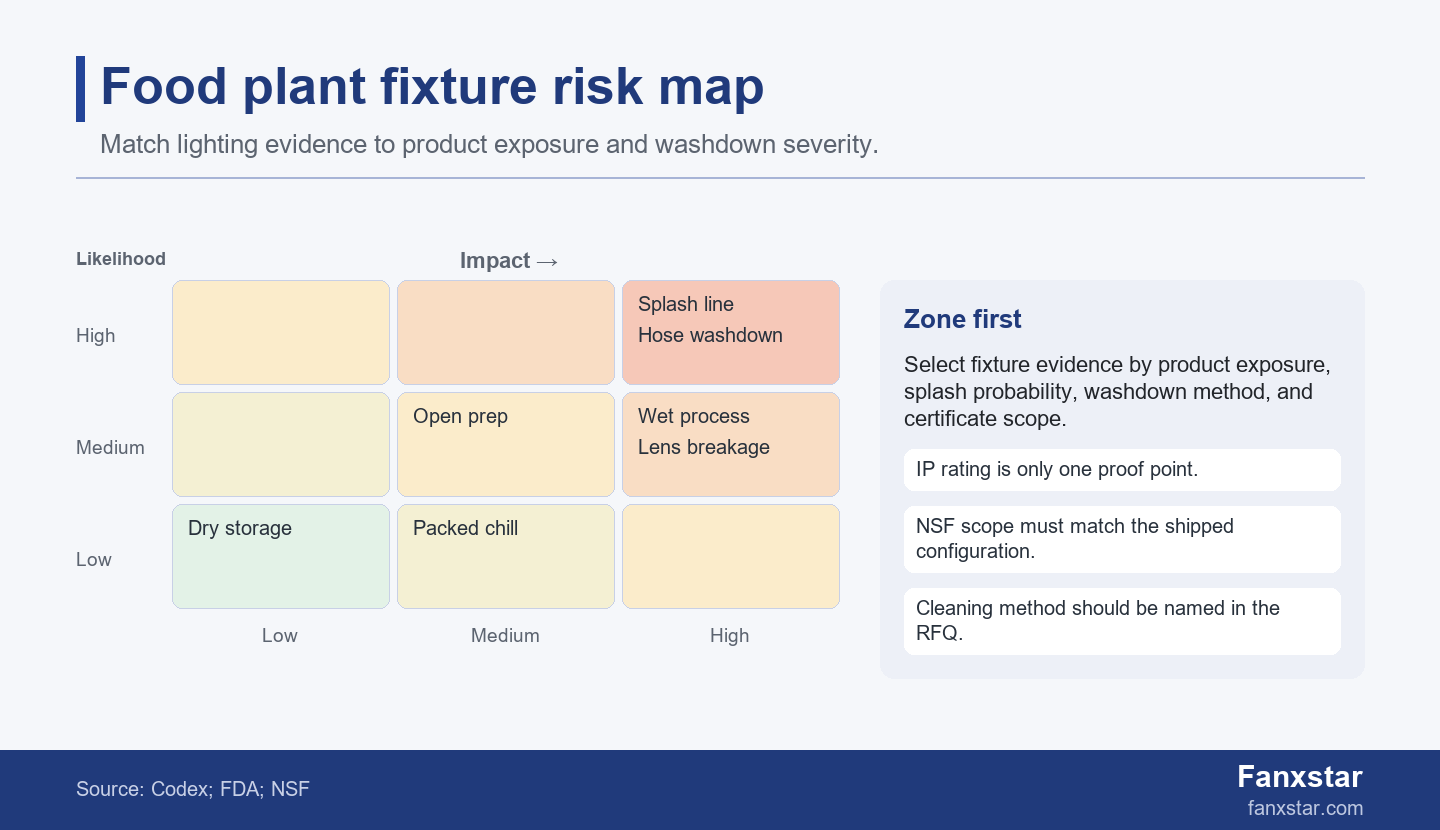
A vapor tight fixture may be correct for many wet or damp areas. A fresh linear fixture may suit retail or lower-exposure chilled displays. A heavier washdown fixture may be needed where hoses, detergents, and splash are regular. The buyer should map the site into zones before asking the supplier to choose a housing.
Open food and splash zones need stricter evidence
Where food is exposed, the buyer should think about breakage and debris. Lens material, diffuser retention, end-cap design, latch security, screw exposure, gasket compression, and mounting hardware all become part of the hygiene review. A bright fixture that sheds debris, traps residue, or requires risky maintenance above open product is not a good food plant fixture.
Splash and washdown zones add another layer. Water can travel along cable entries, latch edges, end caps, screw holes, and mounting brackets. Detergents can attack plastics or gaskets. Cold rooms can create condensation. The sample review should include the exact mounting orientation and cleaning method because a fixture that survives gentle moisture may fail under repeated hose cleaning.
Food plant evidence checks buyers should not skip
Translate the plant map into 4 fixture exposure classes
The FDA Food Code 2022 web page describes the Food Code as advice for a uniform food safety system. A lighting buyer can translate that public-health logic into 4 exposure classes: dry storage, damp or cold processing, open-food preparation, and splash or washdown zones. Each class needs a different level of housing, lens, seal, and cleaning evidence.
The full FDA Food Code document is also useful because it keeps lighting connected to physical facility conditions rather than a generic product label. The implication is that an RFQ should name the zone before naming the fixture. A request for IP65 lighting is weaker than a request for IP65 vapor tight fixtures above an open preparation line cleaned with a specified detergent and water method.
A buyer can use a 6-field zone line for each room: product exposure, moisture level, cleaning method, ceiling height, target light level, and maintenance access. For example, a dry packaged storage room may need dust protection and safe maintenance, while a wet processing line may need stronger gasket, cable-entry, lens-retention, and corrosion evidence.
Separate sanitation evidence from energy evidence
DOE FEMP luminaire purchasing guidance and DLC solid-state lighting technical requirements help buyers think about performance evidence, but they do not replace sanitation or washdown evidence. A food plant file therefore needs 2 evidence tracks: lighting performance and hygiene exposure. The first track covers photometry, power, controls, and warranty. The second covers cleanability, lens safety, IP rating, materials, certificate scope, and the cleaning procedure.
GSA LED and controls guidance is relevant when the plant adds sensors, dimming, or zone controls. Controls can save energy in storage and backroom areas, but they should not create hygiene or service problems. A sensor added to a vapor tight fixture changes the housing surface and cable-entry story, so the buyer should ask whether that option is included in the tested configuration.
The practical implication is that a food plant should not approve a sample until the exact model, length, wattage, lens, CCT, mounting, cable entry, sensor option, and label match the evidence file. A small option change can be acceptable, but it should be named and checked before production.
Build an evidence file for food plant lighting
The buyer should request product and process evidence together
A useful food plant lighting file includes the product data sheet, IP rating, NSF or sanitation listing scope where required, lens material, housing material, gasket design, cable entry, installation instructions, cleaning compatibility statement, temperature range, photometric file, warranty, and change-control rule. The plant should also keep its own site evidence: zone map, cleaning SOP, inspection requirements, and maintenance method.
| Zone | Lighting risk | Useful evidence |
|---|---|---|
| Dry packed storage | Lower product exposure but still needs safe illumination and cleanable surfaces. | IP/dust rating, lens safety, maintenance access, and cleaning plan. |
| Cold or damp processing | Condensation, low temperature, and cleaning chemistry can expose weak seals. | IP rating, gasket design, cable entry, material compatibility, and temperature test. |
| Open food preparation | Broken lens, dripping, debris, or hard-to-clean surfaces can become hygiene hazards. | Shatter-resistant lens, smooth housing, shielding, certificate scope, and cleaning proof. |
| Splash or washdown area | Water jets, detergents, and drainage paths can challenge fixtures. | NSF scope where required, washdown method, IP rating, corrosion evidence, and sample inspection. |
| Inspection or packing line | Workers need enough light, color consistency, and low glare for quality checks. | Layout calculation, CCT/CRI data, flicker check, glare review, and replacement rule. |
This combination protects the buyer from two common errors. The first is choosing a low-cost waterproof fixture that is not cleanable enough for the zone. The second is overbuying a heavy washdown fixture for an area where a simpler, certified, easy-to-clean product would be more practical.
How Fanxstar can support a food processing RFQ
Fanxstar should be briefed with the plant map before product selection. Useful starting points include food processing plant LED lighting applications, A14 IP65 vapor tight fixture, Fanxstar waterproof LED lighting, and food processing washdown lighting guide.
Send zone names, ceiling heights, open-product areas, splash or washdown method, cleaning chemicals, temperature, humidity, mounting constraints, certificate market, target lux, CCT/CRI preference, and whether sensors or emergency functions are needed. Fanxstar can then recommend a platform and evidence checklist instead of guessing from the phrase food grade lighting.
For ODM work, the change rule is especially important. If the buyer needs a special cable, plug, sensor, housing finish, label, or private-brand package, the supplier should explain whether that change affects IP, NSF scope, safety certification, photometry, or cleaning evidence. A food plant should approve the final configuration, not just the first catalog model. When the zone map is ready, Fanxstar can use it to narrow the recommendation to fixtures and options that match the real washdown and hygiene boundary.
Implementation Note for Buyers
For food plants, the most useful approval sheet is a room-by-room fixture register. Each row can name 9 fields: room, product exposure, moisture level, cleaning method, temperature, ceiling height, required certificate scope, fixture model, and maintenance access. That register prevents a common mistake: using the same waterproof fixture language for dry storage, wet processing, and high-splash sanitation zones.
When the register is ready, Fanxstar can match it to food processing plant LED lighting applications and fixture platforms such as vapor tight or waterproof linear products. The buyer should ask for the recommendation to identify which evidence belongs to each room: IP rating, lens safety, cable entry, gasket design, certificate scope, photometry, and cleaning compatibility.
According to Codex food hygiene guidance, HACCP belongs to a food hygiene system rather than a fixture marketing badge. According to FDA Food Code 2022 public guidance, food safety provisions are meant to protect public health. According to the FDA Food Code 2022 document, lighting belongs inside the physical facility context, not in a stand-alone product slogan.
According to the NSF lighting fixture listing example, splash zone and non-food zone scope should be checked by configuration. According to DOE FEMP luminaire purchasing guidance, buyers should use luminaire-level evidence. According to GSA LED and controls guidance, controls and commissioning still matter when the plant adds sensors to food-area fixtures.
The decision rule is to approve the final food-plant fixture by room, not by a single site-wide label. A dry carton room, a chilled prep room, and a hose-cleaned processing line can all need different evidence even when they share the same brand and fixture family.
According to the NSF lighting fixture listing example, optional configurations can matter, so the buyer should compare the shipped lens, CCT, CRI, voltage, mounting, and controls against the listed scope.
FAQ
Are LED lights HACCP certified?
HACCP is a food safety management system, not usually a fixture certification. A light can support a HACCP plan when it reduces relevant hazards and fits the plant zone, cleaning method, and maintenance process.
Does a food processing plant need NSF-listed lighting?
A food processing plant should check NSF-listed lighting when the owner, customer, auditor, local rule, or zone risk requires sanitation evidence beyond a normal wet-location fixture. If NSF evidence is required, the buyer should verify the exact listing scope, model, configuration, and intended zone such as splash zone or non-food zone.
Is IP65 enough for food plant lighting?
IP65 can be useful, but it is not the full answer. Food plants should also check cleanability, lens safety, corrosion resistance, detergent exposure, mounting, cable entry, temperature, and certificate scope.
What information should I send for a food plant lighting quote?
Send a zone map, open-product areas, washdown method, chemicals, temperature, humidity, ceiling height, target lux, mounting method, required certificates, control needs, and cleaning or maintenance rules.