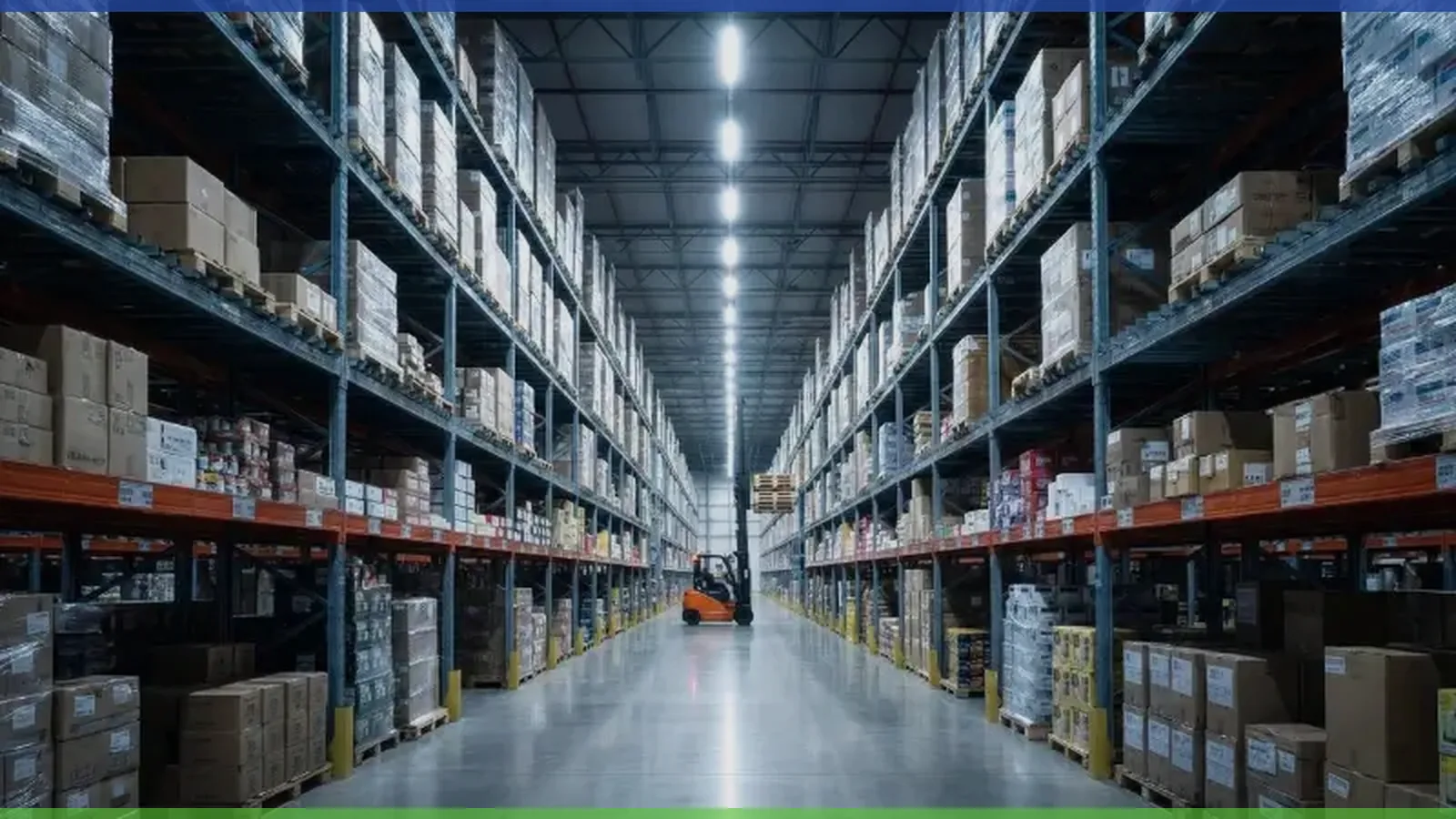
In narrow racking systems, poor illumination often results in the “cave effect”—a phenomenon where high shelves and deep aisles create dark zones that obscure labels and create safety hazards. Traditional lighting often fails to penetrate the vertical faces of the racks, leaving picking teams to work in heavy shadows. Advanced industrial lighting strategies now target the root causes of these shadows, using focused optics and seamless linear designs to deliver precise illumination where it’s needed most.
Key Takeaways
-
Optical Precision: Utilize narrow or asymmetric beam angles (60° or 90°) to project luminous flux onto vertical rack faces rather than wasting light on rack tops.
-
Seamless Continuity: Continuous linear LED systems eliminate the “zebra stripe” effect caused by gaps between fixtures.
-
Uniformity Ratios: Aim for a maximum-to-minimum uniformity ratio of 3:1 to minimize eye fatigue and improve hazard detection.
-
Smart Controls: RF grouping and microwave sensors ensure pathways are proactively illuminated, saving energy without compromising responsiveness.
-
Compliance: Regular technical validation of lux levels (minimum 10-foot candles in aisles) is mandatory for OSHA and ANSI safety compliance.
The Mechanics of Rack Shadows in Narrow Aisles
Shadows in a warehouse are a product of geometry and light physics. When tall racking systems (often 20 to 40 feet high) are spaced closely together, they act as barriers to standard overhead light distribution. Most general-purpose fixtures radiate light in a wide 120-degree circle; in a narrow aisle, up to 40% of this light hits the top of the racks and is absorbed or reflected upward, never reaching the floor or the picking faces.
This “luminous flux blockage” creates sharp contrasts. For a worker, moving between a bright entry point and a dark mid-aisle section causes temporary visual impairment as the pupils adjust. Over an 8-hour shift, this leads to significant ocular fatigue, increasing the likelihood of picking errors and forklift accidents.
“Solving the cave effect requires a shift from horizontal-only lighting to vertical illuminance. You must light the face of the product, not just the floor of the aisle.”
Core Strategies for Shadow-Free Illumination
To eliminate shadows, facility managers must move beyond high-wattage bulbs and focus on light distribution technology.
1. Focused Optics and Asymmetric Distribution
Modern aisle lighting solutions utilize specialized lenses to shape the beam. Instead of a standard round throw, these lenses create a rectangular or asymmetric pattern that matches the long, narrow footprint of an aisle.
|
Beam Profile |
Light Distribution Pattern |
Narrow Aisle Suitability |
|---|---|---|
|
Standard (120°) |
Circular / Diffuse |
Low (Wastes light on rack tops) |
|
Narrow (60°/90°) |
Focused / Deep |
High (Penetrates to floor level) |
|
Asymmetric |
Directional / Vertical |
Excellent (Targets rack picking faces) |
2. No-Shadow Hardware and Slim Form Factors
Physical hardware can often be the source of its own shadows. Bulky housings or wide sensor antennas can block light at the source. Fanxstar linear luminaires utilize ultra-slim designs (often under 80mm in width) to minimize the fixture’s footprint. This ensures that the light source remains unobstructed, providing a clean, consistent field of vision.
3. Seamless Splicing for Linear Consistency
Individual “point source” fixtures (like round high-bays) inherently create dark spots in the “valleys” between lights. Linear LED fixtures that support seamless splicing allow for end-to-end connection, creating a single continuous ribbon of light. This removes the “zebra stripe” pattern and ensures that every shelf, from top to bottom, receives equal intensity.
|
Splicing Feature |
Operational Benefit |
Industrial Advantage |
|---|---|---|
|
End-to-End Coupling |
Removes coverage gaps |
Better barcode read-rates |
|
Modular Drivers |
Simplifies maintenance |
Lower downtime |
|
High Luminous Efficacy |
Up to 160 Lm/W |
Maximum energy ROI |
Advanced Controls: Predictive Path Lighting
Intelligent controls can further enhance safety while slashing energy costs. RF Grouping technology allows fixtures to communicate wirelessly. When a forklift triggers a microwave sensor at the start of an aisle, the system signals the entire row (or a specific “zone”) to ramp up to 100% brightness instantly.
-
Predictive Response: The light “follows” the worker, ensuring the path ahead is always bright.
-
Occupancy Sensing: Reduces idle burn-time by dimming to 10-20% when the aisle is vacant, which can cut energy costs by up to 70%.
-
Daylight Harvesting: Integrated photocells measure natural light from skylights, automatically adjusting artificial output to maintain constant lux levels.
Technical Validation and Compliance
To ensure your strategy is effective, you must perform regular technical audits. Warehouse managers should utilize photometric data to confirm that vertical illuminance meets task-specific requirements. Testing your system twice annually helps identify lumen depreciation and sensor calibration drift.
|
Standard Body |
Aisle Requirement |
Hazard Prevention Focus |
|---|---|---|
|
OSHA 1926.56 |
5-foot candles (minimum) |
Basic employee safety/navigation |
|
ANSI / IES RP-7 |
10-30 foot candles |
Precision picking and label reading |
|
IBC / IECC |
Automated shut-off |
Energy waste reduction |
The Rack Shadow Prevention Checklist
Before breaking ground on a lighting overhaul, ensure your plan covers these critical points:
-
Alignment: Are linear fixtures installed parallel to the aisle rather than perpendicular?
-
Spacing: Has the “distance-to-mounting-height” ratio been calculated to prevent dark spots?
-
Color Temperature: Is the CCT set between 4000K and 5000K to maximize worker alertness and contrast?
-
Environmental Protection: Are fixtures rated IP65/IP66 to handle dust accumulation in the racks?
-
Worker Feedback: Have picking teams been consulted on where they encounter the most glare or shadows?
Conclusion: A Future-Proof Luminous Environment
Eliminating shadows in narrow racking systems is a balance of high-performance hardware and intelligent planning. By prioritizing vertical illumination and seamless linear designs, facility managers can transform their aisles into safe, high-throughput environments. As warehouse automation and robotics become more common, the need for uniform, high-contrast lighting will only increase. Upgrading today ensures that your facility is ready for the technical demands of tomorrow.
Frequently Asked Questions (FAQ)
What is the best beam angle for a narrow warehouse aisle?
For aisles with a width-to-height ratio of less than 1:2, a 60-degree or asymmetric narrow beam is best. This focuses the light on the vertical rack faces and the floor, preventing waste on top of the racking.
How does seamless splicing save on installation costs?
Seamless systems often use internal wiring harnesses. This allows multiple fixtures to be powered from a single point, significantly reducing the amount of conduit, wiring, and labor required compared to individual “point source” fixtures.
Can I use motion sensors with standard high-bay lights?
While possible, legacy HID lights require long warm-up times and don’t respond well to frequent switching. LED fixtures are “instant-on,” making them the only viable choice for motion-based aisle lighting.
Why is vertical illuminance so important?
In a warehouse, the “task” is usually reading a label or SKU on the side of a box. Horizontal lighting (light hitting the floor) doesn’t help with this. Vertical illuminance measures the light hitting the face of the rack, which is where the work happens.
How often should I clean my lighting fixtures?
In a dusty warehouse environment, cleaning diffusers every 6 to 12 months is recommended. Dust buildup can reduce light output by 10-20%, effectively recreating the shadows you worked to eliminate.