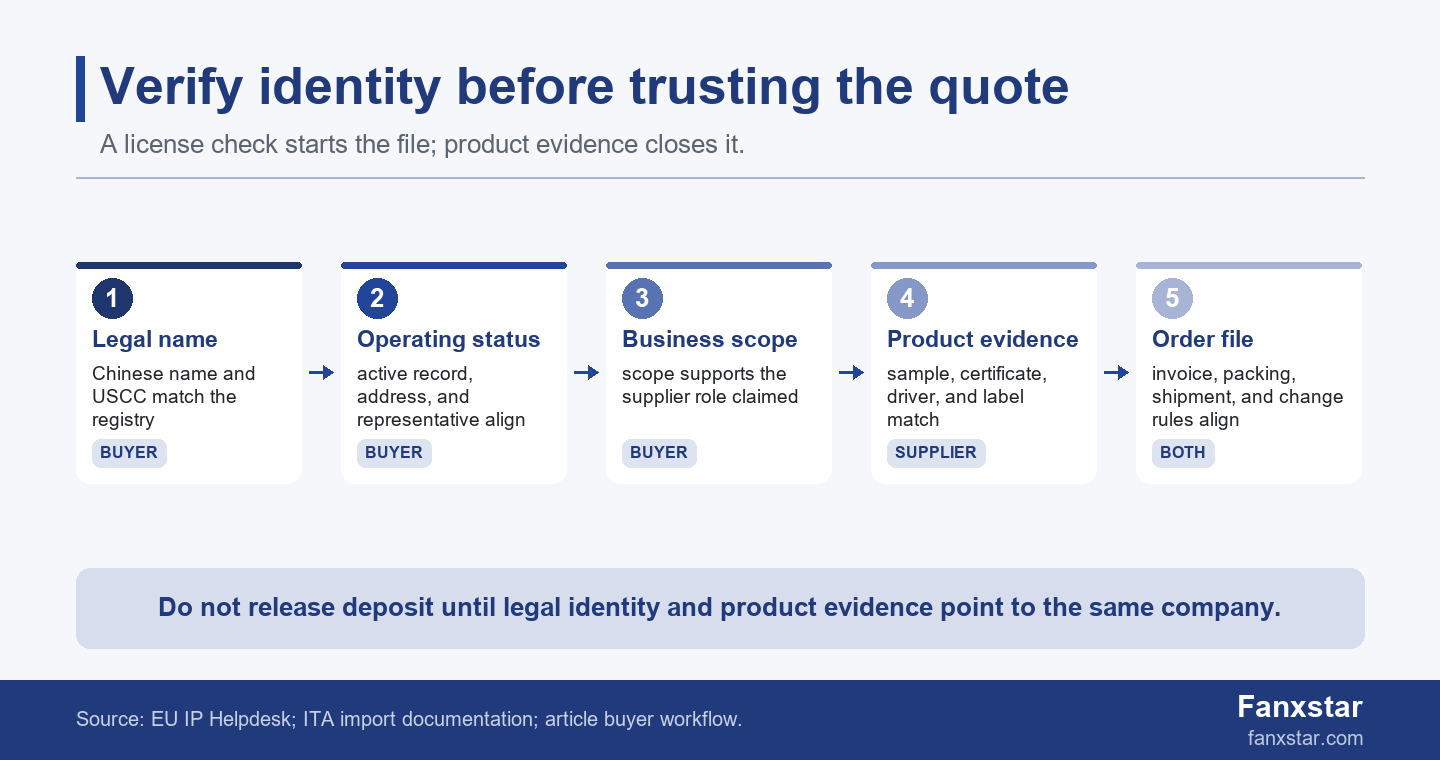
A Chinese supplier business license proves who the legal entity is, not whether the supplier can build the LED fixture you are about to buy. The useful verification path starts with the Chinese legal name and Unified Social Credit Code, then moves to operating status, address, business scope, contract party, product evidence, and shipment documents.
According to the EU IP Helpdesk guide to Chinese company information, information on every company registered in China can be accessed through the National Enterprise Credit Information Publicity System. That makes the business license a serious first check. It does not make the license a substitute for factory capability, product certification, sample approval, or order-control evidence.
Key Takeaways
- Verify the Chinese legal name and USCC first; English supplier names are often trade names and can mislead foreign buyers.
- A valid license is only identity evidence. It does not prove LED manufacturing capability, product certification, quality control, or export readiness.
- Compare the license with contract party, proforma invoice, bank account, sample label, certificate holder, and packing documents before deposit.
- Fanxstar buyers should convert supplier identity checks into an evidence packet: license, product file, sample report, certificate scope, and change-control rule.
What a Chinese supplier business license actually proves
The license is an identity record, not a product approval
A business license helps the buyer confirm that the supplier exists as a registered legal entity. It can show the legal Chinese name, Unified Social Credit Code, registered address, legal representative, registered capital, operating term, business scope, and status fields depending on the registry record and document version. Those fields matter because they anchor the contract party.
The EU IP Helpdesk source is useful because it points foreign companies toward the official NECIPS route rather than relying on a supplier’s English PDF alone. For LED procurement, the practical decision is simple: if the Chinese legal name on the license, registry record, invoice, bank account, and contract do not align, the buyer should stop and clarify the entity before paying a deposit.
The license does not prove that the company owns the factory, controls the bill of materials, holds the exact certification, or can ship the exact LED fixture. A trading company can be legitimate. A manufacturer can be legitimate. The buyer risk appears when the supplier’s legal identity, factory role, product evidence, and payment route are mixed together without being named.
USCC is the strongest search anchor
The Unified Social Credit Code is usually a better search anchor than the English name. Chinese suppliers may use multiple English names for export, exhibitions, marketplaces, and email signatures. The registered Chinese name and USCC should be treated as the stable identity fields. If the supplier gives only an English name, ask for the Chinese legal name and USCC before sending technical files or deposits.
| License field | What to check | Why LED buyers should care |
|---|---|---|
| Chinese legal name | Must match the registry and contract party | English names can be marketing names, not legal identity. |
| USCC | Use the 18-character code as the search anchor | It reduces confusion between similar supplier names. |
| Status | Confirm active registration and abnormal notes | A dormant or abnormal entity changes deposit and dispute risk. |
| Address and representative | Compare license, invoice, bank, and contact records | Mismatch can reveal trading-company or payment-risk gaps. |
| Business scope | Check whether manufacturing or trade role is plausible | Scope is not product proof, but it helps explain the supplier role. |
The table is not a legal opinion. It is a buyer-control tool. A clean license record can reduce identity confusion, but it does not lower product risk unless the same entity also appears in the product evidence and commercial documents.
How to verify the license before an LED lighting order
Start with a document match, then use the registry
Ask the supplier for the latest business license image or PDF. Extract the Chinese company name, USCC, address, legal representative, and business scope. Then search by the Chinese name or USCC in the public registry route identified by official guidance. If the search result and the supplier-provided license do not match, ask for a corrected document before discussing pricing further.
According to International Trade Administration import regulations guidance, import rules and documentation requirements vary by country and can include testing, labeling, or licensing. That matters because the supplier identity used at the start of the deal should also appear in the downstream import file when possible. The buyer does not want 1 company selling, another invoicing, and a third appearing on certificates without explanation.
A scenario estimate shows why the check is worth doing. If a buyer spends 30 minutes verifying the USCC before a 10,000 dollar sample-and-deposit order, the verification cost is tiny compared with even one delayed refund, bank-account correction, or certificate mismatch. The purpose is not to reject every mismatch; it is to force the supplier to explain the commercial chain before money moves.
Compare the license with commercial documents
According to International Trade Administration import documentation guidance, trade documents can include invoices, bills of lading, packing lists, insurance proof, and certificates of origin. For a lighting order, those documents should be compared with the license file before shipment, not after a customs or payment problem appears.
The buyer should compare at least 6 records: business license, quotation, contract or purchase order, proforma invoice, bank beneficiary, and sample label. If certificates are involved, add certificate holder and model scope. If a marketplace is involved, add platform verification status and store operator. Any mismatch should be written into the order file with an explanation, not handled as a casual chat message.
What the license does not prove about LED supplier capability
Manufacturing capability needs product evidence
A license may state a business scope, but scope language is usually broad. It does not prove that the supplier owns tooling, controls drivers, runs aging tests, manages IP ratings, or holds the exact certificate for the LED fixture being quoted. For a B2B lighting order, the buyer still needs product-level evidence: datasheet, drawing, driver model, photometric file, label, certificate scope, sample report, and production change rule.
DLC solid-state lighting technical requirements and FEMP LED luminaire purchasing guidance both keep the buyer focused on complete luminaire evidence rather than supplier claims alone. If a Chinese supplier is quoting a weatherproof light, emergency light, or custom linear product, the buyer should check the actual luminaire version, not only the company registry.
The most common failure is false confidence. A buyer sees a real license and assumes the product file is equally real. These are separate questions. The legal entity can exist while the quoted LED model, driver, certificate, or IP claim remains unverified.
Platform badges are helpful but not enough
Alibaba Verified Supplier information can help buyers understand platform-level supplier assessments, and Alibaba supplier verification services describe legal-registration verification as part of buyer safeguards. These checks can be useful, especially when the buyer first meets a supplier online.
However, platform verification should not replace the buyer’s own order file. The platform may verify that a supplier is registered or assessed, while the buyer still has to confirm whether the exact LED lighting product, certificate, sample, production batch, and invoice entity match the order. Treat platform badges as one evidence layer, not the final approval gate.
The best question is not ‘Is this supplier real?’ The better question is ‘Does the real legal entity control the product evidence and commercial documents for this order?’ That question catches more B2B lighting risk than a license screenshot alone.
The key insight is continuity across 3 different records
The key insight for an overseas LED buyer is that license verification becomes useful only when 3 records stay continuous: the legal entity record, the product evidence record, and the payment or shipment record. A supplier can pass the first record and still fail the second or third. That is why the buyer should not stop after seeing a license screenshot.
According to International Trade Administration import documentation guidance, import transactions rely on commercial documents such as invoices and packing records. According to SBA import and export law guidance, companies should understand import and export rules before international transactions. This means the license check should be tied to the same order file that later supports payment, shipment, and customs review.
In practice, a buyer can use a 7-point continuity check before deposit: Chinese legal name, USCC, signatory entity, bank beneficiary, certificate holder, sample label, and proforma invoice. If 5 of those points match and 2 do not, the buyer should not guess. The supplier should explain the mismatch in writing, especially when the order involves private label, ODM changes, or a certificate-sensitive LED fixture.
A practical rule is to separate acceptable explanations from unresolved risk. A group company using an export arm may be acceptable when responsibility is written into the contract. A bank beneficiary that belongs to an unrelated person, a certificate holder the supplier cannot explain, or a sample label that names another factory should stop the order until the buyer understands the chain.
How Fanxstar buyers should turn verification into an RFQ file
Ask for identity and product evidence together
For Fanxstar or any Chinese LED supplier, the buyer should connect company identity to the product category being purchased. Relevant Fanxstar starting points include Fanxstar company and certification profile, weatherproof LED lighting product platform, LED linear lighting platform, and custom LED lighting ODM service. The right next step depends on whether the buyer is purchasing a catalog fixture, adapting a platform, or requesting ODM changes.
For a standard order, ask for business license, company profile, datasheet, certificate, sample photo, and invoice entity. For a customized order, add drawing, driver, LED board, optics, CCT, label, target market, sample gate, and change-control rule. For private label, add ownership of label artwork and certificate boundary. The supplier should explain which entity signs, invoices, ships, and supports the product.
According to International Trade Administration special documents guidance, some products need certificates related to standards, safety, or other conditions. Lighting buyers should use that principle before shipment: identity evidence, product evidence, and import evidence should describe the same order version.
Use a release rule before paying deposit
A practical release rule is: no deposit until the legal entity, product file, sample goal, and payment route are aligned. This does not mean every mismatch is fraud. It means every mismatch needs a written explanation. A group company, export agent, or trading company arrangement can be legitimate if the responsibility chain is clear.
According to SBA import and export law guidance, businesses should understand import and export rules before international sales. The same caution applies to supplier identity. A buyer who controls the license file early has more leverage than a buyer who discovers identity confusion after goods are produced.
Before sending Fanxstar or another supplier a serious RFQ, prepare the target product, voltage, market, certification expectation, quantity, sample goal, and any private-label needs. Then ask the supplier to return the legal identity file and product evidence in the same packet. That packet is more useful than a license screenshot alone.
FAQ
What is the best way to verify a Chinese supplier business license?
Use the Chinese legal name and Unified Social Credit Code to compare the supplier-provided license with the public company information route. Then compare the same identity against quotation, contract, invoice, bank beneficiary, certificate holder, sample label, and shipment documents before deposit.
Is a Chinese business license enough to prove a supplier is reliable?
No. A business license proves legal identity, not manufacturing capability or product quality. For LED lighting orders, buyers still need sample evidence, product specifications, certificate scope, driver and label details, payment-route clarity, and a written change-control rule.
What if the supplier uses an English name that differs from the license?
That can be normal, but it must be explained. Ask for the Chinese legal name, USCC, and relationship between the English export name and registered entity. Do not rely on the English name alone when paying, signing, or checking certificates.
Should buyers reject trading companies automatically?
No. A trading company can be legitimate if it clearly controls communication, documents, warranty responsibility, and the factory relationship. The buyer should reject unexplained identity gaps, not every non-factory supplier role.