
Classroom lighting can support student concentration when it reduces visual friction: dim areas, harsh glare, screen reflections, flicker, inconsistent color, and controls that teachers cannot use. It should not be sold as a magic performance upgrade. A fixture alone does not guarantee better grades.
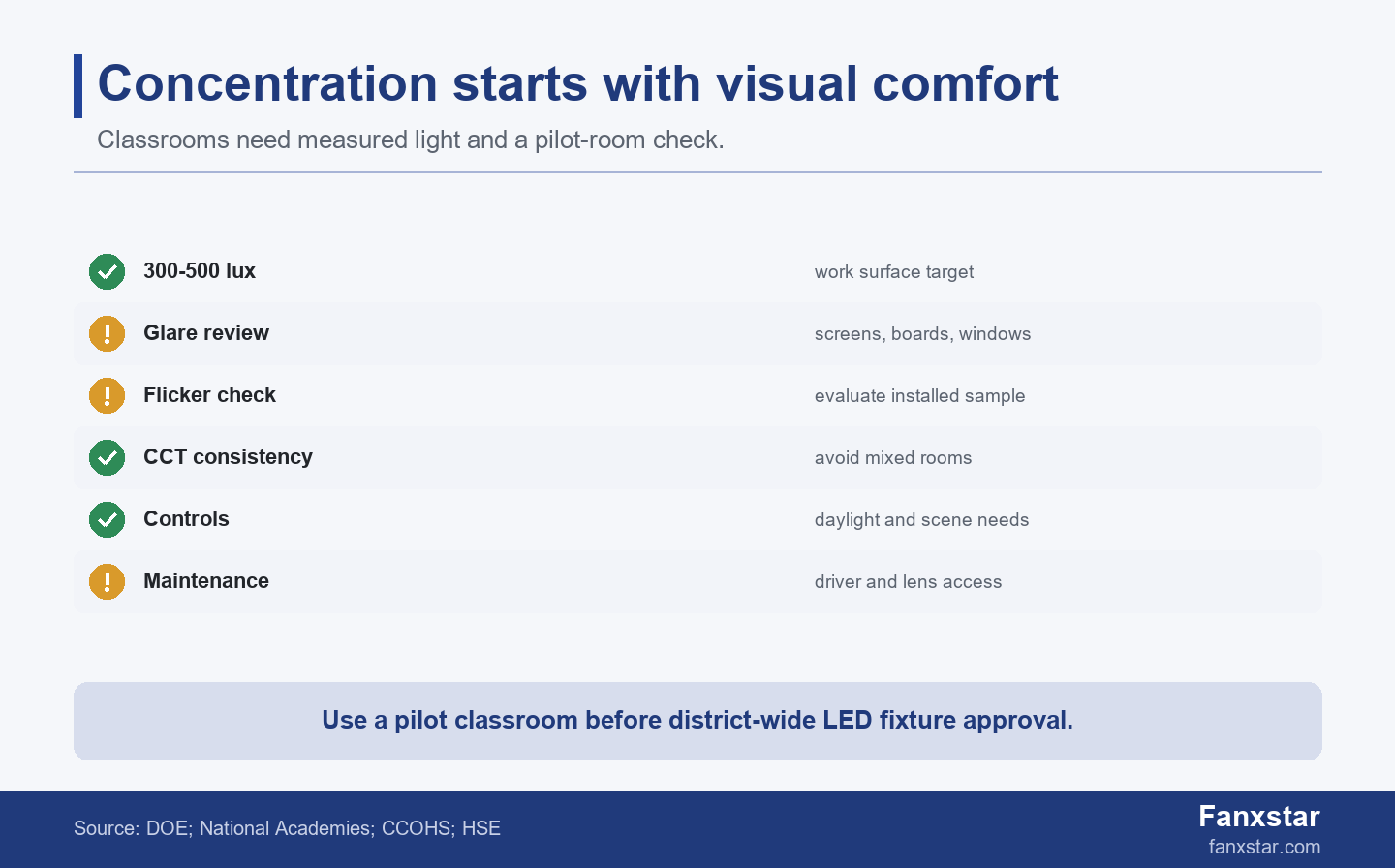
The DOE school lighting specification guide cites an IES classroom target of 30 to 50 footcandles, or 300 to 500 lux, on the work surface and recommends pilot-room evaluation when quality factors such as flicker or glare are hard to judge from paperwork. That is a much safer foundation than exaggerated claims about brain activation or fixed score gains.
Key Takeaways
- Good classroom LED lighting supports concentration by making visual tasks easier and more comfortable, not by guaranteeing academic outcomes.
- A responsible specification checks illuminance, glare, flicker, CCT consistency, color rendering, daylight control, and maintenance access together.
- Pilot classrooms are valuable because glare and flicker can be difficult to judge from datasheets alone.
- Buyers should remove unsupported score-improvement claims and focus on measurable classroom evidence: layout, product data, installed view, controls, and maintenance records.
What lighting can and cannot promise for concentration
Start with visual comfort, not neuroscience hype
Students concentrate better when they can see the task comfortably. That sounds simple, but it covers several real design issues: readable books and papers, visible boards, comfortable screen viewing, enough vertical light for faces, no harsh luminaires in normal sightlines, and no distracting flicker. These factors support attention by removing irritation and uncertainty.
CCOHS lists insufficient light, glare, poor contrast, poor distribution, and flicker as common lighting problems. Those categories are useful for classrooms because a student may not describe the problem as a lighting issue. They may simply squint, avoid a seat, lose focus near a window, or struggle with a reflected board.
The safer claim is that classroom lighting can support concentration when it improves the visual environment. Avoid statements that lighting directly hacks the brain, cures attention problems, or guarantees specific test-score gains. Those claims are weak for a B2B procurement article and can damage trust.
Daylight is useful, but glare control still matters
The National Academies Green Schools chapter is helpful because it reviews daylight and learning evidence with caution. It notes glare distinctions and also points out limits in some daylighting-achievement correlations. This is exactly the tone classroom lighting buyers need: daylight can be valuable, but uncontrolled glare and heat can undermine comfort.
A classroom with windows may still need well-designed electric lighting. Morning sun, whiteboards, tablets, projectors, and glossy printed materials can all create reflections. Blinds, shades, teacher control, fixture placement, and scene settings matter as much as the nominal CCT or fixture wattage.
The specification checklist for classroom LED lighting
Measure the work surface and the installed view
| Design variable | Procurement question | Evidence to request |
|---|---|---|
| Illuminance | Will the work surface be bright enough for reading, writing, and mixed teaching tasks? | Layout calculation, target workplane, measured pilot values. |
| Glare | Can students and teachers see screens, boards, and books without harsh source brightness? | Optic data, luminaire position, window control, mockup observation. |
| Flicker | Does the driver and dimming method remain visually comfortable in real use? | Manufacturer data plus installed pilot-room review. |
| CCT and CRI | Will the room look consistent and will colors appear acceptable? | One CCT plan, CRI data, sample review by school stakeholders. |
| Controls | Can daylight, presentation, cleaning, and after-school use be managed without confusing users? | Scene plan, daylight sensor logic, switch labels, commissioning record. |
| Maintenance | Can the school replace drivers, lenses, and fixtures without disrupting classes? | Product number, warranty, spare parts, access plan. |
DOE school lighting guidance recommends evaluating installed products when flicker or glare are hard to navigate without seeing the product in place. For buyers, that makes the pilot classroom a release gate. It lets teachers and facilities teams compare light level, comfort, CCT, dimming behavior, and maintenance access before a district-wide rollout.
The layout calculation should show maintained illuminance on desks and teaching surfaces, but it should not stop there. Ask for the luminaire location, optic, beam distribution, driver, dimming method, CCT, CRI, mounting height, surface reflectance assumptions, and any daylight sensor logic. If the room includes screens, boards, or glossy surfaces, review them during the pilot.
CCT should support consistency before it supports stories
CCT is often over-marketed. A cooler light does not automatically make a student focused, and a warmer light does not automatically make a classroom calm. The DOE guide’s practical advice is more useful: CCT affects the look and feel of a room, and consistency matters. Mixed CCTs across a classroom can make the environment feel patchy and unprofessional.
For most school projects, the buyer should choose a CCT range with stakeholders, test it in a pilot room, and avoid creating too many fixture variants. If tunable white is specified, the control scenes must be simple enough for teachers to use. A powerful system that is confusing will likely be left in one setting, wasting the design intent.
How to evaluate flicker, glare, and controls before purchase
Flicker is a driver and dimming issue, not only a lamp issue
Flicker risk often appears when the LED driver, dimmer, sensor, or control protocol is changed. A fixture may look acceptable at full output but behave poorly at low dimming levels or under a specific control system. The buyer should evaluate the exact driver and control combination that will be installed, not a similar catalog family.
GSA LED and controls guidance notes that new fixtures optimized for LEDs can control glare and distribution, and that controls may require low-voltage wires or wireless communication. For classrooms, the point is simple: the fixture and the control system should be approved as a package.
A pilot room should include common settings: normal class, presentation, cleaning, daylight-heavy periods, and after-school use. Observe whether transitions are smooth, whether lights buzz or flicker, whether sensor behavior distracts users, and whether teachers can operate scenes without a facilities technician.
HSE human-factors guidance on lighting is written for workplaces rather than schools, but the principle transfers well: different tasks need different lighting levels, and glare, color, and contrast should be considered. A school classroom is also a work environment for teachers, facilities teams, and older staff members. That is why the design should serve both student desks and adult teaching tasks.
The buyer insight is that a school lighting project has at least 5 user groups: students, teachers, facilities staff, cleaners, and after-hours users. A design that works for one group can fail another. For example, a high-output setting may help cleaning after 5 p.m. but feel harsh during screen-based lessons. A dim presentation setting may help projection but make printed handouts harder to read. Scene design should be tested against those real use cases.
According to DOE school lighting specification guidance, the classroom work-surface recommendation cited from IES is 30 to 50 footcandles, or 300 to 500 lux. According to HSE lighting guidance, close accurate work needs different lighting from corridor movement. According to CCOHS lighting ergonomics guidance, glare, flicker, poor distribution, and poor contrast are common lighting problems.
Glare needs the teacher’s view and the student’s view
DLC technical requirements are a useful reminder that LED product evidence should be tied to reporting and classification, but classroom glare review should also include real sightlines. A teacher looks at students, boards, screens, and windows. Students look at books, boards, teachers, laptops, and peers. Each direction can create different glare or reflection problems.
Walk the room from the front, back, corners, and typical seated positions. Look for bright fixture faces, reflections on screens, uneven desk light, dark board areas, and strong contrast near windows. If one row is comfortable and another row is not, the lighting plan needs adjustment before full rollout.
DOE FEMP fixture guidance and ENERGY STAR commercial lighting guidance are not classroom standards, but they keep buyers aware of fixture categories, energy, and operating cost. For a school district, the best LED fixture is not the highest lumen number. It is the fixture that meets the maintained light target, manages glare, fits controls, lowers operating cost, and remains serviceable for years.
The second insight is that maintenance is part of concentration. A classroom with 3 failed drivers, mismatched replacement CCTs, and yellowed lenses will not perform like the pilot room. The specification should name the product number, driver, lens, CCT, CRI, dimming method, warranty, and spare part path so future replacements do not slowly change the room.
According to National Academies review of lighting and human performance, evidence around daylight and student achievement needs careful interpretation rather than simple score promises. According to GSA LED controls guidance, new LED fixtures can be paired with zone-based controls, but controls require wiring or wireless coordination. According to DLC technical requirements, product evidence should follow a reporting pathway rather than rely on a label alone.
A responsible classroom lighting approval workflow
Use a pilot room with measurable pass criteria
A pilot classroom should not be a casual preference test. Set pass criteria before installation: target maintained workplane range, acceptable board visibility, no obvious flicker at common dimming levels, no harsh source brightness from seated positions, one CCT across the room, and simple control behavior. Record measured lux at 9 or more desk locations if the room is typical, and add board or vertical readings where teaching visibility is important.
A practical pilot can use a 2-week observation period. Week 1 checks basic installation, teacher control use, and student-seat visibility. Week 2 checks normal lessons, presentation mode, daylight-heavy periods, cleaning mode, and any after-school use. The verifiable outcome is a room-level pass or fail with a clear limitation: the school tests a small number of rooms before spending the full retrofit budget.
If the school compares 2 fixtures, keep the test fair. Use the same room, same mounting pattern, same control settings, same target CCT, and similar maintained light target. Otherwise the comparison may be about installation differences rather than fixture quality.
Write the procurement file so future rooms stay consistent
The release file should include room type, ceiling height, fixture model, output setting, driver, dimming protocol, CCT, CRI, lens or diffuser, mounting method, control sequence, warranty, and replacement rule. It should also state whether the district allows field-adjustable wattage or CCT switches. Field-adjustable products can help standardize inventory, but only if the final setting is locked and recorded.
For a 20-classroom project, a small inconsistency multiplies quickly. If 5 rooms use 3500 K, 8 rooms use 4000 K, and 7 rooms use mixed replacement products, teachers may experience the building as uneven even when every fixture is technically LED. Procurement discipline protects the learning environment long after the first installation is finished.
The decision rule is to approve the room, not only the fixture. This means the buyer should connect 6 checks before rollout: measured desks, board view, glare, flicker, controls, and maintenance access. In practice, a school can keep the article’s promise modest and still valuable: fewer visual obstacles, clearer teaching conditions, and a better-controlled replacement file.
According to DOE school lighting guidance, CCT options, CRI, dimming performance, optics, voltage, and product number all belong in the specification sheet. That simple document discipline is what keeps a 20-classroom rollout from becoming 20 slightly different lighting experiments.
Where Fanxstar fits in institutional classroom projects
Use platform fixtures when evidence and maintenance matter
Fanxstar is not positioned as a classroom-only brand, but several platform categories can be relevant to institutional spaces that need linear, backroom, service-area, corridor, clean, or weather-resistant lighting. Relevant starting points include LED linear battens, B1 aluminum batten fixtures, M4F fresh linear fixtures, and custom LED lighting options.
The useful RFQ is not ‘make a concentration light.’ It is a measurable brief: classroom size, ceiling type, mounting height, desk layout, target lux, CCT, CRI, glare concern, dimming requirement, control type, driver access, warranty, and pilot-room approval criteria. That lets the supplier respond with a fixture and evidence package rather than a wellness slogan.
FAQ
Can LED classroom lighting improve concentration?
It can support concentration by reducing visual discomfort, glare, flicker, uneven light, and control problems. It should not be presented as a guaranteed academic-performance intervention without project-specific evidence.
What light level is recommended for classrooms?
DOE school lighting guidance cites an IES recommendation of 30 to 50 footcandles, or about 300 to 500 lux, on the classroom work surface. The exact target should be confirmed by the project standard, room use, and maintained-light calculation.
Is 5000K better for student focus?
Not automatically. CCT affects the room’s appearance and should be selected consistently with school input and pilot-room review. A stable, glare-controlled, flicker-aware design is more important than assuming one CCT creates concentration.
Why use a pilot classroom before buying fixtures?
A pilot classroom lets the school evaluate installed light level, glare, flicker, CCT, controls, teacher usability, and maintenance access before purchasing for many rooms. It catches problems that datasheets alone may miss.








