LED junction temperature is not a laboratory detail buyers can leave to the chip supplier. It decides whether a lifetime claim still makes sense after the LED board is mounted inside a sealed luminaire, driven at the selected current, installed in the real ambient temperature, and operated long enough for heat to reach steady state.
The practical buyer question is therefore narrower than “how long does the LED last?” Ask whether the fixture evidence links junction temperature, case temperature, ambient temperature, drive current, thermal path, and the final housing version. If that chain is missing, a 50,000-hour claim may describe an LED package under test conditions rather than the luminaire being purchased.
Key Takeaways
- Junction temperature, often written as Tj, is the LED chip temperature that drives lumen depreciation, color shift, and reliability risk.
- Fixture lifetime should not be inferred from LED package data alone; housing, driver, optics, gaskets, thermal interface, and production assembly all matter.
- Buyers should request thermal evidence at the intended drive current, ambient temperature, mounting orientation, and final housing configuration.
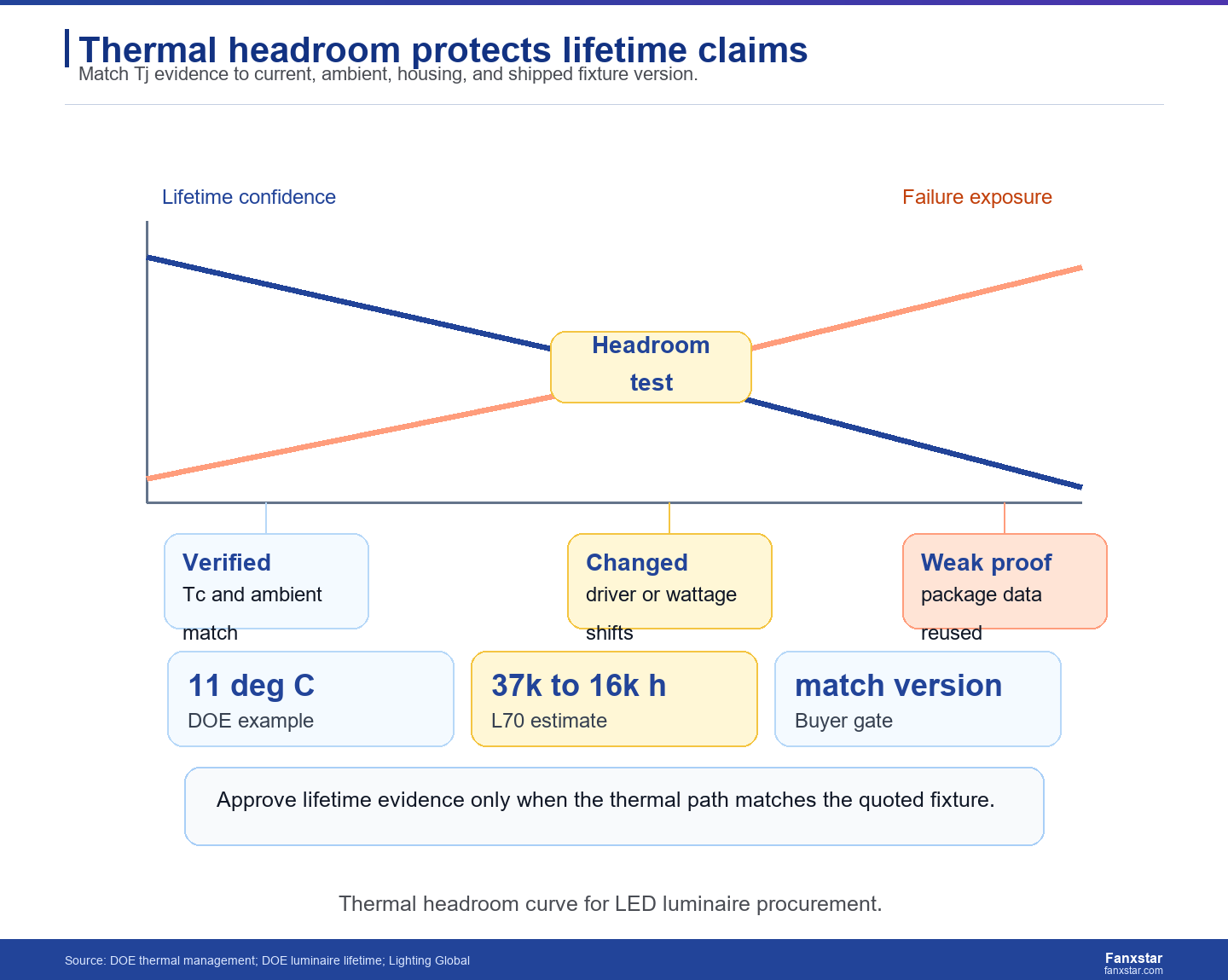
- A small temperature margin can be commercially large: a DOE example showed an 11 deg C Tj increase reducing estimated L70 life from about 37,000 hours to about 16,000 hours.
Why junction temperature changes the buying decision
Tj is not the same as the temperature you feel on the housing
A luminaire can feel moderate on the outside while the LED junction runs much hotter inside. The heat begins at the semiconductor die, moves through the LED package, solder joint, board, thermal interface, metal body, and surrounding air, and only then becomes an external temperature the installer can touch or measure. DOE describes junction temperature as the temperature within the LED device and notes that it is usually calculated from a case or board temperature and the material thermal resistance, not measured directly by touching the fixture.
This distinction matters because a buyer does not purchase a bare LED die. The buyer purchases a finished fixture with seals, diffusers, screws, clips, optics, driver placement, and mounting hardware. If one link in the heat path is weak, the external body may still look acceptable while the board or LED package runs outside the intended condition. In a sealed weatherproof luminaire, a food washdown fixture, a tunnel light, or a parking garage linear fixture, the thermal path is part of the safety and reliability design, not a hidden engineering preference.
Heat changes both light output and lifetime claims
DOE thermal-management guidance for white LEDs explains that LEDs convert a large share of input power into heat that must be conducted away from the die, and that excessive heat affects color, light output, lumen depreciation, and useful life. The same document gives a useful warning example: two identical LEDs operated at the same current but with an 11 deg C difference in Tj showed estimated useful life falling from about 37,000 hours to about 16,000 hours.
The important lesson is not that every 11 deg C difference produces the same result. The lesson is that thermal margin is a real procurement variable. When an RFQ asks for higher wattage, higher ambient rating, narrower housing, thicker diffuser, emergency module, motion sensor, or a custom CCT board, the thermal balance may change. A buyer should not approve the sample on the old lifetime claim unless the supplier can explain why the original thermal evidence still applies.
Lifetime evidence must describe the full luminaire
Package-level data is useful but incomplete
LED package data is important. LM-80 and related lumen-maintenance evidence help buyers compare component behavior under controlled conditions. But component evidence is not the same as fixture reliability. DOE explains that luminaire lifetime depends on the full system, not only lumen maintenance. The point is especially relevant when a supplier promotes a very long L70 number without showing how the driver, housing, optics, thermal interface, and assembly quality are protected.
The DOE luminaire lifetime recommendations make the same broader point: lumen maintenance is only one component of luminaire reliability, and a complete LED luminaire includes thermal, electrical, optical, mechanical, housing, sealant, gasket, driver, and manufacturing considerations. For procurement, that means the evidence request should move from “send LED chip life” to “show how the final luminaire maintains performance in this installed environment.”
Thermal evidence should match the shipped version
The most common documentation gap appears when a test report belongs to a different product version. A supplier may have tested a lower-wattage board, a vented prototype, a different lens, a different LED brand, or a driver mounted outside the heat cavity. The buyer sees a lifetime claim, but the tested heat path is not the same as the shipped heat path. That is how credible components become unreliable procurement evidence.
Ask for the test condition in practical terms: ambient temperature, operating current, input voltage, board type, fixture orientation, housing material, diffuser, driver location, stabilization time, measured case or solder-point temperature, and the formula or data used to estimate Tj. The file does not need to be ornate, but it must be specific enough for an engineer to connect the measured point to the junction-temperature claim.
How to read the thermal path in a specification
Drive current, ambient temperature, and thermal resistance move together
Lighting Global lists LED design, forward current, PCB design, thermal resistances, and ambient temperature as key factors for Tj. That list is useful because it stops buyers from treating one number as magic. A lower ambient rating can hide a weak heat path. A strong aluminum body can be undermined by a poor interface material. A good LED package can be overdriven. A beautiful diffuser can trap heat or force the LED board into a less efficient optical design.
Use a simple scenario estimate to make the issue visible. Suppose a sealed 120 W luminaire turns roughly 80% of input power into heat, so about 96 W must move through the thermal path. If the effective junction-to-ambient thermal resistance is 0.65 deg C per watt, the thermal rise is about 62 deg C above ambient. At a 35 deg C site ambient, the junction would be near 97 deg C before applying any additional local hot-spot assumptions. If engineering changes reduce the effective resistance to 0.45 deg C per watt, the rise becomes about 43 deg C, creating roughly 19 deg C more headroom. This is an illustrative calculation; the real value must come from the LED package data, fixture geometry, and measurement point.
Steady-state measurement is more useful than a short bench check
Lighting Global thermal measurement guidance warns that direct junction-temperature measurement is not normally possible and that thermocouple placement, accuracy, contact quality, and warm-up time affect results. The page also recommends allowing the LED light to warm up to a steady-state temperature and measuring multiple LEDs because some devices in an array can run hotter than others.
For a buyer, this becomes a release rule. Do not rely on a quick power-on photo or a single housing surface reading. Request evidence after stabilization, at the planned ambient or a justified equivalent, and at the hottest LED position. If the application is a freezer vestibule, a 45 deg C plant room, a tunnel ceiling, or an enclosed service corridor, ask how airflow, mounting surface, dust buildup, and nearby heat sources were considered.
Buyer evidence checklist before approving a sample
The checklist should stop weak lifetime claims early
A strong thermal RFQ does not need to become a full engineering textbook. It needs to force the evidence chain into the open before the buyer approves a sample, orders tooling, or accepts a private-label lifetime claim. The following table separates what to ask for from what the evidence should prove.
| Evidence item | What it should show | Buyer decision it supports |
|---|---|---|
| Operating condition | Drive current, wattage, input voltage, ambient temperature, and mounting orientation | Confirms the evidence matches the quoted fixture |
| Measurement point | Tc, solder point, or TMP location, plus thermocouple method and stabilization time | Shows whether Tj was estimated from a meaningful location |
| Thermal path | LED package, board, interface material, housing material, heat sink, and airflow assumptions | Identifies whether a design change invalidates the claim |
| Version control | LED brand, board revision, driver location, lens, seal, emergency module, and sensor option | Prevents a test report from being reused for a different product |
| Lifetime logic | LM-80/TM-21 component evidence plus luminaire-level thermal and driver evidence | Separates component claims from finished fixture reliability |
Thermal design belongs in the product boundary
Thermal design is often discussed only after failures appear, but it should be part of the first product-boundary decision. If a buyer requests a narrower housing, a sealed lens, higher lumen output, a high-CRI board, emergency backup, sensor integration, or a hotter application environment, the supplier should confirm whether the standard thermal path still works. If not, the specification should change before the sample is approved.
For Fanxstar projects, thermal evidence is most relevant when buyers compare waterproof LED lights, vapor tight LED fixtures, linear lighting platforms, and custom LED lighting options for industrial spaces where heat, dust, humidity, and long operating hours combine. The right starting point is not the highest nominal wattage. It is the fixture platform that can keep the LED board, driver, seals, and optics within a credible operating boundary.
Warranty language should follow the thermal boundary
Thermal evidence also protects the warranty conversation. A warranty period is not very meaningful if the supplier has not defined the ambient temperature, daily operating hours, mounting orientation, driver loading, and allowable component substitutions behind that promise. A five-year or seven-year warranty in a 25 deg C test environment does not automatically describe a fixture mounted above a hot production line, inside a poorly ventilated canopy, or near equipment that raises the local ambient.
Buyers should therefore connect thermal documents with the commercial warranty file. Ask which temperature condition is assumed, whether lumen maintenance and driver failure are treated separately, whether the warranty changes for enclosed or high-ambient locations, and whether the supplier must approve substitutions. This does not make the RFQ more complicated for its own sake; it prevents a dispute where the buyer believed the warranty covered the installed condition while the supplier believed the product was used outside the thermal evidence boundary.
A practical release note can be short: “Thermal evidence and warranty apply to the tested fixture version at the stated ambient, mounting orientation, and drive current.” That sentence gives purchasing, engineering, and after-sales teams the same reference point when a project later changes wattage, driver, lens, or installation environment.
FAQ
What is LED junction temperature?
LED junction temperature is the temperature at the semiconductor junction where light is generated. Buyers cannot usually measure it directly in a finished fixture, so it is estimated from a case, solder-point, or board temperature plus thermal-resistance data.
Is a cooler housing proof of a cooler LED chip?
No. A cooler exterior can still hide a hot LED junction if the internal thermal path is poor. Ask for the measurement point, stabilization time, and calculation method before trusting a surface-temperature impression.
Can LM-80 or TM-21 prove total luminaire lifetime?
Not by itself. LM-80 and TM-21 help characterize LED component lumen maintenance, but complete luminaire reliability also depends on driver, optics, thermal path, seals, housing, assembly, and installation conditions.
When should a buyer request new thermal evidence?
Request review or retesting when wattage, LED board, driver, lens, housing, seal, emergency module, sensor option, mounting orientation, or ambient temperature changes. Those changes can alter the thermal path enough to weaken old evidence.
What should be written into the RFQ?
State the target ambient temperature, wattage, lumen output, mounting orientation, fixture version, expected operating hours, and evidence required for Tc or solder-point temperature. Also ask whether the shipped version matches the tested version.