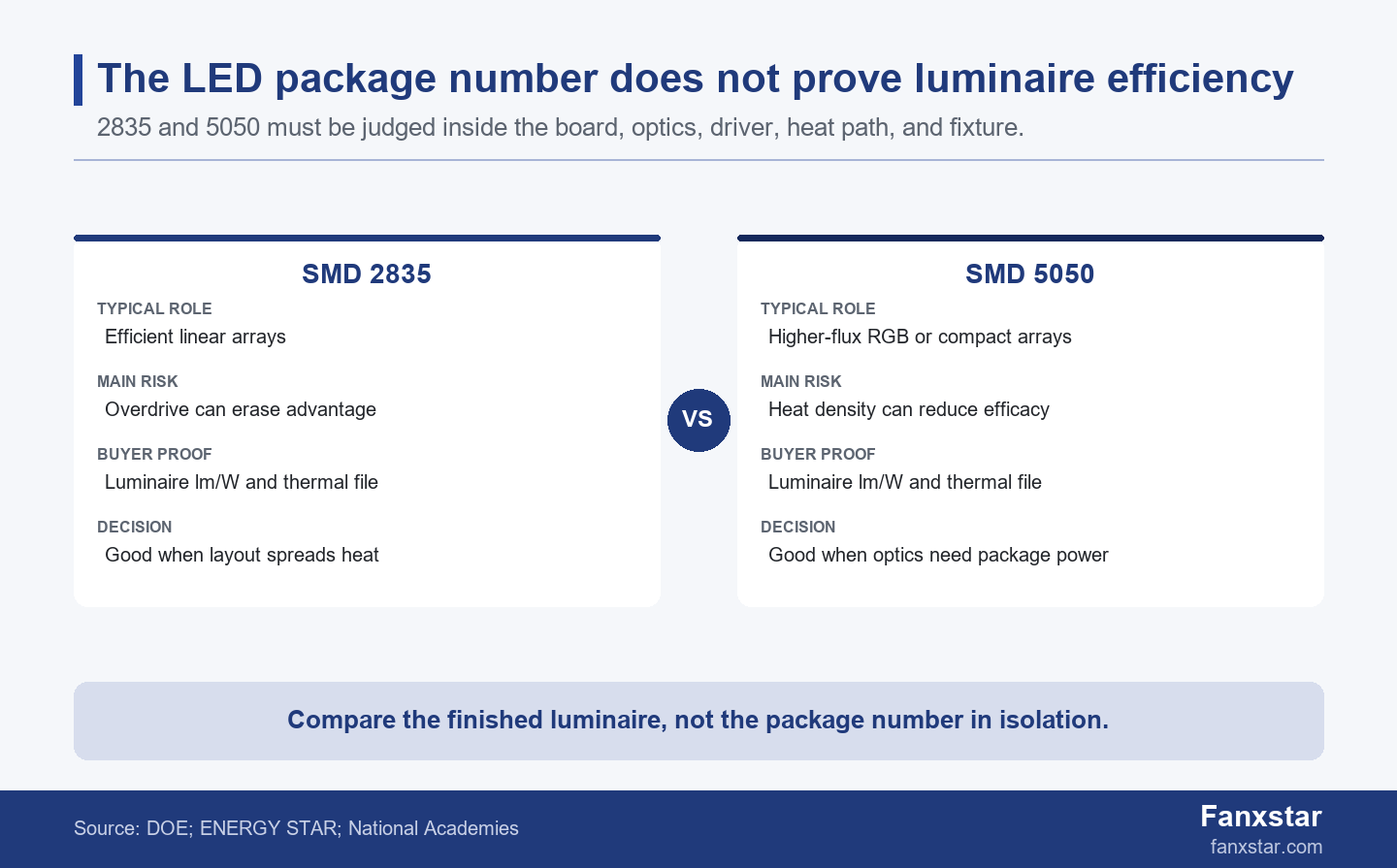
SMD 2835 is not automatically more efficient than SMD 5050, and 5050 is not automatically brighter in a useful way; efficiency is proven at luminaire level through drive current, thermal path, optics, driver loss, and measured output. The buyer should compare the finished LED fixture at the required output, temperature, optics, and driver condition, not the package family in isolation.
According to ENERGY STAR luminaires specification material, finished luminaires are evaluated for performance requirements such as efficacy and lumen maintenance, so at least 2 product-level measures sit above the LED package number. That product-level approach is exactly what chip comparisons often miss: the LED package is only one part of the system that becomes light delivered to the space.
SMD 2835 and SMD 5050 are package families, not complete luminaires. A well-designed 2835 board can be very efficient in linear and area-lighting applications. A well-designed 5050 board can be useful when higher flux density, RGB options, or compact optical geometry matters. Either package can perform poorly when it is overdriven, overheated, paired with inefficient optics, or placed in the wrong fixture body.
Key Takeaways
- SMD 2835 is often efficient in white-light linear arrays, but that advantage depends on drive current, thermal path, optics, and fixture design.
- SMD 5050 can be useful for higher-flux packages, RGB or color applications, and compact optical layouts, but heat density must be controlled.
- The reliable efficiency comparison is finished luminaire lm/W at the target output, not package family, catalog wattage, or LED count.
- Thermal management, driver loss, diffuser loss, CCT, CRI, binning, and lumen maintenance can change the practical result.
- Fanxstar buyers should request fixture-level test evidence before approving a 2835 or 5050 platform for weatherproof, linear, sensor, or custom ODM projects.
Why the Package Number Alone Cannot Prove Efficiency
Luminaire efficacy is the useful buyer metric
According to DOE LED Basics, LEDs offer the potential to cut general lighting energy use nearly in half by 2030, but a buyer purchases a finished product, not a bare chip. The useful comparison is luminaire efficacy: delivered lumens per watt from the finished fixture under the intended test condition. That includes LED package performance, board layout, driver loss, optics, diffuser, housing, and thermal path.
According to ENERGY STAR LED lighting education, LED lighting quality and performance depend on product design, which gives buyers 1 central reason to ask for finished-fixture evidence rather than a package label. A cheap board with many efficient packages can lose the advantage through heat, poor driver efficiency, low-grade diffuser material, or badly matched optics. A higher-power package can look worse on a spec sheet and still be the right choice if it produces the needed beam with fewer optical losses.
The first rule is therefore simple: never approve a luminaire because the quote says 2835 or 5050. Ask what the finished fixture produces at the target wattage, CCT, CRI, beam, ambient temperature, and enclosure condition. If the supplier cannot provide fixture-level evidence, the package claim is not enough.
Thermal behavior can erase a package advantage
According to DOE thermal management paper for white LEDs, junction temperature is affected by 3 inputs: ambient temperature, drive current, and thermal path. That is the key reason chip comparisons become unreliable. A package that looks efficient in ideal conditions can lose performance when packed into a sealed housing, driven hard, or mounted on a weak board.
SMD 2835 packages are often used in distributed white-light arrays where heat can be spread across the board. SMD 5050 packages are larger and can carry more output per package in some designs, but that can concentrate heat. Neither package wins automatically. The board current, metal-core PCB or FR4 design, housing material, airflow, driver heat, ambient temperature, and sealed enclosure all change the result.
| Evidence item | Why package number is not enough | What to compare |
|---|---|---|
| Luminaire lm/W | Package efficacy can be lost in optics, driver, and heat | Finished fixture report at target output |
| Drive current | Overdriving can reduce efficiency and life | Board current and thermal design at normal operation |
| Thermal path | Junction temperature affects performance and reliability | PCB, housing, ambient limit, and heat-sink path |
| Optical design | Lens and diffuser losses change delivered light | Beam, uniformity, glare, and actual delivered lumens |
| Lumen maintenance | Initial brightness does not prove long-term output | L70 or maintenance evidence where available |
| Application fit | A high-efficacy board can still be wrong for the job | Mounting, IP rating, CCT, CRI, and service access |
Based on this evidence list, the most useful comparison is not chip size. It is the fixture-level evidence file: photometric report, electrical data, thermal limit, driver data, lumen-maintenance basis, and application condition.
What SMD 2835 Usually Does Well
Distributed white-light arrays can favor 2835
SMD 2835 is commonly used in white-light strips, panels, linear luminaires, and other designs where many packages can distribute light and heat across a larger board. This can support good efficacy when the design uses appropriate current, driver efficiency, PCB quality, and optics. The package can be a strong choice for linear lighting and sealed luminaires when thermal design is conservative.
The advantage is not automatic. If the supplier drives the packages too hard to hit a lumen target with fewer LEDs, the efficiency and life advantage can narrow. If the diffuser absorbs too much light or the driver is inefficient, the finished fixture may underperform despite using a package family buyers associate with efficiency. If the product needs a narrow high-intensity beam, the distributed package layout may not be the best optical path.
According to DLC solid-state lighting technical requirements, commercial LED qualification covers multiple product categories and performance evidence, so buyers should compare tested luminaires in the relevant use case instead of comparing package names outside the fixture.
The main 2835 risk is assuming efficiency survives every design change
A buyer may start with a 2835 design because it appears efficient and economical, then request changes: higher output, warmer CCT, higher CRI, waterproof housing, motion sensor, emergency pack, longer warranty, or different diffuser. Each change can affect thermal behavior and delivered light. The original package advantage may not survive the final product configuration.
Illustrative calculation: if a fixture target is 6,000 lumens, a 150 lm/W finished luminaire needs 40 W at the fixture level, while a 120 lm/W fixture needs 50 W. Across 1,000 fixtures, the difference is 10 kW whenever the lights run at full output. At 10 hours per day and 300 days, that is 30,000 kWh per year. The calculation is a scenario estimate, not a claim about every 2835 or 5050 product; it shows why finished luminaire efficacy matters.
The buyer decision from the calculation is clear. A small lm/W difference at package level means little unless it survives the whole fixture. A meaningful lm/W difference at finished luminaire level can become a real operating cost in large projects.
What SMD 5050 Usually Does Well
Compact output and color options can justify 5050
SMD 5050 is often associated with larger package size, higher output per package in some designs, and color-mixing options such as RGB products. That can make it useful when the fixture needs compact sources, color effects, or a particular optical geometry. In some luminaires, fewer larger packages may simplify the optical layout or support a beam shape that many smaller packages cannot achieve as cleanly.
According to the National Academies solid-state lighting assessment, solid-state lighting performance is a system-level technology issue, which gives buyers 1 strong reason to resist chip-only conclusions. That is the right frame for 5050 as well. The package may support a useful design, but the system still has to control heat, driver efficiency, optics, color quality, and reliability.
| Assumption | 2835-style design | 5050-style design | Decision meaning |
|---|---|---|---|
| Board spreads heat across many points | Usually favorable | May be unnecessary | The efficient array can win if optics and driver fit |
| Fixture needs compact high-flux source | May need more packages | Can fit better | The bigger package can win if heat is controlled |
| RGB or color mixing is required | Often not the first choice | Often more available | Package role may outweigh pure white efficacy |
| Sealed high-temperature housing | Needs thermal check | Needs stronger thermal check | Thermal evidence decides, not package name |
The table shows that 5050 should not be rejected simply because a buyer has heard that 2835 is more efficient. If the application needs compact output, color mixing, or a specific optical path, 5050 may be the better package. The proof still has to come from the finished luminaire.
The main 5050 risk is heat density
A larger or higher-output package can concentrate heat. In a sealed luminaire, that heat must travel through the board, housing, air gap, and mounting environment. If the thermal path is weak, the fixture may lose efficacy, shift color, reduce lifetime, or require lower drive current than the catalog promise implied.
The buyer should ask for operating current, board material, thermal path, housing material, ambient temperature limit, lumen-maintenance basis, and finished fixture test data. If the fixture is weatherproof, vapor tight, waterproof, or used in high-temperature service areas, the thermal question becomes more important because sealed designs can trap heat.
This is also where price comparisons can mislead. A 5050 design with fewer packages may look economical in the bill of materials, but if it requires a stronger housing, better driver, improved PCB, or lower drive current to control heat, the real cost comparison changes.
How to Compare 2835 and 5050 in a Real Luminaire
Use a finished-product release checklist
According to DOE FEMP commercial and industrial LED purchasing guidance, commercial and industrial LED purchasing guidance includes luminaire categories such as linear ambient, high-bay, low-bay, and troffer products, giving buyers at least 4 finished-product buckets to compare. That is the right discipline for chip comparisons. Ask for the finished luminaire report at the required CCT, CRI, wattage, beam, diffuser, driver, and ambient condition.
A practical release checklist should include fixture lm/W, photometric file, driver efficiency, operating current, board design, housing material, thermal limit, CCT and CRI, lumen maintenance, IP rating if relevant, and the exact product version. If the buyer changes diffuser, housing, driver, or output level after the test, the evidence should be reviewed again.
For high-volume projects, compare total system energy and maintenance effect, not only unit price. If one design saves a few watts per fixture at the same delivered light level and reliability, it can matter. If that design creates glare, poor uniformity, weak sealing, or thermal stress, the energy benefit can disappear in field cost.
Ask what the application is trying to optimize
A supermarket display light may optimize color quality and product appearance. A warehouse linear fixture may optimize lm/W and low maintenance. A parking garage luminaire may optimize durability, sensor compatibility, and uniformity. A waterproof or vapor tight fixture may optimize sealing, thermal control, and service life. The best package depends on which job the fixture must do.
The buyer should also separate initial efficacy from maintained value. A fixture that starts efficient but runs too hot may not be the best long-term choice. A fixture with slightly lower initial efficacy may be better if it has stronger thermal control, more stable driver behavior, better optics, and a more reliable enclosure.
According to International Trade Administration import documentation guidance, common shipment records can include invoices, bills of lading, packing lists, insurance proof, and certificates of origin, giving LED buyers at least 5 documents that should describe the actual product being imported. For LED fixtures, that discipline means the approved sample, BOM, driver, LED package, lens, test report, label, and invoice should describe the same product version.
Where Fanxstar Fits in LED Package Selection
Package choice should follow the fixture platform
Fanxstar buyers should connect package selection to the product platform: LED linear lighting platforms, weatherproof LED lighting product platforms, IP65 and IP66 waterproof LED lights, vapor tight LED light fixtures, and custom LED lighting design options. The LED package is one decision inside a fixture architecture, not a standalone purchasing conclusion.
For a linear fixture, 2835-style distributed arrays may be attractive when the target is efficient white light and smooth diffusion. For compact high-output or color products, 5050-style packages may have a role. For sealed weatherproof fixtures, thermal path and driver choice can matter more than package preference. Fanxstar should receive the application, wattage target, optical requirement, CCT, CRI, ambient temperature, IP rating, and target market before recommending a platform.
The safest buyer language is not 2835 is better or 5050 is brighter. The safer language is: quote the finished luminaire at this output, CCT, CRI, beam, enclosure, driver, and ambient condition, then show the test evidence. That keeps the project focused on delivered performance.
Send the evidence request before sample approval
If the project needs nonstandard CCT, optics, sensors, housing, wiring, or a private-label platform, use Fanxstar custom LED lighting ODM service to define the sample boundary. The buyer should ask which LED package is proposed, why it fits the fixture, what current it will run at, how heat leaves the board, and what fixture-level test data will be available.
A useful sample approval packet includes the LED package family, board layout, driver model, wattage, CCT, CRI, optics, diffuser, housing, IP target, thermal limit, photometric report, and installation condition. If production substitutes the package, driver, or diffuser, the buyer should request a new evidence review before release.
That process protects both sides. The supplier does not have to defend a package label as a universal answer, and the buyer does not have to guess whether a component-level claim will survive the real fixture.
FAQ
Is SMD 2835 more efficient than SMD 5050?
SMD 2835 is often efficient in distributed white-light arrays, but it is not automatically more efficient in every fixture. The result depends on drive current, thermal path, optics, driver loss, diffuser loss, CCT, CRI, and the finished luminaire test result. Buyers should compare fixture lm/W, not package family alone.
Is SMD 5050 brighter than 2835?
SMD 5050 can provide higher output per package in some designs and is common in certain RGB or compact-source applications. Brighter is not always better, because heat density, optics, glare, and driver behavior can reduce useful performance. The buyer should compare delivered lumens, beam quality, and thermal evidence in the final fixture.
Which LED package is better for linear lighting?
For many white-light linear fixtures, a distributed 2835-style array can be a practical choice because it spreads light and heat across the board. Some compact or special optical designs may use 5050-style packages effectively. The correct choice depends on fixture length, diffuser, target output, thermal path, CCT, CRI, driver, and installation environment.
What evidence should buyers request for LED chip efficiency?
Request finished luminaire efficacy, photometric data, driver model, operating current, board layout, thermal limit, CCT, CRI, diffuser or lens specification, lumen-maintenance basis, and the exact product version. Component claims are useful only when they connect to the tested fixture that will be installed or shipped.