China lighting prices will not move in one direction because wages, automation, tooling, components, and inspection risk move at different speeds. A buyer should not ask whether China will stay cheap. The better question is which part of the LED lighting order is exposed to human labor, which part can be automated, and which part still needs engineering judgment.
According to IFR World Robotics 2025 data, China represented 54 percent of global industrial robot deployments in 2024 and installed 295,000 industrial robots. According to China wage data from the National Bureau of Statistics, average annual wages in urban private units reached 69,476 yuan in 2024. Those 2 facts explain why lighting price trends are now a negotiation about process design, not only a negotiation about hourly labor.
Key Takeaways
- Rising labor rates do not automatically mean every China-made LED fixture will become more expensive.
- Automation helps most when the product is stable, repeatable, measurable, and produced in enough volume to justify tooling.
- Custom LED lighting can still become more expensive if each order changes driver, housing, optics, label, cable, or inspection criteria.
- Fanxstar buyers should ask suppliers to separate labor exposure, automation readiness, component risk, and ODM change cost before accepting future price claims.
Why Labor Rates Alone Do Not Explain Future Lighting Prices
The wage story is real, but it is not the whole cost model
According to IMF wage metadata for China, China’s National Bureau of Statistics is responsible for nationwide average wage data, and private-enterprise wage data are collected through survey methods. That matters because buyers need to distinguish official wage trend, factory wage pressure, overtime, regional minimum wage, and the actual labor content inside a lighting product.
According to China Briefing minimum wage guidance, as of April 2026 Shanghai’s monthly minimum wage is reported at RMB 2,740 while Beijing’s hourly minimum is reported at RMB 27.7. Those figures do not directly price a tri-proof light, but they show why labor-sensitive tasks such as manual assembly, packing, line inspection, and rework cannot be ignored in long-term price planning.
Automation changes the slope of price increases, not the need for evidence
According to IFR robot density data, China reached 470 industrial robots per 10,000 manufacturing employees in 2023 and doubled its robot density within four years. This helps explain why many Chinese suppliers can absorb some wage pressure without simply raising unit prices. The factory may automate soldering, testing, adhesive dosing, packaging, or data capture while still using people for flexible assembly and final judgment.
The buyer mistake is assuming automation lowers every quote. Automation can lower repeatable process cost, but it can also add capital cost, fixture tooling, programming work, maintenance, and minimum order expectations. A buyer should ask whether the automation is already installed, whether the quoted product can use it, and whether the savings depend on a stable production version.
Where Automation Helps LED Lighting Buyers
Repeatable products get the most benefit
| Cost driver | What can rise | What automation can offset | Buyer evidence |
|---|---|---|---|
| Direct labor | assembly, packing, inspection hours | repeatable fixtures, automated test | process map and labor exposure |
| Engineering | ODM changes and sample loops | standardized platforms | change log and tooling boundary |
| Quality | rework, inspection, returns | test fixtures and data capture | inspection plan and defect history |
| Capital | robots, tooling, depreciation | stable volume and repeat orders | amortization assumption |
According to World Bank China Economic Update, China growth was projected to moderate from 5.0 percent in 2024 to 4.0 percent in 2026 as trade restrictions and uncertainty weigh on exports, manufacturing investment, and labor demand. In that environment, factories prefer repeatable orders that make capital investment more predictable. A stable LED lighting platform is easier to automate than a custom order that changes every shipment.
For a buyer, the useful supplier question is not whether the factory uses robots. It is which steps are automated for this product family. Automated screw driving, lens placement, current testing, burn-in data capture, or packaging check can improve repeatability only when the product design and inspection standard are stable enough for the equipment to do meaningful work.
Inspection automation can matter more than assembly automation
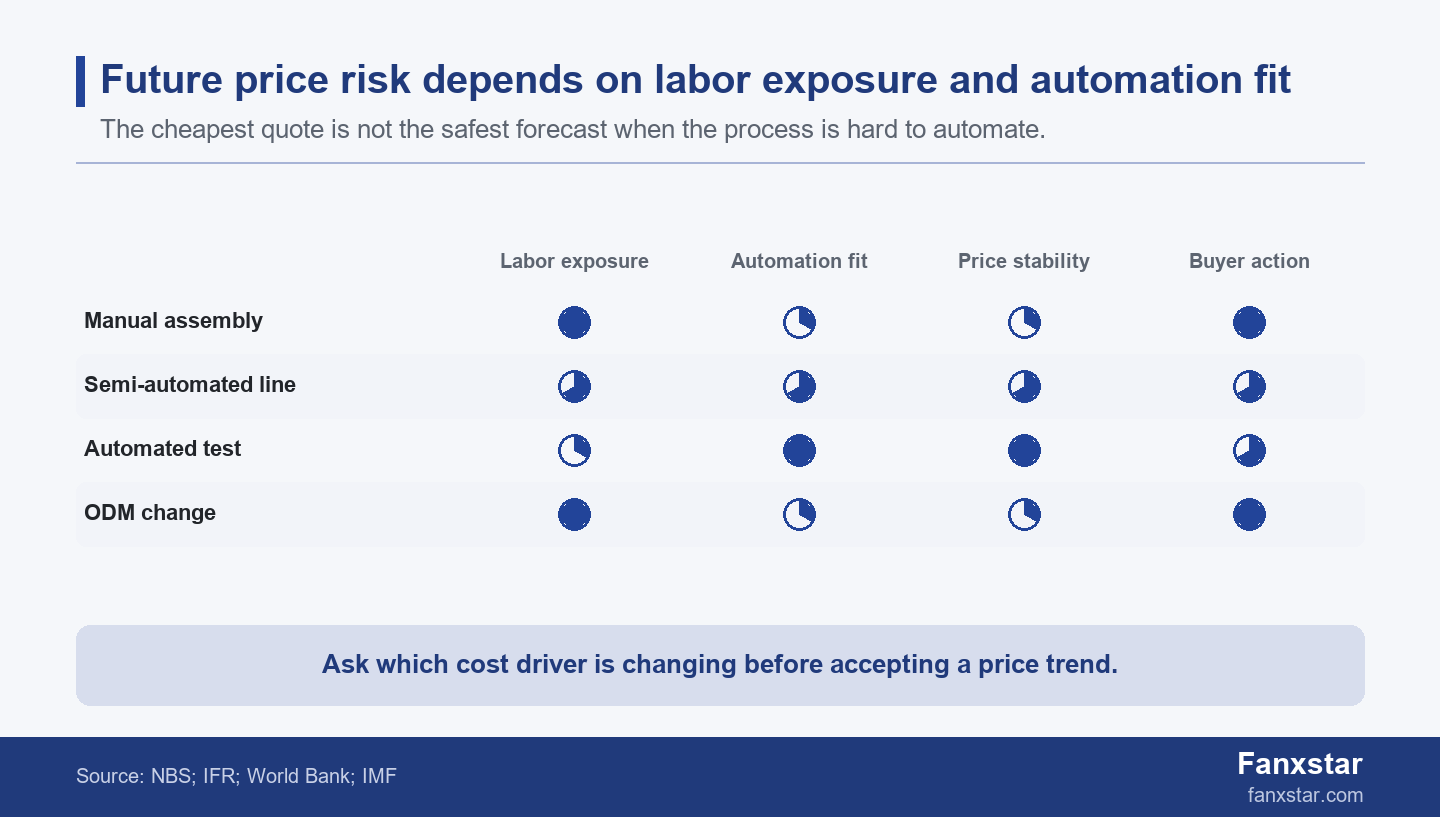
In LED lighting, automation value often appears in test and inspection rather than in a dramatic robot arm. A calibrated electrical test fixture, barcode traceability, photometric sampling, driver programming log, or automated leakage test can reduce hidden cost by catching defects early. The buyer sees this as fewer sample loops, fewer shipment disputes, and clearer warranty boundaries.
World Bank China country materials are useful macro context because they remind buyers that China price planning sits inside a larger growth and structural-transition story. The procurement decision still has to be made at process level: suppliers may defend price by showing better throughput, but the buyer should verify whether the process actually protects quality.
Where Customization Can Push Prices Up
ODM changes reset the automation advantage
Customization can be worth the cost, but it weakens the simple automation story. A changed LED board, CCT, lens, sensor, cable entry, housing, label, emergency function, or certification market may require new tooling, new fixtures, new inspection plans, and more manual judgment. In custom LED lighting design, price stability depends on freezing the change boundary before the supplier quotes mass production.
A buyer should ask for a change-cost table rather than a single future-price promise. The table should separate one-time engineering, tooling, sample fee, unit labor, unit component cost, inspection cost, and certificate or label change. Without that split, a low first quote can become expensive after the first sample reveals that the automation path does not fit the customized design.
Volume determines whether automation savings reach the buyer
A supplier may automate a product family but still price a low-volume ODM order conservatively. The reason is simple: the factory must pay for setup, fixture changeover, programming, quality checks, and operator training. If the order is small or volatile, the supplier may not pass automation savings into the unit price because the savings are consumed by setup risk.
This is why long-term price negotiation should include forecast volume, platform stability, shipment cadence, and allowed substitutions. A repeat buyer with stable drawings and predictable volumes can ask for a stronger automation-backed price roadmap. A buyer changing design every order should expect the supplier to protect margin through engineering or setup charges.
How to Read Future Price Trend Claims From Suppliers
Ask which part of the cost is being forecast
A useful forecast separates wage-sensitive cost, component-sensitive cost, energy and logistics cost, tooling depreciation, and inspection cost. Labor may rise while an automated test station lowers rework. Component prices may fall while certification and documentation demands rise. A supplier who says prices will go up or down without naming the cost driver is not giving the buyer enough information for planning.
According to ILO Global Wage Report 2024-25, minimum wages in 45 percent of 160 countries remained below inflation, which shows why nominal wage numbers alone can mislead procurement teams. Buyers need to compare nominal labor cost, real purchasing pressure, productivity, automation, and supplier process maturity before drawing a price conclusion.
Use a 4-file evidence request before locking a long-term price
Fanxstar buyers can make the conversation practical by asking for 4 files: process map, automation boundary, sample-change log, and price-driver table. For weatherproof LED lighting, linear LED lighting, and vapor tight LED fixtures, the supplier should explain which steps are manual, which are automated, which are inspected by fixture, and which changes reopen the quote.
Send Fanxstar the target product family, annual volume, drawing stability, target market, customization needs, and price horizon through Fanxstar customization. The useful deliverable is a platform and process recommendation, not a vague answer that China labor will rise or automation will make everything cheaper.
Illustrative Price-Risk Scenario for Lighting Buyers
A stable platform can turn automation into a real price buffer
Use a simple scenario estimate. Suppose a repeatable linear fixture order needs 8 minutes of manual assembly, packing, and electrical checking per unit before the supplier standardizes jigs and test capture. If process changes remove 2 minutes per unit on a 20,000-piece annual program, the buyer has removed 40,000 manual minutes, or about 667 labor hours, from the exposure base. The number is illustrative, but the direction is useful: automation matters most when the product is stable enough for the saved minutes to repeat thousands of times.
The same saving is much weaker on a 600-piece custom batch with a new diffuser, new label, new cable exit, and new certification file. The factory may save seconds in one station while spending hours on setup, engineering review, first-article checking, and quality discussion. That is why price forecasts should state the annual volume and version-stability assumption. Without that assumption, a future price looks precise while the process behind it is still moving.
ODM variation can erase a labor-saving claim
A buyer can use 3 release questions before trusting a supplier’s automation story. Is the quoted product the same version that runs on the automated process? Which design changes force the factory back to manual work or new fixtures? What inspection record proves the automated process catches the defects that used to be found by operators? These questions convert automation from a sales claim into a production evidence request.
The decision implication is not to avoid customization. It is to separate stable platform value from change-driven engineering cost. For Fanxstar projects, a good price discussion names the product family, the planned annual quantity, the change boundary, and the sample evidence before negotiating the long-term unit price. That gives the buyer a price roadmap that can survive wage pressure, automation investment, and the next ODM revision.
Buyer Checklist for 2026 Price Planning
Turn the forecast into a purchasing rule
Use a 6-step rule. First, map labor-heavy steps. Second, identify which steps are already automated. Third, confirm the product can actually use those automated steps. Fourth, separate one-time engineering from unit cost. Fifth, freeze ODM changes before mass-production price negotiation. Sixth, define when a design change resets the price agreement.
This rule protects both sides. The buyer avoids false savings from a quote that ignores engineering work. The supplier avoids being forced to absorb design changes that were never part of the automated cost model. In a market where China has both rising wage pressure and world-leading robot adoption, the winning procurement habit is cost-driver clarity.
What to compare between suppliers
Compare suppliers by process stability, test evidence, change-control discipline, and willingness to show cost drivers. A factory with higher wages but stronger automation and inspection may be safer than a cheaper factory that relies on manual rework. Conversely, a highly automated factory may be the wrong fit for a small custom order that needs flexible engineering attention.
The best future price is not always the lowest quoted number today. It is the price that remains explainable after wages change, robots are added, components fluctuate, and the buyer asks for the next customization. That is the price trend B2B lighting buyers can actually manage.
FAQ
Will China labor costs make LED lights more expensive?
China labor costs can push some LED lighting prices higher, especially for manual assembly, packing, inspection, and rework. The effect is not automatic because automation, platform standardization, process data, and component changes can offset or amplify the cost. Buyers should ask which specific process step is changing before accepting a forecast.
Does factory automation always lower lighting prices?
Factory automation does not always lower lighting prices because equipment, tooling, programming, maintenance, and setup costs must be recovered. Automation helps most when the product is stable, repeatable, and produced in enough volume. For low-volume ODM orders, customization and inspection work can consume much of the expected saving.
What should buyers ask before signing a long-term price?
Buyers should ask for a process map, automation boundary, labor-exposure estimate, change-cost table, inspection plan, and volume assumption before signing a long-term price. The supplier should explain when driver, lens, housing, label, cable, sensor, or certification changes reopen the quote.
How can Fanxstar help with automation-related pricing?
Fanxstar can help by mapping the requested lighting product to an existing platform, identifying which steps are stable enough for automated testing or repeatable assembly, and separating one-time ODM cost from unit price. Send volume, drawing, target market, customization needs, and price horizon before asking for a future-price roadmap.