A Ni-Cd vs LiFePO4 emergency battery decision is a total-cost and evidence decision because the pack must support emergency runtime, charging behavior, replacement labor, disposal handling, and ambient-temperature reliability. A buyer who compares only pack price can choose the cheaper line item and still pay more across a building portfolio because emergency battery cost appears again in replacement labor, test failure, disposal handling, documentation, and downtime.
According to IEC 60598-2-22:2021, the emergency-luminaire standard covers emergency power supplies not exceeding 1,000 V and the 2021 edition introduced new lithium battery requirements. According to NFPA emergency lighting guidance, emergency lighting is designed to illuminate automatically for at least 90 minutes after normal power is lost. The practical question is therefore not which chemistry sounds modern; it is which pack, charger, fixture body, and test record can still prove the emergency function years after installation.
Qualified electrical and life-safety professionals should confirm local code requirements, commissioning, inspection, and replacement intervals. For procurement, the useful decision is to compare Ni-Cd and LiFePO4 as installed emergency-lighting systems, not as loose battery chemistries.
Key Takeaways
- Ni-Cd can look cheaper at purchase, but its total cost depends on replacement frequency, labor access, disposal handling, and whether the pack still passes emergency-duration tests.
- LiFePO4 can reduce replacement cycles in many LED emergency lighting projects, but it needs the right charger, protection circuit, temperature range, and certification scope.
- A 90-minute emergency requirement turns battery choice into a runtime-evidence question, not a catalog-voltage question.
- Cadmium and lithium chemistries create different environmental and shipping obligations, so disposal and documentation belong in the RFQ.
- Fanxstar buyers should define emergency mode, housing environment, voltage, battery target, testing method, and market certificate route before approving a battery pack change.
Why Initial Pack Price Misleads Emergency Lighting Buyers
The battery pack is only one part of the emergency function
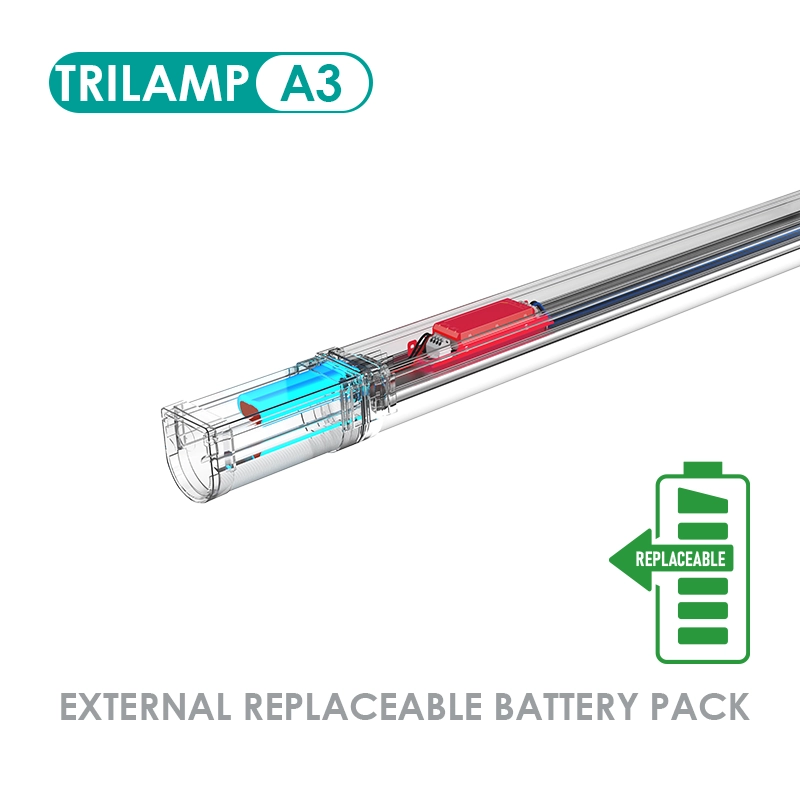
A self-contained emergency luminaire is a small power system. It has a normal LED driver, emergency driver or inverter logic, battery pack, charger, indicator, test switch or self-test function, thermal path, enclosure, and installation condition. If the battery chemistry changes, more than the cell changes. Charging voltage, charge cutoff, battery protection, heat, label data, and certificate evidence may also change.
According to Battery University on LiFePO4 chemistry, LiFePO4 cells use about 3.20 to 3.30 V nominal voltage. According to Battery University on charging LiFePO4, some lithium systems can be damaged or made less safe by treating float charging as if all chemistries behave the same. That is why a LiFePO4 retrofit cannot be approved simply because the pack fits the enclosure.
Ni-Cd has a long history in emergency lighting because it tolerates certain standby and abuse conditions well. LiFePO4 attracts buyers because it can offer longer service life, lower weight for the same usable energy in many designs, and no cadmium. Both statements can be true. The decision turns on the product design, operating temperature, charge system, inspection plan, and local compliance route.
Replacement labor can exceed the chemistry price difference
The hidden cost line is access. Replacing a pack in a corridor bulkhead is easy compared with replacing packs in high ceilings, parking decks, tunnels, cold rooms, dusty industrial spaces, or leased facilities that require off-hour work. If a cheaper pack triggers one additional replacement visit across hundreds of fittings, labor, lift rental, access permits, and retesting can erase the purchase saving.
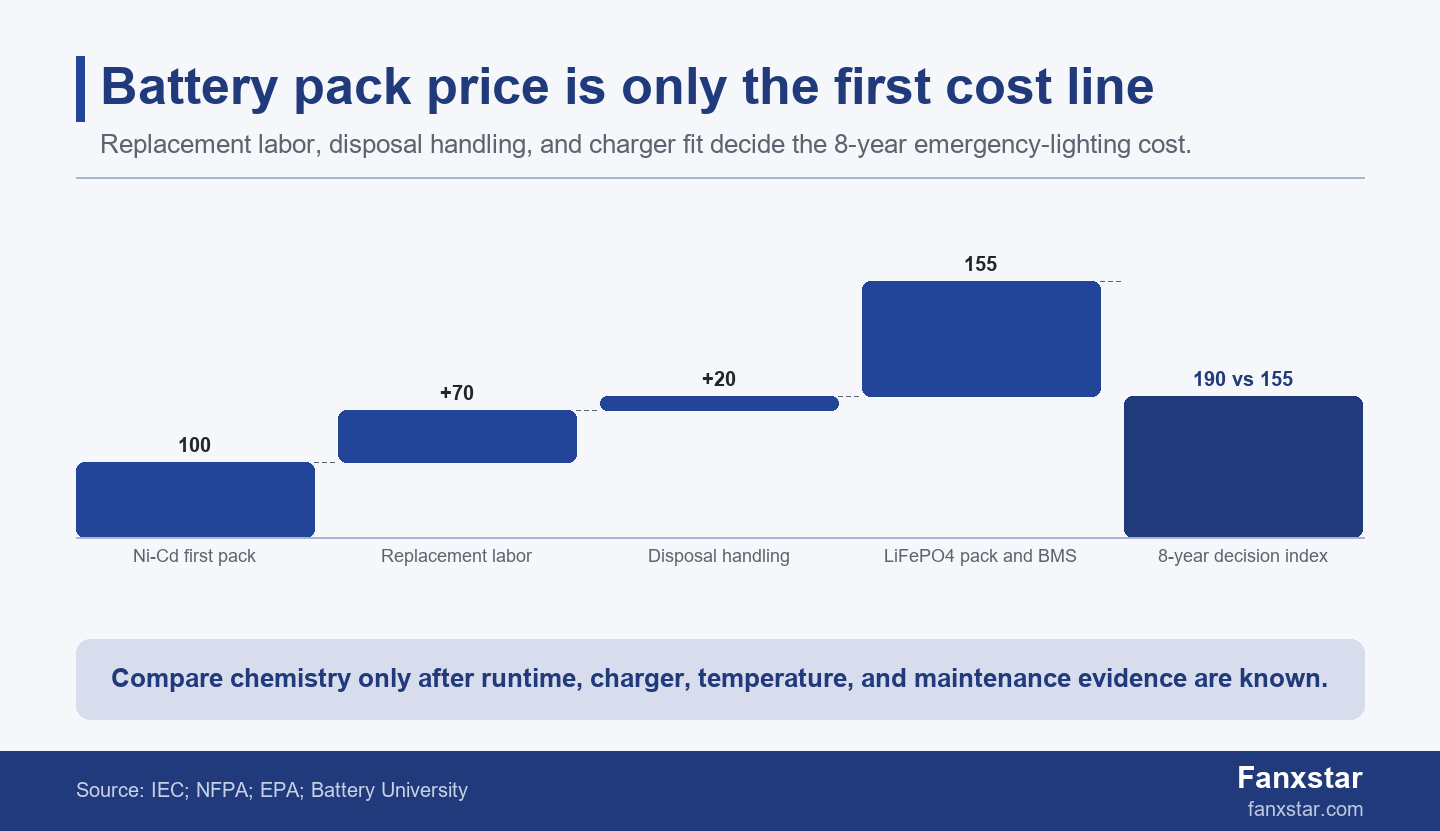
A simple scenario shows the logic. Assume a Ni-Cd emergency pack costs 100 cost units, a LiFePO4 option costs 155 cost units, a planned replacement visit costs 70 cost units per fitting when access labor is included, and disposal handling adds 20 cost units to the Ni-Cd path. If Ni-Cd needs one more replacement inside an 8-year building horizon while LiFePO4 does not, the Ni-Cd path becomes 190 cost units against 155. The calculation is illustrative, but it tells buyers where to ask for evidence.
Runtime, Ageing, and Emergency Duration Evidence
The emergency-duration test is the buyer’s hard boundary
The pack is not successful because it lights the LED on day 1. It is successful when the luminaire can deliver the required emergency output after ageing, heat exposure, charge cycles, and real maintenance behavior. Runtime evidence should be tied to the exact fixture, battery, ambient temperature, and emergency output setting, not to a generic cell datasheet.
According to IEC 60598-2-22:2021, emergency luminaires are treated under a particular luminaire standard rather than as ordinary LED fittings. That distinction matters for B2B buyers because the emergency pack is part of the luminaire evidence file. If the supplier changes the battery chemistry, capacity, cell supplier, charger, or emergency driver, the buyer should ask whether the existing test report still covers the new version.
For a project RFQ, define the emergency duration target, emergency lumen output, ambient temperature range, installation orientation, test method, and market route. If a supplier answers only with nominal voltage and milliamp-hours, the answer is incomplete. The buyer needs the tested system behavior.
Ageing assumptions should be visible in the quotation
Ni-Cd and LiFePO4 degrade differently. Ni-Cd concerns often include capacity loss, memory behavior, high-temperature stress, and cadmium handling. LiFePO4 concerns often include charger compatibility, cell balancing, protection electronics, cold-temperature charging limits, and supplier consistency. A responsible quote should not hide those trade-offs behind a single longer-life claim.
According to Battery University on nickel-based batteries, nickel-based battery behavior creates maintenance and operating considerations that are different from lithium chemistries. According to Battery University on LiFePO4 charging, lithium systems require appropriate charge handling rather than simple continuous float assumptions. The buyer should therefore request a pack-life assumption, not just a chemistry name.
| Decision signal | Buyer implication |
|---|---|
| 90 minutes | Emergency runtime must be proven by the installed luminaire and local code path. |
| 8 years | Portfolio cost should include replacement cycles across the building horizon. |
| 1 chemistry change | Battery change can trigger charger, label, and evidence questions. |
| 0 generic datasheets | A cell datasheet does not prove the luminaire’s emergency function. |
| 1 release file | The buyer should keep runtime, charging, and replacement evidence together. |
| 1 local owner | Commissioning and inspection remain local professional responsibilities. |
Environmental and Compliance Costs Buyers Often Miss
Cadmium changes the disposal conversation
According to US EPA universal waste guidance, batteries are one of five federal universal waste categories. According to the European Commission RoHS page, RoHS restricts ten substances including cadmium. Those sources do not mean every Ni-Cd pack is forbidden in every emergency lighting application, but they do show why cadmium-containing packs create a different environmental file than LiFePO4 packs.
Disposal cost is not only the recycler’s invoice. It includes collection process, storage, labeling, contractor qualification, country or state rules, replacement scheduling, and documentation for facility audits. A building owner that manages thousands of emergency fittings may care more about documented collection and replacement workflow than about a small unit-price saving.
LiFePO4 does not make environmental responsibility disappear. Lithium packs have their own transport, protection, storage, and recycling considerations. The difference is that the buyer should ask different questions: cadmium handling and legacy replacement for Ni-Cd; lithium charging, protection, and shipping evidence for LiFePO4.
Certificate scope can be affected by battery substitutions
Emergency lighting buyers sometimes ask whether an existing luminaire can simply be supplied with a new battery chemistry. The safer answer is: maybe, only if the design and evidence still match. A chemistry change can alter thermal behavior, charging circuit behavior, enclosure space, label data, failure modes, and maintenance instructions.
According to International Trade Administration document guidance, cross-border shipments may require documents that match the product being imported. For emergency luminaires, the document set may include test reports, declarations, wiring diagrams, battery specifications, installation instructions, and market-specific labels. If those documents describe the old Ni-Cd version while the shipped unit contains LiFePO4, the buyer has an evidence mismatch.
This is where Fanxstar’s ODM workflow should be used carefully. The buyer can ask for a LiFePO4 emergency option, but the sample file should say which model, battery pack, charger, emergency duration, label, and certificate route are being tested. Cost analysis without certificate-scope analysis is incomplete.
When Ni-Cd Still Makes Sense and When LiFePO4 Wins
Ni-Cd can still be rational in controlled replacement programs
A buyer may choose Ni-Cd when the existing installed base already uses Ni-Cd, maintenance staff have a predictable replacement schedule, the local approval route is already established, cold or standby behavior is well understood, and disposal handling is built into facility procedures. In that case, switching chemistry only to follow a trend may create more validation work than value.
Ni-Cd can also be easier to justify when a product family, certificate, and service plan were originally designed around it. The buyer should still ask for current supply continuity, pack availability, expected replacement interval, storage instructions, and disposal process. Legacy familiarity is useful only when it remains documented.
| Cost line | Ni-Cd buyer question | LiFePO4 buyer question |
|---|---|---|
| Purchase price | Is the lower pack price still true after replacement labor? | Does the higher pack price include the charger and BMS design? |
| Runtime evidence | Can the pack support the required emergency duration after ageing? | Can the pack support duration with the selected cell, circuit, and ambient temperature? |
| Charging method | Is the luminaire designed around continuous charge behavior? | Is charge cutoff, balancing, and protection handled by the battery system? |
| Maintenance | How often will site labor replace or test packs? | What evidence proves longer service life in this fixture body? |
| Disposal | How will cadmium-containing packs be collected and documented? | How will lithium packs be shipped, stored, and recycled under local rules? |
LiFePO4 wins when access cost, long horizon, and low-maintenance design matter
LiFePO4 becomes more attractive when the buyer has difficult access, high labor cost, a long service horizon, many fittings, or a new LED emergency product platform designed around lithium chemistry from the start. The benefit is not the word lithium; it is a system design that can reduce replacement interventions while still satisfying runtime, safety, and certification evidence.
For parking garages, cold storage corridors, industrial utility spaces, tunnels, warehouses, and wet facilities, battery chemistry should be paired with enclosure and environment. Moisture, heat, cold, dust, chemical cleaning, and vibration can all change real service life. A LiFePO4 pack in the wrong fixture body is not a premium solution; it is an unproven assembly.
Relevant Fanxstar starting points include LED emergency lighting product range, LED emergency batten lights, and emergency bulkhead lights. For custom housing, wiring, battery, indicator, or label requirements, use Fanxstar custom LED lighting ODM service after the emergency function and market evidence route are defined.
RFQ Checklist for a Battery Pack Decision
Send the battery question as a system file
A strong RFQ states the application, fixture type, voltage, emergency duration target, maintained or non-maintained behavior, ambient temperature, mounting height, access constraint, target market, desired testing function, replacement expectation, and existing certification route. It also asks whether the offered battery pack is tested in the exact luminaire body and whether any charger or label changes are required.
The buyer should request three files before approval: a technical pack file, a runtime or test record, and a maintenance or replacement note. For LiFePO4, the pack file should explain protection and charge behavior. For Ni-Cd, the file should explain replacement schedule, storage, and disposal handling. Both need model-specific evidence.
The final decision rule is simple: do not approve a battery chemistry because it is cheaper or newer. Approve the emergency lighting configuration when battery, charger, fixture body, runtime, label, certificate, and maintenance plan all describe the same product.
FAQ
Is LiFePO4 always cheaper than Ni-Cd for emergency battery packs?
No. LiFePO4 often becomes cheaper only when the buyer includes replacement labor, access cost, disposal handling, and service horizon. Ni-Cd may still be rational for an existing certified platform with predictable maintenance. Compare tested system cost, not cell price.
Can a Ni-Cd emergency light be changed to LiFePO4?
Only after the luminaire design and certificate scope are reviewed. A chemistry change can affect charging, protection, thermal behavior, label data, emergency duration, and compliance evidence. Buyers should request model-specific confirmation before accepting a battery substitution.
What battery evidence should a buyer request?
Request the exact battery specification, charger or emergency-driver information, tested emergency duration, ambient-temperature boundary, replacement instructions, and certificate or test-report scope. If the supplier provides only voltage and capacity, the emergency function is not fully documented.
Does Fanxstar support LiFePO4 emergency lighting options?
Fanxstar can discuss emergency lighting products and ODM options where the fixture platform, battery pack, charger behavior, label, and market requirements are defined together. Buyers should send the application, emergency mode, duration target, ambient conditions, and certification route before sample approval.