LiFePO4 is often the better direction for new emergency lighting designs, but it is not a safe drop-in answer for every Ni-Cd fixture. Emergency lighting is a system: battery pack, protection circuit, emergency driver, charger, LED load, enclosure temperature, test routine, certificate, and maintenance plan. A chemistry switch is approved only when that whole system still proves the required emergency function.
According to OSHA exit-route requirements, exit routes must be adequately lighted so an employee with normal vision can see along the route. According to Tridonic emergency lighting battery guidance, emergency lighting battery packs should be reviewed with protection and operating concepts. The practical buyer conclusion is simple: do not compare LiFePO4 and Ni-Cd as loose cells. Compare them as approved battery backup systems that must deliver visible egress lighting when normal power fails.
Key Takeaways
- LiFePO4 is attractive for many new emergency lighting designs because it can reduce replacement burden and package size when the driver and protection system are designed for it.
- Ni-Cd can remain the safer route when an existing certified fixture, charger, or cold-site maintenance routine depends on that chemistry.
- A battery chemistry switch must review runtime, recharge, temperature, waste handling, BMS, charger compatibility, and certificate scope.
- Fanxstar buyers should treat emergency battery choice as part of fixture design, not as an afterthought added after housing and optics are finished.
When LiFePO4 is a better emergency lighting choice
New designs can optimize around the battery system
LiFePO4 makes the most sense when the emergency fixture is being designed or reapproved as a system. The engineering team can select the emergency driver, charging circuit, protection board, pack size, thermal location, enclosure volume, test button or self-test logic, and label file together. In that situation, the battery chemistry is not a replacement part; it is one design decision inside a controlled emergency luminaire.
The buyer benefit is not only chemistry. It is system control. A well-designed LiFePO4 emergency product can reduce battery volume, simplify maintenance planning, and support a longer replacement interval target, but those advantages appear only when charge limits, discharge limits, protection, and emergency load are matched. A product that uses LiFePO4 cells without a disciplined pack and driver design may be less trustworthy than an older Ni-Cd system with a stable approval file.
According to DLC solid-state lighting technical requirements, LED products are evaluated through defined technical requirements and product categories. The same procurement habit applies to battery backup emergency lighting: define the finished product category and evidence instead of trusting a component label. For emergency lighting, the finished product is the emergency function under the actual fixture configuration, not the battery chemistry by itself.
Maintenance economics can improve when replacement cycles are controlled
Emergency lighting batteries create a hidden labor cost. Someone must test the fixture, record results, replace failed packs, dispose of old batteries, and keep proof for safety or facility audits. If a new LiFePO4 design reduces replacement frequency, the saving may be larger than the battery price difference. That is especially true in warehouses, tunnels, cold backrooms, parking garages, and public corridors where access is difficult.
Use a scenario estimate rather than a universal promise. Suppose a site has 200 units of battery backup emergency lighting. If one chemistry requires a replacement visit every 3 to 4 years and another approved system targets 8 years, the labor saving depends on access height, shutdown rules, testing method, pack price, and failure rate. A single failed reapproval or incompatible charger can erase the saving. The correct calculation is maintenance cost minus reapproval and compatibility risk.
According to EPA universal waste guidance, universal waste rules cover certain batteries and other common hazardous wastes. Ni-Cd batteries contain cadmium and require disciplined disposal. Lithium packs also need proper handling. The buyer should therefore compare total operating burden: replacement labor, disposal procedure, storage, transport, and documentation.
Where Ni-Cd may still be the safer decision
Legacy approval can be more valuable than a newer chemistry
Ni-Cd should not be dismissed just because LiFePO4 is newer. If an existing emergency luminaire was certified, tested, labelled, and maintained around a Ni-Cd battery, a chemistry swap can reopen the approval file. The charger may be wrong. The temperature profile may be wrong. The enclosure may trap heat differently. The self-test logic may interpret the battery incorrectly. The label may no longer describe the product.
This matters most in retrofit and replacement programs. A facility manager may ask whether the old Ni-Cd pack can simply be replaced with LiFePO4. The safe answer is usually no unless the fixture manufacturer or qualified engineer confirms compatibility and evidence. Emergency products are not a place for informal substitution because the failure is discovered at the exact moment the fixture is needed.
According to International Trade Administration import regulations guidance, imported products can face documentation, safety, quality, and conformity checks. For emergency lighting, the same discipline applies before shipment. The invoice, product label, battery pack, emergency driver, certificate, and installation instruction should all describe the same version.
Temperature and charging behavior can decide the chemistry
Battery behavior depends on temperature and charging method. A fixture near a hot ceiling, a freezer door, a tunnel service area, or a poorly ventilated electrical room can create a different battery stress than a standard corridor. LiFePO4 packs may need defined charge limits and protection behavior. Ni-Cd packs may tolerate some legacy conditions better, but they bring their own maintenance and environmental burden.
The buyer should ask for the approved operating temperature range, storage range, charging method, emergency discharge current, recharge time, testing routine, and replacement rule. Those details should be tied to the exact pack and emergency driver. A generic statement that LiFePO4 is safer or Ni-Cd is proven is not enough. The question is whether this fixture, in this environment, with this driver, still meets the emergency requirement.
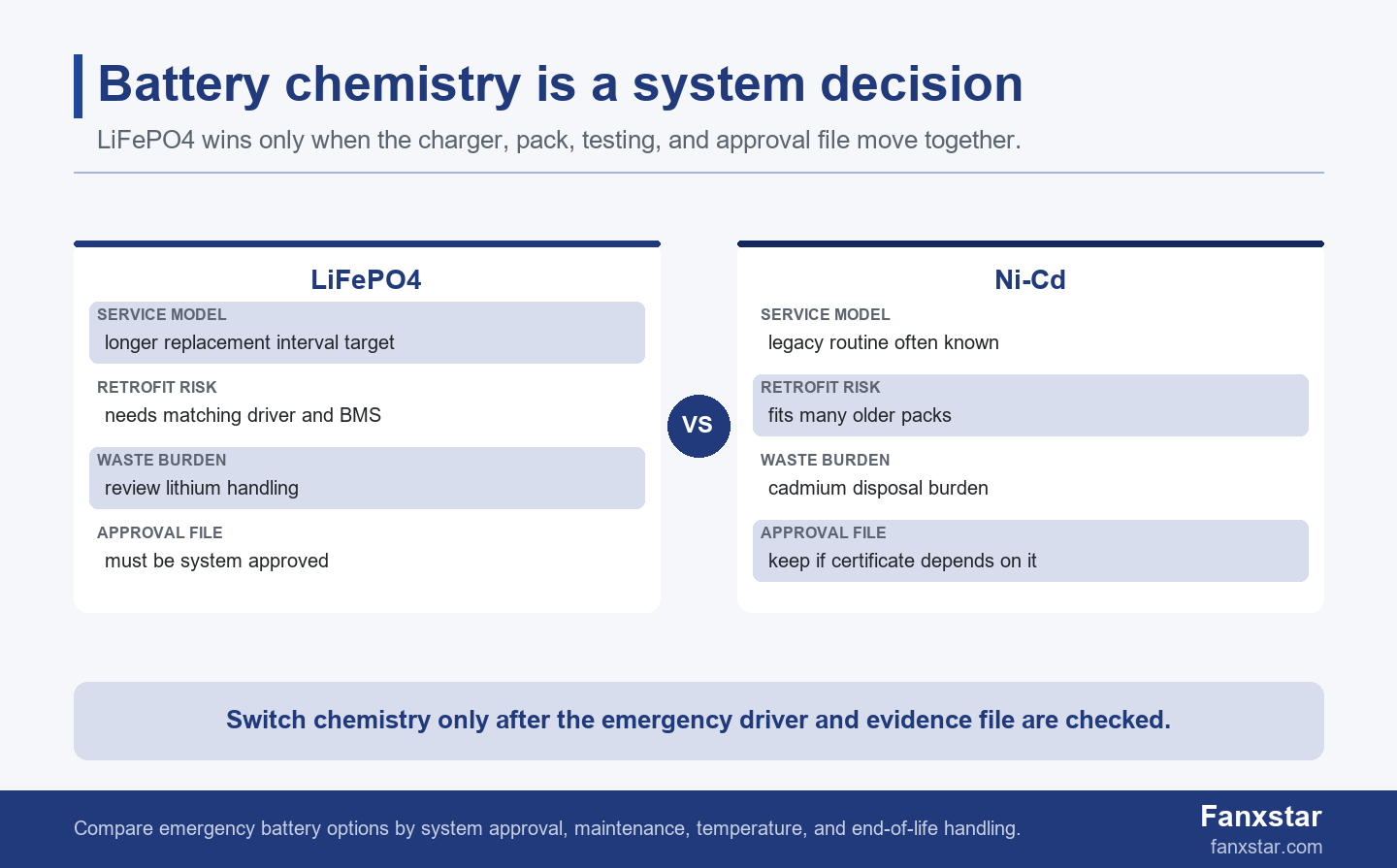
| Decision point | LiFePO4 route | Ni-Cd route | Buyer control |
|---|---|---|---|
| System approval | approve battery, BMS, charger, driver, and fixture together | keep legacy proof if the approved system depends on Ni-Cd | do not swap chemistry as a loose spare part |
| Testing routine | confirm monthly or annual test behavior with the emergency driver | known routine may already be documented | record test current, recharge time, and pass rule |
| Temperature | check charge and discharge limits for the pack | often used in older emergency products | match chemistry to site temperature and enclosure heat |
| End of life | define lithium handling and replacement plan | cadmium creates stronger waste discipline | include battery disposal in total cost |
How to run the switch decision before production
Use a two-gate approval model
Gate 1 is product fit. It asks whether the chemistry, voltage, capacity, protection, charger, driver, LED load, and enclosure temperature are compatible. Gate 2 is evidence fit. It asks whether the certificate, label, test report, installation instruction, maintenance file, and replacement pack rule still match the product being shipped. A switch should not pass one gate and fail the other.
According to GSA LED and controls guidance, LED decisions should account for life-cycle cost and controls behavior. Emergency battery switching should use the same life-cycle logic. A lower battery pack cost is weak if it increases failed tests, shortens standby reliability, creates charger mismatch, or forces the buyer to hold inventory because the documentation is unclear.
For a 24-hour recharge policy, a 2-hour failed test investigation can cost more than the battery price difference on a small site. For a 6-month preventive maintenance cycle, the buyer should know whether the pack is expected to be replaced, retested, or only logged. Those operating numbers should appear in the maintenance file before production release.
For a new design, the buyer can make LiFePO4 the baseline and design the emergency system around it. For an existing Ni-Cd design, the buyer should ask for a formal change note. The note should list what changes, what evidence remains valid, what must be retested, and whether the replacement pack will be available for future service.
Separate runtime proof from battery capacity claims
Emergency lighting buyers often hear battery capacity first: mAh, voltage, chemistry, or pack size. Those numbers do not prove emergency runtime. Runtime depends on LED load, driver efficiency, battery condition, temperature, cut-off voltage, aging allowance, and the test method. A battery with an attractive capacity label can still fail if the emergency driver cannot use that energy correctly or if the test condition is different from the installation.
According to International Trade Administration import documentation guidance, shipment documentation can include multiple commercial and certificate records. Emergency lighting needs a similar technical pack: battery specification, emergency driver data, wiring diagram, charging rule, runtime test, label, maintenance instruction, and replacement part code. If those files do not match, the battery decision is not ready.
The buyer should also avoid mixing pack versions. A sample may use one cell supplier, one protection board, and one driver; production may quietly use another. If the emergency function depends on that combination, the supplier should lock the pack version or define an equivalence rule. Otherwise the buyer cannot tell whether the replacement pack in year 3 is still the same approved system.
Where Fanxstar fits the emergency battery decision
Battery choice should be part of emergency fixture design
Fanxstar’s relevant starting points include LED emergency lighting products, LED emergency batten lights, emergency bulkhead lights, and custom LED lighting ODM service. For these projects, battery choice should be discussed together with housing, diffuser, cable entry, driver, self-test or test button, label, and target market.
A useful Fanxstar brief includes target runtime, input voltage, emergency mode, testing method, installation temperature, housing type, certificate market, replacement pack expectation, and whether the product is new design or replacement for an existing Ni-Cd platform. That lets the engineering team decide whether LiFePO4 is a design baseline, an optional variant, or a risky substitution.
The business value is not a slogan about lithium. It is the ability to align the emergency pack, driver, fixture body, and evidence file before the buyer commits to tooling or mass production. If the pack change affects certificate scope, label data, or maintenance instructions, the buyer should know before the first shipment.
Use evidence language in the RFQ
Write the RFQ so the supplier cannot answer with chemistry alone. Ask for battery chemistry, cell configuration, protection, charger or emergency driver model, rated emergency output, recharge time, temperature range, runtime test method, certificate scope, replacement pack code, disposal note, and production change rule. Then ask which details are locked and which can change without new approval.
International Trade Administration special documents guidance notes that some products may require special documents related to standards or safety. Emergency lighting buyers should treat the battery pack and emergency driver as part of that special document logic. The product must still be explainable after translation, import, installation, testing, and replacement.
If the buyer is switching a mature Ni-Cd product to LiFePO4, ask for a side-by-side sample report. It should compare standby charging, emergency output, runtime, thermal behavior, enclosure fit, labeling, and maintenance instruction. The result may be switch, hold, redesign, or keep both versions for different markets.
Approval checklist before switching chemistry
Do not release the order until these items are answered
The pre-production checklist should include 9 items: target emergency runtime, exact LED load, battery chemistry and pack code, emergency driver model, charging method, temperature range, protection method, evidence or certificate scope, and replacement pack availability. If any item is unknown, the buyer does not yet have a controlled switch plan.
Add a maintenance question: who will test the fixture, how often, what result counts as pass, how will failures be recorded, and what pack will be used for replacement? A battery change that looks good at purchase can fail commercially if future maintenance teams cannot identify or source the correct pack.
Pair this decision with Fanxstar’s LED lighting certification checklist when the market requires UL, ENEC, CE, or emergency evidence. The safest switch is not the chemistry with the best marketing story. It is the chemistry that keeps the emergency function, label, maintenance, and evidence file aligned.
Use a clear release decision
Release the switch when the battery pack, driver, fixture, test record, label, and replacement rule all match. Hold the switch when chemistry changes but the charger, certificate, or maintenance file does not. Redesign the fixture when the desired chemistry needs different thermal space, driver behavior, or protection. Keep Ni-Cd when legacy evidence is more valuable than the upgrade.
That decision language helps procurement avoid two bad extremes: rejecting LiFePO4 because older products used Ni-Cd, or accepting LiFePO4 because it sounds modern. Emergency lighting should be conservative in the right way: open to better systems, strict about proof.
FAQ
Can I replace a Ni-Cd emergency light battery with LiFePO4?
Only if the fixture manufacturer or qualified engineer confirms the battery, charger, emergency driver, wiring, test routine, and certificate scope are compatible. A chemistry swap should not be treated as a loose spare-part change because emergency runtime and evidence can change.
Is LiFePO4 always better than Ni-Cd for emergency lighting?
No. LiFePO4 is often attractive for new designs, but Ni-Cd can remain appropriate when legacy approval, temperature behavior, charger design, or replacement policy depends on it. The safer choice is the approved system that proves emergency function in the target environment.
What evidence should buyers request for LiFePO4 emergency lights?
Ask for battery pack specification, protection method, emergency driver model, charging rule, runtime test, recharge time, temperature range, certificate scope, replacement pack code, wiring diagram, label data, and maintenance instructions for the exact quoted fixture.
Why does battery disposal matter in emergency lighting procurement?
Battery disposal affects operating cost, maintenance process, and compliance discipline. Ni-Cd contains cadmium and requires careful handling, while lithium packs also need proper end-of-life controls. Buyers should include disposal and replacement records in total cost comparison.