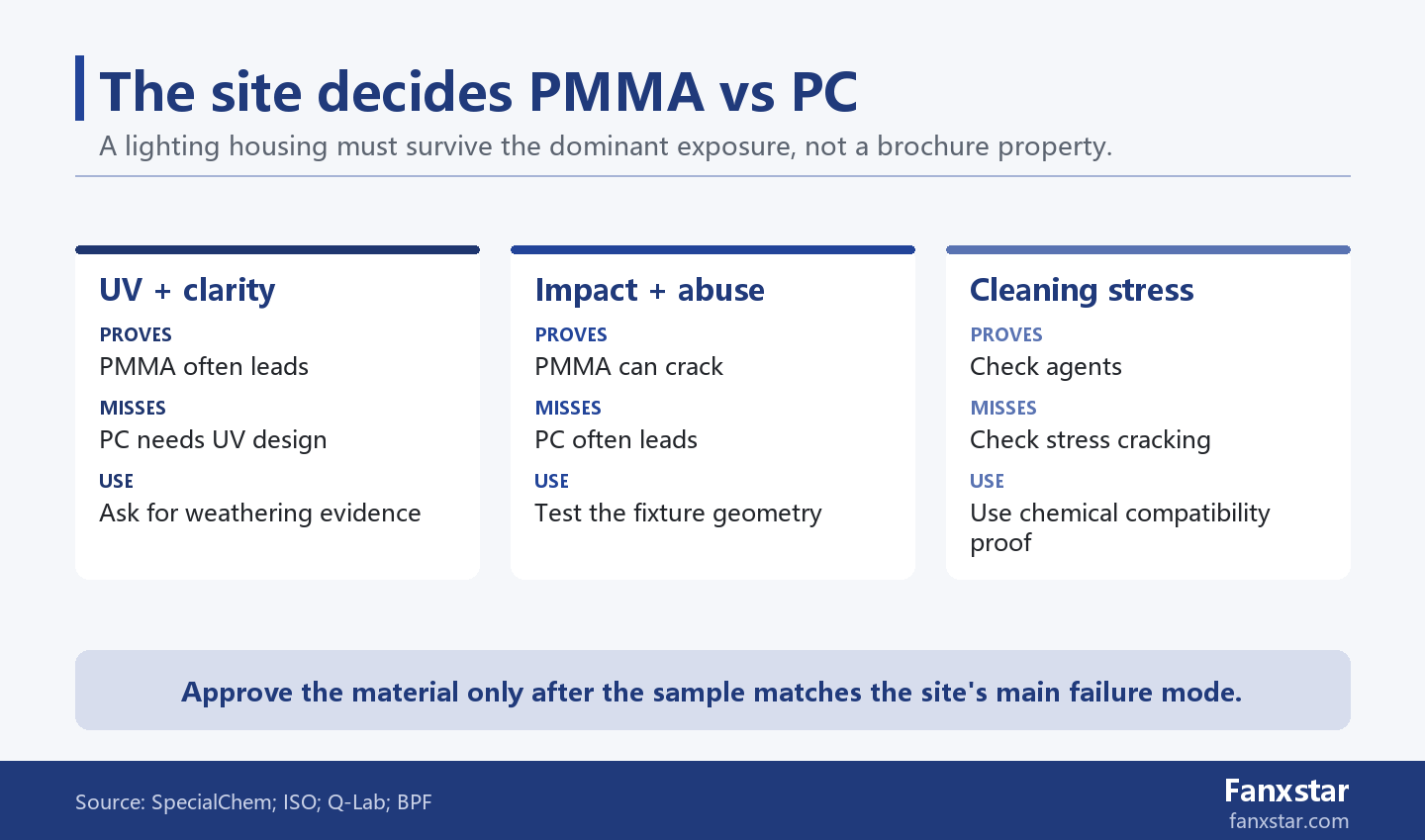
PMMA and PC do not have one universal winner for LED lighting housings. PMMA is often stronger for optical clarity and weathering stability, while PC is often stronger for impact resistance; the correct choice depends on whether sunlight, impact, cleaning chemistry, heat, or service stress is the dominant failure mode.
Key Takeaways
- PMMA vs PC should be decided by site exposure, not by a single material headline.
- PMMA is often attractive for clarity and UV/weathering behavior; PC is often attractive for toughness and impact risk.
- Outdoor lighting buyers should request material grade, UV-stabilization approach, chemical compatibility, and sample aging evidence.
- The diffuser or housing material must be evaluated with lens geometry, gasket compression, screws, cable entry, and cleaning conditions.
Why the Better Material Depends on the Failure Mode
UV aging is only one way a lighting housing fails
The question “PMMA vs PC: which lasts longer under UV?” sounds simple, but a lighting fixture rarely fails from UV alone. A diffuser can yellow, haze, crack near screw bosses, lose sealing pressure, warp from heat, stress-crack after cleaning, or break after impact. The material name helps only after the buyer knows which failure mode matters most for the site.
Aprios explains PMMA UV and weather resistance by emphasizing acrylic’s outdoor clarity and weathering behavior. Xometry’s polycarbonate material guide describes PC as a high-performance thermoplastic known for strength, clarity, heat resistance, and impact resistance. Those two summaries already show the real trade-off: clarity/weathering versus toughness, with grade and design changing the final result.
Lighting housings combine optical, mechanical, and sealing duties
In LED lighting, PMMA or PC is rarely just a decorative cover. It can shape beam distribution, diffuse LED points, protect the electrical compartment, compress a gasket, resist cleaning, and keep the product serviceable. A material that performs well as a flat sheet may behave differently when molded into a long diffuser, clamped by end caps, drilled for screws, exposed to heat from the driver, and washed with chemicals.
That is why the buyer should compare a real fixture sample, not only a material datasheet. Wall thickness, rib design, corner radius, screw torque, gasket pressure, and coating choice can change whether PMMA or PC survives the application. A poor housing design can waste a good material.
The same plastic can behave differently after molding
Material comparisons often quote sheet or resin properties, but a lighting housing is a processed part. Injection molding, extrusion, cooling rate, residual stress, pigment, diffuser texture, coating, and regrind control can change how the part responds to UV, impact, and chemicals. A long vapor-tight diffuser with thin corners is not the same risk as a short flat lens, even if the material family name is identical.
This is why buyer evidence should connect the named material to the actual component. Ask whether the sample is molded from the same grade and color as production, whether the lens texture is final, whether screw torque and gasket compression are representative, and whether any UV additive or surface treatment is included in the production BOM. If those answers are missing, the PMMA-vs-PC debate is still incomplete.
Where PMMA Usually Wins and Where PC Usually Wins
PMMA is often chosen when clarity and sunlight exposure dominate
PMMA is attractive when optical appearance, long-term clarity, and outdoor weathering are the main requirements. It can be a strong candidate for diffusers, covers, or lenses where sunlight exposure and visual stability matter. Its weakness is that it can be less forgiving in high-impact environments or stress-concentrated designs, especially if the fixture uses sharp corners, over-tightened fasteners, or repeated service handling.
Madison Group’s article on polycarbonate yellowing explains that UV exposure is one pathway that can drive optical discoloration in PC. For outdoor LED fixtures, that means the buyer should not ask only whether a material resists UV. The buyer should ask how the material’s optical and mechanical properties are expected to change after UV, heat, and moisture exposure.
PC is often chosen when impact and abuse dominate
Polycarbonate is often selected when the fixture must resist knocks, vandal risk, tool contact, or handling abuse. Xometry’s polycarbonate vs acrylic comparison frames PC as the tougher option while acrylic often leads on optical clarity and scratch resistance. That is a balanced buyer message: PC can be very tough, but the UV and chemical environment still need proof.
Ensinger’s TECANAT natural PC data page lists unfilled polycarbonate as transparent with high strength, rigidity, hardness, and good impact strength, while also warning that lower chemical resistance can limit material selection. For washdown, food-processing, parking, and tunnel fixtures, that chemical and stress-crack boundary may be as important as the impact rating.
How to Ask for UV Evidence Without Overtrusting Lab Aging
Use accelerated weathering as directional evidence
Accelerated UV testing is useful because it creates controlled stress, but it is not a perfect lifetime guarantee. Q-Lab explains ASTM G154 as a fluorescent UV practice that simulates damaging UV energy, elevated temperature, and moisture for materials such as plastics. Atlas summarizes the ISO 4892-3:2024 revision by explaining changes that clarify fluorescent UV instrument types and test parameters.
The buyer should therefore request the test condition, lamp type, cycle, duration, specimen form, and evaluated property. A statement such as “UV tested” is too weak. A better record says what was tested, under which method, what changed, and whether the specimen represents the molded diffuser, coating, and thickness used in the actual fixture.
Compare color, haze, impact, and sealing after exposure
For LED lighting, UV evidence should not stop at whether the material looks acceptable. Ask whether transmittance changed, haze increased, color shifted, impact resistance dropped, cracks appeared at stress points, or gasket pressure changed. If a sample looks clear but loses toughness, the project may still fail in a parking or service environment. If a sample keeps impact resistance but yellows visibly, it may fail in a retail or architectural environment.
Testing should follow the site risk. A sun-exposed canopy needs UV, heat, and moisture evidence. A food plant needs chemical cleaning and washdown compatibility. A parking garage needs impact and cleaning evidence. A tunnel or industrial corridor needs vibration, dust, access, and service stress. A single PMMA-vs-PC answer cannot cover those different exposures.
Cleaning chemistry can reverse the first material choice
Washdown and maintenance chemicals are easy to overlook because they are not visible in the product photo. A material may handle sunlight well but suffer stress cracking near screws after repeated exposure to alkaline cleaner, alcohol wipe, disinfectant, oil mist, or solvent residue. Another material may resist impact but show haze or surface damage after aggressive cleaning. The correct evidence is therefore not only a UV report; it is a compatibility check against the chemicals the site actually uses.
For food processing, cold storage, parking, and service corridors, ask the end user for cleaning frequency, chemical name or safety data sheet, concentration, contact time, rinse practice, and temperature. Then ask the fixture supplier whether the diffuser, gasket, end cap, cable gland, and fasteners tolerate that cleaning route together. A housing failure often begins at the interface between material, stress, and chemical exposure rather than in the center of the lens.
A Buyer Decision Model for Outdoor LED Housings
Weight the site risks before choosing the plastic
Use a simple weighted decision before asking for price. If the site risk is 40% UV and appearance, 25% chemical cleaning, 20% impact, 10% heat, and 5% service handling, PMMA may lead the first shortlist. If the site is 40% impact, 25% vandal risk, 20% service handling, 10% heat, and 5% UV, PC may lead. If chemical stress is high, neither material name is enough until compatibility is checked.
This is an illustrative model, not a universal score. The value is that it prevents buyers from using one property to choose the whole fixture. A UV-focused buyer may ignore impact. An impact-focused buyer may ignore yellowing. A washdown buyer may ignore stress cracking. A weighted model forces the RFQ to state which risk the material must defeat first.
Translate material choice into sample-release evidence
The RFQ should request material name, grade or treatment if available, diffuser geometry, wall thickness, gasket interface, screw or latch design, cleaning-agent limitations, and aging or compatibility evidence. If the supplier cannot name the grade, the buyer should at least ask for a representative material family and a test plan tied to the application.
Do not approve the sample only because the diffuser is clear on day one. Approve it because the evidence path matches the expected environment. For a long weatherproof luminaire, that means material, shape, end cap, gasket, cable entry, and service method are evaluated together.
Use a small evidence ladder instead of a yes-or-no answer
A practical approval ladder has three levels. First, the supplier identifies the material family, grade route, and any UV or coating strategy. Second, the sample is reviewed for geometry risks such as sharp corners, screw stress, gasket compression, and thin sections. Third, the buyer requests exposure evidence tied to the site: UV/weathering for outdoor use, impact for abuse risk, chemical compatibility for washdown, and heat behavior for enclosed fixtures.
This ladder prevents a weak “PMMA is better” or “PC is stronger” answer from becoming the purchase decision. It also gives procurement a fair comparison path. A lower-cost housing may be acceptable if the dominant site risk is mild and evidence is adequate. A premium housing is justified when the exposure map shows a real failure mode that would create water ingress, optical loss, service calls, or replacement cost.
Fanxstar Application Fit for Weatherproof and Vapor-Tight Buyers
Material choice belongs inside the sealed fixture platform
Fanxstar’s relevance is not a claim that one plastic always wins. It is the ability to connect material choice with the actual weatherproof or vapor-tight lighting platform. A buyer can start with vapor tight LED light fixtures or the broader weatherproof LED lighting product platform, then ask how the diffuser, lens, end cap, gasket, and mounting structure should change for the exposure.
For ODM projects, the decision should be made before the sample is built. If the fixture will be used in a sunny canopy, food-processing washdown area, parking garage, or dusty industrial corridor, that scenario should be written into the sample brief. A supplier can then choose PMMA, PC, coating, gasket design, or a different housing route based on the highest-risk failure mode.
The conversation should also include service expectations. A fixture that is never opened after installation can tolerate different design choices from a product that will be cleaned, relamped, rewired, or inspected frequently. If maintenance crews remove covers often, latch strength, screw wear, gasket recovery, and material toughness become part of the material decision, not separate after-sales details.
What to send before requesting a material recommendation
Send the application, indoor or outdoor exposure, expected UV intensity, cleaning chemicals, impact risk, operating temperature, mounting style, and required optical appearance. If a previous fixture failed, include photos showing yellowing, cracking, water ingress, or impact damage. That evidence allows Fanxstar to discuss a fixture-level material plan instead of giving a generic PMMA or PC answer.
The strongest procurement question is: “Which material and housing design will survive this site’s dominant failure mode while preserving optical performance and sealing?” That is a better question than asking which plastic lasts longer in isolation.
FAQ
Is PMMA better than PC for UV exposure?
PMMA is often the stronger first choice when optical clarity and outdoor weathering are the main risks. The final answer still depends on grade, coating, fixture geometry, heat, moisture, cleaning chemistry, and how the diffuser is held in the housing.
Is polycarbonate better for impact-resistant lighting covers?
Polycarbonate is often preferred when impact resistance, toughness, or vandal risk dominates. Buyers should still verify UV stabilization, scratch resistance, chemical compatibility, and stress-cracking risk before using PC in exposed or washdown applications.
Can accelerated UV testing predict exact outdoor lifetime?
No. Accelerated UV testing is directional evidence under controlled conditions, not an exact service-life guarantee. It is most useful when the method, cycle, specimen, measured property, and acceptance rule are documented.
What should an RFQ ask before choosing PMMA or PC?
An RFQ should name the exposure, material grade or treatment, diffuser geometry, wall thickness, cleaning chemicals, impact risk, temperature range, and sample acceptance evidence. The material should be approved with the fixture design, not separately.