PstLM and SVM turn LED flicker from a vague comfort claim into a configuration-specific evidence question. For EU-oriented lighting projects, the buyer should verify the metric, driver, load, dimming mode, and output level before production release, especially when sensors or standby dimming are part of the final fixture.
Key Takeaways
- PstLM addresses short-term flicker perception, while SVM addresses stroboscopic visibility under temporal light modulation.
- EU Regulation 2019/2020 sets full-load limits for LED and OLED mains light sources, but buyers still need configuration-level evidence.
- Flicker evidence can break when the tested sample uses a different driver, load, dimming method, or standby level from the shipped product.
- ODM buyers should freeze the driver and control sequence before approving flicker-related evidence.
What PstLM and SVM Mean for LED Buyers
The metrics separate flicker from stroboscopic visibility
EU Regulation 2019/2020 defines the flicker metric PstLM and the stroboscopic visibility measure SVM. The regulation explains that PstLM = 1 corresponds to a 50% probability that an average observer detects flicker, while SVM = 1 represents the visibility threshold for an average observer. That is already more precise than a supplier phrase such as “flicker-free.”
The buyer’s task is not to memorize laboratory math. It is to know which metric is being discussed and whether the test condition matches the product being purchased. PstLM and SVM are both temporal light modulation topics, but they represent different visual risks. A clean PstLM statement does not automatically answer every moving-task or stroboscopic concern.
The EU full-load requirement is the floor, not the whole decision
The same regulation sets functional requirements for LED and OLED mains light sources: PstLM at full load should be no more than 1.0, and SVM at full load should be no more than 0.4, with stated exceptions for certain applications. EUR-Lex’s summary of the ecodesign and energy-labelling rules confirms that Regulation 2019/2020 covers light sources and separate control gears placed on the market or put into service.
Those limits matter, but procurement risk remains because many commercial LED projects do not operate only at full load. Motion sensors, standby dimming, multi-watt settings, emergency modes, and alternate drivers can create different operating conditions. A buyer should therefore ask whether the evidence covers the exact configuration and output levels that will ship.
Why Flicker Evidence Often Fails in ODM Projects
A tested driver can disappear from the production version
The most common evidence gap is substitution. A supplier tests a reference sample with one driver, then changes the driver for cost, availability, dimming compatibility, voltage, or MOQ before mass production. The flicker report may still be real, but it no longer describes the shipped product. That is a document-fit failure, not necessarily a bad-faith claim.
Commission Regulation (EU) 2021/341 amended Regulation 2019/2020 among other ecodesign measures, and the European Commission light sources product page keeps the policy context for light sources and separate control gears visible. Buyers should use those official sources to anchor the compliance boundary, then ask the supplier for configuration-level proof rather than relying on a broad regulatory reference.
Dimming and sensor standby create the hidden risk window
A fixture can look acceptable at 100% output and behave differently at 20% standby. That matters for parking garages, corridors, warehouses, cold storage, data-center service routes, and backrooms where a motion sensor may keep fixtures at low output for much of the day. A report that only names full-load behavior may miss the operating level users experience most often.
Technical literature also shows why measurement method matters. IEC TR 63158:2018 describes an objective SVM meter for lighting equipment, while a public sample of IEC TR 61547-1:2020 discusses an objective light flickermeter and voltage fluctuation immunity method. The buyer does not need to run the lab, but the buyer should ask which method and condition were used.
Emergency and sensor options should not be bolted onto old evidence
Many LED platforms are sold with optional sensor, emergency, dimming, or multi-watt configurations. The problem appears when a report is created for the base fixture and then reused for a variant that changes the driver path. Emergency battery operation, standby dimming, corridor function, and alternate wattage settings can all create operating states that were not part of the original evidence package.
A buyer does not need to demand a new laboratory report for every harmless cosmetic difference. The practical rule is narrower: any change that affects driver output, LED load, control method, dimming level, voltage input, or emergency operating mode should trigger an evidence review. That review may confirm the old report still applies, but the decision should be explicit rather than assumed.
A Practical Release Model for PstLM and SVM Evidence
Freeze the electrical configuration before testing
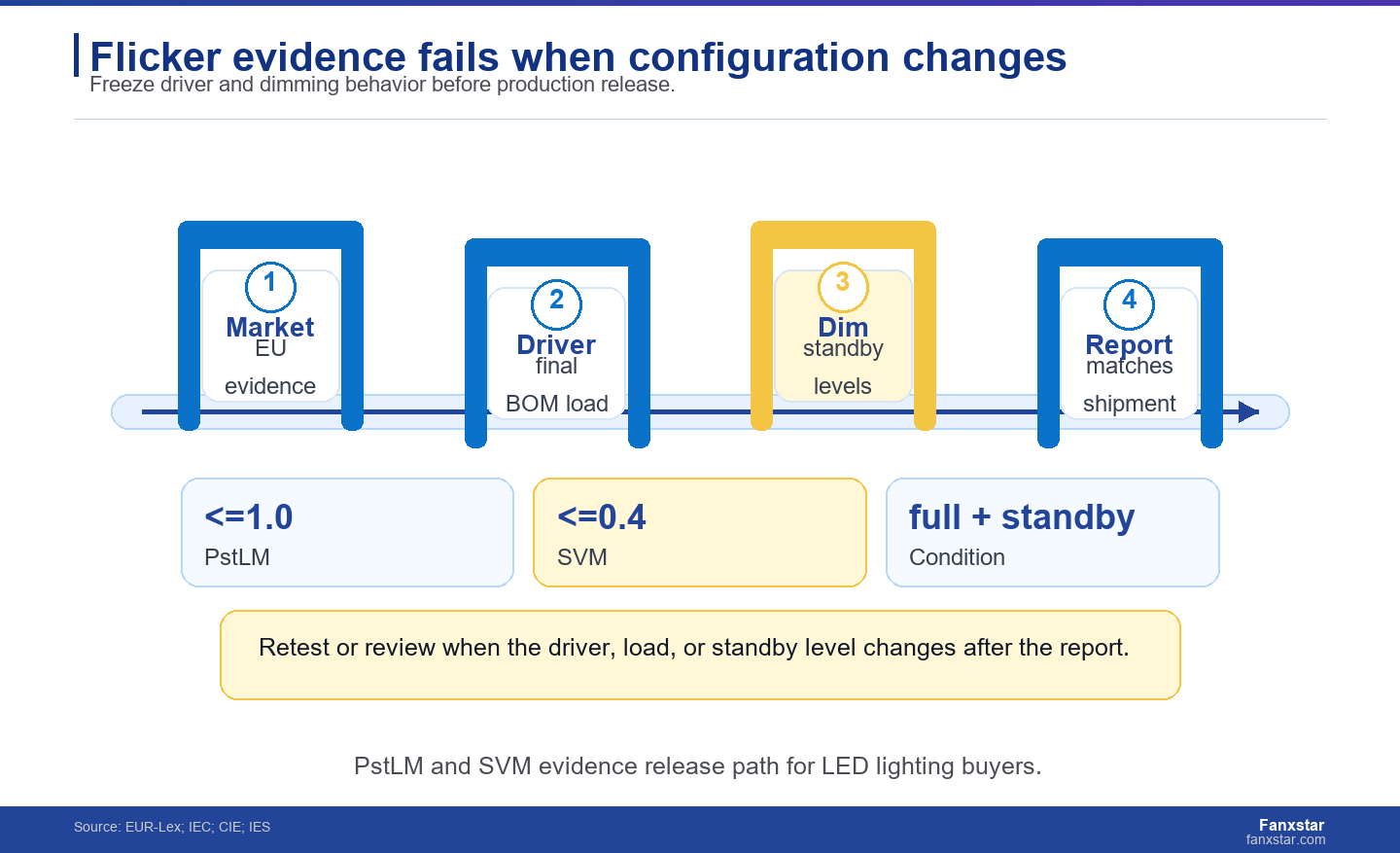
Use a four-gate release model. First, define the market and whether EU ecodesign evidence is required. Second, freeze driver, LED load, dimming method, sensor logic, and emergency option. Third, test the relevant conditions: full output, standby level if used, and any dimming range the buyer will market. Fourth, compare the report, BOM, label, and sample photos before production release.
This model prevents a buyer from receiving the right document for the wrong product. If the driver changes after testing, the flicker evidence should be reviewed again. If the standby level changes from 30% to 10%, ask whether the lower level is still covered. If a sensor option is added after the report, check whether the control path changes the output waveform.
Use an operating-profile estimate to choose test points
Assume a parking fixture operates at full output for 35% of the night and at 20% standby for 65% of the time. A full-load-only check covers the minority condition. The buyer’s evidence request should therefore include the dominant standby level, not only the easiest laboratory condition. This is an illustrative operating profile, but it shows why controls and flicker evidence should be planned together.
CIE’s 2019 paper on PstLM and SVM measurement issues notes that accurate temporal light artifact measurements are a real measurement challenge, and IEA 4E SSL’s publication on PstLM and SVM measurement conditions shows that measurement settings can affect reported results. These sources support a cautious buyer posture: ask for evidence, keep the configuration stable, and avoid casual “flicker-free” language.
Use a change-control threshold, not a vague retest habit
A useful threshold is to review evidence whenever the electrical path changes, and to retest when the change can plausibly alter temporal light modulation. Driver model substitution, output-current change, different LED board loading, new dimming protocol, added sensor standby, or emergency-driver integration are all review triggers. A housing color change or carton update normally is not.
This threshold keeps the process realistic for ODM work. Buyers need evidence discipline, but they also need production to move. The right control is a short release note that states what changed, whether PstLM/SVM evidence is affected, who approved the evidence decision, and which sample photo, BOM, and report version describe the final shipment.
How to Write the RFQ So the Supplier Can Answer Clearly
Ask for measured values and the exact sample condition
A strong RFQ asks: “Provide PstLM and SVM evidence for the final driver, LED load, control mode, and output levels intended for this project.” It should name voltage, frequency, driver model or approved equivalent, dimming method, standby level, and whether sensor control is part of the fixture. This makes the answer auditable.
The buyer should avoid asking only for “low flicker” or “flicker-free.” Those words are easy to say and hard to verify. Measured values, test condition, and configuration match are harder to fake and easier to compare. If the supplier offers a different driver after sampling, the buyer can immediately ask whether the evidence still applies.
The RFQ should also define acceptable evidence format. A report summary should include measured values, sample identification, driver identification, input voltage and frequency, dimming state, test date, and whether the sample represents the final BOM. If the evidence is a datasheet rather than a fixture-level report, the buyer should mark it as preliminary and ask what additional confirmation will be available before release.
Keep the report tied to the BOM and label
The final evidence pack should connect report, BOM, label, datasheet, wiring diagram, and sample photos. If the product is sold as a linear fixture with sensor standby, the report should not describe a different driver used in a non-sensor reference sample. If the same platform has several wattage settings, the buyer should know which setting was tested.
This is especially important for ODM projects where a small electrical change can be invisible in product photos. A buyer may accept a new driver because the fixture body looks identical. The optical appearance is not the evidence. The electrical configuration is.
A clean release file also protects sales language. If the final catalogue, quotation, or customer submittal says the fixture is low flicker, the support file should show the tested configuration behind that claim. Otherwise, a buyer may win the quotation with a comfort promise that the production team cannot defend when a consultant, distributor, or end customer asks for measured evidence. The evidence boundary should be visible before purchase approval, not discovered during a complaint.
Fanxstar Application Fit for EU-Oriented Custom Lighting
Flicker evidence should be designed into the sample brief
Fanxstar’s role is not to replace the buyer’s certification body, laboratory, or market-specific compliance advisor. Its useful role is earlier engineering alignment. For a project using LED linear lighting platform, weatherproof fixtures, sensors, or emergency options, the Fanxstar custom LED lighting ODM service can treat driver selection, standby behavior, and evidence requests as one sample task.
That matters because flicker evidence is easier to preserve before production decisions are scattered across purchasing, engineering, and sales. If the buyer writes the PstLM/SVM requirement at the RFQ stage, Fanxstar can discuss the driver and control sequence before the sample is built. If the buyer waits until shipment, the only remaining options may be delay, retest, or accept weaker evidence.
For buyers developing a private-label or project-specific fixture, the highest-value step is to freeze the evidence boundary before the brand label and package artwork are finalized. Once marketing claims, datasheets, and cartons use low-flicker language, changing the driver or control mode becomes more than an engineering change. It becomes a documentation and market-risk change.
What to send before the next sample
Send target market, voltage, driver preference, dimming method, sensor standby level, expected operating modes, and whether EU ecodesign evidence is required. If the project has a customer complaint about flicker or stroboscopic effects, include the output level and application where the complaint occurs. That turns a vague comfort issue into a testable configuration question.
The safest release rule is simple: do not approve production when the PstLM/SVM report, driver, BOM, label, and control sequence describe different products.
FAQ
What is the difference between PstLM and SVM?
PstLM is used for short-term flicker perception, while SVM is used for stroboscopic visibility. Buyers should ask which metric is being reported and whether the report applies to the exact driver, load, and control condition.
Does EU Regulation 2019/2020 apply to every luminaire?
The regulation is structured around light sources and separate control gears, with specific scope and exemptions. A buyer should verify whether the product is treated as a light source, containing product, or separate control gear in the target market.
Should flicker be tested at dimmed levels?
Yes, when the product will operate at dimmed or standby levels. Full-load evidence may not describe the condition users see most often in sensor-controlled parking, corridor, warehouse, or service-zone lighting.
Can a driver datasheet prove the final fixture is low flicker?
A driver datasheet is useful, but it does not always prove the final luminaire. Load, control method, wiring, dimming level, and production driver substitution can change behavior, so fixture-level evidence is stronger.