
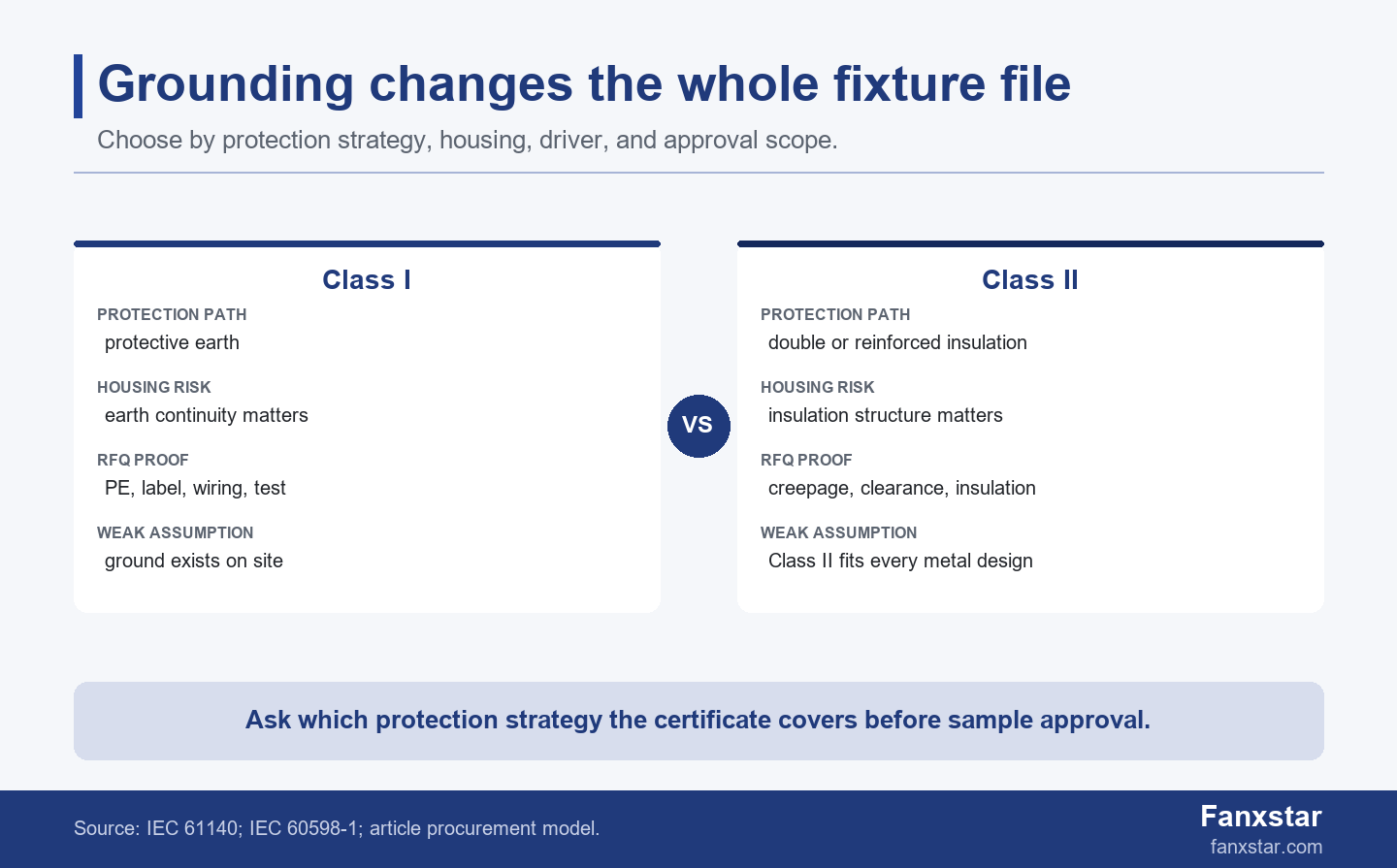
Class I and Class II lighting are different protection strategies, not a simple better-or-worse ranking. Class I depends on a protective earth path when basic insulation fails; Class II depends on double or reinforced insulation so the fixture does not rely on protective earth for shock protection.
According to IEC 61140, the standard applies to protection against electric shock and gives common principles for installations, systems, and equipment. According to IEC 60598-1, luminaires have general safety requirements covering classification, marking, mechanical construction, electrical construction, and photobiological safety. The buyer should therefore ask what protection strategy the exact LED fixture has been designed and approved to use.
Key Takeaways
- Class I lighting uses protective earth as an additional safety measure; the buyer must verify the earth path, label, wiring, and installation assumption.
- Class II lighting relies on double or reinforced insulation; the buyer must verify insulation structure instead of assuming no-ground means lower risk.
- The same housing shape can require different evidence if driver, cable, connector, label, or insulation parts change.
- Fanxstar ODM projects should freeze the protection class, driver, housing, wiring, and certificate boundary before sample approval.
The practical difference between Class I and Class II lighting
Class I transfers part of the safety question to protective earth
A Class I LED fixture is not unsafe because it uses grounding. Its logic is that accessible conductive parts should be connected to protective earth so a fault can be handled by the protection system. That makes the earth path, terminal, conductor, cable entry, label, and installation assumptions part of the product evidence. A metal weatherproof housing, aluminum linear fixture, or industrial luminaire often pushes buyers toward this evidence path.
OSHA electrical safety resources reinforce why electrical protection should be treated as a safety topic. In procurement language, Class I approval is not only a label on a datasheet. It is an evidence chain: fixture design, earth connection, wiring diagram, marking, test record, and installation requirement should point to the same product version.
The weak assumption is that the installation site will always provide a correct ground. A buyer cannot solve site wiring from a supplier RFQ, but the buyer can make sure the fixture documentation is honest about needing protective earth. If the project is in a damp, outdoor, industrial, or public environment, that boundary should be stated early.
Class II moves the proof burden into insulation design
A Class II fixture does not become safer simply because it has no protective earth. Its protection strategy depends on double or reinforced insulation, adequate separation, controlled materials, and a design that does not rely on grounded accessible metalwork. The proof question becomes insulation structure, not earth continuity.
That makes Class II attractive for some applications and unsuitable for others. A compact plastic body may support Class II more naturally than a large metal industrial housing. A driver change, cable change, or housing redesign can affect the insulation story. Buyers should avoid treating Class II as a universal upgrade if the product architecture does not support it.
| Question | Class I evidence | Class II evidence |
|---|---|---|
| How is shock protection achieved? | basic insulation plus protective earth | double or reinforced insulation |
| What should the RFQ name? | PE terminal, wiring, label, earth continuity | insulation structure, creepage, clearance, label |
| What can change the approval? | housing, earth path, cable, connector, driver | housing, driver, insulation parts, assembly gap |
| What is the buyer risk? | site grounding assumption is wrong | supplier treats Class II as a marketing label |
What buyers should ask before comparing grounding requirements
The certificate scope must match the exact fixture
IEC 60598-1 luminaire safety requirements is relevant because luminaire approval involves classification, marking, construction, and tests. A certificate that covers one fixture version may not automatically cover another housing, driver, cable, emergency pack, connector, or insulation structure. The buyer should ask whether Class I or Class II applies to the exact quoted model and market.
According to International Trade Administration special documents guidance, some products may require certificates tied to standards, safety, or other product conditions. For LED lighting, the certificate file should name the product family, model, input voltage, protection class, and any critical variants. If the supplier cannot explain variant coverage, the buyer should hold the sample decision.
A useful check is to compare 5 files side by side: datasheet, label artwork, wiring diagram, certificate, and sample photo. If the datasheet says Class II, the label lacks the expected symbol, the wiring diagram shows an earth conductor, and the certificate names a different driver, the product file is not ready.
Grounding language belongs in the RFQ, not only the drawing
The RFQ should state whether the buyer expects Class I, Class II, or supplier recommendation based on market and installation mode. It should also require the supplier to name the evidence: earth terminal, conductor, continuity test, insulation test, creepage/clearance logic, label, certificate scope, and installation instruction. Without that language, a supplier may quote a mechanically similar fixture with a different protection class.
According to International Trade Administration import regulations guidance, imported products can face documentation, safety, quality, and conformity checks. Grounding class is one of the fields that should remain consistent across product file, certificate, packing record, and installation document.
Where grounding class changes LED fixture design
Housing material and access shape the decision
Metal housings, serviceable compartments, replaceable drivers, cable glands, and external connectors can all affect the grounding decision. A Class I metal fixture may be straightforward when the product has a defined earth path and the installation expects protective earth. A Class II design may need more controlled insulation barriers and a different internal architecture. The same outward shape can hide a very different safety file.
DLC solid-state lighting technical requirements and FEMP LED luminaire purchasing guidance both reinforce a luminaire-level view of LED products. Buyers should not isolate the driver, housing, and label from the safety class. The full fixture is what gets installed and maintained.
A scenario estimate helps: if a buyer changes from a plastic Class II body to an aluminum weatherproof body to improve durability, the project may gain mechanical strength but trigger a new grounding and certificate discussion. The cost of that discussion is small compared with discovering after tooling that the target market expects a different protection class.
Emergency and sensor options can disturb the old answer
Adding an emergency battery pack, microwave sensor, dimming driver, or through-wiring option can change internal spacing, wiring, heat, and access. A product that was previously clear as Class I or Class II may need a fresh review when the electrical architecture changes. This is especially important for ODM lighting where small option changes are easy to request.
According to GSA LED and controls guidance, LED and controls decisions should consider life-cycle cost and system behavior. Grounding class belongs in that system view because a future service technician will interact with the fixture, wiring, driver, and label, not with the sales description.
The buyer should ask the supplier to mark which options are inside the existing approval file and which require review. That one table can prevent a Class II claim from drifting into a Class I product or a Class I product from being shipped with incomplete grounding instructions.
The trade-off is product simplicity versus installation certainty
The trade-off is not that one class is premium and the other is cheap. The trade-off is where the safety burden sits. Class I can be straightforward for robust metal fixtures, but it depends on correct protective earth at the site. Class II can simplify installation in some contexts, but it pushes the proof burden into insulation parts, assembly control, and certificate scope.
According to IEC 61140 protection principles, shock-protection rules are shared across equipment and installations. This means the supplier and buyer are solving connected questions: product design, installation condition, maintenance access, and market approval. If any 1 of those 4 conditions changes, the protection-class answer should be reviewed instead of copied from a previous order.
In practice, a buyer comparing 2 otherwise similar fixtures should ask for a one-page safety boundary note. For Class I, that note should show the earth terminal, continuity path, cable requirement, and label. For Class II, it should show the insulation strategy, critical parts, marking, and what substitutions are forbidden. This small document gives engineering, purchasing, and site teams the same language.
This means a procurement team should not treat grounding language as a late installation note. It belongs in the commercial approval file with the model code, voltage, housing, cable entry, and certificate version. If the buyer later adds an emergency pack or sensor, the same boundary note can be used as a 5-minute review tool: did the new option change wiring access, insulation distance, protective-earth continuity, label language, or the certificate model family? If the answer is yes or unclear, the sample should be paused before the factory repeats the old class claim.
How Fanxstar handles grounding-class decisions in ODM projects
Freeze the protection strategy before sample approval
Fanxstar’s relevant product paths include weatherproof LED lighting product platform, aluminum weatherproof LED luminaires, LED linear lighting platform, emergency lighting product range, and custom LED lighting ODM service. In these projects, grounding class should be treated as an engineering decision, not a late checkbox.
A useful Fanxstar RFQ names target market, input voltage, housing material, installation mode, cable entry, service access, emergency option, sensor option, and expected protection class. If the buyer is unsure, the RFQ should ask for a recommended protection strategy and supporting evidence. That gives engineering room to match safety design with product architecture.
Before the sample is approved, freeze 6 items: protection class, driver, wiring, label, housing, and certificate scope. If any one changes, the buyer should ask whether grounding or insulation evidence changes with it.
Use a hold rule for unclear class claims
A practical hold rule is: do not approve mass production when the protection class in the datasheet, label, certificate, and wiring diagram does not match. Do not approve a Class II claim if the supplier cannot describe the insulation strategy. Do not approve a Class I claim if the earth path and installation instruction are vague.
According to International Trade Administration import documentation guidance, import files can include invoices, bills of lading, packing lists, insurance proof, and certificates of origin. The lighting approval file should be just as consistent. Model, label, certificate, and shipment documents should describe the same protection-class version.
If the project is safety-sensitive, the buyer should also involve local electrical code review or a qualified engineer. A supplier can provide product evidence, but final installation must match local requirements and site conditions.
FAQ
Is Class II lighting safer than Class I lighting?
Class II is not automatically safer than Class I. The two classes use different protection strategies: Class I relies on protective earth, while Class II relies on double or reinforced insulation. The safer choice is the one correctly designed, certified, installed, and maintained for the application.
Does Class I lighting always need grounding?
Yes, Class I lighting depends on a protective earth path as part of its shock-protection strategy. Buyers should verify the earth terminal, wiring diagram, label, continuity evidence, and installation instructions before treating the fixture as ready for use.
Can a metal LED fixture be Class II?
It may be possible in some designs, but the supplier must prove the insulation strategy and certificate scope. A metal housing does not automatically decide the class, but it makes the evidence question more demanding because accessible conductive parts must be considered carefully.
What should an RFQ say about Class I or Class II?
The RFQ should name the target market, installation mode, input voltage, housing material, service access, cable entry, and expected protection class. It should also ask for label artwork, wiring diagram, certificate scope, and a change-control rule for driver or housing substitutions.








