
Mitsubishi Iupilon, Teijin Panlite, and SABIC Lexan can all be credible polycarbonate choices for LED fixtures. The real decision is not which brand is universally best. The real decision is which exact grade matches the optical function, heat, impact risk, UV exposure, flame or certification requirement, molding route, and sample result.
According to SABIC lighting diffusion materials, LEXAN materials are used in LED lighting diffusion solutions. According to Teijin Panlite product information, Panlite is positioned around properties such as impact, heat, dimensional stability, electrical behavior, transparency, and sanitation. According to Mitsubishi Engineering-Plastics Iupilon optical materials, Iupilon appears in optical and light-guide material contexts. These sources support a grade-based comparison, not a brand-name contest.
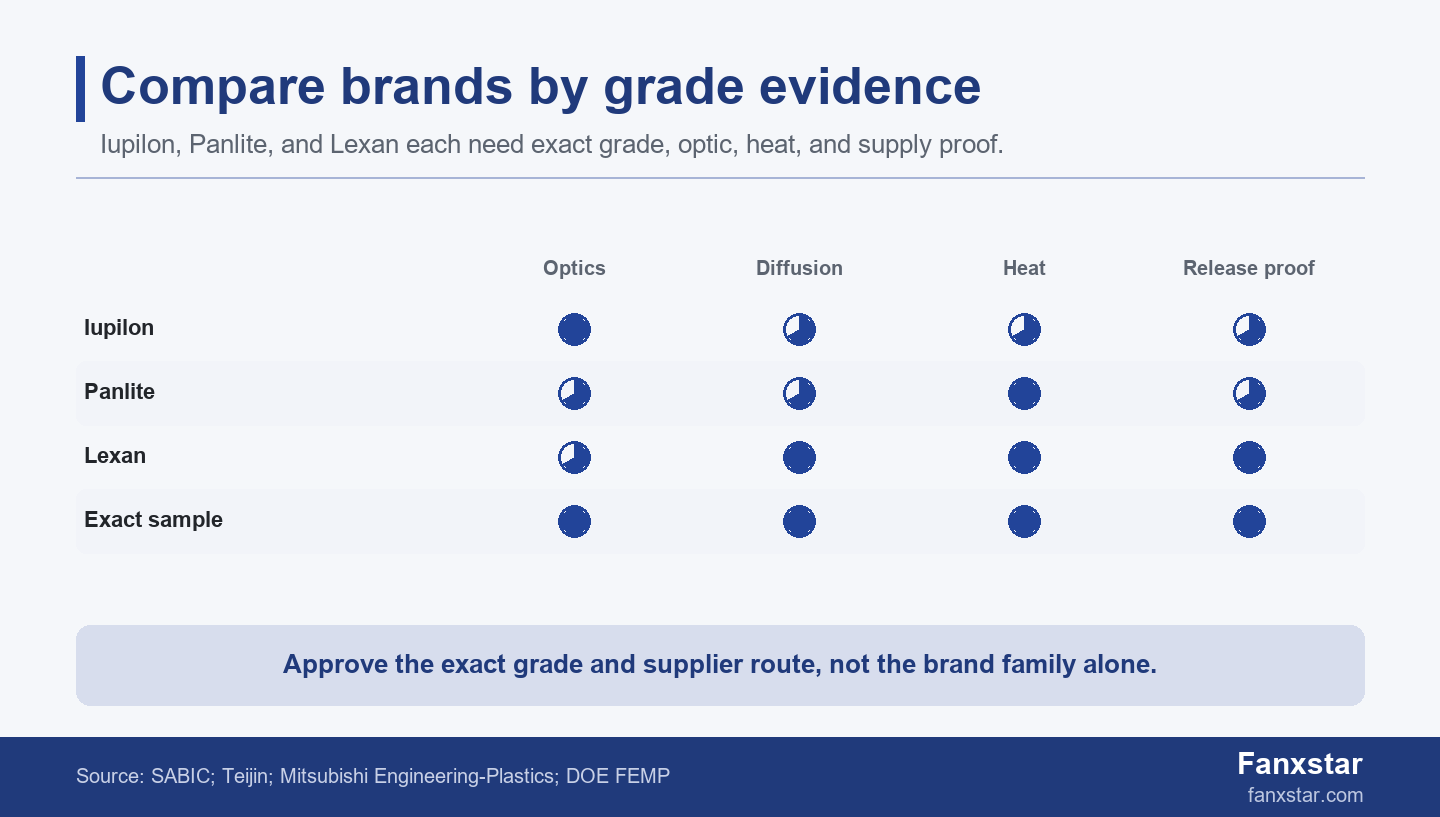
For Fanxstar LED fixture projects, the material discussion should happen with the diffuser drawing, optic target, housing temperature, target market, and sample goal on the table. A buyer who says only I need Lexan, Panlite, or Iupilon may still receive the wrong grade for the fixture.
Key Takeaways
- Iupilon, Panlite, and Lexan are material families, so buyers must specify exact grade, thickness, supplier route, and evidence.
- Transparent cover, diffusing cover, lens, light guide, and impact cover are different jobs even when all use polycarbonate.
- Heat, UV, flame rating, chemical cleaning, and optical haze can change the best grade more than the brand name does.
- A production order should lock the material grade and require reapproval when grade, supplier, thickness, texture, or diffuser finish changes.
Why brand names cannot replace grade evidence
Iupilon, Panlite, and Lexan each contain multiple possible grades
Polycarbonate is not one material decision. A brand family may include transparent grades, diffusion grades, flame-retardant grades, UV-stabilized grades, high-flow grades, optical grades, and specialty grades for electronics or automotive uses. If the RFQ only names the brand family, the supplier still has to choose the actual grade. That choice can affect light transmission, haze, color shift, heat behavior, molding quality, flame rating, and cost.
According to SABIC transparent lighting materials, transparent lighting materials are presented separately from diffusion solutions. According to SABIC LEXAN resin information, LEXAN is a broad polycarbonate resin family. This means a buyer cannot treat one LEXAN mention as proof that the grade fits every LED diffuser or cover.
| Brand family | Useful strength to investigate | Evidence buyers should request |
|---|---|---|
| Mitsubishi Iupilon | Optical and light-guide polycarbonate grades may be relevant when lens or guided-light behavior matters. | Exact grade, optical transmission or diffusion data, thickness, heat limit, UV path, and supply route. |
| Teijin Panlite | Balanced polycarbonate properties including impact, heat, dimensional stability, transparency, and sanitation claims. | Exact Panlite grade, property sheet, application fit, molding condition, and certificate match. |
| SABIC Lexan | Broad PC family with transparent and diffusion lighting materials, including LEXAN LUX lighting solutions. | Exact LEXAN grade, LUX or LUX_C scope if used, flammability or f1 evidence where required, and sample result. |
| Generic PC | Can work when the risk is low and the supplier proves the grade. | Do not accept generic PC wording without grade, datasheet, supplier, and optical sample. |
The same logic applies to Panlite and Iupilon. A Teijin Panlite grade selected for transparency may not be the right grade for a high-heat sealed industrial fixture. An Iupilon optical or light-guide grade may be excellent for guided light behavior but still need confirmation for the final housing, outdoor exposure, and certificate scope. The brand helps the shortlist, but the grade decides the release.
Material arguments fail when they stop at brand reputation. They become useful when they connect 5 items: exact grade, function, exposure, processing, and evidence. The buyer should ask for all 5 before accepting a quote.
Optical function should be named before material brand
An LED fixture cover may need to protect LEDs, hide LED points, spread light, guide light, reduce glare, resist impact, survive cleaning, or meet a flame requirement. These goals can conflict. A highly transparent cover may show LED points. A strong diffusion grade may reduce output. A tougher or flame-retardant grade may cost more or require different molding conditions. A UV-stabilized grade may be necessary outdoors but less important indoors.
According to Teijin optical property overview, optical properties are a material category that should be reviewed in their own right. According to Mitsubishi Engineering-Plastics Iupilon light-guide information, Iupilon is used in optical and light-guide contexts. These references support asking what optical job the fixture cover performs before asking which brand is preferred.
A buyer should use a function-first question: is this part a clear protective cover, a diffuser, a lens, a light-guide plate, an impact shield, or an IP gasketed cover? The answer changes the grade. A lens may need dimensional stability and optical clarity. A diffuser may need haze and light transmission balance. A vandal-prone cover may need impact margin and secure mounting. A food-area cover may need cleaning and chemical review.
The trade-off is never only optical. A material that improves output may have weaker abuse resistance. A material that improves toughness may need optical adjustment. The best fixture does not maximize every property; it balances the properties that matter for the application.
How to compare Iupilon, Panlite, and Lexan for LED fixtures
Use a job-to-grade map instead of a winner list
A practical comparison starts with the fixture job. For a linear industrial luminaire, the diffuser may need to hide LED points, resist impact, keep IP sealing, and tolerate heat. For an architectural linear light, uniform appearance and color consistency may dominate. For an emergency fixture, material choice may interact with flame, label, and certification requirements. For outdoor weatherproof lights, UV stability and gasketed construction become more important.
| Fixture question | Why the brand name is not enough | Approval gate |
|---|---|---|
| Clear cover or diffused cover? | Transparent and diffusion grades solve different optical problems. | Measure light output, glare, LED hiding, and haze on the final thickness. |
| Indoor or outdoor? | UV exposure can change yellowing and brittleness risk. | Request UV-stabilized grade, coating, or outdoor evidence where needed. |
| High heat or sealed housing? | Thermal exposure depends on LED board, driver, enclosure, and ambient temperature. | Check RTI or grade heat data and test the final assembly. |
| Impact or vandal risk? | Toughness depends on grade, thickness, ribs, clips, and mounting. | Test impact or abuse risk using the final diffuser and housing design. |
| Compliance or flame requirement? | UL 94, glow-wire, f1, or market rules can be grade-specific. | Certificate or datasheet must name the exact grade and thickness. |
According to DOE FEMP LED luminaire purchasing guidance, commercial and industrial LED luminaires should be evaluated as procurement assets. Material selection is part of that asset value because diffuser yellowing, cracking, glare, or poor molding can shorten service life or damage lighting quality. A lower material quote can become expensive when covers fail before the rest of the luminaire.
For Iupilon, ask whether the proposed grade is optical, light-guide, general transparent, or another application grade. For Panlite, ask which property set is being used: transparency, impact, heat, dimensional stability, flame, or sanitation. For Lexan, ask whether the supplier is using transparent, diffusion, LUX, LUX_C, flame-retardant, or outdoor-suitable grades. The answer should appear in the material approval sheet.
If a supplier says equivalent PC, ask equivalent to what. Equivalent brand reputation is not enough. The substitute should match optical performance, mechanical performance, thermal behavior, flame or UV requirement, processing route, certificate scope, and sample result. Otherwise, the buyer is accepting an unknown product under a familiar material word.
Test the final thickness, surface, and assembly
Datasheets are necessary, but the final fixture still has to be tested as an assembly. Thickness, rib design, surface texture, clips, screws, gasket pressure, LED spacing, driver heat, and ambient temperature can change the result. A grade that looks good as a flat sample may show stress marks, warping, light streaks, or LED spotting after molding and assembly.
According to SABIC lighting diffusion materials, diffusion materials for LED lighting are designed around light output and scattering needs. That makes sample testing essential. The buyer should check total output, glare, LED hiding, color appearance, and diffuser surface under the final LED board and driver current, not under a generic demo strip.
A strong sample review includes 6 photos or tests: front appearance when lit, side glare view, off-state surface quality, clip or screw stress check, heat-soak check, and material label or supplier certificate. Add UV or chemical cleaning checks when the fixture is used outdoors, in washdown areas, parking garages, food plants, or harsh industrial zones.
The decision rule is to approve the material in the fixture, not the pellet in isolation. If the final diffuser thickness, texture, or supplier route changes, the material approval should reopen. This does not make development slow; it prevents hidden substitution.
Fanxstar material approval workflow for ODM lighting
Connect material choice to the fixture platform
Fanxstar buyers can connect the material decision to weatherproof LED lighting products, vapor tight LED fixtures, LED linear lighting products, custom LED lighting design options, and the PMMA vs PC material guide. The correct material may differ between a waterproof linear fixture, a clear lens product, a tunnel luminaire, and a food-processing washdown light.
A useful RFQ names the product family, cover function, target market, optical target, impact risk, UV exposure, cleaning exposure, ambient temperature, flame or certificate requirement, annual volume, and preferred material brand if any. Then ask the supplier to recommend exact grade, thickness, supplier route, and sample evidence. This keeps the conversation technical instead of emotional.
For private-label projects, the buyer should decide whether the material brand must appear in the BOM, whether substitutes are allowed, and what evidence is required for substitute approval. If a project was approved with a named LEXAN, Panlite, or Iupilon grade, a production switch to another PC grade should require written confirmation and sample review.
The strongest purchase file includes material datasheet, grade name, color or diffusion code, thickness, molding condition if relevant, optical sample result, heat or UV evidence, certificate scope, and production inspection rule. It also states which changes reopen approval. This is especially important because the finished luminaire may not reveal the polymer grade visually.
Make the final decision by risk, not brand preference
If the fixture is an indoor commercial diffuser with low impact and moderate heat, several PC grades may work. If the fixture is an outdoor weatherproof luminaire, UV and sealing behavior matter more. If the fixture is in a warehouse or parking area, impact and abuse risk matter more. If the fixture is in a sealed emergency or industrial product, flame and thermal data may control the decision. Each case can point to a different grade even within the same brand family.
A simple risk ladder can guide approval. Low-risk indoor covers need grade identity and optical sample. Medium-risk industrial covers need optical, heat, and impact evidence. High-risk outdoor, emergency, food, or public infrastructure covers need optical, heat, impact, UV or chemical, flame or certification, and sample evidence. The higher the risk, the less acceptable a generic PC substitution becomes.
The best answer to Iupilon versus Panlite versus Lexan is therefore conditional. Choose the grade that meets the fixture job with the strongest evidence and supply reliability. A brand name can open the discussion, but the product release should close only when the exact grade and final sample meet the application.
FAQ
Is Lexan better than Panlite or Iupilon for LED fixtures?
Lexan is not universally better than Panlite or Iupilon because each brand family contains many grades for different optical, thermal, mechanical, and compliance needs. The right choice depends on the exact grade, optical function, heat, UV exposure, impact risk, flame requirement, certificate scope, and sample result. Buyers should compare grade evidence rather than brand reputation alone.
When should LED fixtures use Iupilon polycarbonate?
Iupilon may be relevant when the LED fixture needs optical or light-guide performance and the selected grade fits the final design conditions. Buyers should request the exact grade, optical data, thickness, heat limit, UV path, processing note, and sample result before approving it for production or allowing a substitute.
What is Panlite useful for in lighting products?
Panlite can be useful where a project needs balanced polycarbonate properties such as impact resistance, transparency, heat behavior, dimensional stability, and electrical or sanitation-related requirements. The final decision still depends on the exact Panlite grade, the molded fixture geometry, the diffuser thickness, and fixture-level test evidence.
Can suppliers substitute generic polycarbonate for a named brand?
Suppliers should not substitute generic polycarbonate without written approval and updated evidence from the buyer. The substitute must match optical output, haze, impact, heat, UV, flame or certification scope, thickness, processing route, and sample appearance. Otherwise, the finished fixture may no longer match the approved design or certificate file.








