

In LED fixture production, connectors occupy a fraction of the bill of materials cost yet account for a disproportionate share of field failures. A spring clamp connector that costs €0.20 more per unit than the generic alternative can determine whether a production run of 5,000 fixtures passes a quality audit in Spain — or generates warranty claims twelve months after installation. Wago, TE Connectivity, and generic (unbranded or no-name) connectors each occupy a distinct position in the OEM and ODM LED manufacturing ecosystem. Understanding what differentiates them — and where each belongs in a production spec — is the kind of engineering knowledge that distinguishes a well-built product from one that ships with a liability embedded in every junction.
Key Takeaways
- Wago’s spring clamp technology maintains consistent contact force over time without relying on installer technique — making it the dominant field-service-friendly connector for LED fixture assembly and replacement in European commercial and industrial installations.
- TE Connectivity’s LUMAWISE product family addresses a specific and underserved problem: the mechanical, electrical, and thermal interface between COB LED arrays and their fixtures, as well as IP66-rated outdoor street lighting control interfaces that Wago’s product range does not cover.
- Generic connectors are not inherently inferior — but they lack the plating quality, contact force specification, and fretting corrosion resistance engineering that Wago and TE achieve through deep R&D investment. In vibration and thermal cycling environments, this gap becomes a field failure.
- For weatherproof and industrial LED fixtures targeting EU or AU certification, named-brand connectors with documented UL/IEC ratings are not optional — they are the certification documentation baseline.
The Physics of Connector Failure in LED Fixtures
Why LED Fixture Connectors Fail: Three Mechanisms
Before comparing brands, it is worth establishing what actually causes connector failure in LED fixture environments, because the three primary mechanisms determine which technology performs better in which context.
The first mechanism is fretting corrosion. When two metal connector contact surfaces experience micro-motion — caused by vibration, thermal expansion and contraction cycles, or even the building’s structural vibration — they rub against each other at a microscopic scale. This wears through the protective plating on the contact surfaces and exposes the base metal, which oxidizes. As the oxide layer accumulates, it acts as an insulator rather than a conductor, increasing contact resistance, causing voltage drop across the terminal, and ultimately producing intermittent power failure or complete circuit loss. Fretting corrosion is a leading cause of connector failure in LED fixtures mounted to vibrating machinery, overhead industrial cranes, refrigeration systems, and anywhere with significant thermal cycling — all of which overlap with weatherproof and industrial LED applications.
The second mechanism is loose connection from installer variation. Traditional screw terminal and twist-and-tuck connections in LED fixture junction boxes depend heavily on consistent torque and technique from the installer. In field conditions — on a ladder, in a cold warehouse, with gloves — the quality of a connection varies. Under-tightened connections create hot spots, arcing, and eventual failure. Over-tightened connections can deform the conductor or terminal.
The third mechanism is environmental ingress at the connector. For IP-rated weatherproof LED fixtures, any non-sealed connector in the wiring path creates a potential breach point. Moisture ingress at a connector in an IP66 fixture undermines the entire IP certification of the fixture, regardless of how well the housing is sealed.
Wago: Spring Clamp Technology for LED Wiring
What Makes Wago Different
Wago’s fundamental innovation is the spring clamp connection mechanism. Instead of relying on screws (which can loosen over thermal cycling) or the installer’s twist technique (which varies in quality), Wago uses a tin-plated copper spring that applies consistent, calibrated contact force to the inserted conductor. This contact force is maintained independently of vibration and thermal cycling — the spring compensates for conductor movement rather than allowing it to create fretting.
In destructive testing reported by Wago, the surrounding materials fail before the metal connection itself does — demonstrating that the spring clamp interface is not the structural weak point in the assembly. For LED fixture manufacturing and field installation, this translates to a measurable reduction in connection-related callbacks and warranty claims, particularly for installations in high-vibration or temperature-cycling environments like cold chain logistics facilities or outdoor weatherproof applications.
Wago’s LED-Specific Product Portfolio
Wago has built a dedicated lighting product line that covers the full wiring architecture of a luminaire. Their 221 Series Lever-Nuts handle wire-to-wire splicing in junction areas, accommodating 12–24 AWG conductors and accepting solid, stranded, and fine-stranded conductor types simultaneously — a practical feature when connecting a fixture’s lead wire (often fine-stranded) to building wiring (often solid). Their 2773 PUSHWIRE connectors are smaller and faster for permanent production-line installations. The 8773 Luminaire Disconnects are purpose-built for lighting applications that require code-compliant service disconnects inside fixture housings. For PCB-level driver connections, Wago offers SMD PCB terminal blocks with silver-coated pins — addressing fretting corrosion at the PCB interface specifically, where the pin connects two circuit boards subject to thermal expansion and contraction.
Wago also offers explicit UV-protection and higher-temperature ratings for outdoor-use connectors — relevant for IP65+ fixtures where internal connector temperatures can be elevated by both LED heat and ambient conditions.
The Knockoff Problem
A significant practical risk with Wago specification: the widespread availability of counterfeit or “Wago-compatible” connectors that are not genuine Wago products. “Wago style,” “Wago equivalent,” and brand names with subtle spelling changes (such as “Wag0” or “Wugo”) are common on online marketplaces and through some low-tier component distributors. These products typically do not use Wago’s engineered spring alloy specification, contact force tolerance, or plating quality. For production quantities of LED fixtures, using counterfeit Wago connectors while documenting “Wago” on the BOM creates a certification and quality risk that is difficult to detect at incoming inspection. Specifying Wago by part number (e.g., 221-412 for a 2-conductor Lever-Nut) and procuring through authorized distributors is the only reliable prevention.
TE Connectivity: Engineered for LED-Specific Architecture
LUMAWISE: Solving the LED-to-Fixture Interface
TE Connectivity’s connector portfolio for LED lighting is architecturally different from Wago’s — and addresses a different set of problems. TE’s LUMAWISE product family focuses on two distinct challenges that Wago’s general-purpose spring clamp connectors do not fully address.
The first is the COB (Chip-on-Board) LED-to-fixture mechanical and electrical interface. LUMAWISE Type Z LED holders provide a solderless connection to COB LED arrays with snap-in LED retention that secures the LED in the holder during assembly and ensures proper positioning in the fixture. This eliminates soldering of the LED array — a process that, done inconsistently, can introduce thermal stress at the LED-to-board interface and affect long-term lumen maintenance. TE Connectivity’s LUMAWISE holders also mechanically press the LED to the heatsink, integrating the thermal management path with the electrical connection.
The second challenge is the outdoor street lighting control interface. TE’s LUMAWISE Endurance N system provides IP66-rated base assemblies for NEMA/ANSI-compliant luminaire receptacles used in street and area lighting. These components — rated for outdoor, year-round deployment — comply with ANSI C136.41 (for dimming-capable systems) and include integrated gaskets and power twist-lock terminals that go beyond what general-purpose connectors can provide in exposed outdoor luminaire environments.
TE Connectivity’s Contribution to Fretting Corrosion Engineering
TE Connectivity has contributed foundational technical documentation on fretting corrosion in LED connector applications — the “Tin Commandments” developed by Jim Whitley at AMP Incorporated (now TE Connectivity) are widely cited as the reference framework for mitigating fretting in tin-plated connectors. Their approach includes designing connectors with adequate normal contact force (minimum 100 grams is cited as the threshold for minimizing micro-motion), using an initial wiping action during mating to break through surface oxide films, and applying contact lubricants and anti-oxide compounds during manufacturing. These design practices are embedded in TE’s commercial connector products but are not systematically present in generic alternatives.
Generic Connectors: Where They Work and Where They Fail
The Honest Assessment of Unbranded Connectors
Generic connectors — unbranded or low-tier branded push-in connectors produced by Chinese or Southeast Asian manufacturers — are used extensively in consumer-grade and entry-level LED fixtures, and many perform adequately in low-stress applications: indoor commercial lighting with stable temperatures, infrequent service, and no chemical or moisture exposure. The performance gap between generic and branded connectors is not always visible in short-term quality tests, which is precisely why they remain common in cost-sensitive production.
The gap becomes material in four specific conditions: vibration environments (where fretting corrosion begins within the first few thousand thermal cycles on generic tin-plated contacts without adequate normal force); high-temperature proximity to LED sources or drivers (where cheap connector housings may deform or creep at temperatures that WAGO and TE housings handle without issue); maintenance and rework scenarios (where a connector that cannot be non-destructively reopened, or that degrades on re-mating, creates field serviceability problems); and certification audits (where a BOM listing generic connectors without UL/IEC ratings creates documentation gaps that halt CE, ENEC, or SAA certification).
The Certification Documentation Gap
For LED fixtures targeting European or Australian markets, every electrical component in the fixture — including connectors — must have documented safety certification for the CE marking technical file. This means UL listing or IEC-equivalent certification, temperature rating, current rating, and flammability classification for the connector housing material. Generic connectors without published, verifiable certifications create a hole in the documentation trail that notified bodies flag during ENEC review. Wago and TE Connectivity publish this data at the part-number level and maintain traceability through authorized distribution. This is the practical reason that named-brand connectors are not a luxury specification for certified LED products — they are the documentation baseline.
Side-by-Side Comparison
| Criteria | Wago (221/2773/8773 Series) | TE Connectivity LUMAWISE | Generic / Unbranded |
|---|---|---|---|
| Connection Mechanism | Spring clamp — consistent force, vibration-resistant | Application-specific (solderless COB holder, IP66 twist-lock) | Push-in or screw — variable force, technique-dependent |
| Fretting Corrosion Resistance | High — spring maintains contact force; silver-coated SMD pins | High — engineered per “Tin Commandments” framework | Low to moderate — depends on contact force and plating spec |
| Field Serviceability | Excellent — lever-nut reopenable; transparent housing for inspection | Application-specific — COB holders are tool-free snap-in/out | Variable — push-in generics often not reliably reopenable |
| IP-Rated Configurations | IP68-rated splice connectors (CoolSplice TE); Wago: indoor-rated for most luminaire products | IP66/IP67 LUMAWISE Endurance N and SlimSeal series for outdoor | Rarely IP-rated; IP claims often unverified |
| LED-Specific Designs | Yes — Luminaire Disconnects, PCB terminal blocks for drivers, SMD terminals for LED modules | Yes — LUMAWISE COB holders, ANSI-compliant street lighting interfaces | No — general-purpose connectors adapted to lighting use |
| Certification Documentation | UL-listed, CE, IEC; full part-number level data sheet | UL-listed, ANSI C136 compliant; full regulatory data | Variable — often incomplete or unverifiable for CE/ENEC |
| Cost Relative to Generic | 15–40% premium per unit | Higher premium — application-specific engineering cost | Baseline cost |
| Counterfeit Risk | HIGH — widespread knockoffs; procure from authorized distributors only | Moderate — less commonly counterfeited | N/A — the product category itself |
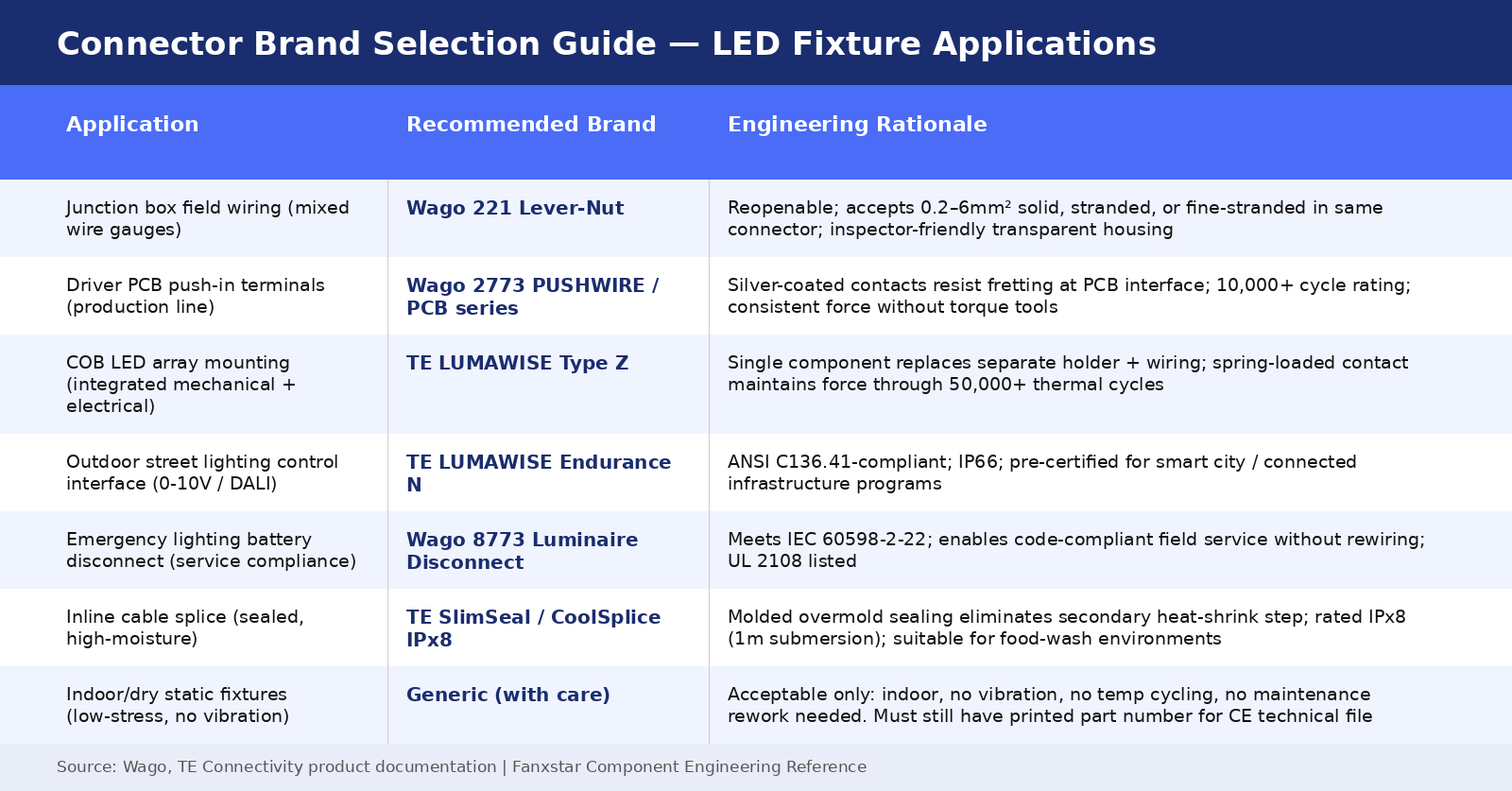
Application-Based Selection Guide
Junction Box Wiring in Weatherproof Industrial Fixtures
For the wire-to-wire connections inside weatherproof LED fixture junction boxes — where building wiring meets the fixture’s internal lead wires — Wago 221 Series Lever-Nuts are the practical standard in European commercial and industrial installations. Their ability to accept mixed conductor types (solid building wiring alongside stranded fixture leads), be reopened without tools for maintenance, and provide visual inspection through the transparent housing makes them the preferred connector for facilities teams doing long-term maintenance on IP65+ fixtures in warehouses, parking structures, and cold chain logistics facilities. For Fanxstar’s weatherproof fixture range deployed in EU and AU markets, this is the connector family we reference in our installation documentation. Review our weatherproof LED fixture specifications for wiring interface details.
Driver PCB Terminal Connections
For connections at the LED driver PCB level — where the driver connects to the AC mains input and the DC output to the LED board — Wago’s PCB terminal block range (including push-button and lever PCB connectors) provides the combination of production-line speed and long-term reliability needed in volume OEM production. The silver-coated SMD PCB terminals specifically address fretting at the PCB interface, where repeated thermal cycling would otherwise degrade tin-plated alternatives. For Fanxstar’s OEM customization projects that include integrated driver design, specifying the PCB connector at the driver interface level is part of the pre-production engineering review we conduct with partners. Learn more about our OEM process and how component-level specification decisions are managed before tooling is committed.
COB LED Array Connections
For LED fixtures using chip-on-board (COB) LED arrays — including high-output industrial high-bay designs and some specialized specialty grow lights — TE Connectivity’s LUMAWISE Type Z holders provide the correct solution. They integrate mechanical retention, electrical connection, and thermal interface in a single solderless component, replacing a solder joint that requires careful process control to achieve consistent quality in mass production. For Fanxstar’s aquaculture grow light range (where COB arrays and IP68 ratings coexist), the LED-to-fixture interface engineering is a core design challenge that LUMAWISE holders directly address.
Outdoor Street Lighting and Area Lighting Control Interfaces
For IP66-rated outdoor area lighting fixtures requiring ANSI-compliant twist-lock receptacles for photo controls or network lighting control nodes, TE Connectivity’s LUMAWISE Endurance N system is the specification standard. Wago does not offer a direct equivalent for this application. Fanxstar’s outdoor weatherproof fixtures for EU and AU markets that require dimming control integration or photocell compatibility can reference the LUMAWISE Endurance N interface for interoperability with existing infrastructure. Contact our engineering team to discuss control interface requirements for specific projects.
Emergency Lighting Driver Connections
For emergency LED fixtures with LiFePO4 battery backup and associated BMS circuits, the battery compartment wiring operates in a confined, thermally active environment. Wago’s luminaire disconnect series provides the code-compliant serviceability that allows the battery pack to be replaced without tools — a meaningful practical feature given the 3–5 year replacement cycle of battery cells in emergency lighting. The spring clamp technology maintains contact quality over the battery’s service life without re-tightening. See Fanxstar’s emergency lighting range for product designs that address these wiring requirements.
Frequently Asked Questions
Are Wago connectors reliable for industrial LED fixture production?
Yes — when genuine Wago connectors are specified and procured from authorized distributors. Wago’s spring clamp technology has been validated in industrial electrical applications for decades, and their UL listing and IEC certifications support use in commercial and industrial LED fixtures globally. The reliability concern with Wago in practice is not the genuine product but the prevalence of counterfeit “Wago-style” connectors that lack the spring alloy engineering and contact force specification of real Wago components. Specifying by Wago part number and procuring through authorized channels is the essential quality control step.
What is fretting corrosion in LED connectors and how is it prevented?
Fretting corrosion occurs when micro-motions between two connector contact surfaces — caused by vibration or thermal expansion and contraction — wear through the protective plating and expose the base metal, which then oxidizes. The oxide film acts as an insulator, increasing contact resistance and eventually causing intermittent or complete circuit failure. In LED fixture environments, thermal cycling from LED heat and ambient temperature changes creates fretting conditions in every installation. Prevention approaches include selecting connectors with adequate normal contact force (sufficient to minimize micro-motion amplitude), using spring clamp technology (as in Wago) rather than screw or push-in connections, and ensuring connectors are engineered to IEC standards with published contact force specifications.
Can generic connectors be used in CE-certified LED fixtures?
Technically, a connector does not need to carry the Wago or TE brand to support CE marking — what matters is documented certification data (UL listing or IEC equivalent, temperature rating, current rating, flammability class). Some generic connectors from reputable Chinese manufacturers do carry these certifications and can support the CE documentation trail. The practical problem is that many generic connectors lack published, part-number-specific certification documentation — meaning that during a ENEC or CE review, the technical file is incomplete. For EU-market LED fixtures, the safest and most time-efficient approach is to use connectors from brands that publish complete grade-level certification data as a matter of standard product documentation.
Does using Wago add significant cost to an LED fixture BOM?
The cost impact is modest and application-dependent. A typical weatherproof LED fixture using three or four Wago 221-Series Lever-Nuts for junction wiring adds roughly $0.30–$0.80 per fixture in material cost over equivalent generic push-in connectors, depending on quantity and sourcing market. Against a fixture cost of $20–$80, this is a sub-2% BOM impact that is easily recovered in reduced warranty claim rates, faster field installation (Wago lever-nuts are measurably faster to install than wire nuts or screw terminals in production and field conditions), and cleaner certification documentation for EU market products.








