
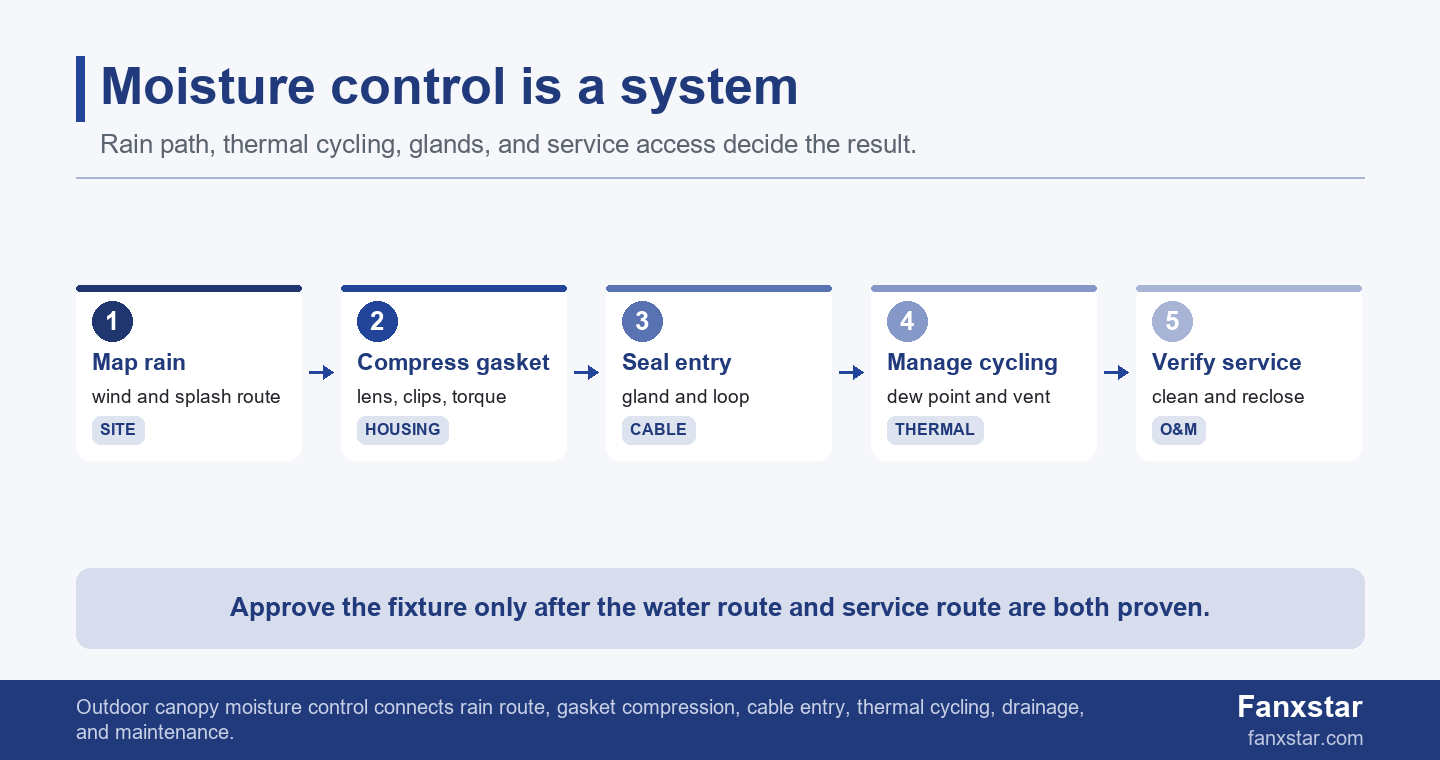
To prevent moisture build-up in outdoor canopy lighting, buyers must control 5 things together: water route, gasket compression, cable entry, thermal cycling, and maintenance reopening. A fixture can look sealed in a catalog but still collect moisture if rain is driven into the wrong angle, if a cable gland is undersized, if the gasket is pinched, or if humid air condenses inside the lens after the LED turns off.
According to IEC IP rating guidance, IP ratings separate dust and water protection into 2 numerals. That is why IP65, IP66, and IP67 should be treated as evidence questions, not decoration. According to the National Weather Service dew point explainer, dew point is a direct measure of atmospheric moisture, which explains why canopy lights can show internal fogging even when there is no obvious liquid leak.
Key Takeaways
- Outdoor canopy lighting moisture control starts with the installation geometry, not only the fixture label.
- IP rating, gasket design, cable gland, drip loop, venting, and service closure must be reviewed as one system.
- Condensation and direct water leakage are different failure modes, so the buyer should diagnose the symptom before approving a fix.
- Fanxstar canopy and weatherproof projects should include a sample review that checks lens, gasket, cable entry, and post-service closure.
Start With Moisture Path, Not Fixture Wattage
Moisture prevention is not one component
Outdoor canopy lights sit in a difficult position. They are often protected by a roof, but they still face wind-driven rain, heat from the canopy surface, cold nights, vibration, insects, dust, vehicle exhaust, and service from below. The fixture may be mounted horizontally, recessed, suspended, or angled. Each installation changes how water sits on the lens, where droplets collect, and how cables enter the body.
The best prevention method is to define the water path before selecting the product. Ask where rain can hit, where splash can bounce, where condensation can form, where the cable enters, and who will open the fixture later. A product that works under a flat warehouse ceiling may need a different gasket, gland, drainage, or venting strategy under an outdoor canopy.
According to NEMA enclosure type guidance, enclosure type definitions are scope-specific and should be checked with the relevant standard details. For canopy buyers, that means IP language, enclosure type language, wet-location claims, and supplier installation instructions should all describe the same real use condition.
Diagnose leakage and condensation separately
Direct leakage usually leaves a path: droplets near the cable gland, staining near an end cap, pooling at the lens edge, or water after heavy rain. Condensation is subtler. The fixture may fog after sunset, after a cold rain, or after a long off cycle. It may clear when the LEDs warm the enclosure. These two symptoms need different fixes. A stronger cable gland may solve one; a pressure equalization vent or assembly dryness control may help the other.
According to the National Weather Service dew point explainer, dew point links moisture in the air to condensation risk. In a canopy luminaire, that means the buyer should not assume fogging equals a failed IP test. The assembly may have trapped moist air, the fixture may be breathing through a weak path, or the surface temperature may be dropping below the dew point during operation cycles.
| Moisture source | Typical symptom | Prevention step |
|---|---|---|
| Wind-driven rain | water marks near lens or end cap | verify IP path, gasket compression, and mounting angle |
| Thermal cycling | fogging after cooling at night | review dew point, vent option, and internal air volume |
| Cable entry | droplets near gland or wire route | specify gland, strain relief, drip loop, and sealant boundary |
| Service reopening | moisture after driver or lens service | define closure torque, gasket inspection, and recheck steps |
Five Fixture Details That Prevent Moisture Build-Up
Start with the lens and gasket path
The lens and gasket path should be easy to inspect because it is the most visible moisture boundary. Buyers should ask whether the gasket is continuous, whether the lens is clipped or screwed, whether compression is controlled, and whether repeated service can deform the seal. A gasket that depends on uneven hand pressure is risky in outdoor canopy lighting because maintenance is often performed on lifts or ladders with limited visibility.
According to IEC IP ratings, water protection is expressed by the second IP digit, so buyers should ask which water test condition the supplier is claiming. A canopy with occasional rain splash may not need the same rating as a washdown area, but a buyer should still know whether the fixture is IP65, IP66, IP67, or another classification and whether the tested sample included the same cable entry and mounting position.
The buyer should also check whether water can sit on top of the fixture or around the lens frame. A recessed canopy light may collect water differently from a surface-mounted vapor tight fixture. If water can pool around a joint, the gasket design and drainage path become more important than the product photo.
Treat the cable entry as a water route
Cable entries cause many moisture failures because they combine electrical penetration, mechanical strain, and installation variation. A canopy light may look perfect until the installer routes the cable upward, forgets the drip loop, overtightens the gland, or uses a cable diameter outside the gland range. The RFQ should specify cable type, diameter, gland model, strain relief, and whether a prewired tail is required.
The best practice is to make the cable route visible in the sample review. Photograph the gland, cable bend, strain relief, and gasket around the entry. If a buyer needs a longer cable or connector, request a new check because the gland range and strain behavior may change. A 1-meter cable and a 3-meter cable can create different handling forces during installation.
According to International Trade Administration import documentation guidance, import records can include multiple shipment documents. Lighting buyers can apply the same version-control habit: the approved sample, cable detail, BOM, label, packing list, and invoice should all identify the same product version. That matters when moisture prevention depends on a small gland or connector change.
According to International Trade Administration special document guidance, some product shipments can require additional certificates or special documentation. For outdoor canopy lights, that means the buyer should decide early whether the order needs wet-location evidence, IP evidence, market certificates, or a site-specific inspection note, because those documents are harder to recover after production has changed the cable entry.
Plan for thermal cycling and service reopening
Outdoor canopy lights heat during operation and cool when switched off. In summer sun, the canopy itself can become warm before evening cooling. In rainy seasons, a fixture can move from warm operation to cold wet air in minutes. That cycling changes internal pressure and can bring moisture into weak paths. A pressure equalization vent may help in some designs, but it must be selected, placed, and tested as part of the finished fixture.
Service reopening is the other common failure moment. A fixture may remain dry for months, then fog after a driver change because the gasket was pinched or the end cap was not tightened evenly. Buyers should ask suppliers for a service closure method, not just an initial IP claim. If the fixture is not intended to be opened in the field, that should also be clear before procurement.
How to Write a Better Canopy Lighting RFQ
Give the supplier the real installation context
A useful canopy RFQ should include the canopy height, mounting method, fixture orientation, exposure to wind-driven rain, ambient temperature range, switching schedule, cable entry direction, maintenance method, and whether the fixture is near fuel, food, parking, or loading operations. It should also state whether the buyer has seen past symptoms: fogging, droplets, corrosion, driver failure, or insects inside the lens.
According to ENERGY STAR lighting upgrade guidance, commercial lighting upgrades can include applications such as parking garage and task lighting, which reminds buyers that exterior lighting replacement is not only an energy project. For canopy lighting, energy savings are important, but safety, visibility, moisture control, and service reliability decide whether the upgrade actually works.
The RFQ should ask the supplier to identify the product version, IP rating, lens material, gasket path, cable gland, vent option if any, bracket or mounting method, and service instructions. If the supplier proposes a moisture fix, ask which failure mode it addresses: direct rain path, cable entry, condensation, trapped assembly moisture, or post-service closure.
Use a sample checklist before batch approval
Before approving volume, inspect at least 10 details on the sample: lens fit, gasket continuity, clip or screw pressure, cable gland, cable bend, drip loop plan, mounting holes, vent location, label position, and service access. Power the sample, let it cool, and inspect again. If possible, install a small pilot in the actual canopy for a short observation period before full replacement.
A 7-day pilot is often enough to reveal obvious fogging patterns after day and night cycles. It cannot prove lifetime, but it can catch weak assembly, trapped moisture, or wrong installation orientation. The buyer should record photographs on day 1 and day 7, including the lens surface, cable entry, and any visible droplets or fogging.
According to DLC solid-state lighting technical requirements, LED performance evidence is tied to defined product categories and reporting. Canopy buyers should treat mechanical moisture evidence with the same discipline: specify the exact product, exact cable entry, exact gasket route, exact test sample, and exact installation boundary.
According to FEMP purchasing guidance for commercial and industrial LED luminaires, commercial and industrial LED purchases should compare complete luminaires in defined categories. The retrofit insight is that a canopy light should be released as a complete product, not as a loose combination of body, lens, gland, driver, and installation habit. If any one of those pieces changes, the moisture-control evidence should be reviewed again.
Where Fanxstar Fits Outdoor Canopy Lighting
Start from the right sealed platform
Fanxstar’s relevant platforms for canopy moisture control include weatherproof LED lighting, IP65 and IP66 waterproof LED lights, vapor tight LED light fixtures, and aluminum weatherproof LED luminaires. The buyer should choose the starting point after defining the water route and service method, not by fixture name alone.
For a fuel-station canopy, uniformity, glare, driver access, and moisture control may all matter. For a logistics canopy, impact, cable protection, and dust may be more important. For a coastal canopy, corrosion and salt humidity may dominate. Fanxstar can evaluate these differences when the buyer provides photographs, installation drawings, target wattage, CCT, beam, mounting height, and maintenance constraints.
If the canopy project needs custom cable length, sensor control, emergency function, private label, or different housing detail, Fanxstar custom LED lighting ODM service should be briefed before the sample is made. Moisture prevention depends on small details, so late changes to cable, gland, lens, or bracket should trigger a new review.
Keep the decision simple for procurement
A good procurement sentence is: quote the outdoor canopy luminaire with the stated IP rating, cable entry, gasket design, mounting orientation, service method, and moisture-control evidence for this site. That sentence is more useful than asking for the best waterproof light because it gives the supplier a real design boundary.
The final purchase file should include the selected model, drawing, IP evidence, cable and gland detail, installation note, service note, photometric file, and any pilot observations. If the buyer keeps that file attached to the order, future maintenance and repeat purchases become much easier to control.
FAQ
Why does moisture appear inside outdoor canopy lights?
Moisture can come from direct leakage, weak cable entry, trapped humid air, thermal cycling, or poor service reclosure. The right fix depends on whether the symptom is droplets after rain, fogging after cooling, or moisture after maintenance.
Is IP65 enough for outdoor canopy lighting?
IP65 may be enough for some protected canopies, but it depends on wind-driven rain, splash, cleaning, mounting angle, cable entry, and service method. Buyers should ask what water test the rating represents and whether the tested sample matches the installed product.
Can a breather vent prevent canopy light condensation?
A vent can help when pressure cycling is the main cause, but it does not replace a correct gasket, cable gland, housing design, or IP evidence. The vented version should be reviewed and tested as part of the finished fixture.
What should buyers check before approving canopy LED lights?
Check the IP evidence, lens and gasket path, cable gland, drip loop, vent option, mounting orientation, service closure method, photometric file, and whether the sample matches the final bill of materials.








