
SAA and RCM are often mentioned together in Australian LED lighting projects, but they do not mean the same thing. RCM is the visible compliance mark used under Australian and New Zealand electrical and communications compliance frameworks. SAA is commonly used in the market to describe third-party electrical safety certification evidence. The buyer’s risk is assuming that a logo, overseas certificate, or supplier sentence is enough to release a shipment.
For LED lighting importers, distributors, and private-label buyers, the safer question is practical: who is the responsible supplier, what category or risk level applies, which certificate or declaration covers the exact model, and what records will still match the shipped product after ODM changes?
Key Takeaways
- RCM is a compliance mark; SAA-style certification can be supporting safety evidence, but neither should be accepted without model scope.
- Australian market release normally requires a responsible supplier and records that match the product being supplied.
- Overseas marks such as CE or FCC do not automatically grant permission to supply electrical products in Australia.
- ODM buyers should control driver, wiring, label, plug, cable, emergency, sensor, and housing changes before relying on old evidence.
What RCM and SAA mean in an LED lighting purchase
RCM is the label buyers can see, not the whole proof file
EESS describes the Regulatory Compliance Mark as the mark representing EESS and ACMA labelling requirements. That visible mark is important, but it does not replace the evidence behind the product. A buyer still needs to know which rules apply, who took responsibility, and which documents support the specific LED luminaire or light source.
EESS marking guidance explains that electrical equipment offered for sale by registered responsible suppliers must be marked with the RCM. For lighting buyers, this means the mark should be treated as the endpoint of a compliance process. It is not a decoration to add after the carton artwork is finished. The product, label, registration status, certificate, declaration, and technical file need to tell the same story.
SAA is different in everyday sourcing language. Buyers may ask for SAA certification when they really mean product-level electrical safety evidence suitable for Australia. Some suppliers answer with a certificate that covers a driver, plug, cable, or related component rather than the finished luminaire. That can be useful evidence, but it may not prove that the complete LED fixture is ready for supply.
Australian release starts with responsibility
EESS registration purpose guidance says responsible suppliers must register before registering or selling in-scope equipment and must declare that equipment meets relevant standards and is electrically safe. That is a stronger standard than a casual sales promise. The responsible party must be able to hold a file that survives inspection. In a private-label lighting order, the importer cannot assume the overseas manufacturer has solved every Australian obligation.
EESS registration guidance for in-scope electrical equipment states that relevant equipment is registered by an Australian or New Zealand responsible supplier, and that each importer has its own responsibility. This is crucial for Fanxstar-style ODM projects: the factory may supply technical evidence, but the market-facing importer, brand owner, or distributor still needs a release path that fits the local framework.
This responsibility point is where many cross-border lighting projects become confused. A factory can help prepare test reports, product photos, rating-label artwork, wiring diagrams, and construction details, but it is usually not the Australian entity placing the product on the market. The importer or distributor should therefore build the compliance file as if it will need to explain the decision later to a customer, regulator, insurer, or retail channel. That file should identify the responsible supplier, the product family, the exact model list, the evidence source, and the version date of the documents being relied on.
The same discipline protects private-label work. If two importers buy a similar LED weatherproof light from the same factory, each buyer may still have a different brand, model code, responsible supplier record, label, instruction manual, and order history. A copied certificate image does not answer those commercial differences. The file should make clear which evidence comes from the manufacturer, which declarations or registrations belong to the local supplier, and which items must be updated when the fixture is customized.
The evidence path before a shipment is released
A label without records creates a weak compliance position
EESS responsible supplier declarations guidance explains that declarations can relate to EESS and/or ACMA schemes when registering on the database. For regulated equipment, the declaration should connect the supplier, equipment, and relevant standards. That matters because a buyer who only approves carton artwork can still be exposed if the declaration, test report, and final construction do not match.
EESS ACMA requirements for use of RCM point buyers back to the marking rules and the role of responsible suppliers. The evidence trail is not a marketing brochure. The buyer should know who signs it, which standards are listed, what model or family it covers, and whether the final model number, brand, rating label, voltage, plug, and instruction manual match the order.
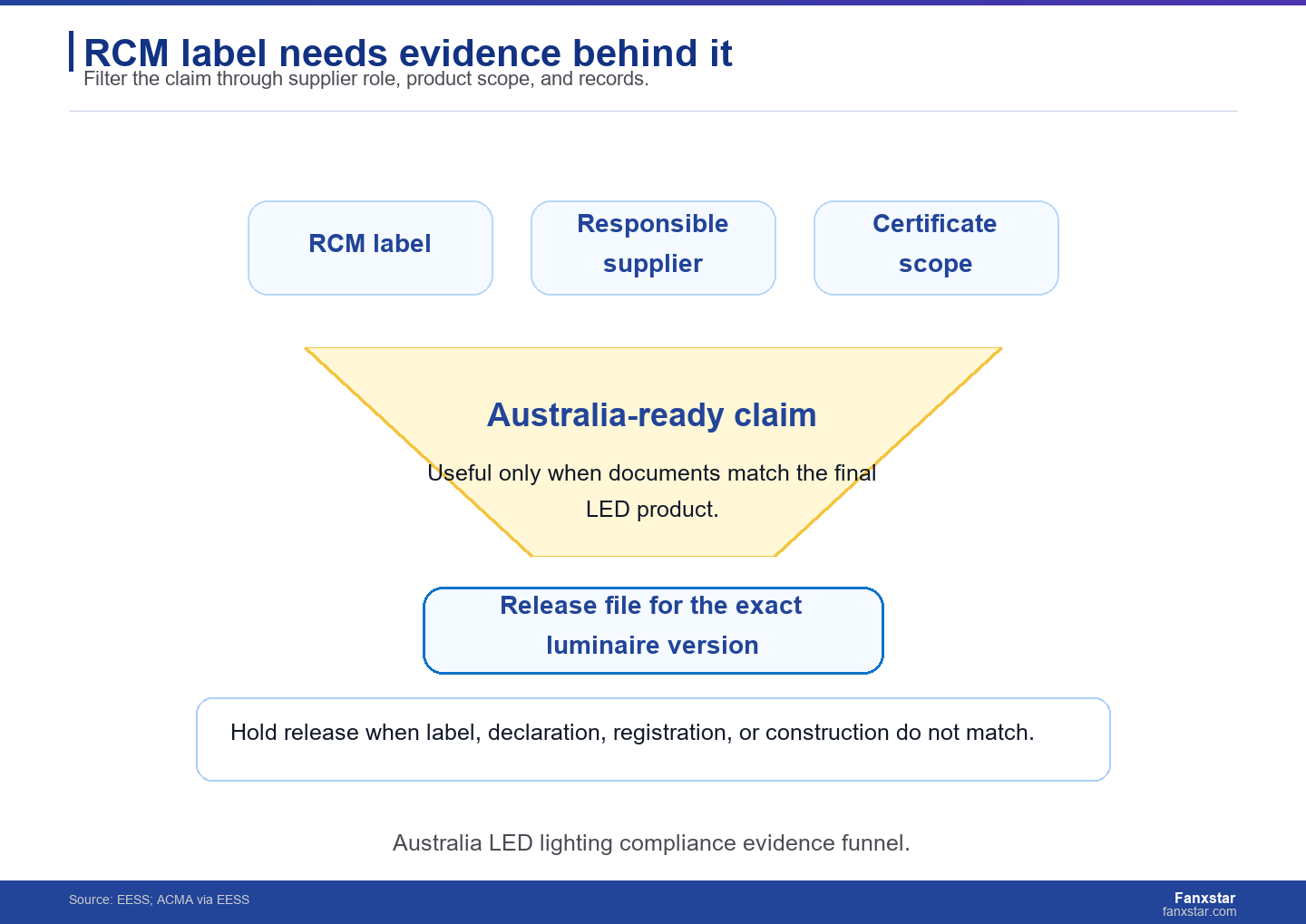
A practical file for an LED luminaire should include the responsible supplier information, certificate or registration evidence where required, applicable standards, test reports, product photos, rating label artwork, user instruction, wiring diagram or driver evidence where relevant, and a bill of materials boundary. If the project includes emergency lighting, sensor control, dimming, special cable, or a private-label housing, the file should state whether those versions are covered.
The EESS level changes what buyers should request
EESS Level 3 guidance states that Level 3 in-scope equipment must be registered by the responsible supplier and marked with the RCM. Level 3 is the highest risk category and normally requires stronger evidence than a low-risk product. A buyer should not let a supplier use one generic RCM statement across products with different risk levels, construction, and end use.
The EESS registration database guidance explains that certificate details are recorded and that a valid Certificate of Conformity is needed before a Level 3 product can be registered. That gives buyers a simple check: if a supplier claims a high-risk product is Australia-ready, ask how the model appears in the relevant registration or certificate chain and who owns the responsible supplier role.
EESS certification guidance adds that certificates uploaded to the EESS platform can be used by registered responsible suppliers for registration. For procurement teams, that is a reminder to request evidence that is usable in the actual release workflow, not just a scan that looks official but cannot be connected to the model or supplier account.
Where LED lighting ODM projects create compliance gaps
A component certificate is not always a luminaire certificate
LED lighting products are assembled from components that may each carry evidence: driver, plug, cable, terminal block, battery, emergency module, sensor, housing material, and LED board. A component certificate can reduce risk, but it does not automatically certify the finished luminaire. The finished product adds wiring, enclosure, heat, marking, installation method, and accessible parts.
The buyer should ask the supplier to state the certificate boundary. Does the certificate cover the whole luminaire model, a product family, a driver series, or one component? Which rating, wattage, voltage, CCT, emergency option, sensor option, diffuser, cable, or plug is included? When the evidence boundary is unclear, the importer may discover the gap only after artwork, packaging, or shipment has already been prepared.
Private-label changes need a release rule
Private-label lighting often changes the brand name, rating label, carton, instruction manual, model code, cable length, plug, emergency option, sensor setting, diffuser, or installation accessory. Each change looks small in a sourcing conversation. In a compliance file, the same change can affect model identity, marking, documentation, or tested construction.
A strong ODM process uses a change log. The supplier identifies which changes are cosmetic, which require label or declaration updates, and which require engineering or certification review. The buyer should not wait until the pre-shipment inspection to ask whether the Australian label and paperwork still match the final production version.
A useful change log is short but explicit. It names the part changed, the reason, the affected model, the evidence that remains valid, and the evidence that must be refreshed. Driver, battery, plug, cable, terminal, emergency module, sensor, diffuser, enclosure, gasket, and rating label changes deserve special attention because they can touch electrical safety, marking, installation instructions, or model identity. When this review happens before the production order is released, the buyer can choose whether to accept the change, request retesting, or hold the variant for a later shipment.
The release meeting should also separate sample approval from compliance approval. A sample can be bright, well built, and visually acceptable while the paperwork is still incomplete. Conversely, a certificate can look good while the sample has already moved away from the tested construction. The importer needs both paths to converge before shipment: the physical product must match the evidence, and the evidence must match the product that will carry the RCM label.
A buyer checklist for SAA and RCM evidence
Questions to ask before paying for tooling or samples
Ask whether the product is in scope for EESS, which risk level applies, whether registration is needed, who will be the responsible supplier, and whether the certificate or declaration covers the final luminaire. Ask whether the model number, brand, rating label, instruction manual, and packaging are already aligned with the Australian file.
Ask for the applicable standard list, certificate number or report reference, issue date, expiry status where relevant, model scope, photos of the tested version, and a statement about allowed substitutions. If a supplier sends only a logo, request the evidence behind it. If a supplier says the product has CE, ask which Australian requirements that evidence does or does not support.
Red flags that should pause release
Pause the order if the certificate model number does not match the quote, the rating label has a different voltage, the driver changes after approval, the emergency pack is added later, the supplier cannot name the responsible supplier, or the declaration lists standards that do not match the product type. Also pause if the supplier treats RCM as a sticker that can be added to any carton without records.
For LED lighting, a compliance gap often appears as a document mismatch rather than an obvious product defect. The sample may function normally. The packaging may look professional. The risk appears when a regulator, customer, or distributor asks for the evidence chain and the buyer cannot connect the sold product to the file.
Fanxstar application fit
How to prepare an Australia-ready lighting brief
Fanxstar buyers can start from weatherproof LED lighting, linear lighting platforms, emergency lighting products, and custom LED lighting ODM service when the project needs Australian market evidence. The first brief should list target market, product family, voltage, wattage, plug or cable, installation type, emergency or sensor option, brand label, and certificate expectation.
For complex orders, pair this article with LED lighting certification checklist for ODM buyers and custom LED lighting design options. Fanxstar can help align the sample with the quote, but the buyer should still decide who owns the responsible supplier role and what evidence must be present before release.
The practical outcome should be an evidence bundle that the importer can understand: product scope, market role, label, declaration, certificate or registration path, and change-control notes. That bundle is more valuable than a short statement that a product is SAA or RCM ready.
FAQ
Is SAA the same as RCM?
No. RCM is the compliance mark used under Australian and New Zealand compliance frameworks. SAA is commonly used as shorthand for safety certification evidence. Buyers should check the exact certificate scope, responsible supplier role, and product registration requirement instead of treating the terms as interchangeable.
Can a CE certified LED light be sold in Australia?
Not automatically. Overseas marks can be useful supporting evidence, but Australian market release still needs the applicable local compliance path, records, responsible supplier role, and correct labelling.
Who is the responsible supplier for imported LED lighting?
The responsible supplier is normally an Australian or New Zealand manufacturer or importer that takes responsibility under the relevant framework. The overseas factory can provide evidence, but the importer still needs a compliant release file.
What should ODM buyers request before approving a sample?
Request certificate scope, model list, applicable standards, test reports, label artwork, declaration path, instruction manual, photos of the tested construction, driver and component boundary, and a rule for substitutions after sample approval.
Does an RCM label prove the whole product is compliant?
The label is important, but it should be backed by records that match the exact product. A buyer should not rely on the mark alone without checking responsible supplier, documentation, and model scope.








