
For LED lighting buyers, “VDE standard” can mean several different things: a German electrical standard, a VDE testing program, a VDE certification mark, an ENEC mark issued through VDE, or evidence used to support CE compliance for the European market. Those meanings are related, but they are not interchangeable.
The buying task is to turn the label into evidence. Before approving a German-market or EU-market luminaire, ask which standard applies, which product version was tested, whether a VDE or ENEC mark is actually granted, how the Low Voltage Directive scope is handled, and whether the declaration, report, label, and shipped construction describe the same product.
Key Takeaways
- VDE is not one single standard; it can refer to standards, testing, certification marks, or evidence from the VDE Institute.
- For EU lighting products, VDE evidence often supports safety confidence, but CE responsibility under the Low Voltage Directive remains with the manufacturer.
- German-market buyers should connect VDE or ENEC claims with the exact luminaire, control gear, label, voltage range, and applicable EN/IEC standards.
- ODM buyers should request certificates, test reports, model-scope details, construction photos, marking artwork, EU Declaration of Conformity, and change-control rules before release.
What buyers usually mean by VDE
VDE can be a mark, a test body, or a standards reference
VDE describes its lighting services as accredited testing and certification for lighting technologies ranging from LED modules to smart outdoor luminaires. The same page lists examples such as VDE, VDE-GS, VDE-ENEC, VDE-EMC, UL, CB Certificate, CCC, EAC, and EU conformity declarations. That breadth is useful, but it also explains why buyers need precise language.
If a quotation says “VDE standard,” ask what is meant. Does the fixture carry a VDE mark? Was a component certified by VDE? Was the product tested against EN/IEC standards by VDE? Is the supplier saying only that the design follows a VDE-related standard? Each answer creates a different evidence burden. A component certificate does not automatically certify the whole luminaire, and a test report does not automatically mean the product may use a mark.
Certification marks have specific scope
VDE certification-mark guidance states that VDE certification marks are awarded after product inspections, manufacturing-facility control, and regular production monitoring. The page also describes marks such as the VDE Mark, VDE GS Mark, VDE EMC Mark, VDE Registration Mark, ENEC Mark, and ENEC PLUS Mark. For buyers, the lesson is that a mark is not decoration. It has a defined product scope and surveillance context.
Ask for the certificate number, certificate holder, product family, model list, rated voltage, rated power, protection class, IP rating, control gear scope, applicable standards, factory identity, and marking permission. If a supplier changes housing material, driver, LED board, emergency module, cable entry, label, or voltage range, the buyer should ask whether the certificate scope still covers the changed product.
How VDE evidence fits with EU compliance
The Low Voltage Directive sets the safety framework
The European Commission Low Voltage Directive page states that Directive 2014/35/EU covers health and safety risks for electrical equipment operating between 50 and 1000 V AC or 75 and 1500 V DC, and that it applies to a wide range of professional and consumer electrical equipment. Most mains-powered LED luminaires therefore need a clear LVD compliance path for EU market access.
The same Commission page notes that the LVD does not require notified bodies to assess whether products comply; the manufacturer is responsible for determining compliance through conformity assessment. This is why voluntary certification can be valuable but should not be misunderstood. A VDE or ENEC certificate can strengthen evidence, but the EU Declaration of Conformity and technical file still need to match the final product placed on the market.
Germany implements the LVD through national rules
The European Commission LVD guidance gives the EU framework buyers should anchor first, while German-market projects should also confirm local product-safety documentation, instructions, labeling, and responsible-party details with the importer or compliance owner. For a German-market buyer, the practical evidence bundle should satisfy the EU safety framework and the market file expected for the product actually placed on the market.
The practical procurement point is not to memorize every legal paragraph. It is to avoid vague compliance claims. If the product is intended for Germany, ask for the applicable EN/IEC standard list, test report references, CE documentation, German or EU label requirements, instructions, risk assessment, and any VDE/ENEC mark scope. A supplier that can only send a logo image has not provided compliance evidence.
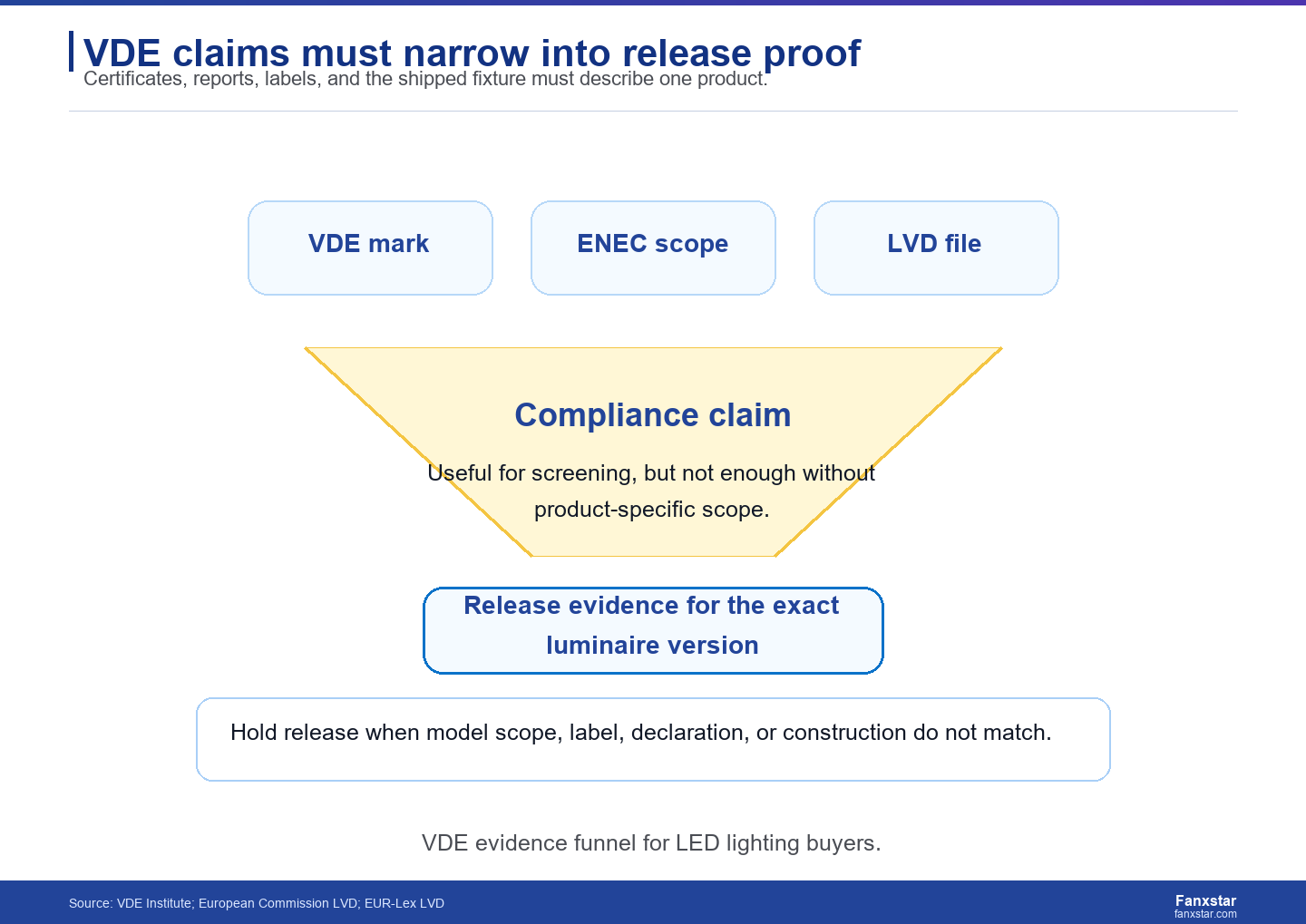
Evidence buyers should request before sample release
The document chain should match one exact fixture
A useful evidence chain begins with product identity. The model number, construction drawing, rating label, power supply, LED module, housing, lens, cable gland, emergency option, sensor option, protection class, IP rating, and installation instruction should all describe the same version. If the documents refer to different model suffixes, the buyer needs a cross-reference before approving the sample.
EUR-Lex hosts Directive 2014/35/EU as the legal text for electrical equipment within certain voltage limits. When a supplier provides a declaration against the LVD, the buyer should check whether the cited standards, model names, responsible manufacturer, and date align with the quote. If a VDE or ENEC certificate is used as supporting evidence, the certificate scope should be traceable to the declaration and label.
Reports and certificates should not be mixed casually
A test report records results under defined conditions. A certificate or mark normally carries a broader certification scope and may include surveillance or factory-control requirements. A declaration is a manufacturer responsibility document. A datasheet is commercial information. A label is the product-facing claim. Buyers need all of these documents to agree, but they should not treat one as a substitute for the others.
VDE certification-mark guidance reinforces the same buyer principle across test bodies: confirm scope, product identity, applicable standards or directive route, and technical evidence before accepting a compliance claim. If the project is ODM or private label, also ask who will be the responsible manufacturer on the EU Declaration of Conformity and who controls the technical file after shipment. This keeps the approval decision tied to an auditable product file, not only to a quotation label.
Typical LED lighting risks behind weak VDE claims
Component approval does not certify the finished luminaire
A driver, cable, terminal block, or LED module may carry useful approvals. Those approvals reduce risk, but the finished luminaire still has construction, thermal, marking, creepage, clearance, insulation, earthing, mechanical, and installation requirements. A buyer should not accept “driver has VDE” as proof that the luminaire is VDE certified or LVD-ready.
VDE lighting testing services include electrical safety, mechanical and thermal safety, construction review, markings, documentation, and component compliance. That list is a good RFQ checklist. Ask the supplier to show how component approvals are integrated into the finished product evidence. If the product uses a custom housing, sensor, emergency kit, or cable entry, the final construction review matters.
Private-label and ODM changes can invalidate evidence
ODM buyers often change the brand label, cable length, plug, driver, emergency pack, sensor, CCT, power setting, packaging, or installation instruction. Some changes are cosmetic; others can change safety scope. The purchase agreement should require written review before substitutions and should identify which changes require certificate review, retest, or updated declaration.
A clean release package includes the certificate or report, EU Declaration of Conformity, rating label artwork, instruction manual, product photos, bill of materials boundary, model list, packaging label, and change-control rule. If the product is sold into Germany, include German-language documentation needs where applicable. The supplier should not wait until customs clearance, tender submission, or customer audit to discover a documentation mismatch.
Use release gates for German-market orders
For a Germany-focused order, split approval into gates rather than one final document review. The first gate is product identity: model, housing, driver, LED board, voltage, protection class, IP rating, and options. The second gate is standards and certificate scope: which EN/IEC standards apply, whether VDE or ENEC evidence covers the model, and whether the certificate holder and factory match the order. The third gate is market documentation: label, instructions, EU Declaration of Conformity, language requirements, and technical-file ownership.
This gate structure catches problems early. A sample can look correct while the label uses the wrong voltage range. A certificate can be valid while not covering the sensor version. A declaration can cite the right directive while using an old model number. A private-label order can pass electrical review while lacking the responsible manufacturer details needed for the market file. Each mismatch is cheaper to correct before production than after goods are packed.
Buyers should also decide who owns post-shipment evidence. If a distributor, importer, or private-label brand will answer market-surveillance questions, that party needs access to the declaration, test reports, model-scope explanation, and change history. A supplier that cannot provide this evidence before shipment may still manufacture a functional luminaire, but it has not completed the German-market compliance package the buyer actually needs.
The same gate sequence should be repeated after substitutions. If the driver becomes unavailable, the cable gland changes, an emergency pack is added, or the label is revised for a private-label order, do not treat the old approval as automatically valid. Reopen the affected gate, check whether the certificate or report scope still applies, update the declaration if needed, and keep the correspondence with the final order file.
This is especially important for long-running framework purchases. The first shipment may be well documented, while the third shipment uses a changed component because supply conditions moved. German-market evidence has to remain current with the shipped product, not only with the first sample. Keep the final evidence bundle with each release lot so later audits can trace what was actually shipped.
Fanxstar application fit
VDE and German-market evidence is most relevant when Fanxstar buyers source mains-powered industrial luminaires, weatherproof platforms, linear lighting, emergency lighting, sensor-ready fixtures, and custom ODM versions. Useful starting points include LED certification checklist for ODM buyers, custom LED lighting design options, linear lighting platforms, and weatherproof LED lights.
Before requesting a quote, send the target market, voltage range, protection class, IP/IK requirement, emergency or sensor option, CCT/CRI, label language, brand ownership, and certificate expectation. Fanxstar can then review whether an existing platform, report, or component set is suitable, or whether a new certification route is needed for the exact product version.
FAQ
Is VDE required for all LED lights sold in Germany?
No. VDE certification is often voluntary, while legal market access depends on applicable EU and German requirements such as LVD compliance, CE documentation, product safety rules, and correct technical evidence. Some buyers or tenders may request VDE or ENEC evidence.
Does a VDE-certified driver certify the whole luminaire?
No. A certified driver is useful component evidence, but the finished luminaire still needs its own construction, thermal, electrical, marking, documentation, and installation-safety review. The product-level claim must match the final fixture.
What is the difference between VDE and ENEC?
VDE is an institute and mark family, while ENEC is a European certification mark for certain electrotechnical products under the ENEC procedure. VDE can issue ENEC-related certification when the product and program scope fit.
How does VDE evidence relate to CE marking?
VDE evidence can support a manufacturer’s compliance case, but CE marking under the Low Voltage Directive remains the manufacturer’s responsibility. The declaration, technical file, label, and product construction must still align.
What should an ODM buyer request before approval?
Request certificates, test reports, model-scope details, applicable standards, rating label artwork, EU Declaration of Conformity, instruction manual, product photos, component boundary, and a rule for driver, housing, cable, sensor, or emergency-module substitutions.








