SASO certification for Saudi LED lighting is a product-and-shipment evidence workflow, not a one-time logo that automatically covers every ODM change. The buyer should treat Saudi market access as a release workflow: classify the product, confirm the technical regulation, secure the product evidence, secure the shipment evidence, and recheck the file when the lighting product changes.
According to Trade.gov Saudi standards guidance, Saleem Saber became mandatory for imported goods entering Saudi Arabia as of July 2018. According to Trade.gov Saudi testing and certification guidance, Saber connects importers, SASO-approved certification bodies, Saudi customs, and related authorities. Those 2 facts make SABER a shipment workflow, not a decorative certificate.
Key Takeaways
- SASO certification for LED lighting is usually managed through SABER and may involve both product and shipment certificates.
- A Product CoC does not automatically clear every future consignment if the model, label, shipment, or evidence file changes.
- Saudi lighting projects may also involve energy efficiency, IECEE recognition, labels, and technical regulations depending on product type.
- Fanxstar buyers should define target Saudi evidence before ODM sample approval, especially when driver, LED board, housing, or label changes.
What SASO and SABER Mean for LED Lighting Buyers
SABER is the system that turns certification into a shipment workflow
Trade.gov describes Saber as an electronic service for obtaining Certificates of Conformity for products destined for Saudi Arabia. The practical point is that the buyer should not ask only whether a supplier has SASO. Ask which certificate applies, which product is covered, and whether the shipment file is ready for the actual consignment.
According to Intertek SALEEM SABER guidance, the Saudi Product Safety Programme includes 2 stages: Product Certification and Shipment Certification of regulated products. This 2-stage structure is the heart of the buyer checklist. Product evidence and shipment evidence answer different questions, so both must be controlled.
Product certificate and shipment certificate are different controls
A product certificate helps show that the product model meets the applicable Saudi technical regulation. A shipment certificate helps show that a particular consignment is cleared through the required process. A buyer can lose time when the team assumes one file replaces the other, especially when invoice, packing, label, and model identity do not match.
According to TUV Rheinland SALEEM program guidance, suppliers should apply through SABER for both products and shipments. For LED lighting buyers, that means the release file should include product identity, certificate scope, shipment documents, and any energy or IECEE evidence that applies to the product category.
Evidence Layers for Saudi LED Lighting
Build the file around model identity
| File layer | Buyer question | Evidence to request |
|---|---|---|
| Product level | Is this model registered or certified? | Product CoC, test report, model identity |
| Shipment level | Is this consignment cleared? | Shipment CoC, invoice, packing list |
| Lighting energy | Does the product need Saudi energy evidence? | energy label or exemption evidence |
| ODM change | Did the driver, LED, label, or housing change? | BOM freeze and change statement |
According to SASO official IECEE certificate page, official certificate information is hosted under the gov.sa domain. That matters because Saudi market access should be verified through official or approved channels, not through a copied logo in a catalog.
According to UL Saudi lighting market access notice, Saudi lighting access can involve lamps, lightings, luminaires, control gear, and ballasts. Those categories show why a buyer must classify the product before asking for documents. A driver, integrated luminaire, and retrofit lamp may not need the same evidence path.
Energy label and IECEE questions should be asked early
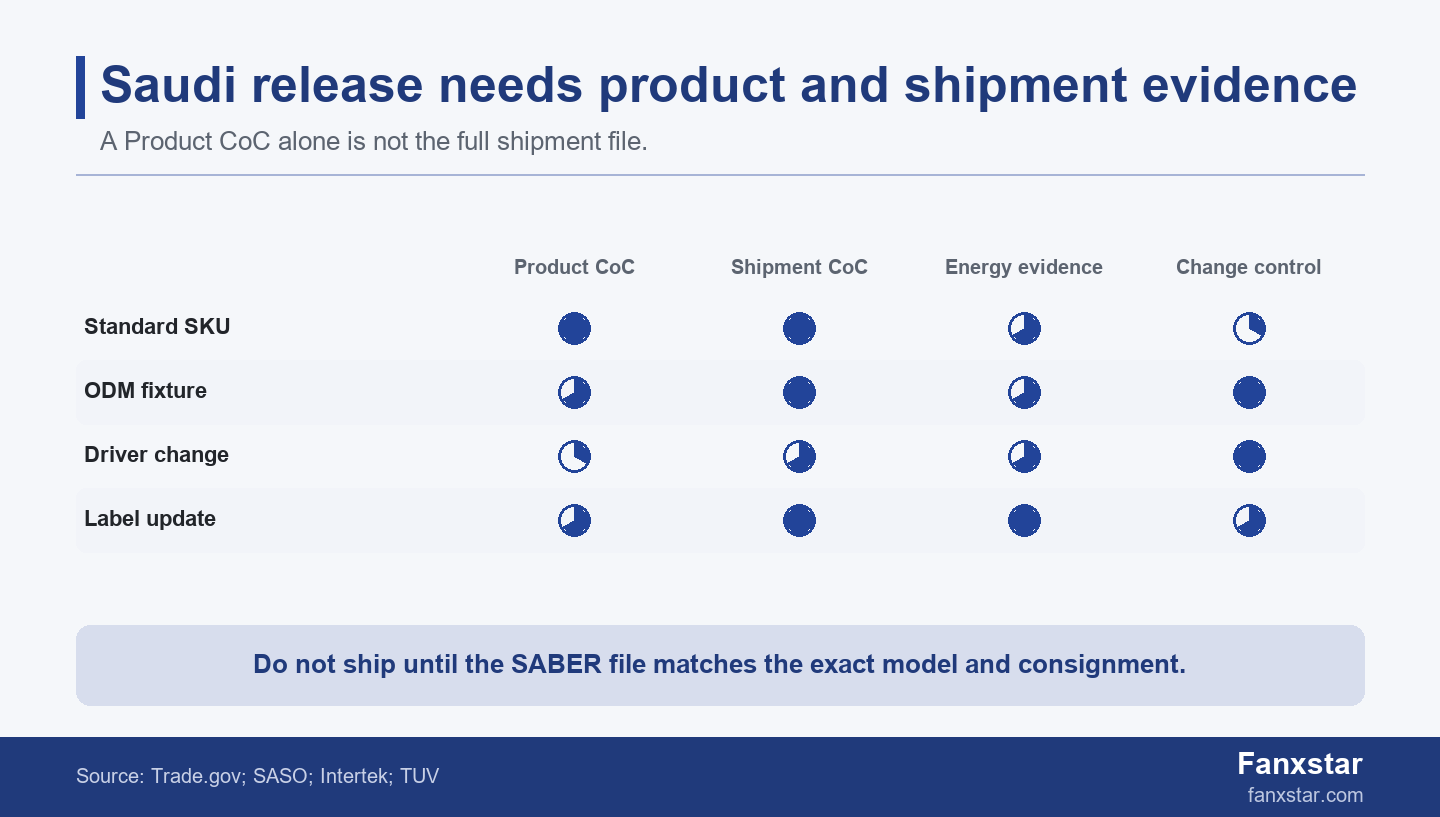
The Saudi file can include more than a basic conformity certificate. Lighting products may need energy efficiency evidence, labels, IECEE recognition, test reports, Arabic or market-specific label information, and product photos. The buyer should confirm the applicable product category before sample approval because label artwork and technical files can affect production packaging.
According to Trade.gov Saudi testing and certification guidance, Saber connects importers and customs with SASO-approved certification bodies. That means the supplier, importer, and certification body all need the same model identity. If the ODM sample changes after the product certificate, the Saudi release file may need a review rather than a simple shipment booking.
Where ODM Changes Create SASO Risk
A custom change can separate the shipment from the certificate
ODM lighting changes can be useful, but they make Saudi evidence more sensitive. A driver substitution, different LED board, changed power rating, new diffuser, housing revision, emergency function, label change, or packaging change can make the certificate file harder to match. The buyer should record every change before asking for shipment release.
Fanxstar buyers should treat SASO planning as part of the sample gate for weatherproof LED lighting, linear lighting, emergency lighting, and specialty industrial fixtures. The useful question is not only whether the supplier has exported to Saudi Arabia. It is whether the exact model and consignment have the correct evidence path.
Ask Fanxstar for a Saudi evidence packet before production
If an ODM product is intended for Saudi Arabia, send Fanxstar the target HS code if known, product category, model name, rated power, lumen output, driver, LED board, label artwork, photos, packaging plan, and shipment schedule through Fanxstar customization. The team can then help identify which product evidence should be frozen before mass production.
Pair the Saudi file with Fanxstar’s LED lighting certification checklist for ODM buyers when the order also needs CE, ENEC, UL, IP, warranty, or market-specific label proof. The goal is not to make the blog a legal opinion. The goal is to prevent the supplier file, importer file, and shipment file from describing different products.
How to Keep a Saudi Lighting File Aligned
Start with product classification, not a certificate logo
The strongest buyer insight is that Saudi market access begins with classification. A lamp, driver, integrated luminaire, emergency fixture, waterproof linear product, and control gear may sit in different evidence conversations. Asking for SASO in a general way can produce a folder of documents without answering whether the exact product, technical regulation, label, and shipment are ready for Saudi Arabia.
According to UL Saudi lighting market access notice, the Saudi lighting context can include lamps, lightings, luminaires, control gear, and ballasts. That list is a warning against vague RFQs. The buyer should name the product category, rated power, voltage, driver, model number, label plan, and whether the product is a lamp, component, or finished luminaire.
Control the local importer handoff before the order ships
A Saudi shipment can fail from a handoff problem even when the factory has useful technical documents. The supplier may provide test reports, photos, labels, model data, and product-change statements, while the importer or local representative may manage SABER account actions and shipment certificate steps. The buyer should decide who owns each action before the goods are packed, not after a forwarder asks for a missing file.
According to Trade.gov Saudi testing and certification guidance, Saber connects importers, SASO-approved certification bodies, customs, and related authorities. That connection shows why a supplier-only answer is incomplete. The importer, certification body, and supplier file must describe the same model, shipment, and documentation package.
According to TUV Rheinland SALEEM program guidance, suppliers should apply through SABER for both products and shipments. That is why the handoff should name the product-file owner and the shipment-file owner before the final carton label is approved.
Make ODM substitutions visible to the Saudi file owner
ODM substitutions are normal in lighting manufacturing, but hidden substitutions are dangerous for Saudi release. A driver brand change, LED board revision, housing update, diffuser material change, wattage adjustment, label edit, or packaging change can separate the shipped product from the certificate file. The buyer should require a change log that says what changed, when it changed, and whether the certificate or shipment evidence needs review.
This change log does not need to be complicated. For most B2B lighting orders, a one-page release sheet can list final model name, rated power, input voltage, driver, LED board, housing, diffuser, label artwork, packaging photo, certificate references, and shipment document owner. If those fields match, the order is far easier to clear. If they do not match, the mismatch is visible before the shipment leaves the factory.
Common Document Mismatches Before Saudi Shipment
Model identity can drift across quotation, label, and certificate
A Saudi lighting file often starts clean and becomes messy as the order moves from quotation to sample, packaging, invoice, and shipment. The model name on the quotation may not match the label artwork. The label may not match the test report. The test report may name a driver that changed during production. The invoice may use a short commercial name that does not match the certificate scope.
Buyers should treat model identity as a controlled field. The same model name, rated power, voltage, product photo, and label information should appear across the supplier file, importer file, and shipment file. If the buyer wants a private-label name for marketing, the evidence packet should still preserve a clear bridge to the tested and certified technical model.
Shipment documents should be prepared before packing is finished
Many delays happen because shipment documents are assembled after production, when cartons are already packed and the forwarder is waiting. By then, correcting labels, product photos, Arabic information, packing list details, or certificate references is slower. A better process is to run a pre-shipment document check while final inspection is still possible.
The pre-shipment check should compare purchase order, invoice, packing list, product label, carton label, product photos, certificate references, and any energy or IECEE evidence. A compact 8-point document check is enough for most lighting shipments if every field is tied to the same model identity. If one field differs, the team should fix it before goods leave the factory. This is not bureaucracy; it is a way to keep the physical product and the SABER workflow describing the same consignment.
Shipment Release Checklist
Use a 5-step release path
A practical release path has 5 steps. First, classify the product and Saudi technical regulation. Second, confirm whether a Product CoC, energy evidence, IECEE recognition, or other file is needed. Third, match the certificate to the final model and label. Fourth, prepare shipment documents and Shipment CoC evidence. Fifth, hold release if an ODM change has not been reviewed.
According to International Trade Administration import regulations, countries can require documentation and regulations for imported products. That general import principle becomes very concrete in Saudi lighting projects: documentation should be built before the goods are packed, not after the forwarder asks for a missing certificate.
Separate what the supplier owns from what the importer owns
The supplier may own technical files, test reports, label artwork, product photos, and product-change explanations. The importer may own SABER account actions, shipment certificate steps, customs coordination, and local-market acceptance. A buyer who collapses these roles into one vague request can lose days because the wrong party is waiting for the wrong document.
The final release rule is simple: do not ship until product identity, certificate scope, shipment documents, label or energy evidence, and ODM change history all match. If the buyer cannot verify those 5 items, the order should be held or reviewed by a qualified Saudi market-access professional before dispatch.
FAQ
Is SASO certification the same as SABER?
SASO certification is not the same as SABER because SASO is the Saudi standards authority, while SABER is the electronic platform used for conformity processes. In buyer language, SASO is the regulatory context and SABER is the workflow where product and shipment evidence may be managed.
Does one SASO certificate cover every shipment?
One SASO-related certificate does not automatically cover every shipment because buyers must separate product-level certification from shipment-level certification. A Product CoC may support the model, while a Shipment CoC is tied to a consignment. ODM changes, label changes, shipment document errors, or model mismatches can require review before shipment.
Do LED lights need Saudi energy evidence?
Some LED lighting products can require energy efficiency, labelling, IECEE, or other market-access evidence depending on product type and Saudi technical regulation. Buyers should classify the product first, then confirm the exact evidence path with the importer, local representative, or approved certification body before sample approval.
What should Fanxstar receive before quoting for Saudi Arabia?
Fanxstar should receive product category, target model, rated power, lumen output, driver, LED board, label plan, target HS code if known, shipment schedule, and any existing Saudi file before quoting for Saudi Arabia. That lets Fanxstar review whether the ODM version and evidence packet can stay aligned before production.