Mexico is one of the largest LED lighting markets in Latin America, but it operates one of the most country-specific compliance frameworks in the region. The Norma Oficial Mexicana (NOM) system is not a regional standard that can be satisfied by CE marking, UL certification, or Energy Star compliance — Mexico maintains its own official standards, its own accredited testing infrastructure, and a strict rule that only locally registered Mexican entities can hold product certificates. For any manufacturer or distributor planning to supply LED lighting into Mexico, understanding exactly which NOM standards apply — and exactly how the certificate holder requirement works — is essential before the first sample is shipped.
In our work supporting clients entering Latin American markets alongside the European and Australian markets where Fanxstar is more established, Mexico has a consistent pattern: companies underestimate the country-specific nature of NOM certification and attempt to leverage existing international test data in ways the system simply does not permit. This guide is intended to prevent that.
Key Takeaways
- NOM certification is mandatory and country-specific — CE, UL, Energy Star, and other international marks are not recognised by Mexican authorities for market access purposes.
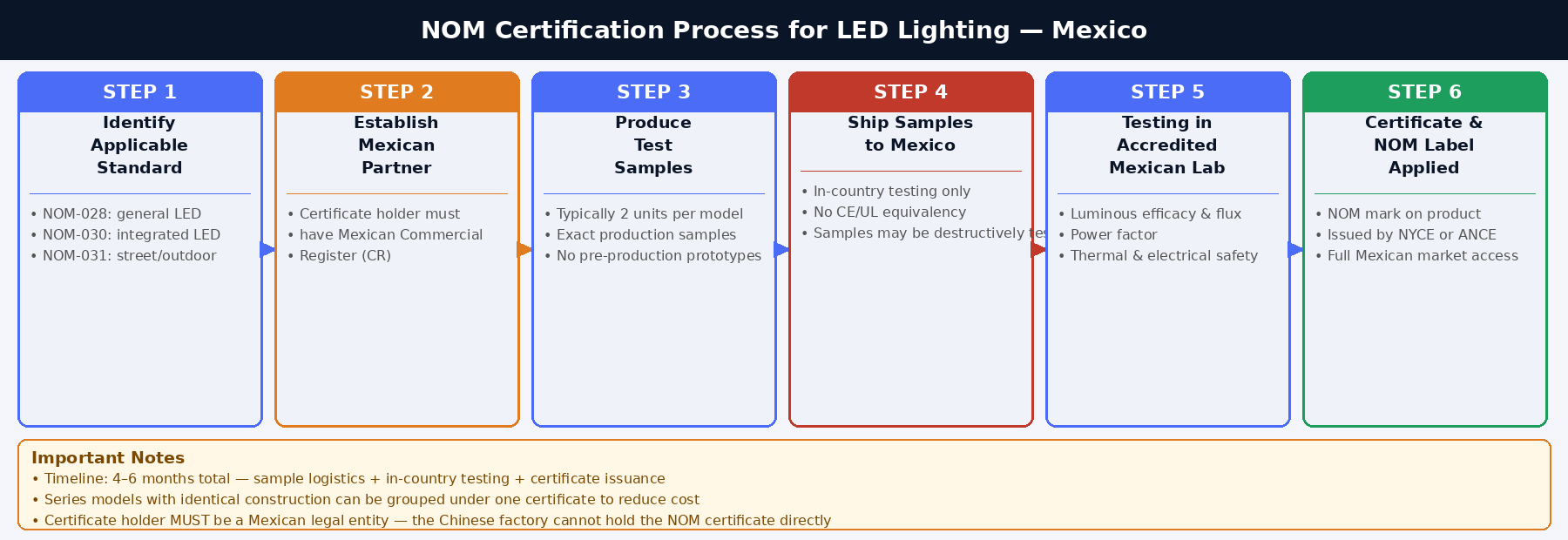
- Three NOM-ENER standards apply to LED lighting: NOM-028 (general luminaires), NOM-030 (integrated LED luminaires for general lighting), and NOM-031 (LED street lighting and outdoor public areas).
- The certificate holder must be a Mexican company — the manufacturer or overseas distributor cannot hold the NOM certificate directly; a local importer or trading partner must be established first.
- Physical testing must occur in Mexico — samples must be shipped to an accredited Mexican laboratory for evaluation and certification.
- Multiple models can be grouped in one certification, but each additional model beyond the base submission incurs incremental cost.
What Is NOM Certification and Why Mexico Requires It?
The NOM Framework Explained
NOM stands for Norma Oficial Mexicana — Official Mexican Standard. These standards are issued by Mexican government agencies and are legally binding for manufacturers, importers, and distributors operating in the Mexican market. NOM certification covers a wide range of industries including electrical products, safety, health, and environmental requirements. For energy-consuming products such as LED lighting, the relevant standards fall under the NOM-ENER series, administered by the Comisión Nacional para el Uso Eficiente de la Energía (CONUEE) — Mexico’s national energy efficiency commission.
Unlike the EU’s CE marking system, where a manufacturer can self-declare conformity, Mexico requires third-party certification by an accredited body operating within the Mexican standards infrastructure. The NOM safety logo affixed to compliant products is distinct from the safety marks of the United States and Canada, and Mexico’s regulatory authorities do not recognize those marks as equivalent. Products requiring compulsory NOM certification may only enter the Mexican market bearing the NOM logo, typically displayed alongside either NYCE (for electronic and communication products) or ANCE (for household appliances and hand tools).
The Three NOM Standards for LED Lighting
LED lighting products in Mexico are subject to three primary energy efficiency standards depending on application. Selecting the correct standard is the first critical decision in the certification pathway.
| Standard | Product Scope | Key Requirements |
|---|---|---|
| NOM-028-ENER | General luminaires — commercial, industrial, and general-purpose LED fixtures | Minimum efficacy limits (lm/W), test methods for luminous flux, power, and power factor |
| NOM-030-ENER | Integrated LED luminaires for general lighting — fixtures with non-replaceable LED modules | Luminous efficacy specifications; combined photometric and electrical performance testing |
| NOM-031-ENER-2019 | LED luminaires for road lighting and public outdoor areas; AC supply up to 480 V or DC up to 100 V; includes solar-powered options | Efficacy, photometric distribution, thermal performance, IP rating requirements; mandatory since June 3, 2021 |
NOM-031-ENER-2019 is the most recently updated of the three, having been officially released on March 4, 2021, and entering mandatory force on June 3, 2021. It replaced NOM-031-ENER-2012 and expanded the scope to include solar-powered road lighting. Products excluded from NOM-031 include decorative or ornamental outdoor lighting, signalling luminaires, colour-changing or monochromatic light fixtures, luminaires recessed into the ground, underwater lighting, and fixtures intended for classified or hazardous areas.
The Certificate Holder Requirement: Mexico’s Most Misunderstood Rule
Why the Certificate Must Be Held by a Mexican Company
This requirement is the most common compliance gap for manufacturers entering the Mexican market from China, Europe, or the United States. Mexican NOM certification requires the certificate holder to be a legal entity with a valid commercial registration in Mexico. The rationale is regulatory accountability: Mexican authorities need a locally registered entity they can hold responsible for the product’s ongoing compliance, recall obligations, and market surveillance cooperation.
This means a Chinese manufacturer — regardless of how well-established or internationally certified — cannot be the certificate holder for products entering Mexico. The typical structure for international manufacturers is to work with a Mexican importer or distributor who holds the NOM certificate on their behalf. The importer’s commercial registration must explicitly include the scope of lighting products in question. This makes selection of the right local partner an integral part of the market entry strategy, not an afterthought.
Structuring Your Mexican Partnership
In practice, the most common approach is for the actual importer — the company physically bringing products into Mexico — to serve as the certificate holder. This simplifies the administrative chain between certificate, customs declaration, and market surveillance. Where the manufacturer works with multiple distributors in Mexico, each distributor typically holds their own NOM certificate for the specific models they import. This allows each business relationship to be managed independently and ensures that a change in distribution partner does not invalidate all products in the market simultaneously.
For manufacturers offering OEM/ODM custom LED products, the certificate holder structure is especially worth planning early. If the Mexican partner is branding the product under their own label, it is cleaner for the certificate to be held in their name from the start, rather than attempting to transfer or amend a certificate originally issued to a different entity.
The Testing and Certification Process
Sample Submission and In-Country Testing
NOM certification for lighting products requires physical samples to be submitted to a testing facility in Mexico. International testing data — including IEC test reports, CB certificates, or LM79 reports from overseas labs — cannot be directly substituted for in-country testing. Typically, two samples of each product model are required. After testing, the facility issues a test report and grants the NOM certification covering that model or product family.
For series models — products that share a common design platform but vary in wattage, length, colour temperature, or body finish — it is possible to group multiple models within a single NOM certification submission. However, each additional model in the series beyond the base model incurs additional cost, so grouping decisions should reflect actual sales forecasts rather than attempting to certify the entire product catalogue in one pass.
The Accredited Bodies
Only bodies accredited within Mexico’s certification infrastructure can issue NOM certificates. The two most relevant designations for lighting are NYCE (for electronic and energy products) and ANCE (for electrical appliances and equipment). QIMA-NYCE is one of the internationally accessible accredited certification bodies operating under the NYCE framework and can coordinate the testing and certification process for manufacturers whose samples are shipped to Mexico from overseas factories.
What NOM Testing Evaluates
Efficacy and Photometric Performance
The core technical evaluation under NOM-ENER standards for LED lighting is luminous efficacy — measured in lumens per watt (lm/W). The standard establishes minimum efficacy thresholds that products must meet or exceed to achieve certification. Testing also covers luminous flux output, power consumption, power factor, and for integrated luminaires, photometric distribution relevant to the application (general illumination or road lighting). For NOM-031 (road lighting), photometric testing is more detailed, covering beam angle distribution, uniformity, and glare control metrics appropriate for public road and outdoor area applications.
Thermal and Endurance Testing
LED luminaires are also evaluated for thermal performance and operational reliability. This includes measurements at stabilised operating temperature to ensure rated lumen output figures represent steady-state conditions rather than initial cold-start values. For industrial luminaires — including the weatherproof and IP-rated products in Fanxstar’s core product lines — thermal stabilisation testing reflects real-world operating conditions more accurately than brief photometric snapshots. Products with integrated drivers and high-power LED modules are particularly sensitive to this aspect of the evaluation.
Labelling Requirements
Certified products must bear the NOM energy efficiency label and the mark of the certifying body (NYCE or ANCE). Labelling must comply with the format and content requirements specified in the relevant standard. For products sold at retail, the NOM mark must be visible on the product packaging. For luminaires sold in commercial and industrial channels — such as weatherproof and emergency lighting products — the mark typically appears on the product itself and its shipping documentation. Spanish-language user instructions and technical documentation are expected for products sold in the Mexican market.
Practical Guidance for B2B LED Suppliers
Planning Certification Alongside Product Development
The most efficient approach is to incorporate NOM certification into the product development and launch schedule, rather than treating it as a post-production administrative step. Because physical samples must be shipped to Mexico for in-country testing, there is an inherent lead time for sample logistics, testing, and certificate issuance. For products requiring new mould tooling — as is common with custom OEM luminaires — the certification timeline should be planned in parallel with production tooling, not sequentially after it. Our OEM/ODM development process delivers production-representative prototypes in 3–5 working days, which enables the certification timeline to begin as early as possible.
Understanding Scope: What NOM Does Not Cover
NOM-ENER standards address energy efficiency performance. They do not, on their own, cover electrical safety in the same comprehensive sense as the IEC 60598 series. Products sold into Mexican commercial and industrial channels may also need to comply with relevant NMX electrical safety standards, particularly for products connected to the Mexican electrical supply (127 V or 220 V AC, 60 Hz — different from the 50 Hz frequency used in Europe). This is another reason why CE marks or IEC safety reports from European markets cannot be assumed to cover all Mexican requirements. The 60 Hz power supply specification, in particular, can affect driver operation, thermal management, and lumen output in ways that must be validated specifically for the Mexican market.
Industrial and Weatherproof Lighting for Mexico
Mexico’s industrial and manufacturing sector — including food processing plants, cold chain logistics operations, automotive manufacturing, and petrochemical facilities — presents strong demand for the same weatherproof and harsh-environment luminaires that are core to Fanxstar’s product offering. The IP ratings, IK10 impact resistance, and temperature-rated designs that serve European industrial clients translate directly to Mexican industrial needs. The key additional step for the Mexican market is ensuring NOM-028 or NOM-030 certification is in place, held by the local Mexican partner, before products enter distribution.
For detailed guidance on selecting the right weatherproof specification for specific environments, including IP rating selection, operating temperature, and IK rating requirements, see our weatherproof LED lighting range. Our engineering team can advise on whether a product configuration requires NOM testing and can coordinate sample production for certification purposes as part of an OEM project.
Frequently Asked Questions
Can an overseas company apply for NOM certification directly, without a Mexican partner?
No. NOM certification requires the certificate holder to be a legally registered company in Mexico with a valid commercial registration that includes the relevant product category in its scope. An overseas manufacturer or distributor cannot hold the certificate directly. The practical implication is that establishing or identifying a Mexican trading partner or importer is a prerequisite for market entry, not an optional arrangement.
How long does NOM certification typically take for LED lighting products?
Once samples are physically in a Mexican accredited laboratory, the testing and certification process typically takes 8–16 weeks depending on lab workload and the complexity of the product. Additional time must be factored in for sample shipping to Mexico, Mexican customs clearance for the test samples, and the certification body’s administrative processing. For manufacturers in China, total elapsed time from sample dispatch to certificate issuance is commonly 4–6 months when planning conservatively. Products that can be grouped as a series can significantly reduce the per-model timeline and cost.
Is NOM certification required for all LED products sold commercially in Mexico, or only consumer goods?
NOM-ENER certification requirements apply across both consumer and commercial/industrial applications for the product types within the standards’ scope. General luminaires under NOM-028, integrated LED luminaires under NOM-030, and outdoor/road lighting under NOM-031 are mandatory regardless of whether the end buyer is a consumer retailer or an industrial facility operator. Products outside the scope of these three standards — such as emergency lighting, decorative lighting, or specialty grow lights — may have different or more limited requirements, but should still be confirmed against the current CONUEE regulatory framework before import.
Does a single NOM certificate cover distribution to all Mexican states?
Yes. NOM certification issued by an accredited body is valid nationally across all Mexican federal states. There are no state-level additional certifications required for lighting products that hold valid federal NOM certification. However, compliance responsibilities rest with the certificate holder — the Mexican importer or distributor — and that entity is responsible for ensuring that the products distributed under their certificate conform to the tested specification throughout the sales cycle.
Mexico rewards suppliers who invest in proper NOM compliance with long-term commercial relationships — the certificate structure, once in place for a stable product range, provides a durable market access foundation that competitors who bypass certification cannot easily replicate. The process is more structured than many other markets, but it is entirely navigable with the right preparation.
If you are evaluating the Mexican market for weatherproof LED, industrial lighting, or custom OEM products and would like to understand how certification fits into your product launch timeline, reach out to Fanxstar’s technical team for a project-specific consultation.