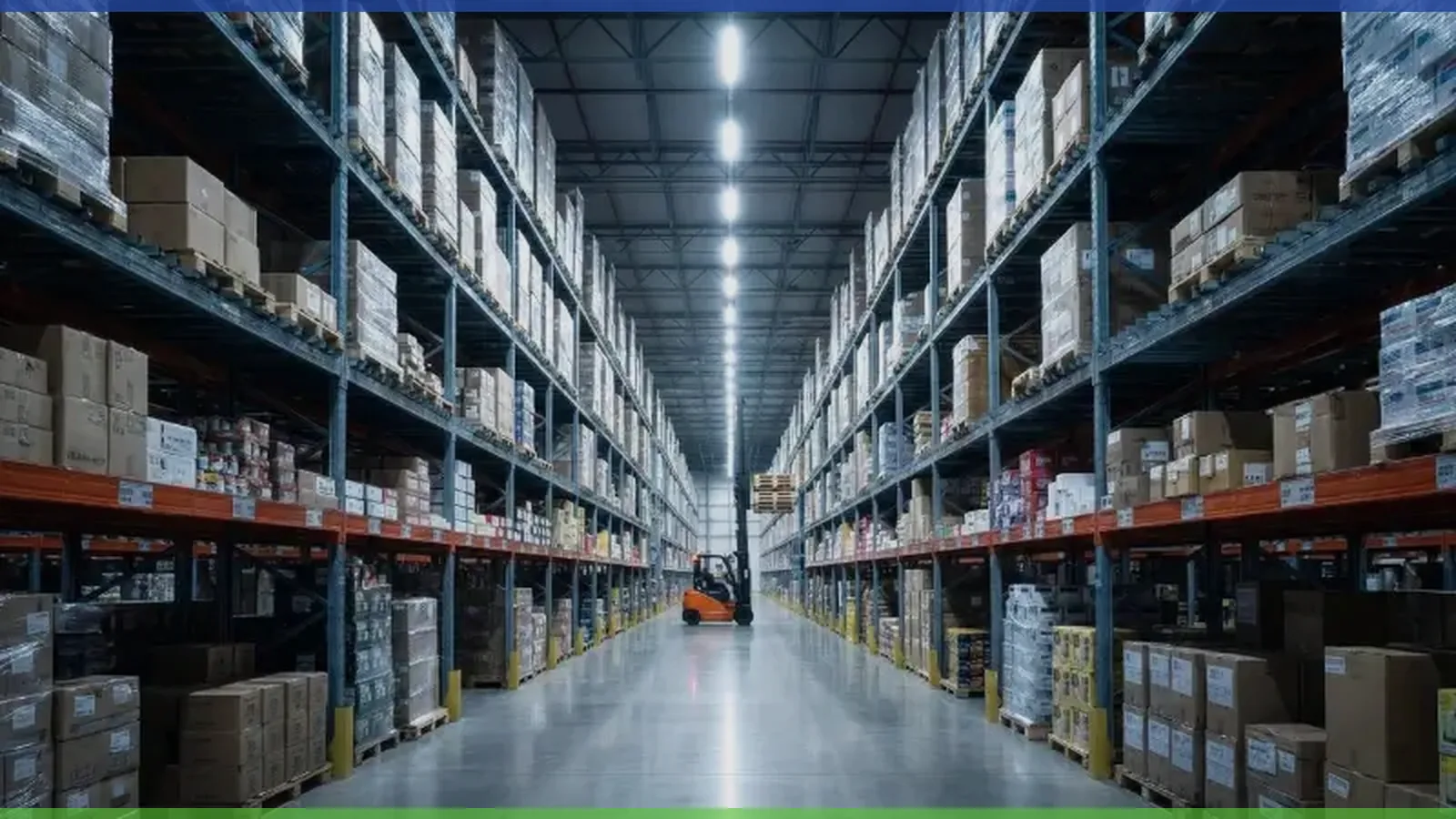
The cave effect in a high-rack warehouse is not just a low-lux problem; it is a vertical visibility, beam-control, rack-shadow, maintenance, and controls problem that must be tested at the aisle face before a buyer approves fixtures. The aisle floor can look bright while rack faces, pallet labels, carton edges, and vertical task surfaces still feel dark. The common buying mistake is to raise wattage or add more fixtures without asking where the light is actually landing.
For Fanxstar buyers, the better question is not only how many lumens the fixture produces. The buyer should ask whether the optic, mounting height, row spacing, controls, and maintenance plan produce usable vertical visibility at the rack face. According to IES RP-7-21, industrial lighting should be treated as an application practice. According to OSHA 1910.178, truck auxiliary lighting is required where general lighting is below 2 lumens per square foot. The cave effect is therefore a productivity and safety-adjacent specification problem, not a cosmetic complaint.
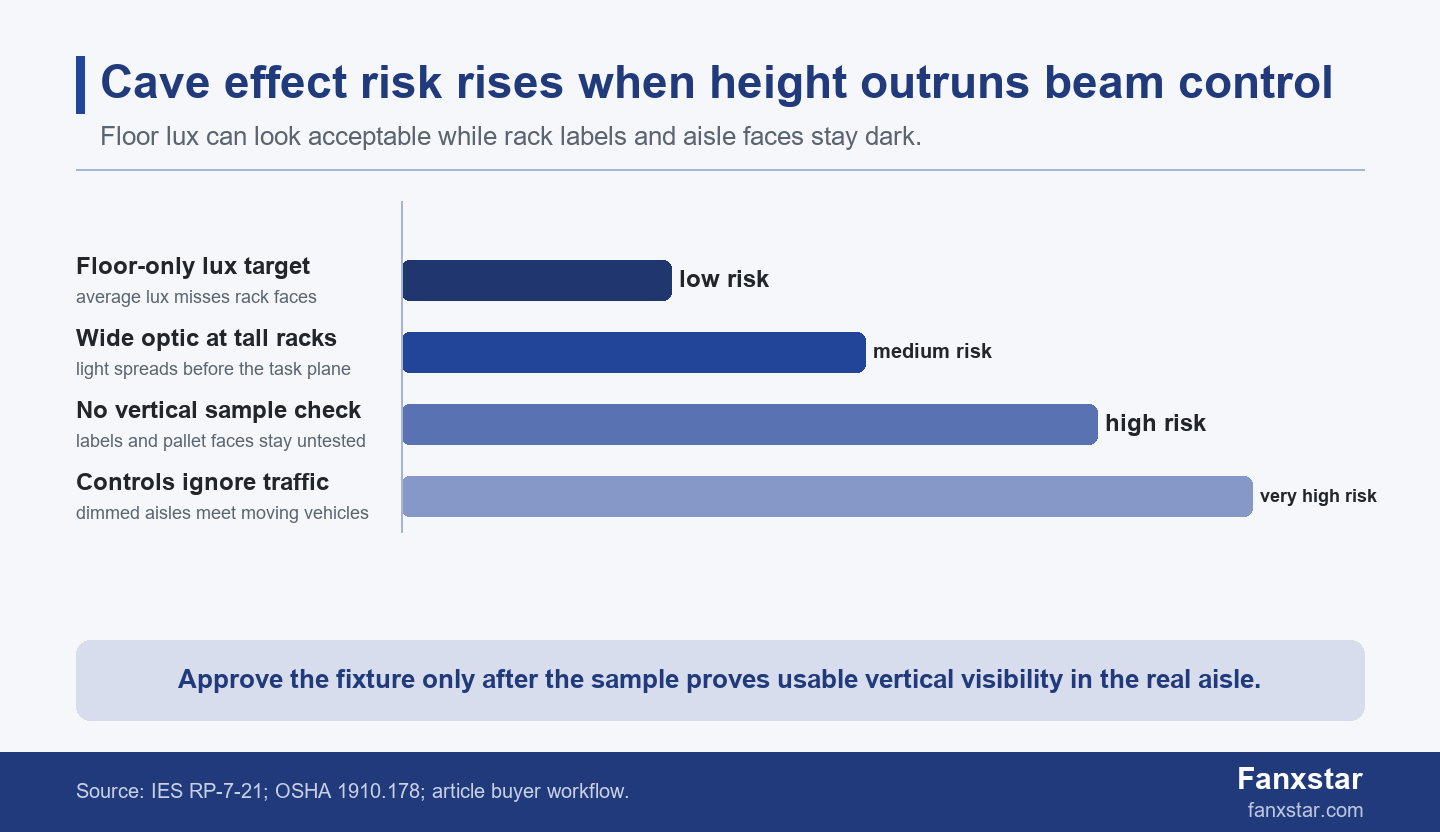
A practical fix starts with a field sample. Choose one real aisle, one mounting height, one rack depth, one fixture optic, and one control behavior. Then judge the aisle at the surfaces workers actually read: labels, pallet edges, floor markings, column numbers, dock signs, and turning points. If those surfaces are clear without glare or harsh contrast, the fixture is probably solving the right problem. If only the floor is bright, the design is still incomplete.
Key Takeaways
- The cave effect is a vertical visibility failure, not simply a low average-lux result.
- Narrower, aisle-appropriate optics can help, but only when mounting height, rack height, spacing, and controls are tested together.
- Forklift routes and high-rack labels should be checked as real task surfaces before purchase approval.
- A sample should include photometry, mounting method, dimming behavior, label readability, and a maintenance access plan.
Why high-rack aisles become visually dark
Average floor lux hides the real task plane
Most cave-effect failures begin with the wrong measurement habit. Buyers ask for a target average illuminance on the floor, receive a simulation, and assume the aisle will feel bright. The floor may be bright enough, yet the useful work may happen 1.5 m to 12 m above the floor on rack faces, carton labels, pick slots, and vertical signage. A fixture that sends too much light downward can create a bright walking path with dark rack walls on both sides.
North Carolina solid-state lighting guidance defines beam angle by the directions where intensity falls to 50 percent of maximum. That definition matters because a catalogue beam angle is not a promise that light will hit the rack face. It is a photometric description that must be interpreted against mounting height, aisle width, rack height, fixture spacing, and target surface.
A simple 5-point aisle review often finds the problem quickly: read a label at low shelf height, middle pick height, upper pallet height, floor marking, and cross-aisle sign. If the low shelf reads well but the top pallet is dark, the layout has a vertical distribution problem. If the floor marking is bright but the label is washed by glare, the issue may be contrast. If the aisle looks good at full output but becomes a cave during sensor dimming, the control scene is part of the failure.
This means high-rack lighting should not be purchased as a lumen package. The buyer is really buying a visibility pattern across height. The fixture, optic, lens, mounting bracket, driver output, and controls must be evaluated as one package. The decision rule is to judge the fixture at 3 vertical zones: lower pick face, middle pallet face, and upper label face. If only 1 of the 3 zones reads well, the project has not fixed the cave effect.
Rack geometry makes the problem worse
High racks create their own shadows. Uprights, beams, pallets, shrink wrap, cartons, and suspended obstructions interrupt the light path. A clean CAD drawing may show open aisles, while the real warehouse has mixed pallet heights, protruding loads, reflective wrap, dark packaging, and rack beams that cut light across the vertical surface. When the beam is too wide, much of the output lands on the top plane or floor. When it is too narrow without enough overlap, the aisle can show stripes.
CIE TN 010:2019 supports using measured beam-axis and beam-angle language for directional sources. For buyers, the lesson is practical: do not accept vague claims such as ‘narrow beam’ or ‘warehouse optic’ without a photometric file and a sample position. The correct optic for a 6 m rack is not automatically correct for a 12 m rack.
A common scenario shows the trade-off. A 42 ft warehouse aisle may replace old high bays with high-output LED linear fixtures. The floor looks efficient, but pickers still use handheld lights to read upper labels. The project then adds more fixtures, raising energy use and glare. A better first move would have been to test an aisle optic that pushes enough light onto the vertical rack face while keeping floor brightness controlled.
The goal is balance. The aisle should not feel like a cave, but it should also not become a glare corridor. Operators need legible vertical surfaces, stable contrast, and comfortable forward visibility.
How to specify a fixture that actually fixes the cave effect
Ask for vertical evidence, not just wattage
The RFQ should name the rack height, aisle width, fixture mounting height, existing fixture spacing, target mounting method, surface reflectance if known, control requirement, and the surfaces that must be readable. A supplier cannot choose the right optic from wattage and building size alone. If the project has forklifts, automated storage, pick modules, mezzanines, or cross-aisle signs, those conditions should be included before sample production.
FEMP LED luminaire purchasing guidance supports looking at LED luminaires as procurement decisions, while DLC Solid-State Lighting program provides a product qualification frame that buyers often use for performance evidence. Those sources do not replace a site-specific lighting design, but they help buyers avoid judging a high-rack project only by price.
| Buyer question | Why it matters | Evidence to request |
|---|---|---|
| Where is the task plane? | High-rack work happens on vertical labels and pallet faces, not only the floor. | Aisle sample photos, vertical readings, or simulation views at rack face. |
| What is the optic? | The beam shape decides whether light reaches the upper rack or spills into glare. | IES file, beam description, and installed sample. |
| How do controls behave? | Dimming can recreate the cave effect during low-traffic periods. | Control zoning plan linked to GSA LED and controls guidance style life-cycle thinking. |
| How is maintenance done? | Dirt, lens aging, and blocked access change performance over time. | Cleaning interval, lens material, driver access, and spare plan. |
If the supplier only answers with a lumen number, the project is not ready. A good response should connect the fixture body, optics, mounting, driver, controls, and test method to the aisle geometry. That connection is what turns a catalogue fixture into a warehouse lighting solution.
Use a controlled sample instead of a broad promise
A controlled sample can be small. One aisle section is enough if it contains the hard conditions: the tallest rack, normal pallet load, typical label size, real mounting height, and the expected control mode. The buyer should inspect the sample from walking height, forklift seat height, and cross-aisle approach. Photos should be taken from the same positions before and after the sample, not only from a polished marketing angle.
OSHA warehousing guidance connects warehouse safety to racking and operational conditions. Lighting cannot solve every warehouse hazard, but poor visibility can make rack damage, obstructed aisles, and label errors harder to detect. That is why the sample should include both visual comfort and operational readability.
A useful sample record contains 6 fields: model code, optic or lens version, mounting height, spacing, control setting, and the surfaces evaluated. If any of those fields change before the purchase order, the buyer should ask whether the sample still applies. Without that discipline, a project can approve one product and receive another visual result.
According to CIE TN 010:2019, beam-axis and beam-angle measurement need defined methods. According to North Carolina SSL guidance, beam angle uses the 50 percent intensity directions around the nominal beam centerline. According to DLC SSL program information, qualified LED products are evaluated through defined product data rather than sales wording. Based on our analysis, a 24-aisle warehouse can waste a sample cycle if it checks only 1 aisle entrance and never looks at upper labels, because the failure appears where the test never looked.
The sample should also include a negative test. Dim the aisle to the planned low level, stand at the entrance, and read the upper labels. If the aisle becomes visually hollow during the energy-saving scene, the control plan must be revised before mass installation.
Where Fanxstar fits in a high-rack warehouse project
Match the platform to aisle geometry
Fanxstar buyers can start from LED linear lighting platforms, weatherproof LED lighting products, motion sensor lighting options, and smart warehouse lighting solutions when a high-rack aisle needs a controlled sample. The right starting point depends on ceiling height, mounting, moisture or dust exposure, service access, and whether controls are integrated or external.
For a dry logistics aisle, a linear platform with an aisle-appropriate optic may be enough. For a dusty or wash-prone storage zone, a sealed weatherproof platform may be a better base. For a space with intermittent traffic, the control question becomes more important: the fixture should not drop to a level that hides rack faces when an operator enters the aisle.
The buyer should also connect the project with LED lighting controls for industrial facilities and LED retrofit planning for warehouses and data centers if the site is replacing old fixtures. Retrofit projects often inherit old spacing, power circuits, and mounting limitations, so the new fixture must fit the existing ceiling as well as the visual target.
Prepare a high-rack lighting brief before asking for samples
Before asking Fanxstar for a recommendation, prepare an aisle brief instead of a generic warehouse brief. Include aisle width, rack height, fixture mounting height, existing spacing, target surface, control requirement, dust or moisture exposure, and whether forklifts, pickers, or automated systems use the aisle. If a lighting simulation exists, add it, but do not let it replace the sample rule.
Import and project files should also be aligned. International Trade Administration import documentation guidance and special documents guidance are reminders that a B2B order eventually becomes a document file. The model, optic, driver, label, packing list, and certificate scope should describe the same fixture that passed the aisle sample.
According to FEMP commercial and industrial LED luminaire guidance, LED luminaires should be evaluated through a purchasing lens, not only a fixture-price lens. According to GSA LED and controls guidance, lighting choices should consider controls and life-cycle behavior. According to ITA import documentation guidance, commercial invoices and packing lists sit inside the order file. According to ITA special documents guidance, some shipments need additional certificates or market documents. Based on our analysis, a 300-fixture warehouse order should keep the aisle-sample record, optic code, driver output, and control setting in the same release file so the approved visual result can be repeated.
The final approval question is simple: can an operator read the right surface at the right height, under the real control setting, without uncomfortable glare? If yes, the fixture is solving the cave effect. If no, increasing wattage may only make the wrong surface brighter.
FAQ
What causes the cave effect in a warehouse aisle?
The cave effect usually comes from a mismatch between rack height, aisle width, fixture beam pattern, mounting position, controls, and target surface. The floor may be bright while vertical rack faces stay dark, especially when tall racks block useful side light. Buyers should inspect labels, pallet edges, and signs at several heights before approving the fixture.
Will higher wattage fix the cave effect?
Higher wattage can help only when the beam pattern already reaches the vertical task surfaces that operators need to see. If the optic sends more light to the floor, extra wattage may increase glare and energy use without fixing upper-rack readability. The better first test is beam distribution and vertical label visibility.
What evidence should a supplier provide?
A supplier should provide photometry, mounting height, optic or lens version, sample photos, control settings, and a record showing that labels and rack faces were checked in the real aisle. For retrofit work, the evidence should also show whether old spacing and wiring force any compromise in beam control or maintenance access.
Can sensor dimming make the cave effect worse?
Sensor dimming can make the cave effect worse when low-level output is set for energy savings but not tested for rack-face readability. Aisles should be checked at full output, low-level standby, and re-entry behavior. If operators enter a dimmed aisle and upper labels disappear, the controls scene needs adjustment before rollout.