A top 10 LED tri-proof light manufacturer list should be used as a shortlist map, not as a universal ranking. The useful question is which supplier can prove the exact sealed fixture version: IP scope, housing, diffuser, cable entry, driver, sample match, certificate file, warranty boundary, and ODM change control.
According to IEC ingress protection guidance, IP ratings describe enclosure protection against dust, water, and hazardous part access. According to NEMA enclosure type guidance, enclosure type language has defined scope and should be checked against the application. This is why tri-proof sourcing should begin with exposure evidence rather than brand visibility alone.
Key Takeaways
- Use the top 10 list as a China supplier shortlist, not as a verified revenue ranking or endorsement.
- Tri-proof light buyers should compare IP evidence, driver model, housing material, gasket, cable entry, certificate scope, sample match, and warranty boundary.
- Fanxstar fits projects that need weatherproof, vapor tight, sensor-ready, emergency, or custom ODM tri-proof lighting evidence.
- Competitor brands can be noted for sourcing context, but the final RFQ should be decided by proof for the exact quoted product version.
How to use a China tri-proof light manufacturer shortlist
Do not treat visibility as proof
A supplier can be visible online and still be the wrong fit for a specific wet-location, dusty, cold, chemical, or washdown project. Tri-proof lighting is a system of body, lens, gasket, clips, cable gland, driver, LED board, label, and installation method. A shortlist is only useful when it pushes the buyer toward the evidence file, not away from it.
According to FEMP LED luminaire purchasing guidance, buyers should evaluate complete commercial and industrial LED luminaires. According to DLC solid-state lighting technical requirements, LED products are reviewed through defined product categories and requirements. The procurement lesson is that a tri-proof light should be compared as a complete luminaire, not as a housing photo.
Use a 3-layer shortlist. Layer 1 identifies supplier visibility and category fit. Layer 2 asks for product evidence: IP scope, driver, housing, cable entry, photometric file, certificate. Layer 3 tests execution: sample match, shipment documents, warranty boundary, and change control. A supplier that passes only layer 1 should not receive a production order.
The top 10 names are a starting map
The following names are presented as a B2B sourcing map, not a third-party ranking: Fanxstar, COMLED, TUBU, OLAMLED, GRNLED, Yistar, LEDYi Lighting, CESP, NVC International, and FSL. Some are more directly associated with tri-proof or weatherproof lighting; others are broader China lighting brands that buyers may encounter during research.
That distinction matters. A broad lighting brand may not be the best supplier for a custom vapor tight fixture. A smaller specialist may be stronger when the buyer needs cable-entry changes, sensor integration, private label, or project-specific housing. The shortlist should therefore be scored by project fit, not by how often a name appears in search results.
| Shortlist candidate | Useful buyer lens | Evidence to verify before RFQ |
|---|---|---|
| Fanxstar | specialty LED lighting ODM and platform-based weatherproof customization | IP scope, driver, housing, sample, certificate, ODM change rule |
| COMLED | tri-proof and linear lighting supplier visibility | product version, certificate, driver, cable entry |
| TUBU | industrial lighting and project sourcing comparison | sample evidence, IP rating, warranty boundary |
| OLAMLED | commercial and linear lighting supplier comparison | fixture category, driver, photometric file |
| GRNLED | LED lighting manufacturer shortlist candidate | housing, driver, certificate scope |
| Yistar | LED lighting supplier comparison | sample match, IP evidence, market documents |
| LEDYi Lighting | component and linear LED sourcing comparison | assembly responsibility and final luminaire evidence |
| CESP | industrial lighting shortlist candidate | sealed fixture evidence and delivery scope |
| NVC International | broader China lighting brand visibility | whether tri-proof model scope matches the buyer’s project |
| FSL | broader China lighting brand visibility | whether the quoted product is the exact sealed luminaire required |
RFQ evidence that separates strong suppliers from weak ones
IP evidence must match the final cable entry and housing
Tri-proof light buyers often ask for IP65, IP66, or IP69K before defining the exposure. That is backwards. The supplier should first understand whether the fixture will face dust, damp air, hose cleaning, cold storage, food processing, parking, tunnel moisture, chemical cleaning, or outdoor corrosion. Then the IP evidence should match the final housing, lens, cable entry, connector, mounting, and service method.
According to International Trade Administration import regulations guidance, imported products can face documentation, safety, quality, and conformity checks. A buyer sourcing from China should therefore ask for documents before shipment, not after a dispute. Product photos and catalog names are not enough.
A practical RFQ should require at least 8 fields: model, wattage, CCT, input voltage, driver, housing material, lens material, IP evidence, cable entry, certificate scope, warranty boundary, and sample deadline. That is more than 8 fields, but the point is simple: do not let the supplier quote a generic waterproof light when the project needs a defined sealed luminaire.
Driver and thermal files are part of tri-proof reliability
The driver is easy to hide inside the housing, but it often decides long-term reliability. Ask for driver model, input voltage range, power factor, surge or protection notes, dimming or sensor compatibility, emergency compatibility if needed, and whether the driver is locked for production. If the supplier changes the driver after sample approval, the buyer should ask whether certificates, inrush, heat, flicker, and lifetime assumptions changed.
According to GSA LED and controls guidance, lighting choices should account for life-cycle cost and controls behavior. For tri-proof lighting, this means the cheapest supplier is not necessarily the lowest-cost supplier over 5 years. Driver failure, seal failure, and difficult replacement can outweigh a small unit-price saving.
Where Fanxstar fits among China tri-proof suppliers
Fanxstar is strongest when the buyer needs ODM control
Fanxstar’s relevant starting points include weatherproof LED lighting product platforms, IP65 and IP66 waterproof LED lights, vapor tight LED light fixtures, aluminum weatherproof LED luminaires, and custom LED lighting ODM service. That fit is strongest when the buyer needs application-specific optics, CCT, sensor logic, wiring, housing, label, or sample evidence.
Fanxstar should not be described as the right choice for every buyer. If a buyer wants only a commodity stock fixture at the lowest spot price, a distributor or catalog supplier may be enough. Fanxstar is more relevant when the project has exposure risk, private-label needs, certification questions, or platform-based customization that must stay aligned with production evidence.
A useful Fanxstar RFQ includes environment, mounting, cable-entry direction, cleaning method, target market, order quantity, warranty expectation, and sample goal. The deliverable should be a platform recommendation and evidence plan, not only a unit price.
Score other shortlist names by the same proof standard
The same proof standard should apply to COMLED, TUBU, OLAMLED, GRNLED, Yistar, LEDYi Lighting, CESP, NVC International, FSL, or any other China lighting supplier. Do not give one supplier a pass because the brand is familiar. Ask each supplier to prove the exact fixture version, not a related family.
According to International Trade Administration import documentation guidance, commercial import files can include invoices, packing lists, bills of lading, and certificates. Lighting buyers should align technical files with those shipment files. The model, label, certificate, packing list, and invoice should describe the same product.
Use a simple 30-60-90 day sourcing gate. By day 30, the buyer should know category fit and sample feasibility. By day 60, the buyer should have product evidence, certificate scope, and sample feedback. By day 90, the buyer should have either a production-ready file or a clear reason to remove the supplier from the shortlist.
How to score the shortlist before requesting samples
Give every supplier the same evidence scorecard
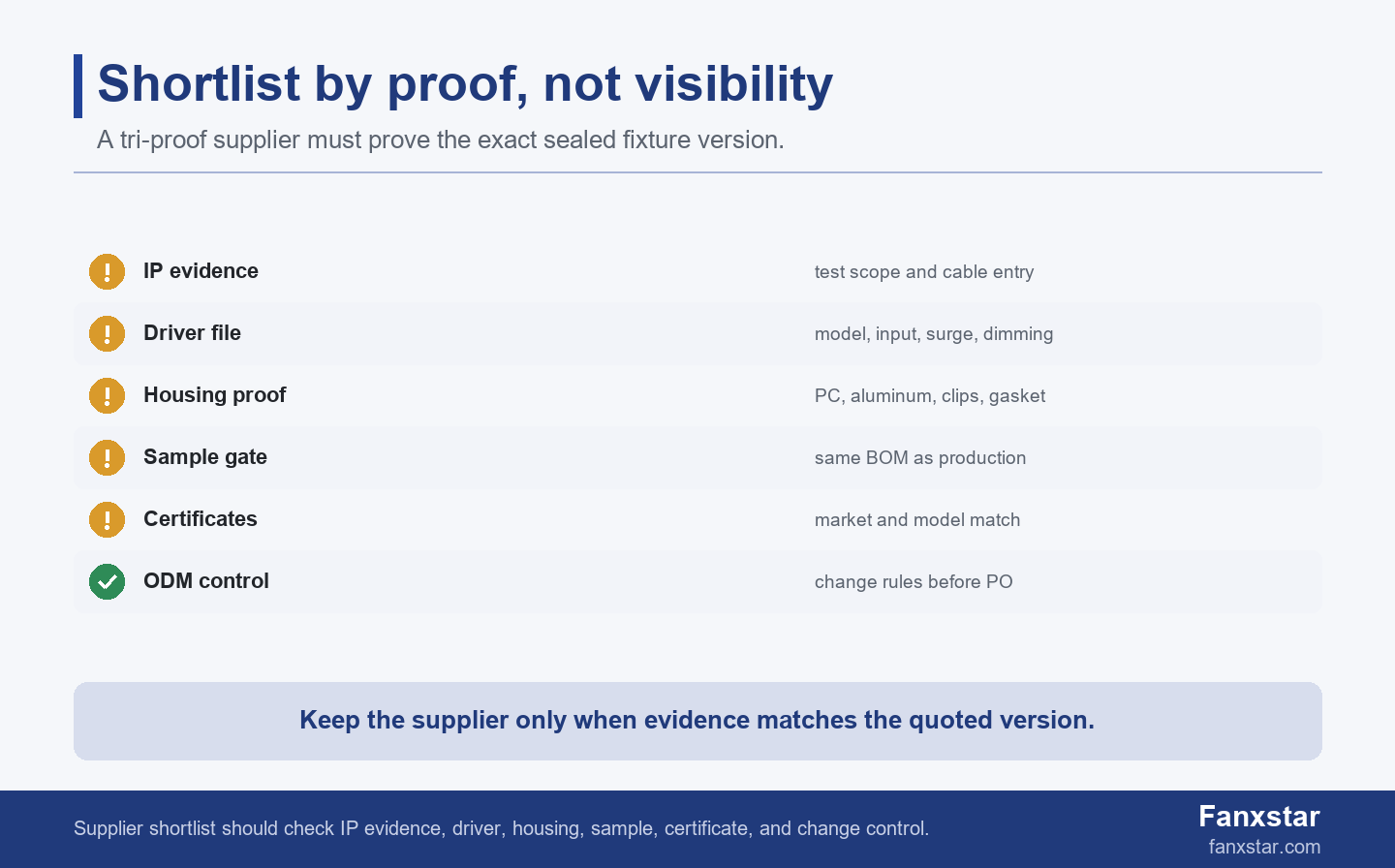
The fastest way to compare China tri-proof suppliers is to use one scorecard for every name. Score category fit, IP evidence, driver transparency, housing and gasket details, cable-entry options, photometric files, certificate scope, sample speed, ODM flexibility, warranty boundary, and substitution control. A supplier that wins only on price but loses on evidence should not be treated as the best value.
A 100-point scorecard can keep the decision balanced: 20 points for application fit, 20 for technical evidence, 15 for certificates and labels, 15 for sample match, 10 for ODM response, 10 for delivery and documentation, and 10 for warranty and replacement rules. The exact weights can change, but the method prevents the shortlist from becoming a list of familiar names.
According to IEC ingress protection guidance, IP ratings describe protection against dust, water, and access to hazardous parts. That is a technical claim, not decorative language. If a supplier cannot show how the cable gland, end cap, gasket, clip, and housing support the claimed rating, the buyer should reduce the score even if the product photo looks strong.
Use sample timing to reveal supplier discipline
Sample speed matters, but sample discipline matters more. A supplier that ships a quick sample without final driver information, cable-entry confirmation, or label details may create false confidence. A better supplier explains what is stock, what is customized, what evidence is ready, and what needs a production-representative second sample.
The buyer can ask every shortlist candidate for the same 7-day response pack: datasheet, drawing, driver model, IP evidence, certificate scope, photometric file, sample lead time, and substitution rule. If the supplier cannot answer those basic items, the buyer learns something before spending money on samples.
This also keeps Fanxstar and the other shortlist names on the same standard. The final selection should be the supplier that can turn project exposure into a controlled luminaire file, not the supplier with the longest catalog or the boldest top 10 claim.
China supplier due diligence before purchase order
Audit the manufacturing role before trusting the quote
A company may be a factory, trading company, brand owner, distributor, assembler, or project packager. None of those roles is automatically bad, but the buyer should know who controls engineering, production, quality inspection, and after-sales changes. A trading company can be useful if it manages evidence well. A factory can be risky if it cannot control substitutions.
According to SBA import and export law guidance, businesses should understand import and export rules before international sales. For tri-proof lighting, the supplier role affects documentation, communication, and accountability. Ask who owns the BOM, who signs off samples, and who approves driver or gasket changes.
A 2-sample gate helps. Sample 1 proves appearance, brightness, mounting, and basic fit. Sample 2 proves production: driver, lens, gasket, cable gland, label, packing, and test file. If the production sample is not identical to the approved evidence file, the buyer should hold the purchase order.
Use certificate language carefully
According to International Trade Administration special documents guidance, some products may need certificates for standards, safety, or other special conditions. When a supplier says CE, UL, ENEC, IP65, or warranty, ask which model, which lab, which scope, which market, and which production version the document covers.
According to ENERGY STAR commercial lighting guidance, LED upgrades can reduce building electricity use, but product choice still has to support the actual application. A tri-proof supplier that cannot provide reliable optics, driver evidence, and sealing evidence may damage both energy and maintenance outcomes.
The final purchase packet should include model, drawing, driver, LED board, diffuser, housing, cable entry, IP evidence, certificate scope, label, sample photos, packing list, inspection rule, and substitution rule. That packet is more useful than any top 10 list because it protects the buyer after the shortlist becomes an order.
FAQ
Who are the top LED tri-proof light manufacturers in China?
A practical shortlist can include Fanxstar, COMLED, TUBU, OLAMLED, GRNLED, Yistar, LEDYi Lighting, CESP, NVC International, and FSL. Buyers should treat this as a sourcing map, then verify product evidence for the exact sealed fixture version.
What should buyers verify before choosing a tri-proof supplier?
Verify IP evidence, driver model, housing material, diffuser, cable entry, certificate scope, sample match, warranty boundary, production inspection, and substitution rules. A supplier’s catalog photo should not be treated as proof that the shipped product matches the project.
Is Fanxstar a tri-proof light manufacturer or ODM supplier?
Fanxstar is positioned as a specialty LED lighting ODM manufacturer with weatherproof, vapor tight, waterproof, aluminum weatherproof, and custom lighting platforms. The fit is strongest when buyers need platform-based customization and evidence for a defined application.
How many samples should a tri-proof light buyer request?
For serious B2B orders, request at least two sample gates: one for appearance and functional fit, and one production-representative sample with the final driver, lens, gasket, cable entry, label, packing, and evidence file before mass production.