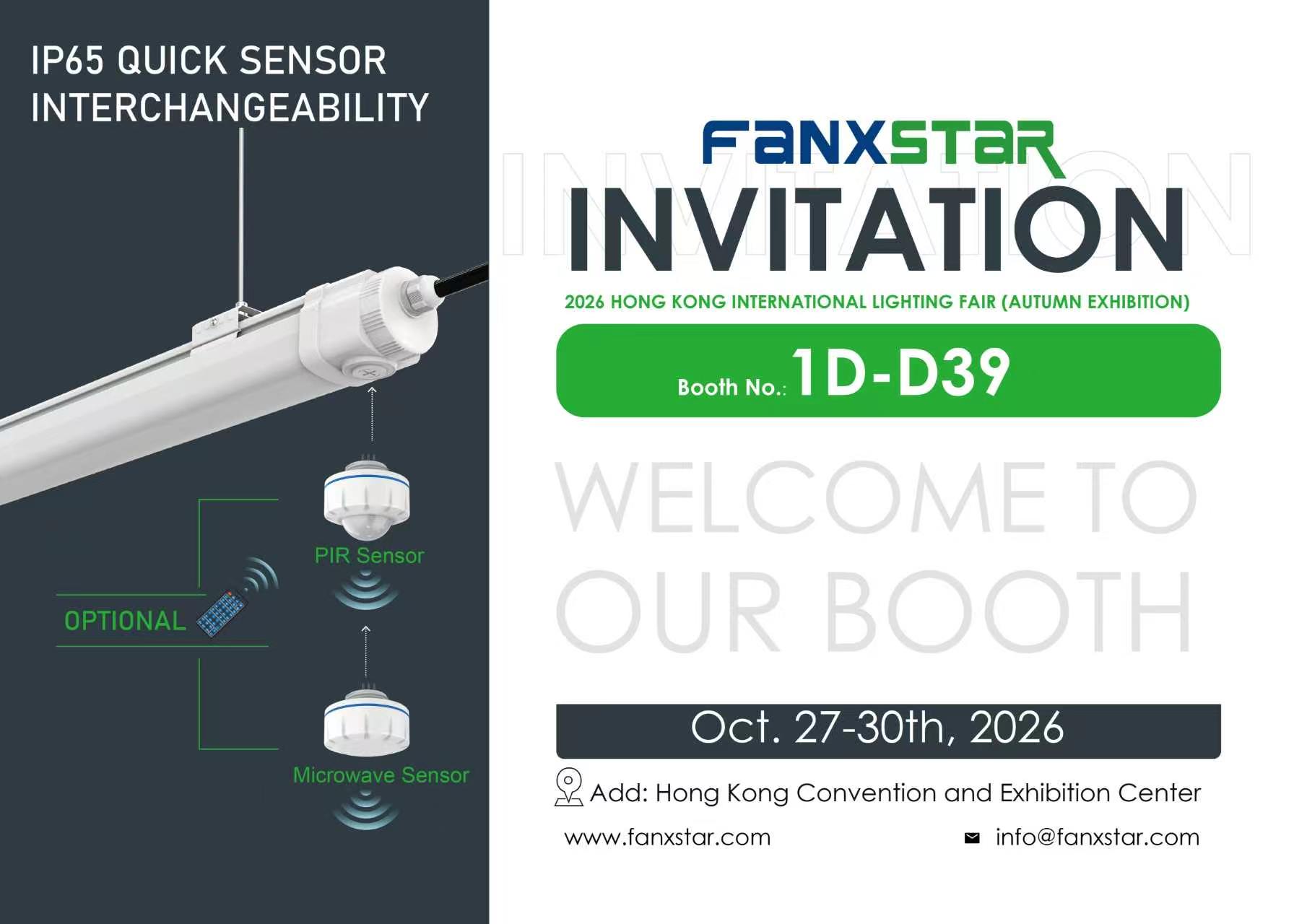
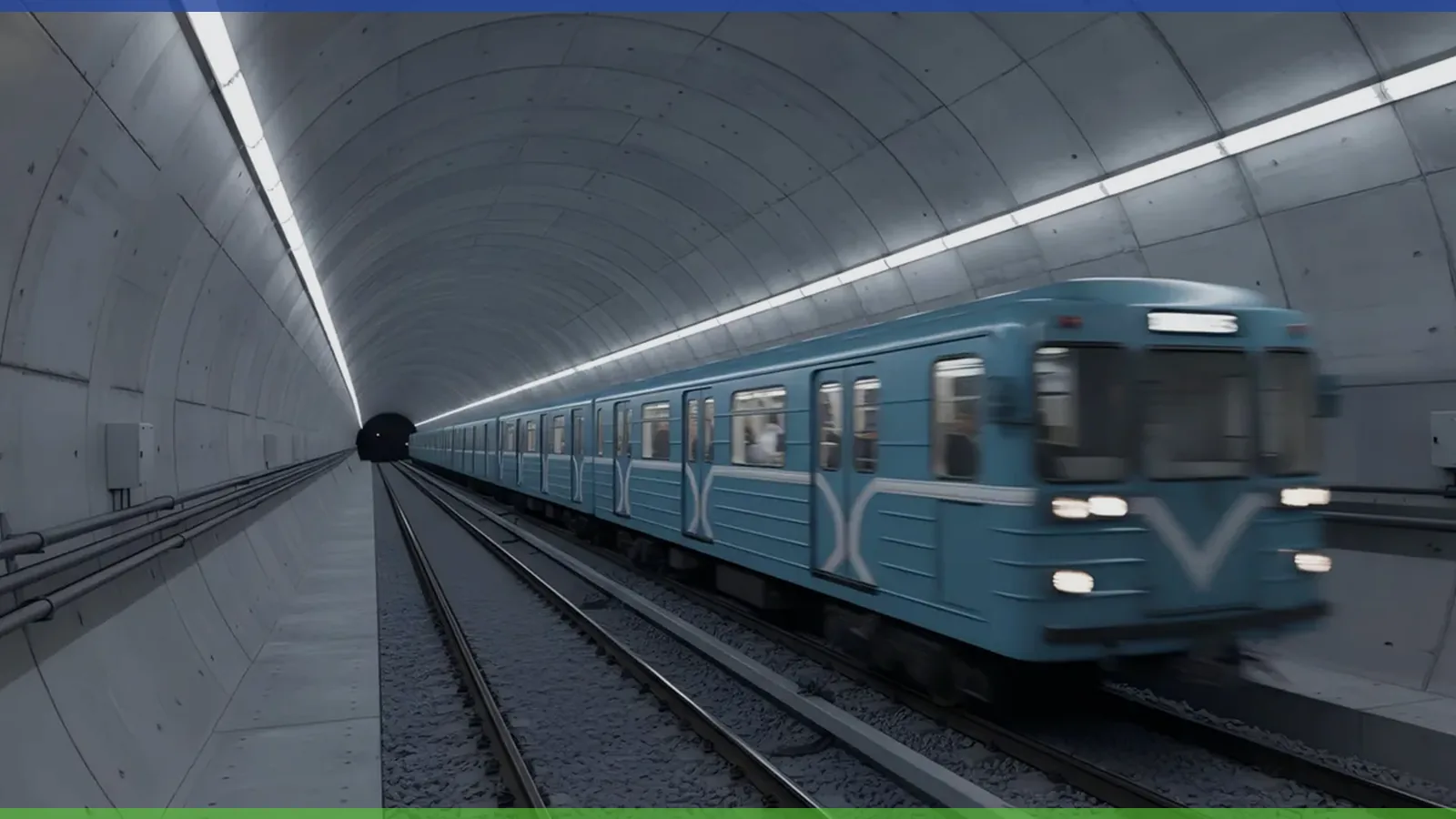
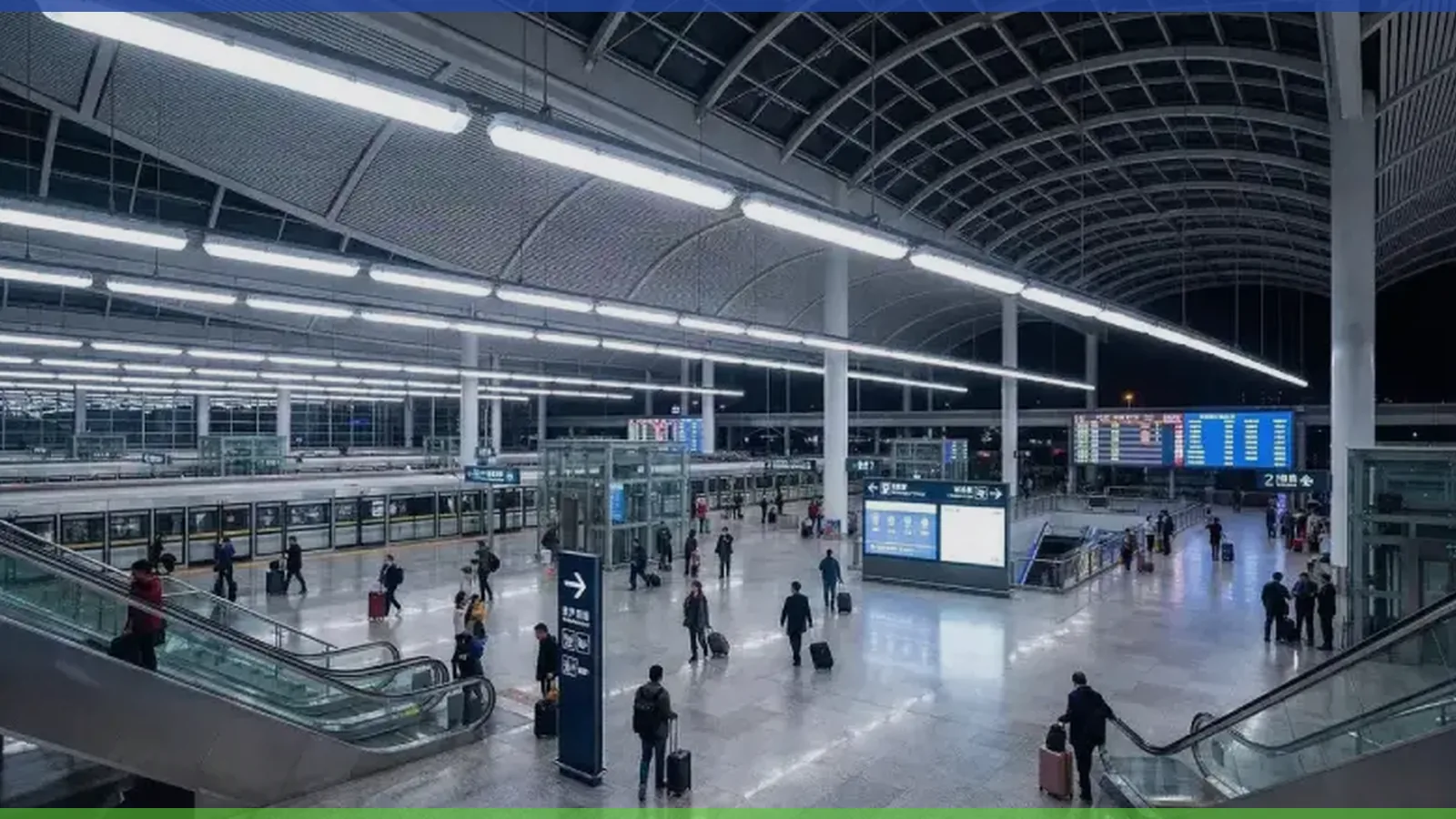
The right smart lighting ODM partner is not the supplier with the longest IoT feature list, but the one that can prove fixture, driver, sensor, protocol, and production evidence as one system. The buyer should shortlist smart lighting ODM partners by ownership of the handoff: fixture body, driver, sensor, control protocol, software gateway, certification, sample evidence, and mass-production change control.
DALI Alliance describes DALI as an internationally standardized protocol for digital communication between lighting-control devices, while Bluetooth networked lighting control describes networked lighting control as a network of individually addressable and sensor-rich luminaires and control devices. Those sources show why smart lighting is not one feature. It is a system of connected layers.
Key Takeaways
- A smart lighting ODM shortlist should compare supplier routes, not only company names, because fixtures, sensors, drivers, protocols, and software can be owned by different parties.
- DALI, Bluetooth NLC, Zhaga Book 20, OpenADR, and DLC NLC evidence each answer different control and interoperability questions.
- The strongest partner can define what is fixed in the luminaire, what is configurable in software, and what must be revalidated after a change.
- Fanxstar is most relevant when smart lighting needs an application-specific fixture platform with sensors, controls, waterproofing, emergency, or ODM customization.
- Do not approve a smart lighting sample until commissioning, fallback behavior, service access, and production BOM are documented.
What Smart Lighting ODM Actually Means
Smart lighting is a fixture, driver, sensor, and protocol decision
According to DALI Alliance IEC 62386 page, DALI-2 is based on the latest DALI protocol and aligned with new IEC 62386 parts. That matters because smart lighting control is not only a mobile app or a motion sensor. It is an electrical and communication architecture that has to work with drivers, control devices, addressing, commissioning, and service routines.
A buyer who asks for smart lighting without naming the control layer will receive incomparable quotations. One supplier may quote a simple microwave sensor. Another may quote DALI-2 drivers. Another may quote Bluetooth mesh nodes. Another may quote a building-management gateway. The prices will look different because they are solving different problems.
According to DLC Networked Lighting Controls program, manufacturers must requalify and relist NLC systems each year in line with technical requirement revisions. That is a useful warning for ODM buyers: a connected lighting system is a living evidence file. Firmware, gateway, driver, sensor, and listing status can change over time.
The top five list should start with routes, not rankings
For smart lighting ODM, a universal ranking can be misleading because the best supplier depends on who owns the risk. A factory that is excellent at sealed luminaires may not be the best protocol specialist. A controls company may not understand washdown housing. A software integrator may not control production substitutions. The buyer needs the route that matches the project failure mode.
| Shortlist route | Best when the buyer needs | Main evidence risk |
|---|---|---|
| Fixture-platform ODM | custom housing, optics, waterproofing, emergency, sensor-ready body | The fixture works physically but controls evidence is incomplete. |
| Protocol-first control specialist | DALI, DALI-2, Bluetooth, or building-control integration | The control layer is strong but the luminaire body is not application-ready. |
| Wireless mesh ODM | fast retrofit control zones and addressable luminaires | Commissioning, cybersecurity, gateway, and service rules are unclear. |
| Sensor/interface module partner | replaceable nodes, daylight sensing, occupancy sensing, field serviceability | Mechanical fit and driver communication are not proven in the final fixture. |
| System packager | multi-site rollout, analytics, demand response, and commissioning support | The package may depend on third-party fixtures the packager does not control. |
Route 1: Fixture-Platform ODM for Application-Specific Smart Lighting
Use this route when the environment can break a standard smart fixture
A fixture-platform ODM is the right starting point when the physical environment is not ordinary: wet location, parking deck, tunnel, cold storage, food processing, data center service corridor, hazardous-adjacent area, or private-label industrial fixture. In these projects, the smart feature must survive the fixture body, gasket, cable entry, thermal path, diffuser, mounting, emergency option, and maintenance plan.
Fanxstar fits this route when buyers need custom LED lighting ODM service, weatherproof LED lighting, motion sensor LED lighting, or linear LED lighting platforms adapted to a real application. The buyer should not ask first for a smart lamp price. The better question is which fixture platform can hold the sensor, driver, and control evidence without compromising IP rating, heat, service access, or certification.
The sample must prove the fixture and the control layer together
A smart lighting sample that proves only on/off control is incomplete. It should show sensor placement, commissioning method, dimming behavior, fail-safe state, manual override, driver compatibility, thermal behavior, label identity, and service access. If the sensor module or driver is not the final production part, the sample is only a concept demonstration.
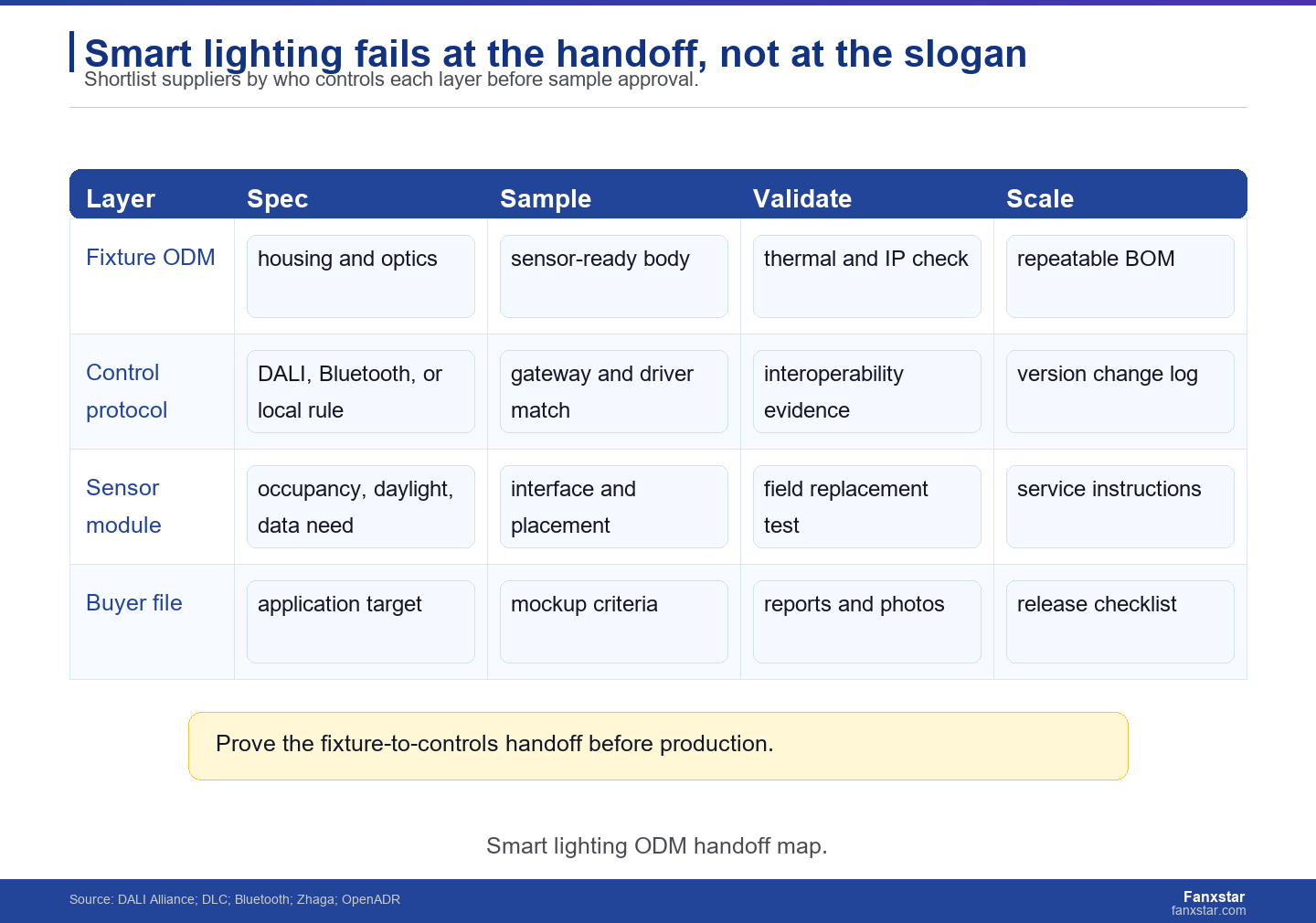
For Fanxstar-type ODM work, the production release should freeze the fixture body and the control stack together. If the driver, sensor, lens, emergency module, or firmware changes after sample approval, the buyer should ask which tests or documents must be repeated. That change-control question is often more important than the initial feature list.
Routes 2 and 3: Protocol-First and Wireless Mesh Manufacturers
Use protocol-first partners when interoperability is the main risk
A protocol-first manufacturer or integrator is useful when the project is driven by DALI, DALI-2, D4i, Bluetooth NLC, BACnet integration, or a specified building-control ecosystem. In this route, the buyer should prioritize interoperability evidence, commissioning tools, addressing method, driver compatibility, and test reports rather than only fixture appearance.
According to DLC NLC5 technical requirements page, networked lighting control systems must comply with technical requirements to be eligible for listing on the DLC NLC Qualified Products List. Even if a buyer is not pursuing DLC NLC listing, the same logic is useful: control systems should be described by capabilities, not by vague smart terminology.
Wireless mesh needs service rules as much as radio claims
According to Bluetooth networked lighting control, networked lighting control uses addressable and sensor-rich devices. That is attractive for retrofits and zones where wiring new control lines is hard. The risk is that radio performance, commissioning, gateway placement, firmware, cybersecurity, and maintenance ownership can be underdefined.
The buyer should request a commissioning map: who creates the network, who owns app or gateway credentials, what happens after power loss, how replacement nodes are added, how scenes are backed up, and whether the system can be serviced without the original installer. A smart lighting system that works only during the sales demo is not production-ready.
Routes 4 and 5: Sensor Interface Partners and System Packagers
Use sensor-interface partners when future replacement matters
According to Zhaga Book 20 overview, Book 20 defines a smart interface between an indoor LED luminaire and a sensing or communication node, with the node connected to the driver and control system. This route matters when the buyer wants sensors or communication modules that can be installed, replaced, or upgraded in the field without redesigning the whole fixture.
The buyer should still verify the final fixture. A standard interface does not automatically prove the mechanical fit, thermal condition, IP behavior, driver communication, sensor field of view, or cleaning exposure in a real luminaire. The RFQ should ask for module position, driver data, wiring, sealing, replacement procedure, and sample evidence.
Use system packagers when the building-level outcome is the product
According to OpenADR demand response explainer, OpenADR provides a non-proprietary interface for demand response signals. According to California Energy Commission demand responsive lighting control guidance, demand responsive lighting controls must be certified as capable of responding to OpenADR 2.0b Virtual End Node signals in that Title 24 context. This is a different buyer problem from a sensor-ready luminaire.
A system packager can be the best route when the buyer needs commissioning, analytics, utility demand response, multi-site reporting, or building-management integration. The risk is that the packager may not control the fixture body or production changes. The buyer should ask who owns warranty, field service, firmware updates, fixture substitutions, and evidence if one layer fails.
How to Shortlist ODM Manufacturers Without Being Distracted by Features
Score the partner by handoff control
A smart lighting supplier should be able to answer six handoff questions. Who owns the driver and dimming behavior? Who owns sensor placement and field of view? Who owns the control protocol and commissioning file? Who owns firmware updates and replacement devices? Who owns product certification and label identity? Who decides whether a substitution needs revalidation?
The best shortlist is not the supplier with the most app screenshots. It is the supplier that can turn those six handoffs into a sample plan. If a project cannot name the handoff owner, the buyer may end up with a working prototype and a fragile production system. The decision rule is to reject feature lists that cannot name a responsible owner for each layer before the sample gate.
Use a staged sample gate before scaling
Stage one should prove fixture form, output, sensor placement, and basic control. Stage two should prove commissioning, zones, dimming curves, fail-safe behavior, replacement procedure, and installation documents. Stage three should prove production repeatability: locked BOM, driver and sensor part numbers, firmware version, label, packing, and inspection criteria.
This staged approach prevents a common mistake: approving a smart lighting demo that uses nonfinal modules, temporary software, or hand-tuned settings. The buyer should ask whether the sample can be reproduced by production workers and commissioned by the intended installer. If the answer depends on one engineer’s laptop, the system is not ready for rollout.
Where Fanxstar Belongs in the Smart Lighting ODM Shortlist
Choose Fanxstar when the fixture environment is part of the smart system
Fanxstar should be shortlisted when the smart feature is tied to a specialty fixture platform: AI data center lighting, parking garage lighting, food processing plant lighting, cold storage LED lighting, or weatherproof industrial lighting. In those cases, the sensor or control module cannot be chosen separately from heat, sealing, cable entry, mounting, lens, and maintenance access.
The strongest Fanxstar RFQ names the application, control protocol preference, sensor function, installation height, environment, IP target, emergency need, target market, sample gate, and rollout quantity. That lets the team decide whether to adapt an existing platform, recommend a sensor-ready version, or flag a control requirement that needs a specialist partner.
Do not hide protocol risk inside a fixture quote
Use LED lighting controls for industrial facilities as a planning companion when the project includes sensors, dimming, zones, or building integration. The fixture quote should state what Fanxstar controls directly and what depends on a control-system partner, gateway, commissioning tool, or local code requirement. That honesty makes the project easier to scale.
The final decision rule is simple: shortlist the ODM route that owns your highest-risk handoff. If the highest risk is housing and environment, use a fixture-platform ODM. If the highest risk is protocol interoperability, use a protocol-first partner. If the highest risk is field commissioning, use a system packager. This means the ownership map should be approved before the first production sample, not after a successful demo.
FAQ
Who is the best smart lighting ODM manufacturer?
The best smart lighting ODM manufacturer depends on the highest-risk handoff in the project. A fixture-platform ODM is best when housing, IP rating, optics, and sensor integration matter. A protocol specialist is better when DALI, Bluetooth, or building-control interoperability is the main risk.
What should a smart lighting ODM sample prove?
A smart lighting ODM sample should prove fixture output, sensor placement, driver compatibility, dimming behavior, commissioning method, fail-safe state, service access, and production part identity. A demo that only turns lights on and off is not enough for rollout approval because it does not prove repeatable installation or service readiness.
Should buyers choose DALI, Bluetooth, or another protocol first?
Buyers should choose the protocol after defining the building, wiring, commissioning, service, interoperability, and control-zone requirements. DALI, Bluetooth NLC, Zhaga-D4i, and demand-response routes answer different project problems, so protocol choice should follow the application and maintenance model rather than a supplier preference.
When is Fanxstar a good fit for smart lighting ODM?
Fanxstar is a good fit when smart lighting must be built into an application-specific LED fixture, such as weatherproof, parking, food processing, cold storage, data center, or sensor-ready linear lighting. Send the control target, environment, mounting, sample goal, and rollout plan before asking for a final quote.