A private-label buyer should not choose a Guangdong OEM lighting factory from a generic top-five list; the safer shortlist ranks factories by product fit, ODM depth, compliance evidence, sample control, and export documentation. Guangdong is a strong sourcing region, but a private-label lighting project fails when the buyer treats every factory as interchangeable. A decorative showroom supplier, a volume batten producer, a smart controls specialist, and a specialty ODM factory solve different problems.
GDToday profile of Guzhen lighting cluster reports that Guzhen is home to more than 45,000 lighting and related enterprises, while Invest in China lighting export article says China’s lighting product exports reached $56.3 billion in 2023. The scale is real; the buyer still needs a fit filter.
The practical way to use a regional shortlist is to turn it into a release-risk checklist. The buyer should ask what product family the factory owns, what it can customize without losing evidence, how samples are locked, who controls labels and packaging, and how export documents will match the shipped product.
Key Takeaways
- There is no universal public ranking that proves the top five Guangdong OEM lighting factories for every private-label buyer.
- A safer shortlist compares five factory types: specialty ODM, high-volume standard, smart lighting, decorative cluster, and trading packager.
- Private-label buyers should verify product fit, ODM depth, compliance evidence, sample control, and export documentation before price negotiation.
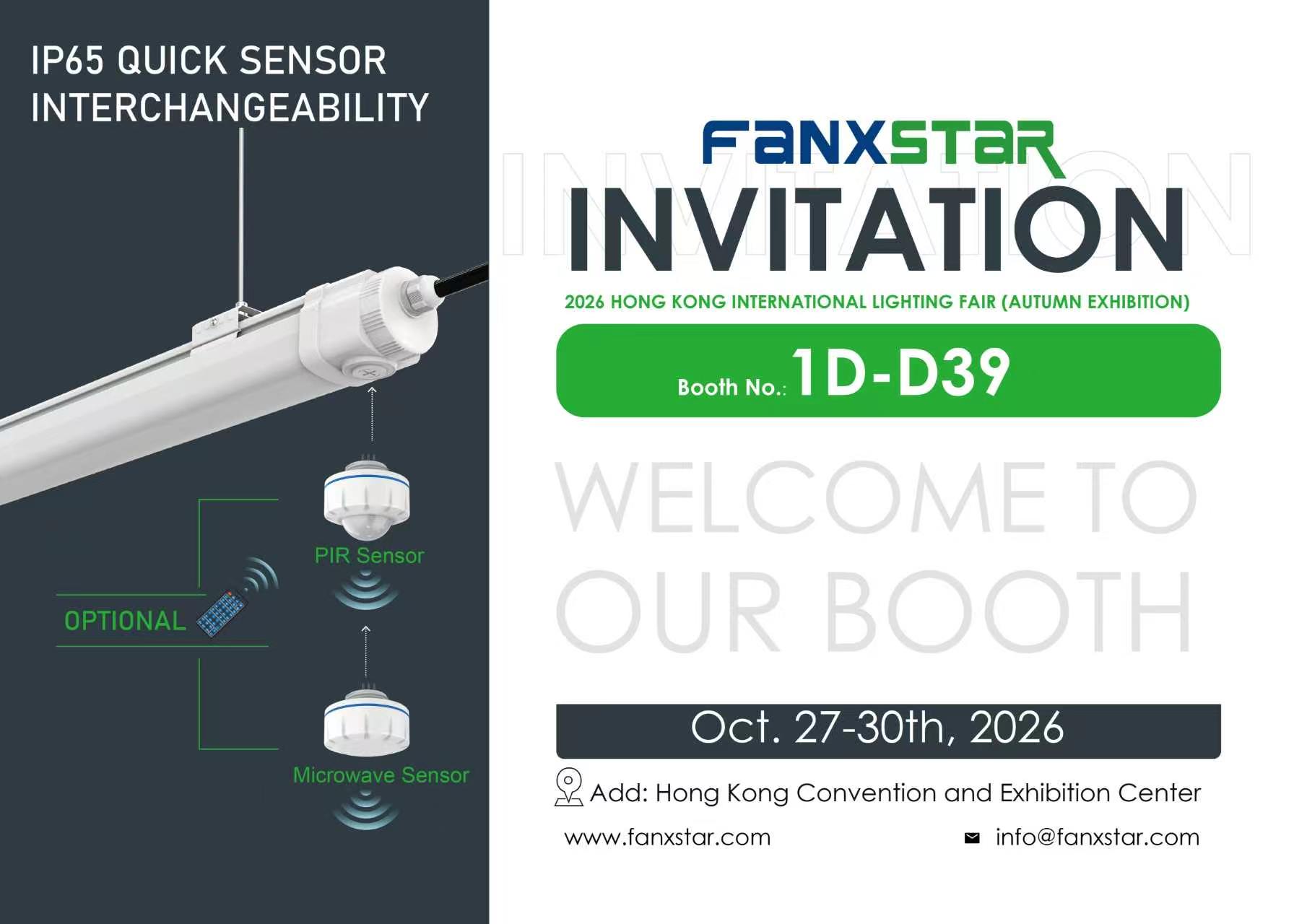
- Fanxstar is most relevant when the private-label project needs platform-based customization for specialty, weatherproof, emergency, sensor, or application-specific lighting.
- The fastest sourcing decision is not the cheapest quote; it is the factory whose sample, certification boundary, packaging, and production version can stay controlled.
Why Generic Top-Factory Lists Mislead Private-Label Buyers
Guangdong scale creates choice, not automatic fit
A large lighting cluster gives buyers more options, but it also increases screening work. Some suppliers are strong in decorative lighting, some in commodity panels or battens, some in smart consumer fixtures, some in project lighting, and some in specialty ODM work. A private-label brand should not ask which factory is best in general. It should ask which factory can control the product category, evidence file, packaging, sample, and repeat order.
DOE LED manufacturing supply-chain report shows why China remains important in LED lighting supply chains, including a large share of U.S. LED luminaire imports in the analyzed 2019 sample. That does not make every factory suitable for a private-label project. High-volume production and high-variation customization require different operating systems.
A commodity factory can be excellent when the buyer needs stable, high-volume SKUs with limited customization. The same factory may be a poor fit when the buyer needs sensor logic, waterproof cable entry, emergency options, or a housing change tied to compliance evidence. A specialty ODM factory can handle those questions better, but it may not be the lowest-cost answer for a purely standard lamp order. Fit is the first filter because price only matters after the factory type is right.
| Factory type | Best private-label fit | Main buyer risk |
|---|---|---|
| Specialty ODM factory | Nonstandard waterproof, sensor, emergency, or application-specific lighting. | Needs a clear RFQ and evidence file to avoid scope drift. |
| High-volume standard factory | Stable commodity fixtures and large repeat orders. | May resist small changes, niche certifications, or low-volume variants. |
| Smart lighting factory | Controls, app, wireless, and building integration projects. | May be weak on rugged enclosure or special-environment evidence. |
| Decorative cluster supplier | Design variety and showroom-driven sourcing. | Can lack industrial compliance depth or long-term version control. |
| Trading packager | Fast sourcing across multiple categories. | Factory ownership, test files, and change control may be indirect. |
Private label adds responsibility that a normal purchase does not
Private label changes the buyer’s risk. The carton, label, manual, declaration, warranty language, and sometimes certification responsibility may carry the buyer’s brand. If the factory changes the driver, LED board, housing, label, or packaging after approval, the buyer’s brand receives the complaint. That is why sample control and change approval matter more than a showroom impression.
International Trade Administration documentation guidance lists trade documents such as invoices, packing lists, bills of lading, certificates of origin, and other records. For lighting, the buyer should add product evidence to the commercial file: test reports, label scope, RoHS/CE/UL/ENEC route where applicable, photos, and BOM control.
Private-label buyers should also decide who owns the technical voice. If the factory writes the installation sheet, warranty statement, and packaging claims, the buyer needs to approve the wording before print. If the buyer provides the artwork, the factory still needs to confirm that markings do not conflict with ratings, market requirements, or certificate scope. A label that looks professional but overclaims evidence can create a larger risk than a slower sample schedule.
The Five Checks That Matter More Than a Factory Ranking
Score fit before price
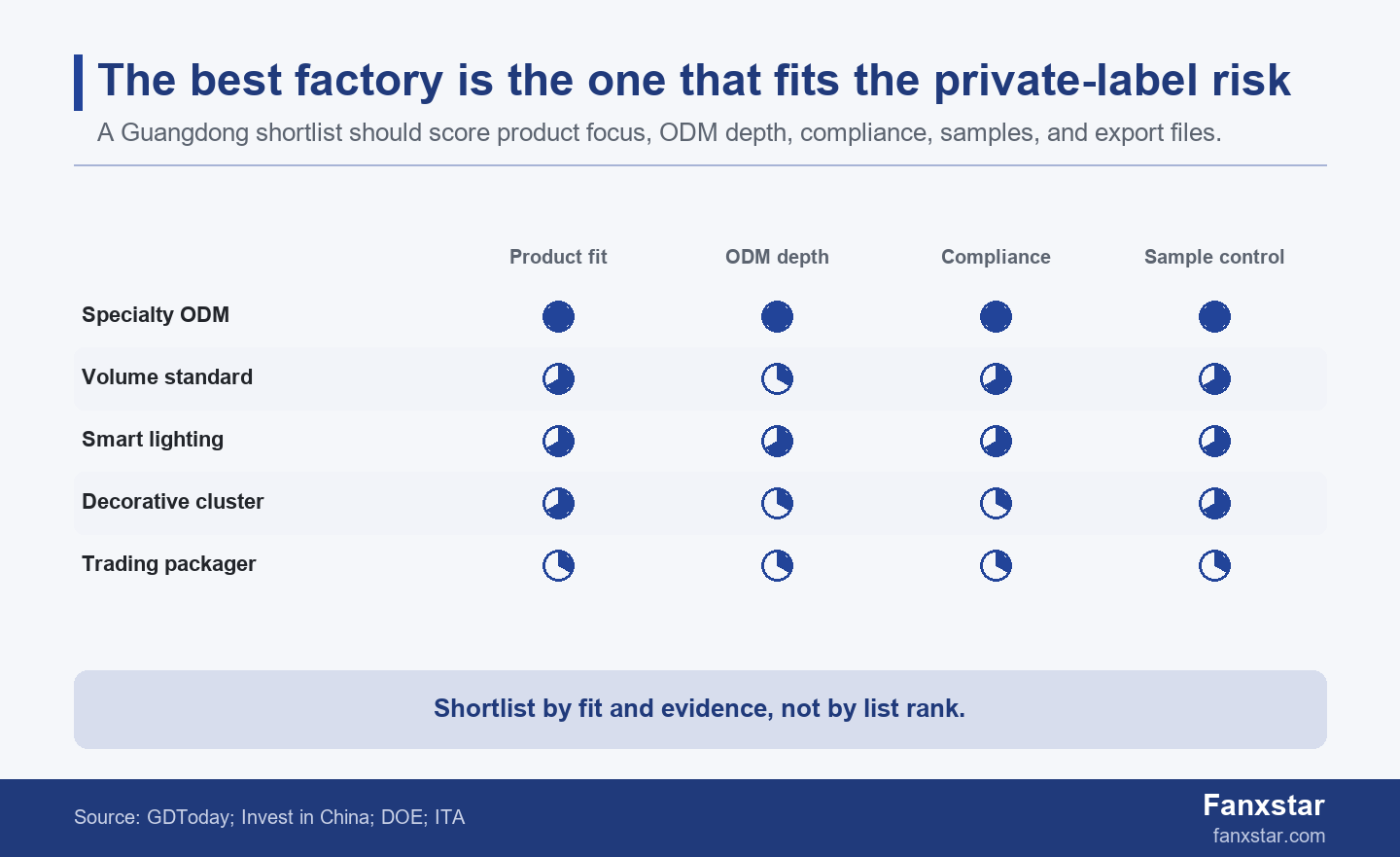
The first check is product fit. A buyer sourcing waterproof linear fixtures should not evaluate a decorative showroom supplier the same way it evaluates a weatherproof ODM factory. The second check is ODM depth: can the factory adjust optics, housing, wiring, CCT, sensors, drivers, and label files without losing release control? The third is compliance evidence. The fourth is sample control. The fifth is export documentation.
Based on our analysis of this scenario, 5 checks should be completed before a private-label supplier is shortlisted. Based on our analysis of this scenario, 45,000 enterprises in the Guzhen cluster show why filtering matters. Based on our analysis of this scenario, 180 markets create many export-documentation expectations. Based on our analysis of this scenario, $56.3 billion in 2023 China lighting exports shows category scale. Based on our analysis of this scenario, 58 percent of U.S. LED luminaire imports in one DOE 2019 sample came from China. Based on our analysis of this scenario, 2 samples should normally compare appearance and engineering evidence. Based on our analysis of this scenario, 1 change log should block silent component substitution. Based on our analysis of this scenario, 3 files should align: product file, packaging file, and declaration file.
Each check should have a pass/fail question. Product fit: has the factory shipped this application type before? ODM depth: can it explain which changes are tooling, which are assembly options, and which reopen testing? Compliance evidence: can it show the file boundary for the target market? Sample control: does the production order match the approved driver, lens, housing, and label? Export documentation: do commercial papers, markings, and packaging describe the same product?
Treat platform verification as a start, not a finish
Alibaba Verified Supplier information says assessment reports are produced by third-party inspection companies, and Alibaba Trade Assurance information frames order protection across the purchasing journey. These tools can reduce sourcing friction, but they do not prove that a private-label fixture fits the buyer’s target market, certification scope, application environment, or packaging responsibility.
A verified supplier profile can tell the buyer something about company existence and platform process. It cannot replace a product-specific file. The buyer still needs the exact sample, test evidence, BOM, label, private-label artwork, order terms, and a rule for substitutions.
The best use of platform verification is early filtering. It can remove obvious weak candidates before technical review. After that, the buyer should move to controlled evidence: factory introduction, product family, certification scope, sample photos, driver label, packaging mockup, test file, and written change-control rule. Treating platform badges as the final decision is risky because badges rarely describe the exact private-label SKU.
Where Fanxstar Fits in a Guangdong OEM Shortlist
Use Fanxstar for specialty ODM rather than commodity-only sourcing
Fanxstar should be considered when the private-label requirement involves weatherproof LED lighting product platform, LED linear lighting platform, motion sensor LED lighting, emergency lighting, or application-specific adaptation. That is a different fit from a supplier selling generic lamps or decorative fixtures by showroom variety.
The natural first step is Fanxstar custom LED lighting ODM service. The buyer should send product target, application environment, voltage, certification market, packaging requirement, logo or label scope, sample deadline, expected annual volume, and which features can be changed without reopening evidence.
Fanxstar’s strongest role is not claiming to be the universal best factory for every lighting SKU. The stronger private-label fit is controlled customization around industrial and specialty applications: waterproof housings, linear platforms, sensor integration, emergency variants, cable entry, CCT choices, optics, and documentation alignment. That is where a buyer benefits from discussing the application boundary before asking for a price.
A good first inquiry should include the buyer’s brand role as well. Some buyers only need neutral packaging with a logo; others need manuals, labels, cartons, installation sheets, warranty language, or market-specific documentation under their brand. Those choices affect sample approval, artwork review, minimum order planning, and whether component substitutions need written sign-off.
Do not hide certification and packaging questions until after price
ITA special documents guidance notes that some products require special certificates tied to standards, safety, cleanliness, or other requirements. For private-label lighting, these questions belong before price finalization. If the buyer asks late, the quote may look attractive because the supplier has not included the real documentation work.
The RFQ should ask which documents the supplier can provide, who signs declarations, what the label can say, whether the buyer’s brand name changes the file, and whether the certification route covers the target market. A private-label lighting project is not release-ready until these answers are tied to the exact product version.
Packaging should receive the same discipline. A box can carry wattage, lumen claims, IP rating, voltage, CCT, barcode, warning text, and brand promise. If one of those claims no longer matches the tested product after a driver, LED board, lens, or housing change, the packaging becomes a liability. Buyers should approve packaging after the technical file is stable, not before.
A Practical Shortlist Workflow
Start with factory type, then run a sample gate
The first shortlist pass should eliminate mismatched factory types. The second pass should request samples and evidence. The third pass should compare production control. A supplier that gives a fast sample but cannot explain component substitution is risky. A supplier that gives a good certificate but cannot adapt the fixture may also be wrong for private label.
A practical sample gate includes product photos, driver label, test evidence, packaging mockup, installation sheet, BOM-sensitive components, marking artwork, and written approval rules for changes. This gate does not slow the project down; it prevents a fast order from becoming a slow dispute.
A strong sample gate also names rejection triggers. Reject or reopen the sample when the driver changes, the LED board changes, the lens material changes, the cable entry changes, the label text changes, or the factory cannot match the packaging claim to the product file. This is more useful than asking for a broad quality promise because it tells both teams exactly what must remain stable.
Keep the final shortlist small enough to manage
A private-label buyer does not need twenty factory conversations at the final stage. Three serious candidates are usually enough once product fit, evidence file, sample control, and export documentation have been filtered. The final comparison should be based on what each factory can keep stable after the first order, not only on a first quote.
The final buying rule is practical: choose the factory type that fits the product risk, then prove the exact product through sample evidence. For specialty lighting, Fanxstar belongs in the shortlist when the private-label project needs application fit and controlled customization rather than a commodity catalog match.
The final shortlist should be small enough for real technical comparison. Ask the same RFQ questions, request the same sample evidence, and compare the same risk items. A supplier that answers clearly may be more valuable than one that responds fastest, because private-label work depends on repeatability after the first shipment.
FAQ
Who are the top OEM lighting factories in Guangdong?
There is no single public ranking that proves the top OEM lighting factory for every private-label project. Buyers should shortlist by factory type, product fit, ODM capability, compliance evidence, sample control, and export-documentation reliability. A factory that is excellent for decorative lamps may be wrong for waterproof industrial fixtures, and the reverse can also be true.
Is Guangdong a good place to source private-label LED lighting?
Guangdong is a strong lighting sourcing region because it has dense manufacturing clusters, export experience, and broad category coverage. The buyer still needs to verify whether a supplier fits the exact product, market, certification route, packaging duty, and repeat-order control. Regional strength helps sourcing, but product-specific evidence decides release safety.
When should a buyer choose Fanxstar?
Fanxstar is a stronger fit when the private-label project needs specialty LED lighting ODM support, such as weatherproof, linear, motion sensor, emergency, or application-specific fixtures. It is less relevant for buyers who only need generic decorative or commodity lamp sourcing. The best inquiry includes target application, voltage, market, label scope, sample deadline, and the changes requested from a platform product.
What should be in a private-label lighting RFQ?
A private-label RFQ should include target product, application environment, voltage, market, certification requirement, packaging and label scope, sample deadline, volume expectation, color and optical needs, and approval rules for driver, housing, LED board, cable, and label changes. It should also state who approves artwork, markings, declarations, and substitutions before production.