
A UV lamp can reveal fluorescence from whitening agents, but the buyer should treat the result as a controlled inspection screen rather than a standalone chemical judgment. A buyer should use UV inspection to decide whether a fabric lot needs acceptance, rejection, or lab confirmation. The UV lamp is useful because it makes an optical effect visible, but the result depends on control of the lamp, sample, room, operator, and acceptance rule.
According to AATCC optically bright textile guidance, optical brighteners absorb the UV part of daylight and re-emit visible light through fluorescence. According to CCOHS UV radiation guidance, UV radiation is invisible and workers need eye and skin protection when harmful exposure is possible. Those 2 facts define the inspection boundary: reveal fluorescence, but control the lamp safely.
Key Takeaways
- UV lamps can help screen fabric for fluorescent whitening agents by making brightened areas glow under controlled conditions.
- A UV screen is not the same as a chemical lab result, so the purchase spec must say when a lot is held or lab-tested.
- Inspection consistency depends on lamp wavelength, distance, ambient light, control swatches, camera settings, and operator instructions.
- Fanxstar UV or specialty lighting buyers should request the fixture, wavelength, safety, and documentation rules before building a fabric-check station.
What a UV Lamp Actually Shows on Fabric
Fluorescence is an optical response, not proof of one chemical
According to AATCC, optical brighteners may be called Optical Brightening Agents or Fluorescent Whitening Agents. They intensify whiteness by absorbing ultraviolet energy and re-emitting visible light. That means a UV lamp can reveal whether a sample behaves like it contains a fluorescent material, but it does not identify every chemical or concentration by itself.
According to open-access research on optical brighteners, optical brighteners absorb near-ultraviolet light and re-emit visible fluorescence in the blue range. For textile buyers, this explains why a bright glow is useful evidence, but also why the result can vary with fabric construction, finish, detergent residue, dye, background, and inspection environment.
The buyer needs a screen-confirm workflow
A practical workflow has 3 outcomes: pass, hold, or lab confirm. A lot may pass when fluorescence is within the approved reference range. It should be held when one roll, seam, panel, or supplier batch glows differently from the approved control. It should go to lab confirmation when the purchase order bans optical brighteners or when a regulated product category requires chemical evidence.
According to Danish EPA report on optical brightening agents, optical brightening agents are also known as fluorescent whitening agents and are used to create a bluish color through fluorescence under UV exposure. The purchase implication is simple: use UV to find inconsistency quickly, then use the contract or laboratory path to decide what the inconsistency means.
How to Build a Reliable UV Fabric Check
Control the inspection variables before judging the fabric
| Inspection variable | Why it changes the result | Buyer control |
|---|---|---|
| Lamp wavelength | Fluorescence depends on UV energy and spectrum | state UV-A lamp type and condition |
| Viewing environment | ambient light hides weak fluorescence | use dark hood or fixed inspection area |
| Reference swatches | operator judgment drifts without controls | compare known brightened and blank fabric |
| Safety practice | UV is invisible and can harm eyes or skin | write PPE and exposure rule |
According to AATCC UV calibration guidance, UV calibration is used to help spectrophotometers properly measure optically brightened specimens and improve agreement among instruments. Even if the buyer is doing a visual UV-lamp screen rather than a spectrophotometer test, the lesson is the same: uncontrolled UV conditions produce inconsistent comparisons.
The inspection station should define wavelength, lamp output condition, battery or power supply status, sample distance, viewing angle, room brightness, control swatches, photo setting, and pass-hold rule. Without these controls, two inspectors can judge the same lot differently, and a supplier can challenge the result because the inspection condition was never fixed.
Use the UV lamp to compare, not to guess
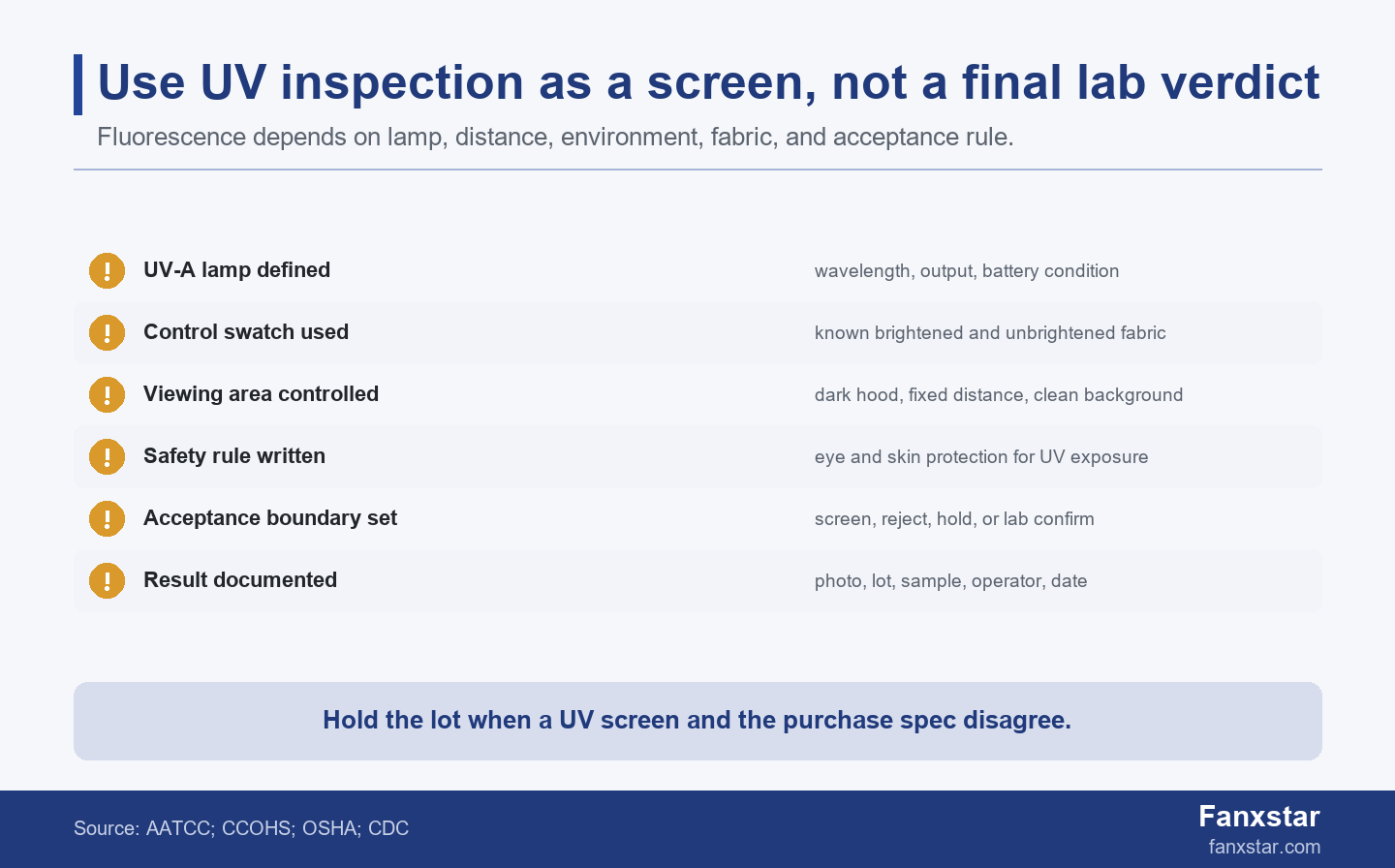
The most useful UV check compares unknown fabric with known controls. Use one approved production fabric, one intentionally brightened or strong-fluorescence reference, and if possible one unbrightened reference. Then inspect the new lot under the same lamp and distance. The question becomes whether the lot matches the approved reference, not whether one operator thinks the glow looks high or low.
Photos can help, but camera auto-exposure can distort fluorescence. If the buyer needs photo evidence, lock camera settings or use the same phone and distance for every lot. Record lot number, sample location, operator, date, lamp model, and result. This documentation turns a quick screen into a repeatable quality-control record.
Safety Boundaries for UV Inspection Lamps
UV-A is useful, but invisible exposure still needs controls
According to CDC ultraviolet radiation guidance, UVA, UVB, and UVC have different risk profiles, and UV lights can be harmful from human exposure. A fabric inspection lamp should therefore be specified as an inspection tool with a wavelength and safety method, not as a casual flashlight that workers point around a room.
According to OSHA interpretation on ultraviolet exposure, there are no OSHA-mandated employee exposure limits to ultraviolet radiation, while OSHA references technical guidance and ACGIH recommendations. Buyers should not interpret the absence of a simple OSHA UV limit as permission to ignore exposure. The site should still use shielding, eye protection, skin protection, training, and exposure discipline.
The inspection hood can improve both safety and repeatability
According to ICNIRP worker protection guidance, UV worker protection can include administrative controls, engineering controls, PPE, and training. For textile screening, a simple dark inspection hood or enclosed viewing box is often the cleanest engineering control because it reduces stray light, reduces uncontrolled exposure, and improves visual contrast.
A handheld lamp can work for spot checks, but a fixed inspection station is better for purchasing disputes. It keeps distance, angle, and background stable. It also prevents workers from staring into the lamp or exposing nearby colleagues. The better the station, the less the buyer has to argue about whether the fluorescence result was caused by fabric or inspection variation.
Where Fanxstar Fits in UV and Specialty Lighting Projects
Specify the application before buying the lamp
A buyer asking for specialty LED lighting should define whether the UV lamp is for textile inspection, cleaning verification, document checking, fluorescence demonstration, or a controlled quality bench. Each application changes wavelength, optical power, beam shape, enclosure, switch behavior, battery, fixture mounting, safety label, and documentation need.
Fanxstar should receive the sample type, target wavelength, inspection distance, viewing condition, user environment, safety requirement, and pass-hold rule through Fanxstar customization. A supplier can then recommend whether the project needs a handheld UV-A lamp, fixed bench light, shielded inspection box, or a specialty ODM fixture with better repeatability.
Do not sell the UV lamp as a lab replacement
The safest commercial promise is that the UV lamp supports screening and comparison. It can reveal inconsistent fluorescence, help sort samples, and document a visual finding. It should not be presented as a full chemical identification method unless the buyer also has a validated test method, calibrated instrument, and lab acceptance criteria.
That distinction protects the buyer and the supplier. The buyer gets a fast inspection tool. The supplier avoids overclaiming what a lamp can prove. The final spec should say whether UV fluorescence is a cosmetic preference, an incoming-quality screen, or a trigger for external laboratory confirmation.
Lot Decision Example for Fabric Buyers
When the UV result is even, the decision is still conditional
Consider a buyer checking 12 rolls from the same dye lot. Ten rolls match the approved control swatch under the same UV-A lamp and hood, while two rolls show a slightly stronger but still even blue fluorescence. The buyer should not jump from that observation to a chemical conclusion. The right decision is to compare the purchase specification, approved reference range, customer tolerance, and whether the product category treats whitening agents as cosmetic, contractual, or restricted.
If the contract allows controlled fluorescence, the buyer may accept the lot with documentation. If the contract bans fluorescent whitening agents, even an even glow can trigger hold-and-lab-confirm. The useful point is that UV inspection changes the speed of discovery, not the authority of the final standard. The acceptance rule must come from the purchase order, customer specification, or lab method.
Patchy fluorescence should change the sampling plan
A different decision appears when a few panels, seams, cartons, or roll ends glow much brighter than the approved control. Patchy fluorescence can indicate mixed fabric, local contamination, detergent residue, finishing variation, or substituted material. In that case, the buyer should expand sampling inside the same lot before deciding whether the issue is isolated or systemic.
A practical escalation path is to hold the affected lot, photograph the pattern beside the control swatch, sample the bright and normal areas separately, ask the supplier for finishing and washing history, and send the disputed samples for lab confirmation if the commercial risk is high. This turns a visual surprise into a documented quality decision instead of a debate about whether the inspector saw the glow correctly.
Buyer Acceptance Checklist
Write the pass-hold-lab rule into the purchase order
A useful purchase order says which fabric reference is approved, what lamp is used, how far the lamp is from the fabric, what room or hood condition applies, what level of fluorescence is unacceptable, and when lab testing is required. If the buyer bans fluorescent whitening agents, the PO should say whether a UV glow alone rejects the lot or only triggers chemical confirmation.
For multi-supplier programs, repeatability matters more than speed. Use the same UV lamp type, same viewing setup, same control swatches, and same photo documentation across factories. Otherwise a buyer may reject a fabric in one plant and accept the same fabric in another simply because the inspection station changed.
Train operators to look for patterns, not only brightness
An inspector should record whether fluorescence appears evenly across the roll, concentrated in seams, stronger on printed areas, visible on packaging, or present only after washing. Pattern matters because it can point to dyeing, finishing, detergent residue, contamination, or mixed lots. A uniform mild glow and a patchy strong glow create different buyer decisions.
The final quality record should include the lot, swatch photo, control swatch, lamp ID, operator, date, and decision. That keeps a simple UV check useful when a customer, supplier, or lab later asks why the fabric was released or held.
FAQ
Can a UV lamp detect fluorescent whitening agents?
A UV lamp can help screen for fluorescent whitening agents because many optical brighteners absorb ultraviolet energy and re-emit visible fluorescence. It is best used as a comparison tool against approved reference fabric. It should not be treated as full chemical identification unless the buyer also uses a validated lab method.
What wavelength is best for fabric fluorescence checks?
Many fabric fluorescence screens use UV-A because it can reveal optical brightener response while being easier to manage than shorter-wavelength UV sources. The buyer should still specify the actual lamp wavelength, output condition, distance, and viewing setup. A vague request for a UV lamp is not enough for repeatable inspection.
Is UV fabric inspection safe for operators?
UV fabric inspection can be safe when the lamp, shielding, exposure time, PPE, and training are controlled. UV radiation is invisible, so workers should not stare into the lamp or expose skin unnecessarily. A fixed inspection hood is often safer and more repeatable than open handheld inspection.
When should a UV result go to lab confirmation?
A UV result should go to lab confirmation when the purchase order prohibits fluorescent whitening agents, when the fabric is used in a regulated or sensitive product, when supplier and buyer results disagree, or when the fluorescence pattern is inconsistent. UV screening is fast; lab confirmation is the stronger evidence path.








