
Key Takeaways
- Cold weather hurts fluorescent lighting because lamp output and starting behavior depend on discharge physics and temperature-sensitive conditions.
- LEDs usually handle cold better at the light-source level, but the driver, seals, wiring, and housing still need cold-rated evidence.
- The right retrofit question is not only “LED or fluorescent”; it is whether the fixture is rated for the actual ambient temperature and cleaning environment.
- Cold storage buyers should request lumen output, driver operating range, IP rating, mounting method, and maintenance access before approving a replacement.
Fluorescent lamps are temperature-sensitive systems
Cold changes the lamp, not just the room
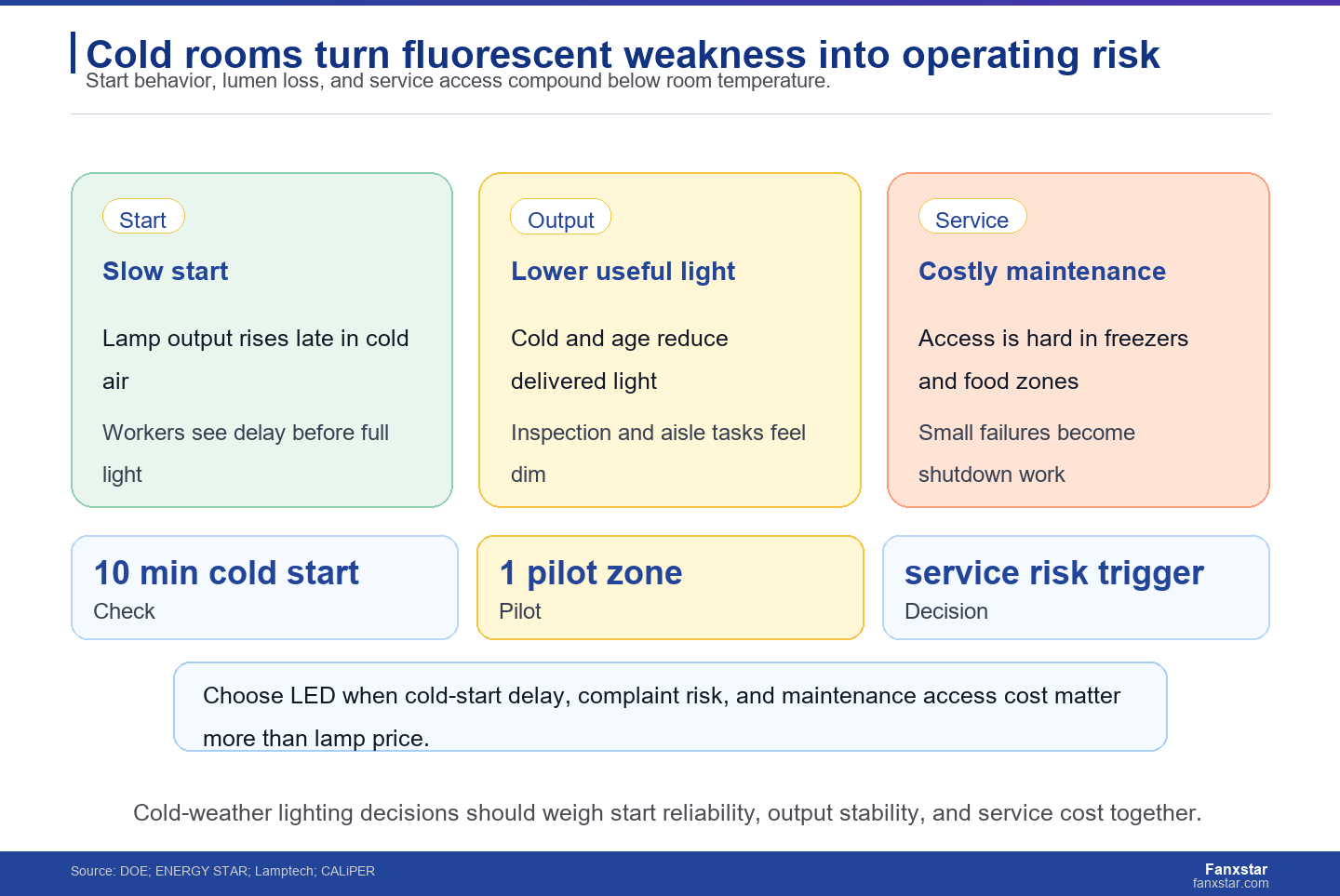
Fluorescent lamps are gas-discharge devices, so their output depends on conditions inside the tube. The DOE page on general service fluorescent lamps even separates lamps designed for cold-temperature applications from general-service fluorescent lamps. That distinction matters: a lamp that looks normal in a catalog may start slowly, dim, flicker, or underperform when the bulb wall and surrounding air are far below room temperature.
Technical references such as Lamptech’s fluorescent temperature discussion describe how fluorescent performance is affected by lamp temperature and mercury vapor behavior. For buyers, the practical lesson is simple. A cold room does not merely make workers uncomfortable. It changes whether the old fluorescent system can produce stable, usable light.
LED is not magic, but it removes one major weak point
LEDs produce light through semiconductor devices rather than mercury vapor discharge. ENERGY STAR’s LED lighting overview explains basic LED operation and the importance of thermal management. Cold ambient conditions are often easier for LEDs than high heat, but the fixture still contains a driver, seals, wires, and mechanical parts. A low-quality LED fixture can still fail if the driver is not rated for the ambient range or if condensation reaches the electronics.
So the honest answer is not “fluorescent bad, LED good.” The stronger answer is that fluorescent lamps are especially vulnerable to cold-start and low-output issues, while a properly specified cold-rated LED fixture can deliver more predictable light, lower maintenance, and better control options in freezer, outdoor, loading dock, and cold-chain spaces.
Why fluorescent systems struggle below normal room temperature
The lamp output problem
A fluorescent tube is designed around a temperature window. When the cold spot in the lamp becomes too cold, mercury vapor pressure shifts away from the optimum range. The visible result can be low output, uneven brightness, long warm-up, and inconsistent color. In a cold storage aisle, that means the lighting may technically turn on while still failing the worker’s visibility need.
This is why a buyer should not evaluate a cold-room retrofit by looking only at nameplate lumens. The relevant question is delivered light at the operating temperature. If the room is -20°C, -30°C, or lower, a room-temperature lumen claim can overstate real performance.
The ballast and start-up problem
Fluorescent systems also depend on the ballast and starting circuit. Cold can make starting harder, extend warm-up time, and expose old ballast weaknesses. In warehouses and service corridors where lights are switched or controlled frequently, that can shorten practical life and irritate operators.
The cost appears in small pieces: a slow start here, a dim aisle there, a maintenance call after a lamp fails to strike, a temporary work light during repair. For a single fixture, the cost feels minor. Across a freezer, loading dock, parking stair, or outdoor canopy, it becomes a reliability problem.
The maintenance-access problem
Cold spaces make every replacement more expensive. A lamp change inside a freezer may require personal protective equipment, safety procedures, disruption to storage movement, and a worker willing to spend time in low temperature. If the fixture is mounted over racking or production equipment, access can cost more than the lamp.
The DOE FEMP page on energy-efficient light bulbs is useful because it reminds buyers to compare lighting technologies by efficiency and application context, not only purchase price. In cold rooms, maintenance access is part of that context. A cheap lamp that needs frequent attention can be more expensive than a better-rated fixture with stable output.
When LEDs are more reliable in cold weather
Cold can help the LED source but not the whole fixture
LED light output and life are heavily affected by heat, so cold ambient air can be favorable for the LED source itself. However, that does not mean any LED product is automatically suitable for a freezer or outdoor winter site. The driver may have a minimum operating temperature. The gasket may stiffen. Cable insulation may become brittle. Condensation may collect around entry points.
Buyers should therefore separate the LED source from the luminaire. The fixture needs a rated operating-temperature range, IP rating, driver evidence, and mechanical design that fits the installation. A cold-rated LED fixture is a system, not only an LED chip.
Controls make the retrofit more valuable
LEDs also pair more naturally with dimming and occupancy controls than old fluorescent systems. In a freezer aisle, a fixture may run at a standby level and rise to full output when staff or forklifts enter. That can reduce energy use while preserving safety and visibility. It also avoids repeated fluorescent start-up stress.
DOE CALiPER work on LED replacements for linear fluorescent lamps, such as the DOE T8 LED replacement testing report, shows why buyers should compare delivered light, fixture compatibility, and real use conditions. A replacement is successful only when it provides enough usable light in the target space.
Cold-room specification checklist for B2B buyers
Ask for the operating-temperature range
The first specification line should state the minimum and maximum ambient temperature. Do not write “cold room” if the actual range is -18°C to -25°C. Do not write “freezer” if the room can reach -40°C. The supplier needs the number, the duty cycle, and the expected mounting location.
Ask whether the lumen output, driver start-up, and warranty assumptions apply at that ambient. If the datasheet only gives room-temperature values, ask for cold-rated evidence or choose a fixture designed for that environment.
Check IP rating and condensation exposure
Cold rooms often include humidity, washdown, condensation, or thermal cycling when doors open. That means ingress protection and gasket design matter. A fixture that survives cold dry air may not survive a food-processing washdown zone or a freezer doorway with frequent condensation.
For Fanxstar buyers, the most relevant product starting points are cold storage LED lighting solutions and vapor tight LED light fixtures. The buyer should share temperature range, washdown level, ceiling height, mounting method, and cleaning routine before asking for a replacement recommendation.
Compare total maintenance cost, not only watts
Energy savings are important, but cold-room lighting projects often win or fail on maintenance. A fixture that reduces relamping, improves output stability, and avoids freezer shutdowns can justify a higher initial price. The payback estimate should therefore include energy, labor, access equipment, production disruption, and safety risk.
A simple comparison can use installed watts, annual operating hours, electricity price, expected service visits, and average labor time per visit. Even if the energy saving is modest, avoiding repeated cold-room service calls can make the LED retrofit worthwhile.
How Fanxstar should be used in a cold-weather retrofit
Turn the environment into the sample brief
A good cold-weather lighting RFQ does not start with a wattage. It starts with ambient temperature, moisture, mounting height, cleaning exposure, required light level, controls, and service access. Fanxstar can use those inputs to recommend whether a weatherproof, vapor-tight, or custom platform is the better starting point.
If the project involves a freezer, cold-chain warehouse, food-processing washdown area, or outdoor winter corridor, share the environmental profile through the Fanxstar custom LED lighting ODM service before approving the sample. The sample should prove cold start, sealing, driver range, mounting, and light distribution together.
Use a sample gate before replacing a full site
Do not replace a full cold room based only on a catalog screenshot. Test a small zone first, confirm start-up, output, glare, controls, and cleaning compatibility, then scale. If the site has multiple temperature zones, test the coldest or most humid zone rather than the easiest area.
When the project is ready, buyers can contact Fanxstar for an ODM lighting quote with room temperature, ceiling height, quantity, IP requirement, and control preference. That creates a practical sample task rather than a generic LED quote.
Buyer scenarios that change the recommendation
Unheated warehouse
An unheated warehouse may not need a freezer-rated fixture, but it still needs a driver and housing that tolerate winter temperature swings. Motion sensors can add savings if aisles have intermittent traffic. The buyer should check detection range at mounting height and avoid sensor placement that sees doors, moving curtains, or irrelevant traffic.
The key risk is under-specifying the coldest expected start condition. If the fixture starts only after the room warms up, it fails the operational need.
Food freezer or cold-chain room
A freezer or cold-chain room needs a stronger specification: minimum ambient, IP rating, condensation management, cleaning exposure, and maintenance access. The fixture should deliver usable light immediately enough for safety and workflow. If workers must wait for lamps to warm up, the old fluorescent logic is already costing time.
This is where a cold-rated sealed LED platform is usually more defensible than another fluorescent replacement cycle.
A cold-site retrofit decision model
Measure the moment when lighting performance matters, not only the average wattage
A cold-room retrofit should begin with the task moment. If workers enter a freezer, loading bay, or food-processing washdown zone, the question is not only how many watts the fixture uses after warm-up. The buyer should observe the first ten minutes of operation, the time to usable light, the lowest operating temperature, and whether the task requires immediate visual accuracy. That observation often explains why a lamp that looks acceptable on paper fails in the real cold zone.
This is an illustrative method, not a universal standard. A storage area with occasional access may tolerate a short ramp-up differently from an inspection point, a picking aisle, or an emergency route. The buyer’s decision should connect light behavior to the job being performed at the coldest operating moment.
Performance programs make the same point in a different way: a lighting product is evaluated by measurable behavior, not by a broad technology label. The ENERGY STAR Lamps specification is useful here because it shows how lamp performance requirements are written as defined criteria rather than marketing claims. A cold-site buyer should apply the same discipline to ambient rating, start behavior, output stability, driver temperature range, warranty conditions, and whether the fixture will be cleaned or exposed to condensation.
Include maintenance access in the payback calculation
A simple retrofit estimate can mislead when it counts only energy. Suppose a cold area requires lift access, sanitation coordination, or a production pause before lamps can be serviced. Even if the lamp price looks attractive, each failure may create labor, scheduling, and safety cost that is larger than the lamp itself. Under those assumptions, the economic break point is not the first fixture wattage comparison; it is the point where avoided maintenance visits and complaints justify a more reliable LED platform.
For Fanxstar buyers, this is where the product decision connects to application fit. A cold storage lighting project should specify operating temperature, washdown exposure, mounting height, service access, and whether workers need instant full output. Those inputs help the supplier choose a fixture and driver design that can be tested in a representative cold zone rather than guessed from a room-temperature catalog sheet.
The most useful retrofit note is therefore a site note, not a lamp note. Record the coldest observed temperature, whether doors remain open during loading, how often lights are switched, whether workers report flicker or delayed output, and how difficult it is to replace a failed lamp. Those facts let the buyer separate a true cold-performance problem from a general maintenance backlog or an over-optimistic lighting layout.
FAQ
Why do fluorescent lights get dim in cold weather?
Fluorescent lamps depend on discharge conditions inside the tube. Cold can move the lamp away from its optimum operating condition, causing low output, slow warm-up, or starting trouble.
Do LED lights always work better in freezing temperatures?
Good cold-rated LED fixtures usually work better than standard fluorescent systems in cold spaces, but the driver, seals, wiring, and housing must still be rated for the actual ambient temperature.
Should I retrofit fluorescent freezer lights with LED tubes or new fixtures?
For critical cold rooms, a complete cold-rated luminaire is often safer than a simple tube swap because it controls driver, sealing, optics, and thermal design together.
What temperature rating should I ask for?
Ask for the rated operating range that covers the lowest expected ambient temperature, not the average room temperature. Include door openings, defrost cycles, and washdown exposure if relevant.
Can motion sensors be used in cold storage?
Yes, but the sensor type, detection pattern, and standby logic must be matched to the aisle layout and temperature. Test a sample zone before full rollout.








