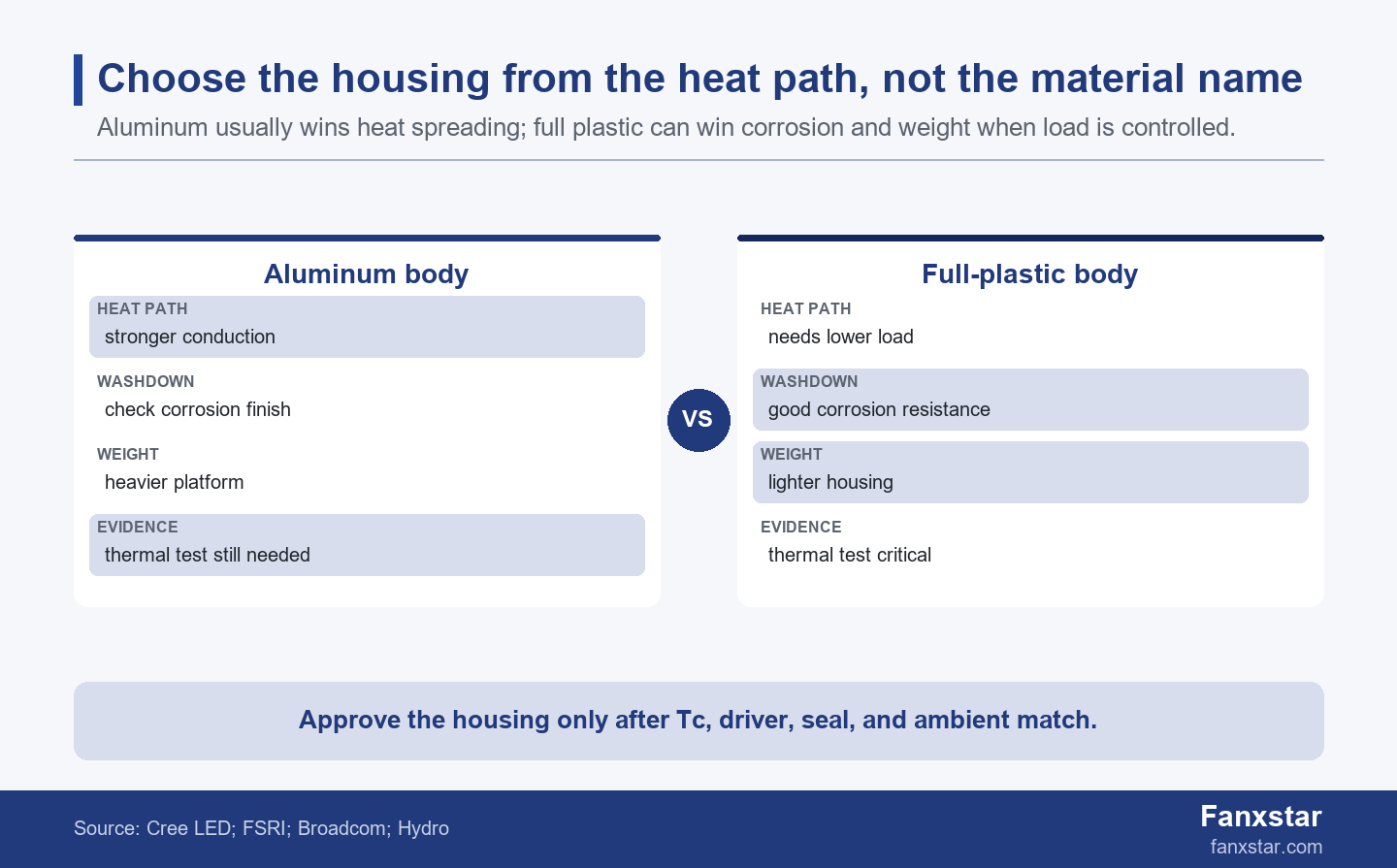
Aluminum is usually the stronger heat-spreading choice, but a tri-proof light is approved by the complete thermal path, not by the housing material name alone. A buyer should not ask whether aluminum or full plastic is better in isolation. The correct question is whether the LED board, driver, housing, seal, ambient temperature, cleaning exposure, and maintenance plan create a thermal path that can be proven before shipment.
According to Cree LED thermal management guidance, aluminum thermal conductivity is listed at 120 to 240 W/m K, while acrylic is listed at 0.2 W/m K. According to FSRI polycarbonate material data, measured polycarbonate thermal conductivity is around 0.163 W/m-K at 15 C for one unconditioned sample. Those numbers explain why material choice matters, but they still do not replace fixture-level thermal testing.
Key Takeaways
- Aluminum usually gives a stronger heat-spreading path for higher-output tri-proof lights.
- Full-plastic housings can work when load, driver heat, ambient temperature, and service conditions are controlled.
- The buyer should approve the complete thermal path, not only the shell material.
- Fanxstar buyers should request Tc, driver case temperature, LED board temperature, seal condition, and washdown exposure before locking an ODM platform.
Why Aluminum Usually Wins the Heat-Spreading Argument
Thermal conductivity creates the first bias
According to Broadcom LED thermal management guidance, aluminum has good thermal conductivity above 200 W/mK. That is why aluminum appears so often in LED heat sinks, metal-core boards, and fixture bodies. It can spread heat away from the LED board and driver zone more effectively than ordinary plastic when geometry and interfaces are well designed.
According to Mitsubishi Engineering-Plastics polycarbonate data, polycarbonate thermal conductivity is listed at 0.19 W/(m K), and the document says this is very small compared with metals. A full-plastic tri-proof light therefore needs a different design logic. It cannot rely on the housing alone to behave like an aluminum heat spreader.
The heat path includes more than the outer shell
According to Cree PCB thermal guidance, drawing heat away from the LED junction is one of the most critical LED design parameters, and high junction temperature adversely affects output and lifetime. For a buyer, this means the shell material is only one layer. Heat must move from LED junction to solder point, PCB, housing, air, and surrounding environment.
A strong aluminum shell can still perform poorly if the LED board does not contact the heat path, if the driver is trapped in a sealed hot pocket, if the thermal pad is weak, or if dust and ambient heat reduce convection. Conversely, a full-plastic fixture can be acceptable at lower wattage when the LED board, driver, housing volume, and ambient condition are designed together.
Where Full-Plastic Tri-Proof Lights Can Still Make Sense
Corrosion and weight can change the buyer decision
| Decision factor | Aluminum advantage | Full-plastic advantage | Evidence to request |
|---|---|---|---|
| Heat spreading | higher conductivity and heat path | acceptable only at lower load | Tc, driver case, ambient test |
| Washdown corrosion | depends on alloy and finish | strong corrosion resistance | salt, detergent, gasket evidence |
| Weight and handling | heavier but robust | lighter and easier to handle | mounting and clip test |
| ODM flexibility | machining and extrusion options | molding and insulation options | tooling and certification boundary |
According to RTP guidance on thermally conductive compounds, thermally conductive thermoplastics can reduce weight and improve corrosion resistance in wet environments. This does not mean ordinary plastic replaces aluminum in every tri-proof fixture. It means a buyer should define washdown, chemical exposure, ceiling load, insulation, and installation handling alongside thermal needs.
Full-plastic tri-proof lights can make sense in lower-wattage corridors, damp areas with corrosion concern, lightweight retrofit projects, or applications where electrical insulation and housing weight matter. The risk is when a supplier copies an aluminum-power platform into a plastic body without reducing load, improving volume, or proving temperature under real operating conditions.
A plastic body needs a stricter operating envelope
A full-plastic fixture should have a written operating envelope: rated power, maximum ambient temperature, mounting condition, driver location, allowed dimming range, cleaning chemistry, and expected duty cycle. If the buyer later increases wattage, changes driver, adds emergency battery, or installs in a hotter ceiling, the old thermal evidence may no longer apply.
According to LED Professional thermal management review, thermal management affects light output, light quality, and lifetime. That is the commercial reason to demand the envelope. Heat is not an abstract engineering issue; it becomes lumen drop, color shift, driver failure, gasket aging, warranty cost, and customer dissatisfaction.
Buyer Tests Before Choosing Aluminum or Full Plastic
Measure fixture temperature, not only material data
A buyer should request a fixture-level temperature test at the intended wattage and ambient condition. The record should include LED board temperature, driver case temperature, outer housing temperature, room temperature, mounting orientation, test duration, and whether the diffuser, clips, gasket, and cable entries are final production parts. Without those details, a temperature value is hard to trust.
According to Hydro heat sink design guidance, thermal performance depends on air or liquid flow, fin or channel design, surface treatment, thermal resistance, joining, materials, thermal interface material, and cost. The same principle applies to tri-proof lights: a good material cannot rescue a weak geometry, and a clever geometry still needs evidence.
Test after sealing and after cleaning exposure
Tri-proof lights are sealed products, so an open-bench thermal test can be misleading. The buyer should test the final sealed housing, final diffuser, final gasket compression, final cable gland, and final mounting clips. Washdown or chemical-cleaning exposure can also change plastic, gasket, coating, and screw behavior, so thermal approval and IP approval should not be completely separate conversations.
For food processing, parking, cold storage, or wet industrial sites, ask for a combined file: IP or ingress evidence, cleaning exposure notes, thermal test, driver data, and maintenance access. A full-plastic fixture may be selected for corrosion resistance, but it still needs heat evidence. An aluminum fixture may be selected for heat, but it still needs finish and corrosion evidence.
Where Fanxstar ODM Choices Affect Thermal Risk
Driver, CCT, lens, and emergency function can change heat
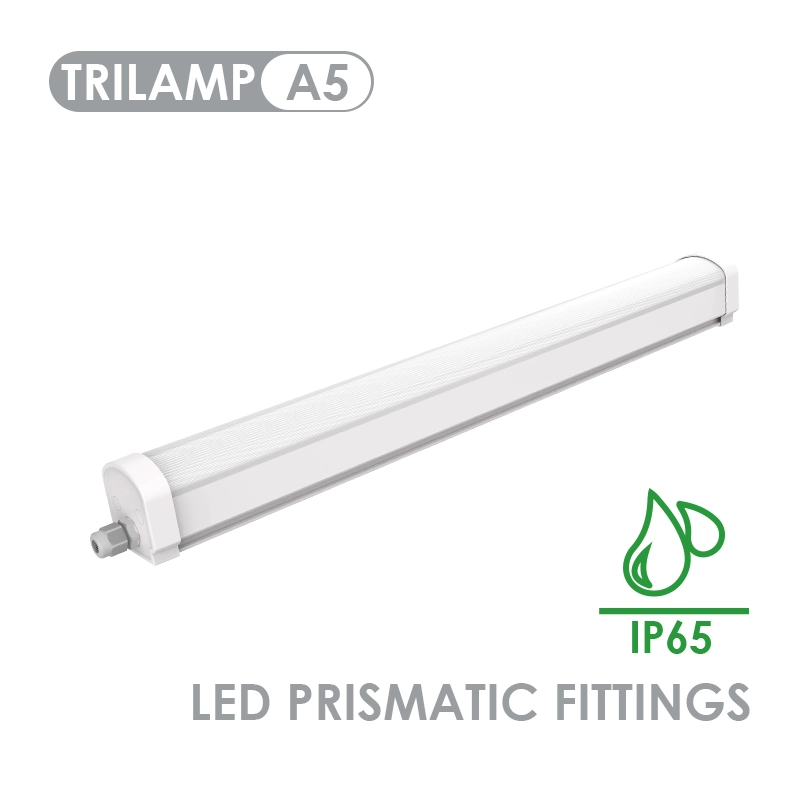
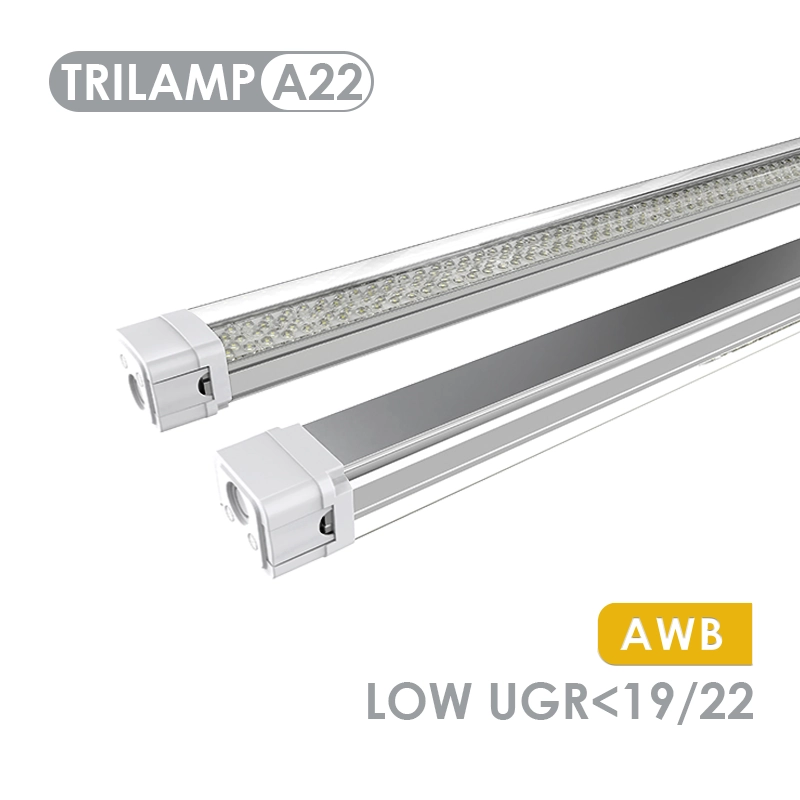
In a Fanxstar vapor tight LED fixture or weatherproof LED lighting platform, thermal risk can change when the buyer asks for a different driver, higher wattage, sensor, emergency battery, cable exit, diffuser, CCT mix, or housing material. A product that passed as a stock aluminum fixture may need review when it becomes a private-label plastic fixture.
Pair this topic with Fanxstar’s custom LED lighting design options when the project changes optics, wiring, housing, sensor, or label requirements. The useful request is not ‘make it cheaper in plastic.’ It is ‘show the temperature, seal, and lifetime boundary for this exact changed fixture.’
Use platform selection before price negotiation
Price discussions should come after platform selection. Aluminum may cost more but reduce thermal risk at higher output. Full plastic may reduce corrosion or weight concerns but require lower load, better driver selection, or a larger housing volume. The buyer should not compare quotes until both suppliers are quoting the same thermal and environmental requirement.
Send Fanxstar the wattage target, ambient temperature, mounting condition, cleaning exposure, IP requirement, certification market, expected lifetime, and sample test goal through Fanxstar customization. The supplier can then recommend whether aluminum, full plastic, or a hybrid platform is the safer starting point.
Illustrative Thermal-Risk Scenario
A small temperature margin can become a warranty problem
Use a scenario estimate rather than a universal rule. Suppose a sealed tri-proof fixture is approved at a comfortable board and driver temperature during a 25 C room test, then installed in a 40 C service corridor with limited airflow and longer operating hours. The housing material is not the only changed variable; ambient temperature, convection, driver pocket, dust, gasket compression, and duty cycle all move at the same time. A few degrees of lost margin can become the difference between a stable fixture and an early warranty conversation.
This is why buyers should avoid accepting a material comparison without an operating-condition line. A plastic body may pass in a mild corridor and fail in a hot ceiling. An aluminum body may protect heat but still fail corrosion or clip retention in aggressive washdown. The useful comparison asks which failure mode is more expensive to correct after installation: thermal stress, corrosion, weight, service access, or certificate rework.
The sample should test the intended compromise
If a buyer chooses full plastic to reduce corrosion risk, the sample should intentionally test thermal load, cleaning exposure, mounting, and opening task together. If the buyer chooses aluminum to protect heat margin, the sample should intentionally test finish, fasteners, cable entry, gasket behavior, and handling weight. The sample is not a showroom proof; it is a focused stress check of the compromise the buyer is about to make.
For Fanxstar ODM projects, the release file should state the chosen compromise in plain language. For example: full plastic selected for corrosive washdown at lower wattage, with thermal test required at final driver and diffuser. Or: aluminum selected for higher-output corridor lighting, with coating and gasket evidence required before shipment. That sentence keeps later substitutions from quietly changing the risk profile.
Final Selection Rule for Buyers
Use aluminum when heat margin is the dominant risk
Choose aluminum when output is higher, ambient temperature is elevated, installation is enclosed, driver heat is significant, or the project needs a stronger heat-spreading margin. Still request fixture-level temperature data because aluminum alone does not prove the LED junction and driver are protected. The buyer should also verify whether the aluminum body actually touches the thermal path instead of acting only as an outer cover.
For high-bay-adjacent industrial corridors, long operating hours, emergency functions, or hotter ceilings, the safer default is usually an aluminum or hybrid thermal path. The buyer should then focus on corrosion finish, gasket design, cable entry, and maintenance access. If the site has chemical cleaning or coastal air, the aluminum decision should include coating and fastener evidence before price approval.
Use full plastic only when the operating boundary is proven
Choose full plastic when corrosion resistance, lighter weight, insulation, or cost matters and the product operates within a proven thermal envelope. The buyer should ask for temperature evidence at final wattage, final driver, final diffuser, and final seal. If the supplier cannot provide that evidence, the material saving may be hiding a lifetime risk. The safer plastic quote is the one that names its wattage and ambient boundary clearly.
The decision should end with a release file: final housing material, LED board, driver, diffuser, gasket, thermal test, IP evidence, cleaning boundary, and substitution rule. That file matters more than the slogan aluminum versus plastic. It also gives procurement a clear reason to reject a later substitution that changes housing material without repeating the thermal proof.
FAQ
Are aluminum tri-proof lights always better?
Aluminum tri-proof lights are not always better, but they usually provide stronger heat spreading for higher-output fixtures. The buyer still needs fixture-level thermal evidence because aluminum can fail if the LED board, driver, thermal interface, seal, or airflow is weak. Corrosive cleaning or poor coating can also make a metal body the wrong trade-off.
Can full-plastic tri-proof lights handle industrial use?
Full-plastic tri-proof lights can handle industrial use when wattage, ambient temperature, driver heat, cleaning exposure, and operating hours stay inside a proven envelope. They are often attractive for corrosion resistance or lighter weight. Buyers should request temperature, IP, gasket, and cleaning evidence before approval, especially when replacing an aluminum platform.
What thermal data should buyers request?
Buyers should request LED board temperature, driver case temperature, housing temperature, ambient temperature, mounting orientation, test duration, final diffuser and gasket status, and operating wattage. The test should use final production parts because an open sample can hide heat buildup in a sealed tri-proof fixture. A useful report also states whether the product was tested after cleaning or ingress exposure.
When should Fanxstar review housing material choice?
Fanxstar should review housing material choice when a buyer changes wattage, driver, sensor, emergency function, diffuser, housing material, or installation environment. Send ambient temperature, cleaning exposure, IP target, certification market, and expected operating hours before the sample is locked. That lets the team compare aluminum, full plastic, or hybrid routes before the quote becomes fixed.