A corroded stainless steel clip is rarely the first failure mode that crosses an engineer’s mind when specifying a weatherproof LED fixture. Yet in coastal, food processing, and chemical environments, it is exactly what compromises the IP rating, voids the warranty, and puts maintenance crews on ladders ahead of schedule. The choice between 304 and 316 stainless steel for mounting clips, fasteners, and hardware on LED fixtures is a decision with a well-defined engineering logic — and a surprisingly large total cost of ownership gap when you get it wrong.
Key Takeaways
- The difference between 304 and 316 stainless steel is molybdenum: 316 contains 2–3% molybdenum, which stabilizes the protective oxide layer against chloride-induced pitting — the failure mode that kills stainless fasteners in coastal, marine, food processing, and chemical environments.
- For installations within 5 miles (8 km) of a coastline, 316 is not an upgrade — it is the minimum viable specification for clips and fasteners on outdoor IP65+ LED fixtures.
- Galvanic corrosion between stainless steel fasteners and aluminum housings is a separate failure mode that requires isolation (EPDM or nylon washers), regardless of whether 304 or 316 is used.
- The 20–30% price premium for 316 vs. 304 fasteners is recovered in maintenance cost savings within the first service interval in high-chloride environments — especially for elevated fixtures where labor costs for access dominate.
The Metallurgy in One Paragraph
Why 304 Fails in Salt Environments
Both 304 and 316 stainless steel are austenitic alloys that resist corrosion by forming a passive chromium oxide layer on their surface. This layer self-repairs when scratched in the presence of oxygen — which is why stainless steel generally outperforms carbon steel in most environments. The failure mechanism is pitting corrosion, triggered by chloride ions. Chloride ions attack the passive layer faster than it can rebuild, creating microscopic pits that deepen autocatalytically — the pit’s interior becomes progressively more acidic, accelerating further corrosion. At this stage, the fastener appears intact on the surface while being undermined structurally.
316 stainless steel addresses this failure mode directly. Its 2–3% molybdenum content creates molybdate ions that stabilize the chromium oxide passive layer even in the presence of chlorides. The layer stays intact and continues repairing itself. 304 lacks this defense. As one specialist analysis noted, once chlorides break down 304’s passive layer, the metal cannot rebuild it fast enough and structural failure follows. For outdoor LED fixtures subject to salt spray or chloride-bearing wash-down chemicals, this is not a theoretical distinction — it is the practical difference between a 2-year failure and a 10-year service life.
Pitting Resistance Equivalent Number (PREN)
For procurement engineers who need a numerical comparison: 304 stainless typically carries a Pitting Resistance Equivalent Number (PREN) of around 18, while 316L stainless reaches a PREN of 24 or higher. The PREN formula weights chromium, molybdenum, and nitrogen content to predict chloride resistance — a PREN above 24 is widely used as the minimum threshold for environments with elevated chloride concentrations, such as chemical processing facilities and coastal installations. This number provides an objective basis for upgrade decisions in project specifications.
Environment-Based Decision Framework
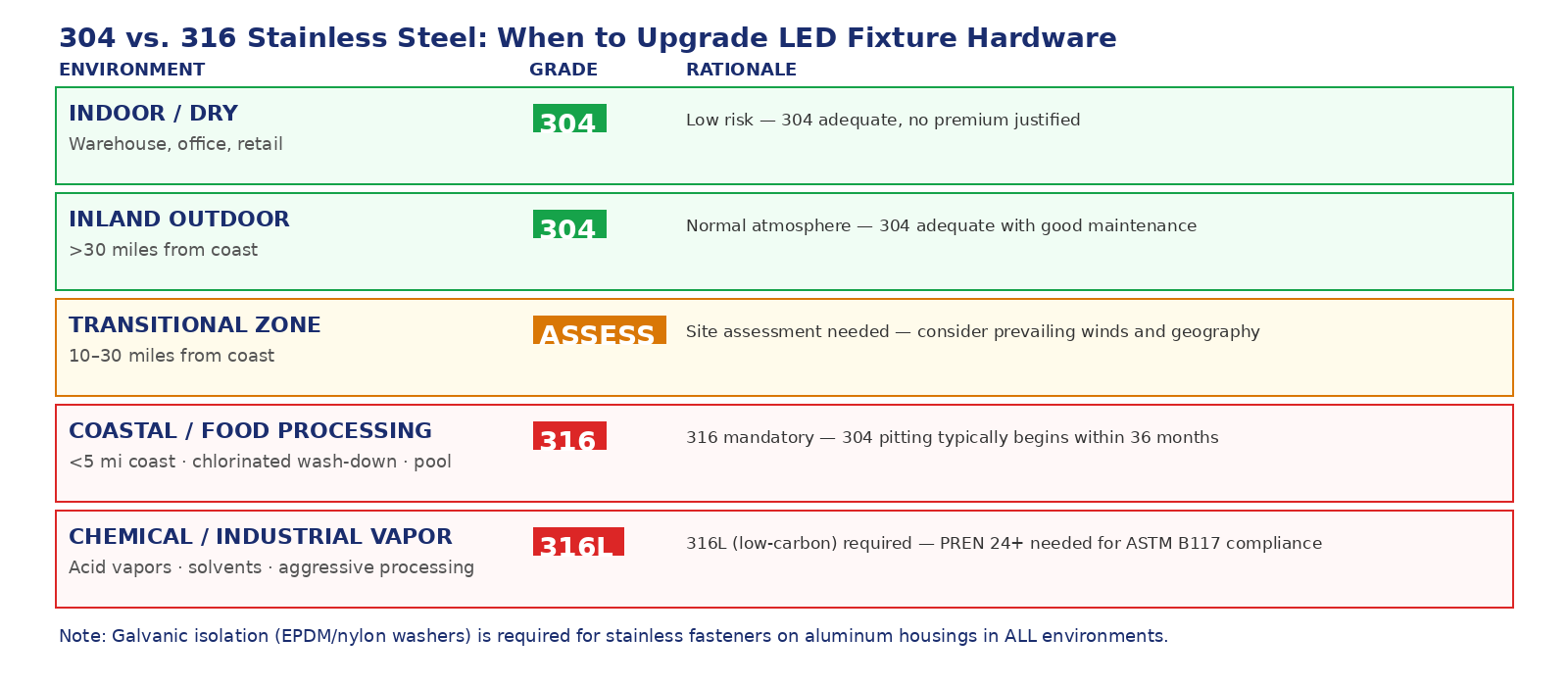
| Installation Environment | Chloride Exposure | Recommended Grade | Rationale |
|---|---|---|---|
| Indoor warehouse / office | None / negligible | 304 | Low exposure; 316 cost premium not justified |
| Inland outdoor (>30 miles from coast) | Low — rain/humidity | 304 | Standard atmospheric conditions; 304 adequate |
| Outdoor, 10–30 miles from coast | Moderate (wind-borne) | 304 or 316 — site assessment required | Depends on prevailing winds and local geography |
| Outdoor, within 5 miles of coastline | High — continuous salt spray | 316 mandatory | 304 develops pitting within ~36 months; warranty void risk |
| Food processing / cold chain wash-down | High — chlorine-based cleaning agents | 316 mandatory | Bleach and food-grade sanitizers aggressively attack 304 |
| Swimming pool / aquatics facilities | High — chlorinated water vapor | 316 mandatory | Chlorine vapor attacks 304 identically to salt spray |
| Chemical processing / industrial vapor | Very high — acid/solvent vapor | 316L (low carbon) or higher alloy | PREN 24+ required; 316L avoids carbide precipitation at welds |
| De-iced road or bridge infrastructure | High seasonal — road salt spray | 316 | Winter de-icing creates chloride environment comparable to coastal |
The Galvanic Corrosion Problem: A Separate Failure Mode
Why Stainless Steel on Aluminum Creates Its Own Risk
Most weatherproof LED fixture housings are aluminum — chosen for thermal management and weight. Stainless steel clips and fasteners on aluminum housings create a galvanic pair where, in the presence of an electrolyte (moisture, salt water), the less noble metal becomes an anode and corrodes preferentially. Aluminum is significantly less noble than stainless steel. In a wet environment, the aluminum around the fastener holes corrodes, eventually causing the screw to “pull through” the housing and compromising the IP seal.
Critically, this failure mode is separate from and additional to the 304-vs-316 chloride pitting question. A 316 fastener on an aluminum housing without isolation will still cause galvanic attack on the aluminum — the grade upgrade only solves the pitting problem on the fastener itself. The solution for galvanic corrosion at the fastener-housing interface is isolation: EPDM (Ethylene Propylene Diene Monomer) or nylon washers placed between the fastener and the aluminum housing break the electrical path between the two metals, preventing the galvanic cell from forming.
For Fanxstar’s IP66 weatherproof fixtures deployed in coastal Europe and Australia — where aluminum housings, stainless hardware, and salt-laden air are all present — the standard specification combines 316 stainless clips with EPDM isolation washers. This addresses both failure modes simultaneously and is part of the engineering brief we walk through with OEM and distribution partners. Explore our full range of weatherproof LED fixtures to see how these specifications are applied in practice.
The “All Stainless” Label Problem
A practical procurement challenge: 304 and 316 are visually identical. The same finish, the same shine, the same surface characteristics. Without a material certificate (mill test report) or physical testing (X-ray fluorescence analysis can distinguish the grades in seconds), there is no way to tell them apart by inspection. This is why project specifications must state the grade explicitly — “stainless steel” is not a specification. Demanding a material certificate (ASTM A276, EN 10088, or equivalent) that confirms the molybdenum content of the fastener batch is the only reliable method of verifying the specification has been met. For certified LED fixtures requiring ENEC or CE documentation, this material traceability chain extends to all metallic components, not just the optical and electrical parts.
The TCO Calculation: Why 316 Is Cheaper in Harsh Environments
The Maintenance Math Over 10 Years
The upfront cost premium for 316 vs. 304 stainless fasteners varies by form factor and market, but typically falls in the 20–30% range for equivalent fasteners and clips. For a weatherproof LED fixture using four M6 stainless clips, this premium translates to a per-fixture material cost difference of a few cents to a few dollars — negligible against the fixture’s total cost.
The meaningful cost comparison is in maintenance. Analysis of coastal terminal facilities managing elevated fixtures (requiring scissor lifts and OSHA-compliant safety protocols) shows that 304 hardware failures require service interventions approximately every four months in high-chloride environments, generating annual maintenance costs roughly three times higher than equivalent 316 installations — where service intervals extend to around 14 months. When the specialized labor cost for elevated access work is factored in, the economic case for 316 in coastal or chemical environments becomes overwhelming within the first service cycle, regardless of the upfront cost difference. For Fanxstar’s European distribution partners managing installations in coastal Spain, Portugal, or the Netherlands delta region, this maintenance calculus is a standard part of project cost justification conversations with end-client facility managers.
When Certifications Create a Hard Requirement
ENEC, CE, and IP-Rated Fixture Certification
When certifying LED fixtures for IP65 or IP66 under EN 60598 (the EU standard for luminaires), the notified body may examine the corrosion resistance of mounting hardware as part of environmental protection verification — particularly for outdoor luminaires. While the standard does not mandate 316 by name, the test body can require evidence that all exposed metallic components, including fasteners, are rated for the installation’s environmental classification. For Zone 1 coastal or Zone 2 food-processing environments in EU projects, specifying 316 stainless clips removes the risk of a certification query and provides the engineering documentation trail that facility auditors and insurance inspectors require.
For fixtures submitted to Fanxstar’s OEM certification support process — where our engineering team manages CE, ENEC, and SAA certification for custom-developed products — we include hardware material specification review as a standard step in Stage 2 of the OEM process (prototype review). Partners developing weatherproof products for coastal or food-process markets should flag this early in the project brief. Review our OEM customization process for how this fits into the full development timeline, or contact our engineering team directly to discuss hardware specifications for your project.
Practical Specification Checklist for LED Fixture Hardware
When specifying stainless steel clips and fasteners for weatherproof or industrial LED fixtures, the following checklist covers the key engineering decisions:
First, establish the chloride exposure classification for the installation site (distance from coast, presence of cleaning chemicals, de-icing exposure, or industrial vapors). Use this to select 304 for low-exposure inland installations and 316 or 316L for any moderate-to-high exposure environment. Second, specify the grade explicitly in the BOM — “stainless steel” is not sufficient. Reference ASTM A276 or EN 10088 with grade designation and require mill test report confirmation. Third, assess galvanic pairing: if stainless fasteners will contact aluminum housing, specify EPDM or nylon isolation washers as standard hardware. Fourth, for elevated or difficult-access fixtures (high bays, parking structures, building facades), apply 316 as default regardless of location classification, since the labor cost of early maintenance makes the upfront premium trivial. Fifth, for chemical or food-processing environments, evaluate whether 316L (low-carbon grade) is appropriate to avoid carbide precipitation at welded or heat-affected zones. Finally, confirm that fastener size and thread specification are compatible with the fixture’s thermal management design — over-torquing stainless clips on aluminum housings can cause thread stripping that creates both a structural failure and an IP sealing failure simultaneously.
Frequently Asked Questions
Is 316 stainless steel always better than 304 for LED fixture clips?
Not always — it depends entirely on the installation environment. In dry indoor settings with no chemical exposure, 304 provides adequate corrosion resistance at a lower cost, and 316 offers no practical benefit that justifies the premium. The upgrade to 316 is justified — and in many cases required — where chlorides are present: coastal outdoor installations, food processing or cold chain facilities using chlorinated sanitizers, aquatic facilities, and chemical or industrial processing environments. The decision criterion is not “is 316 better overall?” but “what is the chloride exposure level of the specific installation?”
Can you mix 304 and 316 fasteners in the same fixture?
Technically possible but not recommended for high-exposure environments. Where one fastener fails, the others typically follow within a similar timeframe once the corrosion environment exceeds 304’s threshold. Mixing grades also introduces tracking complexity in material documentation for certification purposes. For fixtures targeting a consistent warranty period, a single-grade specification throughout is the cleaner engineering and documentation approach.
What causes stainless steel fasteners to rust on aluminum fixtures?
There are two distinct mechanisms. First, the stainless fastener itself can develop pitting corrosion if it is 304 grade in a high-chloride environment (the primary reason to specify 316). Second, and separately, the aluminum housing around the stainless fastener can corrode via galvanic attack — caused by the electrochemical potential difference between stainless steel and aluminum when an electrolyte (moisture) is present. The second mechanism is addressed by isolation washers, not by upgrading from 304 to 316. Both mechanisms can occur simultaneously in coastal environments, so both solutions should be applied together.
Does IP66 rating mean the fixture hardware is corrosion-resistant?
No — and this is a critically important distinction. The IP (Ingress Protection) rating under IEC 60529 certifies protection against ingress of water and solid particles. It says nothing about corrosion resistance of external components. An IP66-rated fixture can have 304 stainless clips that corrode and fail in a coastal environment — the IP rating is unaffected because the water ingress test and the salt corrosion environment are different test standards. For true coastal durability, specify both the IP rating and the hardware corrosion specification (316 stainless + EPDM isolation), and ideally request an ASTM B117 salt spray test result from the fixture manufacturer. Fanxstar’s weatherproof LED fixture range is engineered with both dimensions of protection addressed as standard.