When a B2B buyer sources LED fixtures, the chip specification rarely appears on the purchase order — but it determines almost everything that matters: lumen maintenance over time, color consistency across a large production run, CRI accuracy in food retail environments, and how confidently a manufacturer can justify a 7-year warranty. Three chip brands come up in nearly every commercial and industrial sourcing conversation: Samsung, Epistar (now part of Ennostar), and Sanan.
They represent three distinct supply chain positions. Samsung is a premium Korean semiconductor company with a global brand that adds perceived quality value to the finished fixture. Epistar is a Taiwanese chip specialist with deep MOVPE epitaxy expertise and a vast product catalog covering the full spectrum. Sanan is China’s largest LED chip manufacturer by volume, with cost competitiveness and domestic supply chain integration that no other brand can match. Understanding what each actually delivers — and where each brand’s reputation may be inflated or understated — is the practical goal of this guide.
Key Takeaways
- Samsung LM301B/H sets the efficacy benchmark for mid-power white LEDs in commercial general lighting, with tight color binning, anti-sulfurization coating, and a global supply network — making it the specification of choice for premium-branded fixtures targeting European and North American markets.
- Epistar (now Ennostar) offers the broadest product catalog in the industry, covering 2835, 3030, 5050, COB, and specialty spectrum packages; reliable for general commercial applications with extensive certifications and strong mid-tier pricing. Note: Epistar formally merged into Ennostar Corporation in October 2025.
- Sanan is China’s largest LED chip producer by volume and holds performance parity with Epistar for standard general lighting applications — routinely substituted in Chinese domestic manufacturing without quality compromise. Its scale enables lowest landed cost for high-volume OEM production.
Understanding the LED Chip Supply Chain
Where Chips Fit in the Fixture
An LED fixture’s bill of materials has three critical components: the chip (the semiconductor light source), the driver (which regulates power), and the optical and thermal system (housing, optics, heatsink). The chip determines the fixture’s raw efficacy, color quality, and long-term lumen maintenance. A poorly specified chip will cause a fixture to fall short of its rated lumens within two to three years — a liability claim waiting to happen for any OEM manufacturer selling into markets with 5- or 7-year warranty commitments.
The chip market operates on a tiered model. Tier 1 brands (Samsung, Osram, Nichia, Cree/Wolfspeed) invest heavily in wafer epitaxy R&D, own their manufacturing processes end-to-end, and publish detailed reliability data. Tier 2 brands (Epistar/Ennostar, Lumileds, Bridgelux) are strong commercial suppliers with good factory infrastructure and broad certification coverage. Tier 3 is where naming complexity begins: many Chinese manufacturers relabel Sanan or Epistar wafer material under different brand names, creating the market noise that makes chip verification essential for any serious procurement conversation.
The “Epistar or Sanan” Confusion in Chinese Manufacturing
A known practice in Chinese LED manufacturing is for factories to claim Epistar chip sourcing when the actual chips are from Sanan. This is not necessarily deceptive in terms of performance outcome — industry sources confirm that Sanan chip quality is equivalent to Epistar for standard general lighting applications at commercial drive currents. Sanan is China’s dominant domestic chip supplier, with approximately 40,000 employees and a production scale that far exceeds any other Chinese chip maker. The substitution happens because Epistar carries stronger brand recognition among international buyers unfamiliar with Sanan, even though Sanan’s technical performance for 2835, 3030, and 5050 packages is comparable. For a B2B buyer specifying a Chinese-manufactured fixture, the practical takeaway is: asking for a chip brand declaration in the OEM agreement is necessary, and “Epistar or equivalent” is a reasonable specification that captures both.
Samsung: The Efficacy and Binning Benchmark
LM301B and LM301H — The Commercial Lighting Flagship
Samsung’s mid-power 3030 package LED — produced in the LM301B (general lighting) and LM301H (horticulture-optimized, anti-sulfurization) variants — became the industry reference point for white LED efficacy in commercial fixtures. The LM301B delivers approximately 220 lm/W under laboratory conditions, representing a step change from the 160–180 lm/W that characterized the previous generation of commercial chip packages. The flip-chip design eliminates the gold wire bond used in traditional LED construction: electrodes are positioned on the underside of the chip rather than on top, removing a light obstruction and improving thermal transfer directly to the PCB. The result is lower junction temperature at a given drive current, which translates to better lumen maintenance over the fixture’s operating life.
The LM301H adds anti-sulfurization treatment to the standard LM301B specification — a practical requirement for any commercial or industrial environment where airborne sulfur compounds are present. Cold storage facilities, food processing plants, agricultural buildings, and coastal industrial locations all expose LED chips to sulfur at concentrations that cause silver contact corrosion in unprotected chips, producing the characteristic dark spots and lumen loss that create early warranty claims. For Fanxstar’s weatherproof fixture range — including tri-proof lights deployed in food processing and coastal environments — the anti-sulfurization coating in the LM301H is a specification that directly reduces warranty exposure.
Color Binning and the Practical Value for OEM Production
Samsung’s SDCM (Standard Deviation of Color Matching) binning system for the LM301 series specifies 3-step MacAdam ellipse binning as standard, meaning color variation across chips from the same production bin is imperceptible to the human eye at normal viewing distances. For a manufacturer producing 2,000 units of a commercial panel light or linear tri-proof, tight color binning means that the fixture color appearance will be consistent across the entire production run — no visible warm/cool variation across an installed ceiling. This consistency is difficult to achieve with less tightly binned chips and is one of the reasons Samsung’s premium pricing is justified for commercial applications where uniformity is a quality standard.
Samsung LM301H EVO — Latest Generation
The LM301H EVO represents Samsung’s most recent advancement in the 3030 mid-power package, shifting the blue pump wavelength from the standard 450 nm to 435 nm. While this is primarily a horticulture optimization (aligning better with chlorophyll absorption curves), the EVO’s reported efficacy of up to 3.14 μmol/J under test conditions also signals continued process improvement in the underlying chip architecture. For commercial general lighting fixtures, the primary relevance of the EVO is as a signal of Samsung’s continued investment in the 3030 platform — confirming that the LM301 family will remain a supported, current product architecture rather than a legacy holdover.
Epistar (Ennostar): Taiwan’s Broadest Product Catalog
Company Evolution: From Epistar to Ennostar
Epistar Corporation, established in 1996 in Hsinchu, Taiwan, was for many years the world’s largest LED chip manufacturer by product breadth. The company applied proprietary MOVPE (Metal Organic Vapor Phase Epitaxy) technology to produce high-brightness LEDs covering the full visible and near-UV spectrum. In 2020, Epistar and fellow Taiwanese LED maker Lextar merged into the Ennostar holding structure, and in October 2025, Epistar formally merged fully into Ennostar Corporation. For B2B buyers, the practical implication is that Epistar product lines continue under Ennostar branding — but any procurement agreement specifying “Epistar” chips should now reference Ennostar as the parent entity.
Epistar’s competitive advantage is catalog breadth. Where Samsung optimizes a focused set of mid-power commercial packages to industry-leading efficacy levels, Epistar covers 2835, 3030, 5050, 3535, COB formats, high-voltage LED strings, and specialty spectrum chips including UV and deep-red phosphor variants. This makes Epistar (Ennostar) the natural chip supplier for manufacturers who need a single-vendor relationship that spans multiple product lines — panel lights, downlights, tri-proof battens, and specialty grow lights — without maintaining relationships with multiple chip suppliers.
Performance Profile for Commercial Applications
Epistar’s commercial mid-power chips perform strongly in standard general lighting applications. The company’s warm-white efficacy has reached 170 lm/W in laboratory conditions using high-voltage LED technology with optimized phosphor conversion. In production volumes, Epistar chips in the 2835 and 3030 packages typically deliver 150–170 lm/W at commercial drive currents — competitive with Samsung’s standard LM301B specification at mid-tier pricing. Color rendering up to CRI 95 Ra is achievable across the Epistar catalog, covering the requirements for retail food display, hospitality, and medical lighting applications where color accuracy matters as much as efficacy.
For OEM manufacturers targeting European markets, Epistar’s certification coverage is well-established. The company has invested in LM-80 lumen maintenance testing across its primary product lines, providing the 6,000-hour and 10,000-hour data needed for ENERGY STAR compliance and DLC qualification — both of which are required for North American commercial projects. This LM-80 data availability distinguishes Epistar from many smaller chip suppliers who cannot provide independent long-term lumen maintenance validation.
Sanan: China’s Volume Leader
Scale and Strategic Position
San’an Optoelectronics, headquartered in Xiamen, China, was established in 2000 and has grown to become the largest LED chip manufacturer in China by production volume — operating multiple facilities with approximately 40,000 employees and holding over 3,600 patents. The company received China’s National Science Progress Award first prize for its work on high-efficiency semiconductor lighting technologies, and it operates a national postdoctoral research workstation, indicating genuine R&D depth rather than pure volume manufacturing. Sanan was also validated by Samsung’s supply chain audit for microLED applications — a technically demanding qualification that speaks to the company’s process maturity beyond standard LED chip production.
Sanan’s market positioning is built on three pillars: cost competitiveness from domestic supply chain integration, sufficient technical performance for standard commercial applications, and the scale to guarantee supply continuity for high-volume OEM production. China’s LED industry is Sanan’s primary market, and it is difficult to overstate how dominant the brand is in that context: the majority of Chinese-manufactured LED lighting fixtures, across all price tiers, use Sanan chips — often without this being disclosed in product marketing. This market reality means that when evaluating fixtures from Chinese manufacturers, Sanan chips are the statistical baseline, not the exception.
Technical Performance for Commercial Lighting
For standard commercial lighting applications — tri-proof battens, warehouse high bays, linear battens, panel lights — Sanan chips perform at parity with Epistar chips in independent quality assessments. The key parameters for commercial applications are lumen output per watt at operating current, color maintenance over 50,000 hours, and forward voltage consistency across production lots. Sanan’s 2835 and 3030 packages achieve 130–150 lm/W at 1W drive in standard commercial configurations, with CRI options up to Ra95 available. The company produces chips in the same standard package formats (2835, 3030, 5050, 5730) as Epistar, making them interchangeable for most commercial applications at the PCB design level.
Where Sanan is less competitive than Samsung is in premium applications requiring the tightest color binning, maximum efficacy, or specific reliability certifications valued in EU/NA markets. A 270 lm/W aquaculture grow light — like Fanxstar’s specialty grow light range — warrants Samsung chip specification because the application demands both peak efficacy and spectrum precision that Sanan’s standard commercial catalog does not match. But for a standard 60W tri-proof batten in a warehouse application, the efficacy difference between a Sanan 3030 chip and an LM301B is commercially negligible, while the cost difference is meaningful at high volumes.
Side-by-Side Comparison
| Parameter | Samsung (LM301B/H) | Epistar / Ennostar | Sanan |
|---|---|---|---|
| HQ / Origin | South Korea | Taiwan (now Ennostar) | Xiamen, China |
| Peak Efficacy (lab) | ~220 lm/W (LM301B) | ~170 lm/W (warm white) | 130–150 lm/W (typical) |
| Color Binning | 3-step MacAdam (SDCM) | 5-step SDCM (standard) | Standard commercial bins |
| Anti-sulfurization | Yes (LM301H) | Available on select models | Standard versions only |
| CRI Range | CRI 70 / 80 / 90 | CRI 70 / 80 / 90 / 95 | CRI 70 / 80 / 90 / 95 |
| Package Formats | 3030 (LM301), CSP, COB | 2835, 3030, 5050, 3535, COB, UV | 2835, 3030, 5050, 5730, COB |
| LM-80 Data Available | Yes | Yes | Available for key products |
| Market Tier | Premium (global brand signal) | Mid-premium (volume capability) | Cost-competitive (high volume) |
| Scale / Volume | Global — limited chip-only sales | Taiwan — broad catalog | China #1 by volume — 40,000 employees |
Application-Based Selection Guide
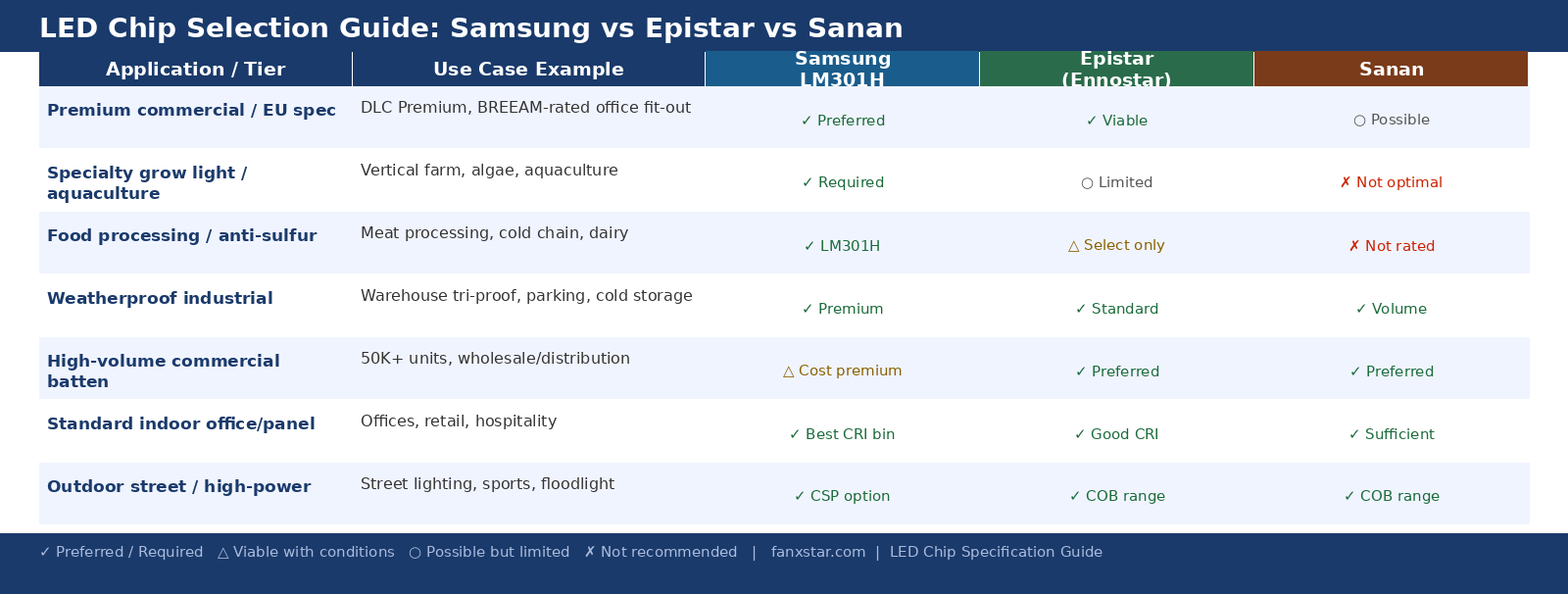
Premium Commercial: Samsung Is the Specification Signal
For fixtures entering retail purchasing programs, DLC Premium listings, ENERGY STAR compliance programs, or premium branded product lines targeting European building projects, Samsung chip specification is the lowest-risk path. The LM301B’s 220 lm/W lab benchmark justifies high-efficacy claims. The 3-step MacAdam binning guarantees color uniformity in production runs. The anti-sulfurization LM301H covers food processing, coastal, and agricultural environments. And the Samsung brand name itself functions as a quality signal to B2B buyers who evaluate chip specification as a proxy for overall product quality — an important commercial reality in competitive distributor negotiations.
For Fanxstar’s specialty grow lights targeting aquaculture and vertical farming applications — where efficacy up to 270 lm/W is claimed and spectrum precision is a key differentiator — Samsung chip specification is the technically defensible choice that supports those performance claims in product documentation. The LM301H’s horticulture-specific binning and EVO variant’s spectral optimization are purpose-built for these applications in a way that Epistar and Sanan standard commercial catalogs do not replicate.
Volume Commercial: Epistar and Sanan Deliver Quality at Scale
For standard commercial and industrial applications — warehouse tri-proof battens, parking garage vapor tight fixtures, office linear lights, general-purpose high bays — Epistar and Sanan chips deliver technically sufficient performance at materially lower cost per chip than Samsung. For a manufacturer producing 50,000 units of a 40W tri-proof for a wholesale distribution customer, the chip cost difference between Samsung LM301B and an equivalent Epistar or Sanan 3030 package can represent a meaningful per-unit BOM saving without measurable performance compromise at the 50,000-lux, 50,000-hour specification that wholesale distribution customers actually test to.
Epistar’s advantage over Sanan in European market positioning is primarily documentary: Epistar’s longer international trading history means more distributors and specifiers are familiar with the brand, and its LM-80 data availability across the catalog is more comprehensive. For products targeting EU/UK certification programs or DLC listings, having Epistar chip LM-80 data on file simplifies the photometric report process versus establishing Sanan data for the first time with a certification body.
Fanxstar’s Chip Selection Framework
In practice, professional LED fixture manufacturers like Fanxstar select chips by application rather than brand loyalty. The framework is straightforward: Samsung LM301H for specialty, high-efficacy, and premium-branded product lines where chip specification is a selling point; Epistar for mid-tier product lines requiring documented LM-80 data and broad market recognition; Sanan for high-volume standard commercial SKUs where cost per lumen at scale is the governing constraint. All three chip options can produce fixtures that legitimately meet commercial specifications — the selection criteria are market positioning, documentation requirements, and volume economics, not fundamental technical inferiority of lower-tier options.
If you are developing a new fixture line and need to specify chip selection as part of OEM product development, Fanxstar’s engineering team works through chip selection, driver matching, thermal design, and certification planning as an integrated product development process — rather than treating the chip as an afterthought. The right chip selection made at the design stage is worth significantly more than the wrong chip at a lower price point.
What to Verify When a Manufacturer Claims Premium Chips
The “top secret” of the LED chip market — as industry sources note — is that chip brand claims are frequently unverified and sometimes inaccurate. A manufacturer claiming Samsung chips may be using a Samsung-derived package that is not the current-generation LM301 platform. A manufacturer claiming Epistar may be using Sanan material (which, as noted, is not necessarily a performance problem but is a transparency problem). For serious B2B procurement, the following verification steps are standard practice.
First, request the chip model number — not just the brand. “Samsung” is insufficient; “Samsung LM301H” is the specification. “Epistar 2835 CRI80 130 lm/W” is a specification. Second, request the chip datasheet and confirm the rated efficacy at the specified drive current matches the fixture’s claimed system efficacy after thermal derating. A fixture claiming 200 lm/W with Samsung chips should have a plausible thermal path that keeps junction temperature low enough to maintain near-chip-spec output. Third, for products entering DLC or ENERGY STAR programs, the photometric testing data from an accredited laboratory will verify actual lumen output and color performance independently of chip brand claims. Fourth, for high-value OEM programs, requesting a material declaration or conducting incoming inspection against a chip sample reference board are standard quality assurance measures that professional manufacturers — including Fanxstar — support as part of the OEM quality process.
Frequently Asked Questions
Is Sanan chip quality actually inferior to Epistar for commercial lighting?
No — for standard commercial lighting applications (general illumination, tri-proof fixtures, high bays, panel lights), Sanan chip quality is at parity with Epistar. Both companies produce chips meeting the performance parameters that commercial lighting buyers specify: rated efficacy at drive current, CRI range, CCT options, package format, and 50,000-hour lifespan. The industry practice of claiming Epistar when using Sanan persists because of brand perception rather than technical reality. A B2B buyer who specifies either brand in an OEM agreement and receives the other is unlikely to find measurable performance difference in standard commercial applications.
Why does Samsung LM301 cost significantly more than Epistar or Sanan equivalent packages?
Samsung’s pricing premium reflects three real differences: tighter color binning (3-step MacAdam versus the 5-step standard for most Epistar commercial packages), a higher raw efficacy number (220 lm/W versus 150–170 lm/W for comparable Epistar mid-power commercial packages), and the commercial value of the Samsung brand as a quality signal in finished product marketing. The efficacy difference means more light per watt at the fixture level, which supports genuine energy performance claims — but whether that increment justifies the cost premium depends on the product’s market position and whether the buyer is paying for performance or for a brand name on the spec sheet.
Epistar merged into Ennostar — does this change anything for buyers currently specifying Epistar chips?
For practical purposes, existing Epistar product lines continue under Ennostar management with the same product catalog, manufacturing facilities, and supply chain. The merger formalized in October 2025 consolidated Epistar and Lextar operations under one entity. Buyers should update procurement agreements and technical documentation to reference Ennostar rather than Epistar as the legal entity, and should confirm with their supplier that the specific chip model numbers they rely on continue to be manufactured under the Ennostar umbrella. For Fanxstar’s OEM customers using Epistar-sourced fixtures, the transition does not require product re-certification as the chip manufacturing process itself has not changed.
For a weatherproof LED fixture targeting food processing environments, which chip is best?
The Samsung LM301H is the strongest specification for food processing environments due to its anti-sulfurization coating, which protects the silver chip contacts from the sulfur compounds present in protein-rich food manufacturing atmospheres. Standard chip packages — including standard Epistar and Sanan 2835 and 3030 products without anti-sulfurization treatment — are vulnerable to contact corrosion in these environments, causing premature lumen loss and the darkening spots that trigger warranty claims. IP66 minimum (IP69K for high-pressure steam cleaning) housing, combined with Samsung LM301H chip specification, constitutes the defensible engineering answer for food processing LED fixtures. Fanxstar’s weatherproof fixture range is engineered with these environment-specific requirements built in — chip selection, housing material, and IP rating specified together rather than independently. Contact us to discuss the right specification for your food processing facility project.