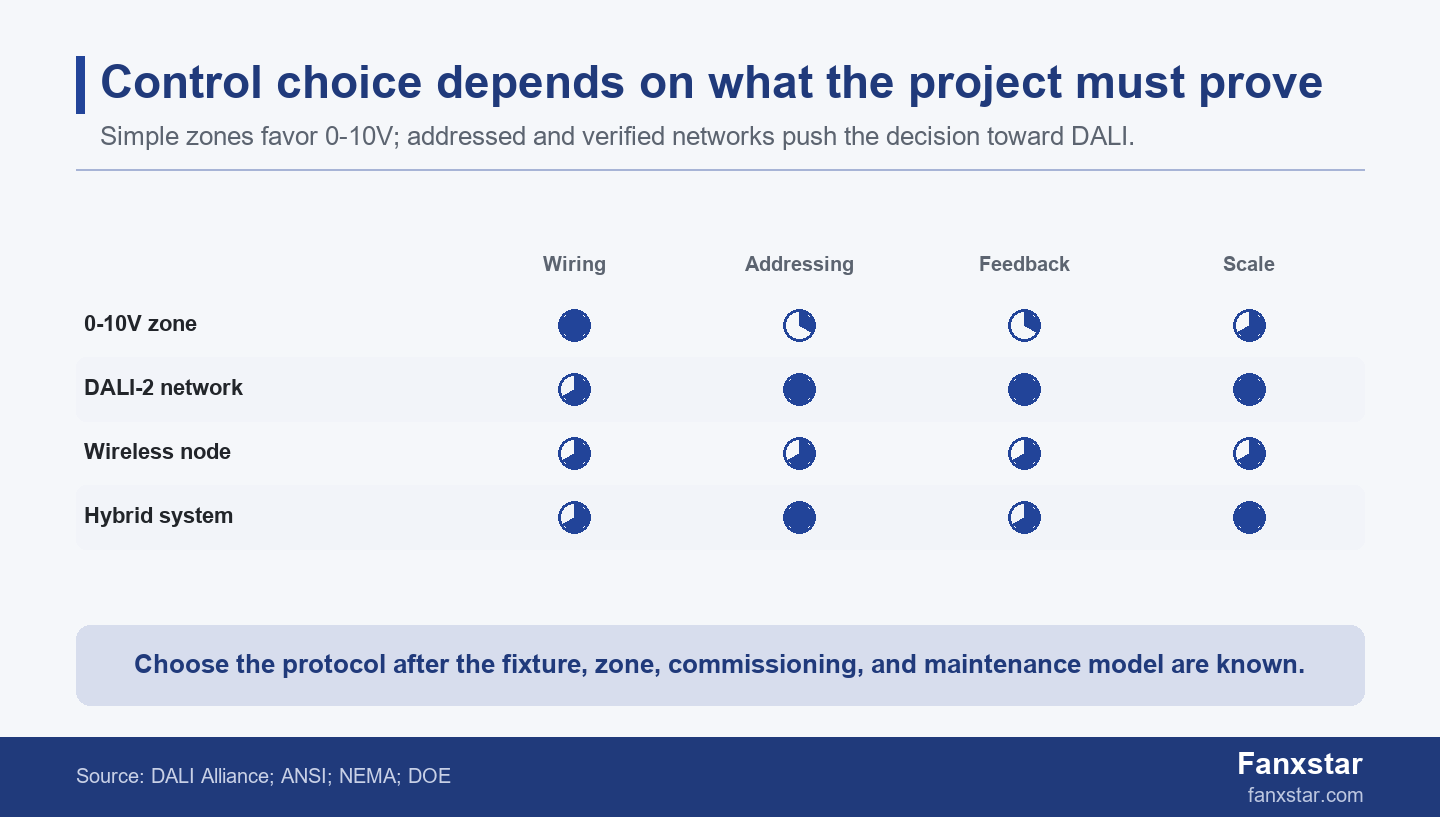
0-10V and DALI are not simply old versus new dimming choices; they solve different control problems around wiring, addressing, feedback, commissioning, scale, and maintenance ownership. A small zone with simple wall controls can be a good 0-10V project, while a site that needs addressing, scenes, feedback, and future reconfiguration may justify DALI or a hybrid architecture.
According to NEMA ANSI C137.1 scope material, ANSI C137.1 specifies a 0-10V analog interface between dimmable drivers or ballasts and controls. According to DALI Alliance IEC 62386 information, IEC 62386 is the international standard for DALI technology and separates multiple device parts. The standards point to the real difference: one is an analog interface; the other is an addressed digital control language.
The buying question is therefore not which dimming method is modern. The buying question is how much control intelligence the project actually needs, who will commission it, and whether the final LED fixture, driver, sensor, and wiring package has been tested as one system.
Key Takeaways
- 0-10V dimming is often practical for simple zones where analog control, predictable wiring, and low commissioning complexity are the main goals.
- DALI is stronger when the project needs addressed devices, scenes, status information, grouping changes, or more disciplined network commissioning.
- The protocol does not guarantee good dimming by itself; driver quality, fixture design, wiring, controls, and sample testing still decide field behavior.
- Industrial and specialty lighting projects may use a hybrid path when simple local zones and central network control both exist in the same facility.
- Fanxstar dimming projects should define the fixture-driver-control combination before sample release, especially when sensors, emergency packs, waterproof housings, or custom wiring are involved.
The Real Difference Is Analog Level Versus Addressed Digital Control
0-10V sends a level; DALI communicates with devices
According to NEMA ANSI C137.1 scope material, 0-10V dimming is an analog interface between controls and dimmable drivers or ballasts, which keeps the first decision at the interface level rather than the whole system level. In practical buyer terms, 0-10V uses a low-voltage control signal to tell compatible drivers what dimming level to follow. It is familiar, widely supported, and often economical for straightforward zones.
DALI works differently. It is a digital communication system where devices can be addressed, grouped, and commanded with more information than a simple analog level. That extra capability can be powerful, but it also creates commissioning responsibility. A DALI project can fail commercially if no one owns addressing, documentation, future changes, and maintenance training.
According to DALI-2 comparison material, DALI-2 adds certification and improved interoperability compared with DALI version-1, giving buyers 2 reasons to ask which DALI generation the quote uses. That matters because complex control networks depend on predictable behavior across devices. The buyer should still check whether the exact driver, sensor, gateway, and luminaire package has been validated together.
The interface is not the whole system
According to NEMA lighting controls category guidance, lighting controls can include dimmers, occupancy sensors, photosensors, timers, and related devices, creating at least 5 control vocabulary groups. That definition keeps the buyer from treating the dimming protocol as the entire design. A project still needs zoning, daylight logic, occupancy behavior, manual override, emergency exceptions, and commissioning.
| Decision factor | 0-10V strength | DALI strength | Buyer question |
|---|---|---|---|
| Control concept | Simple analog dimming level | Addressed digital communication | Does the project need zones or individual addresses? |
| Wiring and commissioning | Often easier for simple zones | Needs bus design and commissioning discipline | Who owns setup and future changes? |
| Feedback and diagnostics | Limited by interface and system design | Better suited to status and device-level information | Does maintenance need feedback? |
| Scale | Good for small or clear zones | Stronger for complex networks | Will the space be reconfigured later? |
| Interoperability | Depends on drivers and controls matching behavior | DALI-2 improves certification and interoperability | Can the supplier prove final compatibility? |
Based on this comparison, 0-10V is usually easier to justify when the project has fixed zones, modest control needs, and limited maintenance demands. DALI becomes more compelling when the buyer needs individual addresses, group changes, scenes, monitoring, or better documentation of what each device is doing.
The worst decision is a protocol chosen by habit. A contractor may prefer 0-10V because it is familiar. A consultant may prefer DALI because it is more capable. Neither preference is enough until the project states what must be controlled, measured, commissioned, and maintained.
Where 0-10V Is Still the Practical Choice
Simple zones reward simple control
0-10V often fits warehouses, backrooms, utility corridors, parking levels, simple offices, and industrial areas where each zone has a stable lighting role. If a group of fixtures should dim together and the maintenance team does not need device-level status, a clear 0-10V design can be more practical than a networked system that nobody wants to commission.
According to DOE research on 0-10V LED streetlight dimming, 0-10V LED behavior can depend on interactions among luminaires and controls, a 2023 finding that makes sample testing more important than interface labels. The lesson is broader than streetlights: analog dimming should be tested with the actual driver, control device, cable length, load count, and fixture configuration expected in the project.
The most important 0-10V questions are low-end stability, minimum dim level, off-state behavior, flicker, control-wire routing, polarity, driver compatibility, and how the system reacts when a sensor or manual override is added. A buyer should not accept the phrase 0-10V dimmable without a driver data sheet and a sample test.
The hidden risk is inconsistent low-end behavior
Many complaints appear at the bottom of the dimming range. The fixture may not dim as low as expected, may step instead of fade, may flicker, may glow when it should be off, or may behave differently across driver batches. These issues can be more expensive to solve after installation than before sample approval.
Illustrative calculation: assume a site has 500 fixtures and the selected control strategy forces each fixture to stay 10 W higher than the intended low-end level for 10 hours per day. The avoidable load is 500 x 10 W x 10 hours, or 50 kWh per day. Over 300 operating days, that becomes 15,000 kWh before any demand or maintenance effects. The calculation is not a universal savings claim; it shows why low-end behavior deserves a sample test.
The sample test should include the final driver, final control device, intended number of fixtures per zone, realistic cable run if possible, sensor or daylight input if used, and the minimum dim setting the buyer expects. If the quote cannot identify the driver and control interface, the dimming claim is not ready for release.
Where DALI Becomes the Better Fit
Addressing and feedback justify the added structure
DALI becomes attractive when the lighting system needs individual or group addresses, scene recall, reconfiguration, status information, and a cleaner handover file. In data halls, large warehouses, commercial campuses, service corridors, and specialty facilities, those features can reduce future change friction if the project has a commissioning owner.
The commissioning owner is the key phrase. DALI value depends on setup discipline: device addressing, grouping, documentation, gateway logic, user access, and maintenance training. If the system is installed but not documented, future maintenance teams may lose the very benefits the buyer paid for.
According to GSA LED lighting and controls guidance, LED and controls guidance should consider life-cycle cost and energy efficiency, so the 2024 project decision cannot stop at first hardware price. For DALI buyers, that means the cost comparison should include commissioning, handover documentation, troubleshooting capability, and the value of future reconfiguration.
DALI is not automatically safer for every project
A digital protocol does not fix a weak lighting design. If fixture optics are wrong, drivers are poorly matched, cable routing is careless, or the owner will never use scenes and status feedback, DALI can become unnecessary complexity. A small fixed zone may be better served by a clean 0-10V design with tested drivers and clear wiring.
According to DesignLights Consortium control strategy guidance, occupancy, daylight harvesting, scheduling, dimming, and high-end trim are 5 separate strategies that can be combined in different ways. The control strategy should be chosen from the project need, not from a protocol ranking.
The practical rule is simple: choose DALI when the project needs device-level control or information enough to justify commissioning. Choose 0-10V when simple zones, tested driver behavior, and easier installation are more important. Use a hybrid design when different areas of the facility have genuinely different control needs.
How Fanxstar Buyers Should Specify Dimming
Connect protocol choice to the final fixture version
Fanxstar dimming discussions should start with the fixture family and application. Useful starting points include LED linear lighting platforms, motion sensor LED lighting, LED lighting controls for industrial facilities, AI data center LED lighting solutions, and Fanxstar custom LED lighting ODM service. The final decision should identify the driver, control input, sensor option, emergency module if any, and wiring boundary.
For sealed weatherproof fixtures, dimming and control changes can affect enclosure space, cable entry, service access, and IP evidence. For linear fixtures, dimming may affect driver selection, heat, low-end behavior, flicker perception, and installation wiring. For data center or warehouse projects, controls may also intersect with heat load, maintenance access, and zone documentation.
| RFQ field | Why it matters | Evidence to request |
|---|---|---|
| Driver dimming interface | The fixture cannot follow a control protocol it does not support | Driver data sheet and fixture BOM |
| Zone or address map | Separates analog zones from digital device control | Floor plan with control groups or addresses |
| Minimum dim level | Low-end behavior drives user satisfaction | Sample dimming test and flicker check |
| Emergency or sensor option | Modules can change wiring and control logic | Final wiring diagram and compatibility note |
| Commissioning owner | DALI value depends on setup discipline | Commissioning checklist or handover file |
| Maintenance goal | Defines whether feedback and diagnostics matter | Fault response and replacement workflow |
The table turns a protocol request into a testable RFQ. Instead of asking for DALI or 0-10V in isolation, the buyer asks for the fixture-driver-control evidence needed to approve a sample.
Approve the sample as a fixture-control system
A good sample approval should include dimming curve observation, low-end behavior, flicker check, off-state behavior, driver label, wiring diagram, sensor or emergency interaction, and the intended control device or network. If a future production batch substitutes the driver or sensor, the buyer should treat that as a product-version change, not a small purchasing detail.
According to International Trade Administration import documentation guidance, common import files can include invoices, bills of lading, packing lists, insurance proof, and certificates of origin, giving dimmable fixture buyers at least 5 records to keep aligned with the shipped product. For dimmable LED fixtures, the quote, driver data, wiring diagram, installation instructions, and sample test should all describe the same control version.
If the project requires custom CCT, optics, sensors, housing, or wiring along with dimming, use custom LED lighting design options and Fanxstar custom LED lighting ODM service to define the evidence packet before sample tooling or production release.
FAQ
Is DALI better than 0-10V dimming?
DALI is better when the project needs addressed devices, group changes, scene control, feedback, and documented commissioning. 0-10V can be better for simple fixed zones where analog dimming, easier wiring, and lower commissioning complexity matter more. The better choice depends on project scale, maintenance goals, and fixture-control compatibility.
Can 0-10V and DALI be used in the same facility?
Yes, a hybrid facility can use 0-10V in simple zones and DALI in areas that need addressing or feedback. The buyer should document where each protocol applies, how gateways or controllers are separated, and who maintains each system. Mixing protocols without a zone map can make troubleshooting harder.
What should buyers test before approving dimmable LED fixtures?
Buyers should test low-end dimming, flicker, off-state behavior, driver compatibility, control response, sensor interaction, emergency module behavior if used, and the exact wiring method. The sample should use the final fixture, driver, control device, and control protocol so production does not drift from the approved behavior.
Does DALI require special commissioning?
DALI usually requires more commissioning discipline than a simple 0-10V zone because devices may need addressing, grouping, scene setup, gateway configuration, and handover documentation. That extra work can be worthwhile in complex sites, but it should be planned and budgeted instead of discovered after installation.