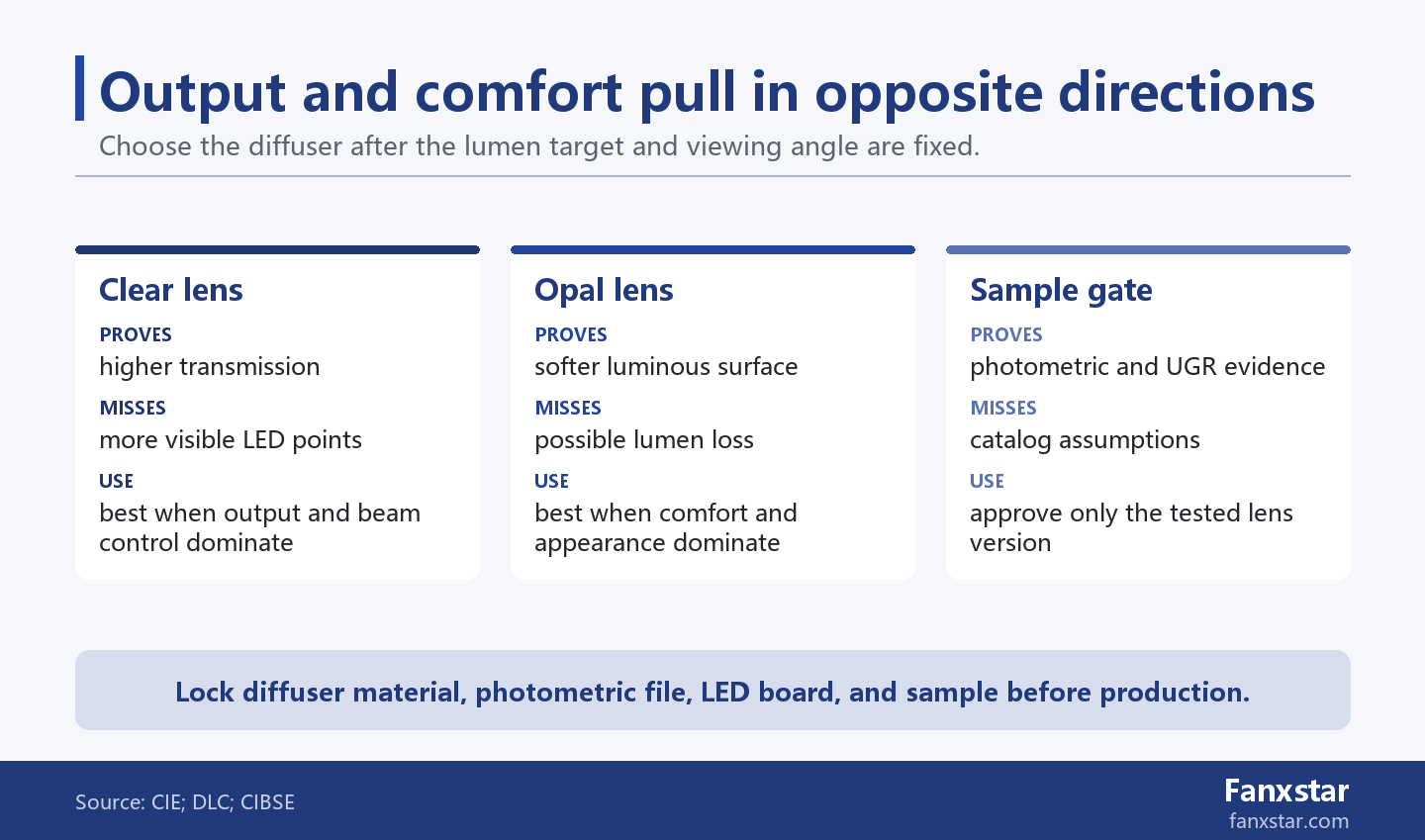
Opal and clear diffusers solve different lighting problems. Clear diffusers can preserve output, beam definition, and efficiency, but they can expose LED points and increase perceived glare. Opal diffusers soften the source and improve visual comfort, but they usually trade away some transmission and beam precision. The right choice depends on the ceiling height, viewing angle, task, fixture spacing, lumen target, cleaning exposure, and what evidence the buyer can get before approval.
For B2B LED fixture buyers, the important question is not which diffuser is better in general. It is whether the selected lens gives the required maintained illuminance while keeping glare, appearance, material durability, and service risk under control in the real site.
Key Takeaways
- Clear diffusers usually protect lumen output and beam control; opal diffusers usually protect comfort and source diffusion.
- The trade-off should be checked with photometric files, sample viewing, UGR or glare evidence where relevant, and maintained illuminance calculations.
- Diffuser material, cleaning chemicals, UV exposure, impact, and heat can be as important as optical transmission.
- ODM buyers should lock the diffuser, LED board, optic, CCT, CRI, housing, and test file together before mass production.
What changes when a diffuser changes
The diffuser is part of the optical system
A diffuser is not a cosmetic cover. It changes transmission, luminous distribution, pixel visibility, beam edge, glare, cleaning behavior, and sometimes thermal conditions around the LED board. A clear diffuser may let more light through and preserve a defined distribution. An opal diffuser scatters light, blends LED points, and makes the fixture look softer, but the same scattering can reduce delivered lumens or change where the light lands.
CIBSE Journal discusses LED luminaire diffuser demands from the perspective of technical material and optical selection. That framing is useful because the choice is not only opal versus clear. The buyer also has to consider material grade, thickness, surface texture, UV stability, impact resistance, flame behavior, cleaning method, and how the diffuser integrates with the housing and gasket.
Luminit describes light-shaping diffusers as optical components that homogenize light, reduce glare, and eliminate hot spots. For lighting procurement, this means catalog terms such as opal, frosted, prismatic, clear, and microstructured should be translated into performance evidence. The buyer needs the actual photometric file, not only a photo of the lens.
Clear is not automatically brighter in the useful sense
A clear lens often transmits more raw light, but useful brightness depends on distribution and task. If the clear lens creates hotspots, visible LED dots, or high-angle glare, occupants may perceive the lighting as harsh even when the lux meter reads well. In low ceilings or shopper-facing spaces, visual comfort can matter more than a small lumen gain.
Opal is not automatically better either. In a high-bay warehouse, parking garage, tunnel, or industrial aisle, too much diffusion can waste light outside the task or require more fixture watts to meet the same maintained illuminance. The buyer should define whether the project is limited by energy, glare, beam control, visual appearance, cleanability, or product display quality.
Glare control and UGR evidence
UGR is a discomfort-glare model, not a universal pass
CIE describes discomfort glare research for non-uniform luminaires and notes the challenge created by high luminance contrasts in modern LED sources. This is directly relevant to clear diffusers because exposed LED points can create small bright regions that feel more uncomfortable than the average illuminance suggests.
DLC explains UGR as a calculation used to estimate discomfort glare with a practical range that can help buyers compare interior luminaires. A UGR value is useful only when the calculation matches the room, mounting height, surface reflectance, viewing direction, and fixture layout. A generic UGR claim on a datasheet should not replace a project-specific review.
DLC V5.1 technical requirements include UGR-related premium criteria for some products. Buyers can use that as a reminder that glare is becoming a formal evidence topic, not only a subjective complaint. Even when a project does not require DLC, a buyer can still ask for photometric data, luminance, and sample viewing before choosing a clear or opal version.
Sample viewing catches problems calculations miss
Glare and appearance should be checked with a sample at the intended mounting height and viewing distance. A diffuser that looks fine on a desk can look harsh in a corridor. A lens that looks too soft in a photo can be ideal over a supermarket aisle where customers see the fixture from below. The sample review should include direct view, side view, task view, and any reflective surfaces in the space.
Buyers should also look for color variation, lens seams, dark bands, bright LED points, yellow tint, dust visibility, and edge leakage. These details rarely appear in a simple lumen table, but they influence whether the installed project feels premium or cheap.
Lumen output and energy trade-offs
Transmission loss has to be priced honestly
If an opal diffuser reduces transmission, the buyer may need a higher-output LED board, higher drive current, closer fixture spacing, or more fixtures to meet the same maintained illuminance. That can increase energy, heat, and cost. If a clear diffuser improves transmission but creates discomfort, the buyer may still lose the project through complaints, rework, or dimming that defeats the energy model.
ENERGY STAR explains that LEDs convert energy to light more efficiently than older light sources, but the fixture still has to deliver that light through optics and a diffuser. A high-efficacy LED board behind the wrong lens can produce the wrong commercial result. The buyer should therefore compare luminaire lumens after the diffuser, not LED package lumens before the diffuser. This is especially important when two quotes use the same LED board but different lens materials, because the lower-priced version may quietly lose output or comfort.
The correct comparison uses luminaire-level data for the exact diffuser option. Do not apply one fixture wattage and one lumen package across clear and opal versions unless the supplier proves the photometric file covers both. A diffuser substitution can change efficiency, distribution, and glare. For ODM lighting, it can also change certification or material evidence if the lens material changes.
Maintained illuminance is the decision target
A buyer should not choose the diffuser by initial lumens alone. The better target is maintained illuminance at the task after lumen depreciation, dirt, ambient condition, controls, and spacing are considered. Opal may be preferred where comfort and appearance protect the value of the space. Clear may be preferred where high mounting height, wide spacing, or task intensity makes output and beam control more important.
This is why the diffuser decision should sit beside CCT, CRI, beam angle, mounting height, fixture spacing, and control strategy. If the clear lens produces too much glare, the site may dim the lights. If the opal lens reduces output too much, the buyer may add more watts. Either way, the real cost appears after installation unless the optical decision was tested early.
Application-based choices
Where opal often earns its place
Opal diffusers often fit low ceilings, visible fixtures, retail aisles, backrooms with frequent staff presence, supermarkets, food counters, clean interior zones, service corridors, and applications where people look toward the fixture. The goal is to hide LED points and create a softer luminous surface. In these spaces, comfort and appearance can be part of the commercial return.
For fresh retail and food environments, pair diffuser choice with food processing plant LED lighting requirements, cleaning method, color rendering, and material resistance. A soft fixture that yellows, cracks, traps dirt, or cannot be cleaned safely will not remain premium for long.
Where clear can be the stronger answer
Clear or structured diffusers can be stronger in high ceilings, industrial aisles, parking areas, utility zones, and places where fixture appearance is less important than delivered output and beam control. They can also help when the optic is designed to place light on a vertical surface, rack face, tunnel wall, or circulation route. The buyer should still check direct-view glare and camera/reflection conditions.
For parking, warehouse, and utility applications, compare diffuser choice with parking garage lighting requirements, warehouse and logistics LED lighting, and waterproof LED light platforms. A diffuser that is right for an office can be wrong for a wet industrial corridor, and a diffuser that is right for a high bay can be too harsh for a supermarket.
Evidence to request before approving a diffuser option
Photometric and material proof should match the final lens
Ask for photometric files for the exact diffuser, not only the fixture family. Request lumen output, wattage, beam distribution, UGR or glare evidence where relevant, CCT and CRI, lens material, thickness, impact or IP implications, cleaning compatibility, UV or yellowing statement where relevant, and a sample that uses the production lens.
Cleaning and aging evidence should not be treated as a separate quality topic. In food processing, cold storage, parking, tunnel, coastal, and outdoor-adjacent environments, the diffuser can be exposed to moisture, detergent, dust, oil, temperature swings, or UV. A clear lens that scratches or fogs can lose the output advantage that justified it. An opal lens that yellows, cracks, or traps residue can lose the visual comfort that justified it. Buyers should ask how the selected material behaves in the real maintenance routine, not only how it looks on day one.
If the supplier changes from PC to PMMA, from clear to opal, from smooth to prismatic, or from one thickness to another, the buyer should ask what evidence changes. A lens substitution can affect output, glare, sealing, impact resistance, fire behavior, chemical resistance, and aging. It is not a harmless visual edit.
A good sample review is practical and repeatable
Install or mock up the sample at the planned height. View it from the normal working position, from the approach path, and from any angle where occupants or customers will see the LED source. Compare clear and opal versions under the same CCT and output setting. Take notes on glare, visible LED points, shadows, task contrast, fixture appearance, and whether the lighting feels too sharp or too flat.
For commercial rollout, keep a sample record with photos, model number, diffuser material, driver, LED board, CCT, CRI, wattage, and photometric file. That record protects the buyer when production later offers a substitution. If the lens is part of the visual identity of a retail or supermarket chain, the record is as important as the electrical specification.
Fanxstar application fit
How to brief Fanxstar on diffuser selection
Fanxstar diffuser decisions are relevant for linear lighting platforms, weatherproof LED lighting, waterproof downlights, waterproof LED light platforms, and custom LED lighting ODM service. The buyer should send mounting height, viewing angle, task type, lumen target, CCT, CRI, cleaning exposure, IP/IK requirement, and whether comfort or output is the priority.
Pair this topic with custom LED lighting design options, LED retrofit planning for warehouses and data centers, and LED lighting controls for industrial facilities when the project also involves dimming, sensor standby, or a replacement of older fluorescent fixtures. Fanxstar can then test diffuser, optic, driver, and housing choices together rather than treating the lens as a late accessory.
FAQ
Is an opal diffuser better than a clear diffuser?
Not always. Opal usually improves diffusion and comfort, while clear usually protects output and beam control. The better choice depends on mounting height, viewing angle, task, glare tolerance, lumen target, and material exposure.
Does an opal diffuser reduce lumens?
It often reduces transmission compared with a clear lens, but the exact loss depends on material, thickness, texture, LED layout, and fixture design. Buyers should request luminaire-level photometric data for the exact diffuser option.
When should buyers choose a clear diffuser?
Clear or structured diffusers can be suitable for high ceilings, industrial aisles, parking areas, utility zones, and projects where output and beam control matter more than fixture softness. Glare should still be checked with samples and photometric evidence.
How can buyers check glare before ordering?
Ask for photometric files, UGR or glare evidence where relevant, and a sample viewed at the intended mounting height and angle. Compare clear and opal versions under the same output and CCT conditions.
What should an ODM buyer lock before production?
Lock the diffuser material, lens finish, LED board, driver, CCT, CRI, wattage, housing, gasket, photometric file, and substitution rule. If the lens changes, ask whether output, glare, IP, material, and certification evidence still apply.