Key Takeaways
-
Superior Thermal Performance: 6063 aluminum offers excellent thermal conductivity (~200-218 W/mK), efficiently transferring heat away from sensitive components.
-
Unmatched Extrudability: Its chemical composition allows for the creation of complex, high-surface-area fin designs that maximize cooling efficiency.
-
Cost-Effective Excellence: It provides the ideal balance of performance, manufacturability, and cost, making it superior to copper for most applications.
-
Premium Finish: The alloy’s smooth surface is perfect for anodizing, enhancing durability, corrosion resistance, and thermal emissivity.
6063 aviation aluminum stands out as the preferred heat sink material because it combines high thermal conductivity with excellent mechanical properties. Manufacturers value its superior extrudability, which enables intricate designs for better cooling performance in LED lighting and consumer electronics.
What is 6063 Aluminum and Why Do We Use It?
6063 is a heat-treatable alloy from the 6000 series (Al-Mg-Si). Its utility stems from a well-balanced set of properties that make it the industry standard for thermal management.
Key Properties for Heatsinks
-
Thermal Conductivity: At ~201 W/m·K, it moves heat rapidly.
-
Extrudability: It can be pushed through dies to create complex, thin fins that maximize surface area.
-
Lightweight: With a density of 2.7 g/cm³, it is 3x lighter than copper.
-
Corrosion Resistance: It forms a protective oxide layer, which can be enhanced by anodizing.
6063 vs. 6061 vs. Copper: A Technical Comparison
Why choose 6063 over other common materials? The data speaks for itself.
|
Property |
6063 Aluminum |
6061 Aluminum |
Copper |
|---|---|---|---|
|
Thermal Conductivity |
~201-218 W/m·K |
~155-170 W/m·K |
~398 W/m·K |
|
Extrudability |
Excellent (Complex fins) |
Good (Simpler shapes) |
Poor (Machined/Skived) |
|
Cost |
Low |
Medium |
Very High |
|
Weight |
Light |
Light |
Heavy (3x Al) |
Verdict: While copper conducts heat better, it is heavy and expensive. 6063 wins for most applications by offering sufficient cooling at a fraction of the cost and weight, with superior design flexibility.
The Extrusion Advantage: Maximizing Surface Area
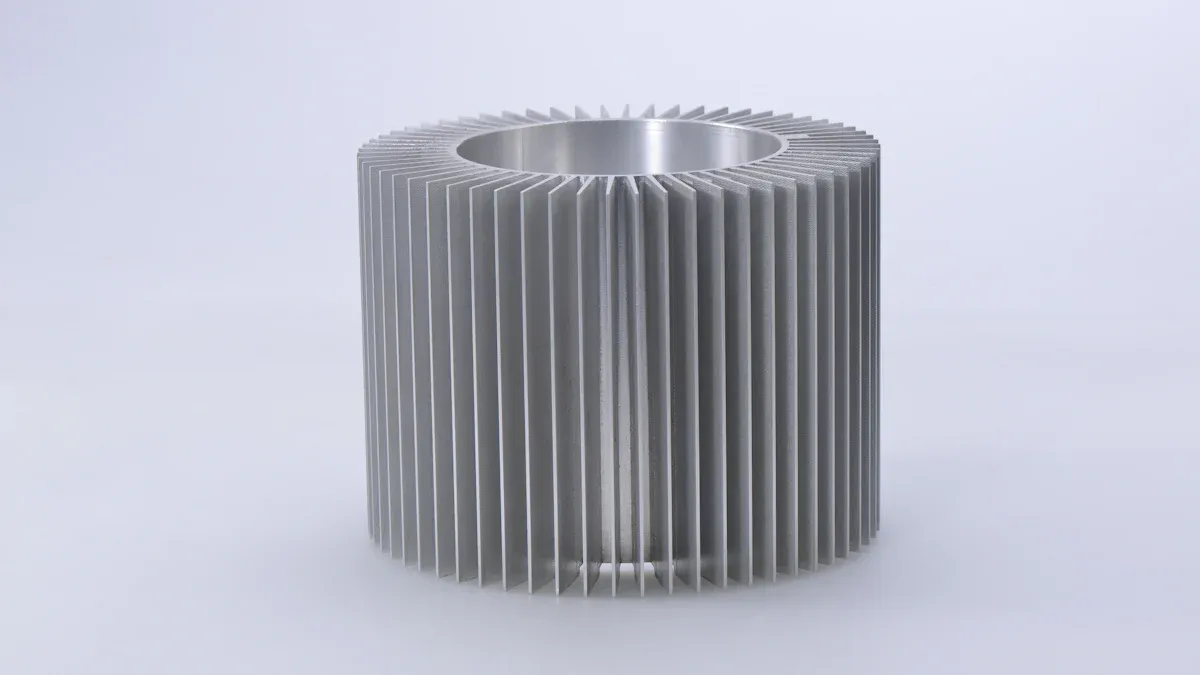
The primary goal of heatsink design is to maximize surface area for convection. 6063’s superior extrudability allows engineers to create:
-
High-Aspect-Ratio Fins: Tall, thin fins packed closely together.
-
Complex Geometries: Integrated mounting channels and screw ports directly in the profile.
Optimizing Your Heatsink Design
To get the most out of 6063 aluminum, consider these design factors:
1. Surface Finish & Anodizing
We highly recommend anodizing for 6063 heatsinks. This electrochemical process creates a hard, corrosion-resistant surface. Crucially, black anodizing can increase thermal emissivity, helping the heatsink radiate heat more effectively.
2. Temper Selection
For most extruded heatsinks, the T5 temper offers the best balance of strength and formability. It ensures the fins are rigid enough to withstand handling but ductile enough to be extruded without cracking.
Real-World Applications
You will find 6063 aluminum heatsinks in critical systems everywhere:
-
LED Lighting: Essential for cooling high-power LED arrays to ensure 50,000+ hour lifespans.
-
Power Electronics: Cooling inverters, motor drives, and EV charging stations.
-
Consumer Electronics: CPU coolers, laptop chassis, and audio amplifiers.
FAQ
Why is 6063 better than 6061 for heatsinks?
6063 has higher thermal conductivity (~201 vs 167 W/mK) and is much easier to extrude into complex, thin-fin shapes that maximize cooling surface area.
Does anodizing improve heatsink performance?
Yes. Anodizing improves corrosion resistance and surface hardness. Black anodizing also significantly improves radiative heat transfer, boosting overall cooling efficiency.
Can 6063 aluminum replace copper heatsinks?
In many cases, yes. By using complex extruded fin designs that are impossible with copper, 6063 can offer comparable cooling performance at a much lower weight and cost.
Is 6063 aluminum suitable for outdoor use?
Absolutely. 6063 has excellent inherent corrosion resistance. When anodized, it becomes extremely durable against rain, humidity, and UV exposure, making it ideal for outdoor LED fixtures.