Aquaculture LED lighting should be specified as a water-system component, not as a brighter version of ordinary grow lighting. The fixture must survive the tank or marine environment, deliver a repeatable spectrum, avoid service disruption, and give the buyer evidence that can be tested before scale. For tanks, hatcheries, marine systems, and algae growth, the winning RFQ names water exposure, corrosion path, spectrum target, mounting method, dimming requirement, and sample pass rule before it asks for price.
Fanxstar is most useful when its aquaculture and specialty grow-light platforms become a fast evidence path for those constraints.
Key Takeaways
- Specify the water boundary: Decide whether the fixture faces splashing, humidity, immersion, salt, cleaning, or cable strain.
- Separate spectrum from survival: A useful spectrum does not solve corrosion, connector, mounting, or service risk.
- Match product family to system type: V10, V40, V80, V9, and VC150 fit different tank, marine, algae, and rack contexts.
- Use a sample pass rule: Ask the first sample to prove one limiting condition before scale or tooling.
- Keep biology claims bounded: Lighting supports aquaculture operations, but species performance needs local production expertise.
Start With Water Boundary Before Spectrum
The first aquaculture lighting question is not how bright the fixture is; it is what water can do to the product.
FAO aquaculture resources, NOAA Fisheries aquaculture, and USDA NIFA aquaculture programs all treat aquaculture as a specialized production system. That matters for lighting buyers because a tank or marine environment is not a dry ceiling with a plant underneath it. The fixture may face humidity, splash, salt, immersion, cleaning cycles, cable strain, and limited service access.
The RFQ should therefore start with the water boundary: dry-zone fixture over tanks, splash-zone linear tube, submerged or near-submerged marine light, algae rack light, or biotech pilot fixture. After that boundary is named, spectrum, dimming, length, output, connector, and mounting can be specified with less guesswork.
Tanks Need Cable Entry And Service Access Proof
Specification note: For aquaculture LED lighting for tanks, marine systems, and algae growth, the point behind “Tanks Need Cable Entry And Service Access Proof” should become a reviewable acceptance line. The RFQ should state the site condition, the product evidence, the sample observation, the approver, and the fallback if Fanxstar recommends a standard platform or ODM change. That keeps aquaculture projects often combine biological response, waterproof construction, corrosion resistance, cleaning access, and electrical safety into one vague grow-light request from being hidden inside a general fixture preference.
A tank project can fail through a tiny detail that is not visible in a catalog photo. Cable direction, strain relief, connector position, driver location, cleaning access, and replacement method all influence whether the product remains manageable. Fanxstar V10 and V40 seawater tube references are useful starting points, but the buyer should still ask for the actual tank geometry and cable route to be reviewed before sample approval.
Marine Systems Need Corrosion And Immersion Boundaries
Specification note: For aquaculture LED lighting for tanks, marine systems, and algae growth, the point behind “Marine Systems Need Corrosion And Immersion Boundaries” should become a reviewable acceptance line. The RFQ should state the site condition, the product evidence, the sample observation, the approver, and the fallback if Fanxstar recommends a standard platform or ODM change. That keeps aquaculture projects often combine biological response, waterproof construction, corrosion resistance, cleaning access, and electrical safety into one vague grow-light request from being hidden inside a general fixture preference.
Marine lighting buyers should avoid using a general waterproof statement as the whole specification. A V80 IP68 marine growth light reference may be appropriate when the project needs a stronger water boundary, but the RFQ still needs operating depth or exposure, salt or freshwater context, mounting method, and maintenance plan. The supplier evidence should make those boundaries visible, not imply a universal marine answer.
Algae Growth Needs Repeatable Spectrum, Not A Mystery Lamp
Specification note: For aquaculture LED lighting for tanks, marine systems, and algae growth, the point behind “Algae Growth Needs Repeatable Spectrum, Not A Mystery Lamp” should become a reviewable acceptance line. The RFQ should state the site condition, the product evidence, the sample observation, the approver, and the fallback if Fanxstar recommends a standard platform or ODM change. That keeps aquaculture projects often combine biological response, waterproof construction, corrosion resistance, cleaning access, and electrical safety into one vague grow-light request from being hidden inside a general fixture preference.
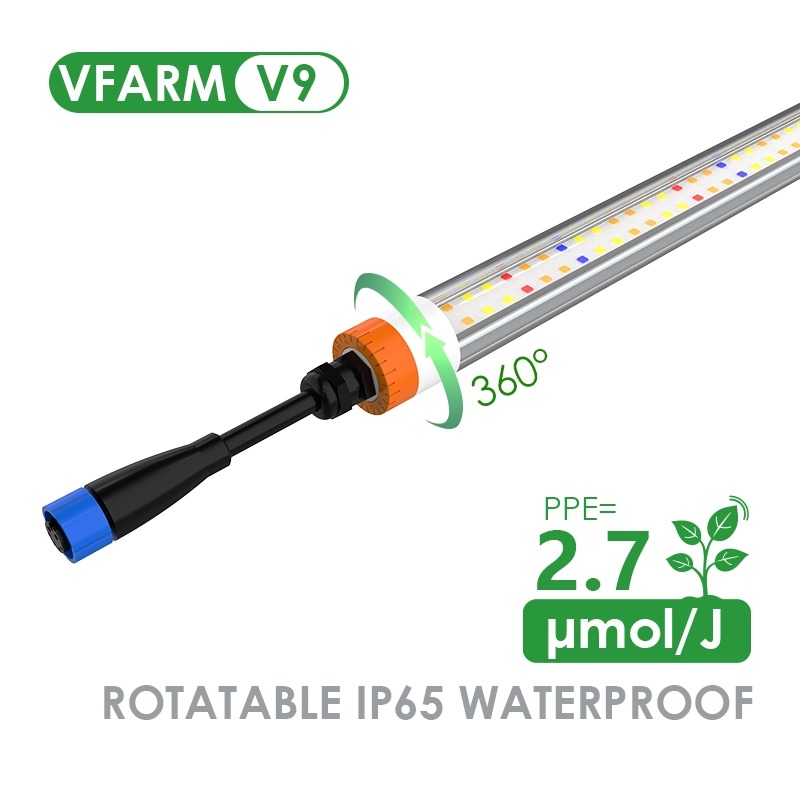
For algae and microalgae work, the lighting question becomes more repeatability-focused. Spectrum target, fixture distance, dimming method, heat effect, culture density, and rack geometry should be written down before the buyer requests a custom change. V9 dimming tubes and VC150 grow-light references can support that conversation when the project needs a controlled light recipe instead of only waterproof construction.
Application Matrix For Tanks, Marine Systems, And Algae
A useful aquaculture RFQ maps system type to the evidence the sample must prove.
| System Type | Main Lighting Constraint | Evidence To Request | Fanxstar Direction |
|---|---|---|---|
| Fish or shrimp tanks | Water boundary, glare, mounting, and service access | IP scope, cable entry, corrosion note, cleaning access, sample mounting | V10, V40, V80 seawater and marine references |
| Marine display or hatchery systems | Corrosion, optics, heat, and livestock disturbance | Material, lens, spectrum target, dimming behavior, install height | V80 or V40 depending immersion and mounting plan |
| Algae or microalgae growth | Spectrum, uniformity, heat, and culture density | Spectrum target, distance, dimming control, rack or tube geometry | V9, VC150, V10, or V40 platform review |
| Research or biotech pilot | Repeatability, sample records, and quick iteration | Control logic, sample pass rule, change log, batch comparison | Platform-based ODM sample before tooling |
The matrix changes the buying sequence. Instead of asking for an aquaculture light in general, the buyer asks which system the light must survive, which spectrum or control variable must be repeatable, and which product family is closest to the proof task. That makes Fanxstar platform-based ODM faster because the first sample has a specific job.
Scenario Estimate: Cable Entry Can Become Service Time
The smallest untested mechanical detail can become the largest avoidable work item during pilot setup.
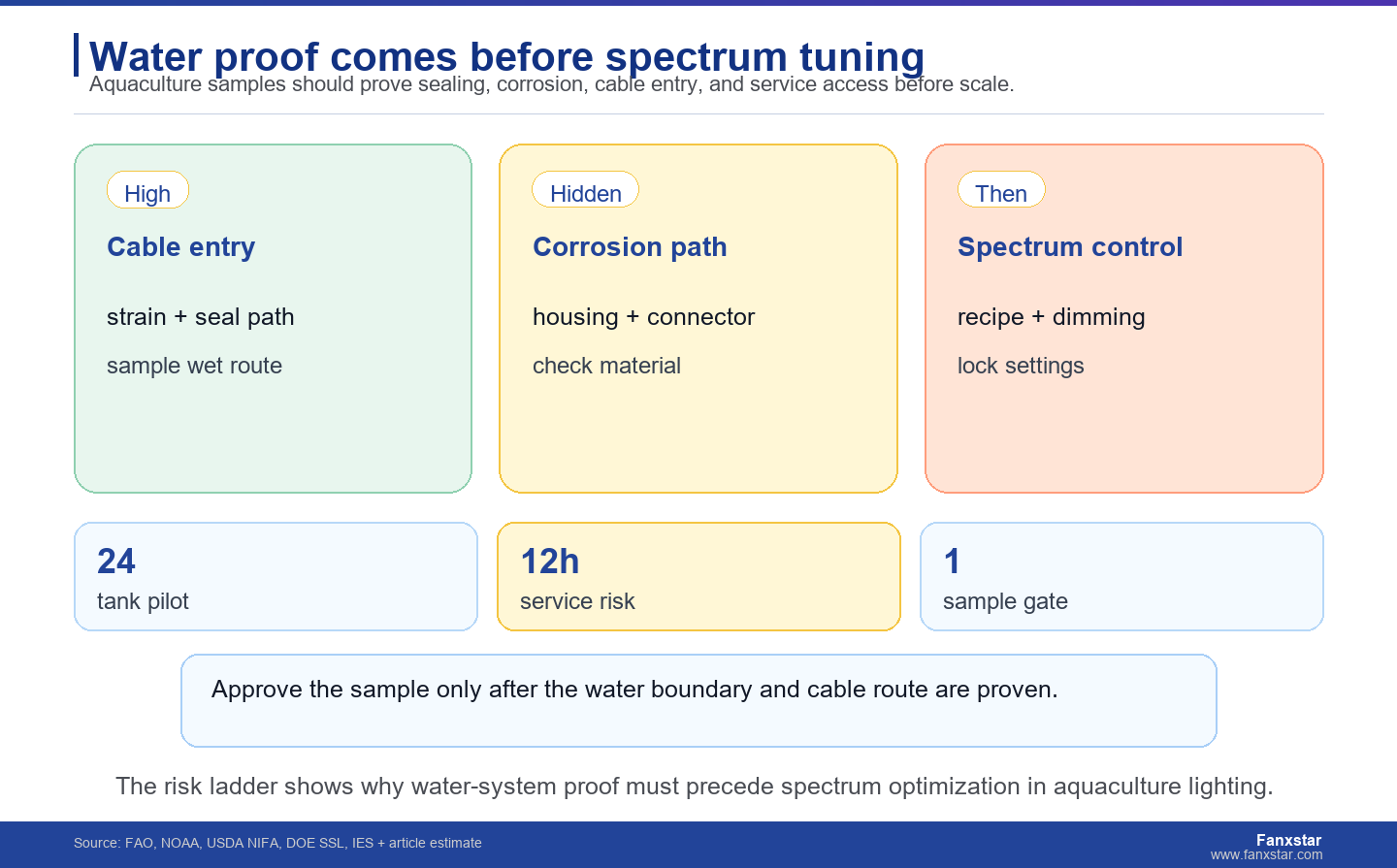
The scenario uses 24 tanks with two fixtures per tank. If an unclear cable-entry or strain-relief detail adds 15 minutes of rework per fixture, the project loses 720 minutes, or 12 service hours. The estimate does not measure biological output or claim a real project result. It shows why aquaculture buyers should test cable routing and water boundary before they fine-tune spectrum settings.
The decision implication is practical: do not approve the sample only because the light output appears suitable. Approve it when cable entry, mounting, sealing, corrosion boundary, dimming method, and service access all match the tank system. Then spectrum optimization becomes a controlled variable instead of a rescue operation.
RFQ Checklist For Aquaculture LED Lighting
The RFQ should let the supplier choose a platform and identify the one condition the sample must prove.
Ask for species or culture type, tank or rack drawing, water boundary, salt or freshwater context, fixture position, immersion or splash exposure, cleaning method, spectrum target, dimming method, operating hours, heat limit, cable route, connector preference, driver access, corrosion concern, sample pass condition, target quantity, and required documents. If a biological performance claim is needed, keep that work with the buyer production team or local specialist.
Relevant Fanxstar starting points include biotech and aquaculture LED lighting solutions, aquaculture and algae LED lighting, vertical farming LED lights, and Fanxstar custom LED lighting ODM service. When the system boundary is clear, buyers can contact Fanxstar for an ODM lighting quote with a sample task that can be tested.
How To Turn The Site Requirement Into Supplier Evidence
Depth in aquaculture LED lighting for tanks, marine systems, and algae growth comes from proving the installation logic, not from adding more fixture descriptions. The buyer is working inside fish tanks, algae cultivation systems, wet service corridors, hatchery rooms, and marine-adjacent production spaces, where the wrong assumption can travel from the quotation into samples, drawings, purchasing, installation, and maintenance. Aquaculture projects often combine biological response, waterproof construction, corrosion resistance, cleaning access, and electrical safety into one vague grow-light request. A useful supplier brief makes that risk visible before the first price comparison.
Separate organism response, spectrum/photoperiod, water exposure, corrosion risk, service access, and pilot measurement before scaling fixtures.
Start With The Condition That Can Falsify The Product Choice
The first review question is not whether aquaculture and algae lighting, waterproof linear fixtures, IP-rated housings, spectrum-tuned ODM variants, and wet-area emergency products are available. It is which site condition would make a good-looking product unacceptable. That condition may be temperature, water path, cleaning chemistry, photoperiod, classified atmosphere, hygiene geometry, dimming behavior, route visibility, service access, or document traceability. If the condition is not written down, the RFQ invites every supplier to answer a different question.
A stronger brief writes one sentence for the failure mode and one sentence for the acceptance evidence. For example, the buyer should state what would count as a failed sample, what document would close the review, what operating condition must be shown on the datasheet, and which decision must be escalated to the engineer, quality team, farm operator, food-safety team, or authority having jurisdiction. This does not slow procurement; it removes the back-and-forth that happens when price is compared before the product has earned the right to be compared.
Translate Product Features Into Reviewable Gates
Feature lists are easy to misread because the same word can mean different things in different rooms. “Sealed” may mean splash resistance in one project, cleanability in another, and dust control in a third. “Emergency” may mean route recognition, backup duration, battery service access, or local testing responsibility. “Custom” may mean a harmless cable length change or a new optical, thermal, or certification burden. The procurement file should translate each feature into an acceptance gate.
The useful gates are practical: what condition is being controlled, what product evidence supports it, what sample behavior must be observed, what document must be archived, and what decision remains outside the supplier’s authority. Fanxstar can support aquaculture and algae lighting, waterproof linear fixtures, IP-rated housings, spectrum-tuned ODM variants, and wet-area emergency products, but the buyer should still ask for one organism/production objective, one spectrum and photoperiod note, one waterproof mounting review, one cleaning/corrosion check, and one pilot measurement plan. When those gates are separate, the supplier can give a clean yes, no, or “needs review” answer instead of burying uncertainty inside a quotation note.
Use A Scenario Estimate To Expose Hidden Coordination Cost
If a pilot rack uses 24 fixtures and two spectrum or mounting assumptions change after installation, even 30 minutes per fixture creates 12 hours of rework before biological results can be compared. The number is an illustrative planning estimate, not a claim from a specific Fanxstar project. Based on our analysis of this scenario, its value is that it makes the hidden cost visible. Calculated from the scenario estimate, every repeated review minute becomes a real schedule burden once it is multiplied by fixture count. Data from the acceptance-gate table should therefore be reviewed before final supplier comparison. Research from the source matrix should stay attached to the RFQ so a low fixture price does not hide extra drawings, late certificate review, repeated sample changes, or a maintenance plan that should have been checked before ordering.
The buyer can reduce that cost by creating a small evidence table before supplier comparison. One column names the zone or use case. One column names the risk being controlled. One column names the required document or sample observation. One column names the person who can approve it. One column records whether the product is standard, ODM-modified, or not suitable. This table also helps Fanxstar keep ODM work disciplined: customization should solve the written constraint, not expand because the original requirement was vague.
Keep ODM Changes Inside A Controlled Path
ODM flexibility is valuable only when the change is tied to a measurable reason. A housing change should answer a material, sealing, cleaning, corrosion, or mounting problem. An optical change should answer a task-plane, biological, glare, aisle, or uniformity problem. A control change should answer dimming, sensor, emergency, photoperiod, or automation behavior. A document change should answer certification, quality, audit, or facility approval needs. Without that link, customization becomes a risk multiplier.
The safer path is to approve changes in layers. First select the closest standard platform. Then mark the exact gap that prevents acceptance. Then request one controlled adjustment. Then test the sample against the original gate. If the sample fails, record whether the failure came from the product, the site assumption, the installation detail, or the document pack. That record is what turns a specialty lighting project from trial-and-error into repeatable procurement.
Evidence Notes To Keep With The RFQ
The following evidence notes should stay with the RFQ rather than being scattered across emails. They give the buyer a compact way to connect third-party or official references with the local decision, while keeping the supplier claim inside its proper boundary.
- Regulatory or standards boundary: According to FAO aquaculture resources, Aquaculture systems should be discussed as managed water, species, and production environments rather than generic lighting spaces. Use this source when the RFQ turns aquaculture LED lighting for tanks, marine systems, and algae growth into a product claim.
- Safety or operating requirement: According to NOAA Fisheries aquaculture, Aquaculture decisions depend on species, water systems, and responsible site management. Use this source when the RFQ turns aquaculture LED lighting for tanks, marine systems, and algae growth into a product claim.
- Design evidence: According to USDA NIFA aquaculture programs, Aquaculture is a specialized production category where technical decisions need application context. Use this source when the RFQ turns aquaculture LED lighting for tanks, marine systems, and algae growth into a product claim.
- Maintenance evidence: According to DOE solid-state lighting, LED performance should be considered at system level, not as isolated brightness. Use this source when the RFQ turns aquaculture LED lighting for tanks, marine systems, and algae growth into a product claim.
- Procurement evidence: According to IES standards, Lighting decisions should be application-specific and evidence-driven. Use this source when the RFQ turns aquaculture LED lighting for tanks, marine systems, and algae growth into a product claim.
The final commercial comparison should happen only after those notes are complete enough for review. Fanxstar can support lighting hardware and ODM spectrum work, while the buyer must validate biological outcomes with its own species, water quality, growth targets, and operating protocol. That boundary is not a disclaimer at the end of the process; it is a buying rule at the beginning.
Related Fanxstar Guides
- Specialty Agriculture, Aquaculture, and Biotech LED Lighting
- Specialty LED Lighting ODM For Extreme Environments
- Vertical Farming LED Lighting Guide
Aquaculture Sample Action Card
- Name the water boundary.
- Map cable entry and driver access.
- Set one spectrum target.
- Define the wet-route sample test.
- Scale only after service access passes.
Frequently Asked Questions
Is aquaculture LED lighting the same as plant grow lighting?
No. Some spectrum logic overlaps, but aquaculture lighting must also handle water boundary, corrosion, cable routing, mounting, and service access inside a managed water system.
Which Fanxstar products are relevant for tanks and marine systems?
V10 and V40 are seawater tube references, V80 is a marine growth light reference, and V9 or VC150 can support controlled spectrum and grow-light conversations when the project is algae or biotech oriented.
Can lighting alone determine aquaculture growth results?
No. Lighting is one system variable. Species, water quality, feed, density, temperature, maintenance, and local production expertise all affect results, so biological claims should stay with the project team or specialist.