Hazardous location LED lighting should not enter procurement as a rugged fixture request; it should enter as a classification-and-certificate review. A luminaire can be bright, sealed, waterproof, and industrial-looking while still being wrong for a gas, vapor, dust, zone, class, division, group, or temperature boundary. Procurement teams need to collect the location classification, certificate marking, installation method, and maintenance boundary before comparing model price or lead time.
Fanxstar can support hazardous-location inquiries with product and ODM documentation, but final selection must comply with local hazardous location codes (ATEX/IECEx/Class I Div 2) and qualified project review.
Key Takeaways
- Classify before quoting: Area classification and substance risk must exist before a hazardous-location model is compared.
- Match the marking: Class/Division, Zone, ATEX, IECEx, UL, group, and temperature class are not decorative labels.
- Separate waterproof from hazardous: Ingress protection can matter, but it does not replace hazardous-area certification.
- Ask for documents: Certificates, markings, datasheets, installation instructions, and wiring details belong in the first RFQ.
- Keep authority boundaries clear: Final acceptance belongs to qualified local engineering, installers, inspectors, and authorities.
Classification Comes Before Fixture Selection
The supplier cannot responsibly select hazardous-location lighting before the location is classified.
According to 29 CFR 1910.307, hazardous classified locations require equipment and wiring methods suitable for the classified condition. That tells procurement teams where to begin: not with wattage, housing shape, or IP rating, but with the classification basis. If the buyer cannot state whether the concern is gas, vapor, dust, class, division, zone, group, temperature, ambient range, and installation market, the supplier can only provide a preliminary discussion.
IECEx and ATEX references are useful because they make certificate traceability visible. UL hazardous-location services are useful because they remind buyers that marking scope must match use. NFPA and local codes matter because final acceptance is local. These sources do not turn an article into engineering advice. They define the boundary: hazardous-location procurement must be document-led.
Class, Division, Zone, And Market Rules Are Different Fields
Specification note: For hazardous location LED lighting procurement, the point behind “Class, Division, Zone, And Market Rules Are Different Fields” should become a reviewable acceptance line. The RFQ should state the site condition, the product evidence, the sample observation, the approver, and the fallback if Fanxstar recommends a standard platform or ODM change. That keeps procurement teams can confuse rugged, waterproof, or emergency products with certified hazardous-location equipment when certificate scope is reviewed too late from being hidden inside a general fixture preference.
Do not compress hazardous-location language into one word such as explosion-proof. A North American Class/Division discussion, an IECEx certificate, an ATEX market requirement, and a local installation code may overlap, but they are not interchangeable purchasing labels. The buyer should ask the project team which marking system applies, which atmosphere or dust group is relevant, what temperature class is required, and what authority will review the installation. A quote without those fields is at best preliminary.
Ingress Protection Still Matters But It Is Not The Certificate
Specification note: For hazardous location LED lighting procurement, the point behind “Ingress Protection Still Matters But It Is Not The Certificate” should become a reviewable acceptance line. The RFQ should state the site condition, the product evidence, the sample observation, the approver, and the fallback if Fanxstar recommends a standard platform or ODM change. That keeps procurement teams can confuse rugged, waterproof, or emergency products with certified hazardous-location equipment when certificate scope is reviewed too late from being hidden inside a general fixture preference.
Wet, dusty, and corrosive exposure may exist inside or near hazardous areas, but IP rating and hazardous-area approval answer different questions. IP language addresses enclosure protection against ingress. Hazardous-location approval addresses equipment suitability in a classified atmosphere. A product can be waterproof and not certified for the classified area. It can also be certified for one hazardous scope and still be wrong for another group, temperature class, or ambient condition.
Maintenance Method Can Affect The Compliance Boundary
Specification note: For hazardous location LED lighting procurement, the point behind “Maintenance Method Can Affect The Compliance Boundary” should become a reviewable acceptance line. The RFQ should state the site condition, the product evidence, the sample observation, the approver, and the fallback if Fanxstar recommends a standard platform or ODM change. That keeps procurement teams can confuse rugged, waterproof, or emergency products with certified hazardous-location equipment when certificate scope is reviewed too late from being hidden inside a general fixture preference.
Hazardous-location procurement should include cable entry, gland, opening method, spare part policy, and replacement instructions. A luminaire that is acceptable when sealed may become a risk if maintenance requires unapproved parts, wrong cable fittings, or unauthorized opening. Procurement teams should therefore compare installation and maintenance documents along with certificate markings. The future technician is part of the product decision.
Document Matrix For Procurement Teams
Hazardous location procurement should be a document comparison before it is a price comparison.
| Procurement Field | Why It Matters | Document To Request | Buyer Boundary |
|---|---|---|---|
| Classification basis | The luminaire cannot be selected until the atmosphere and location are classified | Area classification drawing or written basis | Must come from qualified local engineering or authority review |
| Marking system | Class/Division, Zone, ATEX, IECEx, and UL markings are not interchangeable labels | Certificate, marking photo, datasheet, installation instructions | Match market and project code before sample approval |
| Gas, vapor, dust, and temperature | A fixture can be certified yet still wrong for the substance or temperature class | Group, temperature class, ambient range, protection method | Do not substitute waterproof or IP language for hazardous-area scope |
| Maintenance and wiring | Opening, sealing, cable entries, and replacement can change compliance risk | Wiring diagram, gland details, access method, spare-part policy | Installer and authority requirements govern final acceptance |
The matrix gives procurement teams a practical intake form. It also protects the supplier relationship. When the buyer sends classification, marking, group, temperature, and installation boundary, the supplier can answer with a document-matched product path, a limitation, or a request for more review. When those fields are missing, both sides risk discussing a product that cannot be accepted later.
Scenario Estimate: Late Certificate Review Creates Rework
A certificate mismatch is easier to prevent in the RFQ than to repair after supplier selection.
The scenario uses 24 luminaires in a hazardous-area package. If classification and certificate scope are discovered late and each luminaire family creates 2 hours of procurement or engineering rework, the package adds 48 review hours. That number is not a field measurement. It is a decision model. It shows why certificate scope should appear before price, not after shortlist approval.
The practical fix is simple: ask for the certificate before the sample, and ask for the classification before the certificate. The supplier should not be forced to guess. The buyer should not approve a sample that cannot be matched to the local classification. And the quotation should record which documents are verified, which are preliminary, and which require authority review.
RFQ Checklist For Hazardous Location LED Lighting
A hazardous-location RFQ should let the supplier identify certificate fit or stop early.
Ask for country, facility type, classified area drawing, substance or dust type, Class/Division or Zone system, gas or dust group, temperature class, ambient range, ingress requirement, corrosion exposure, mounting method, cable entry, wiring method, emergency requirement, required certificate system, marking requirements, installation instructions, maintenance policy, sample pass condition, and authority review process. If any field is unknown, mark it unknown instead of replacing it with generic industrial lighting language.
Relevant Fanxstar starting points include Fanxstar hazardous location LED lighting solutions, Fanxstar explosion-proof lighting product category, and contact Fanxstar for an ODM lighting quote. The local image library currently has emergency and weatherproof visual references but no exact explosion-proof product image record, so product geometry in cover planning is only a visual anchor. Certificate documents must lead the final selection.
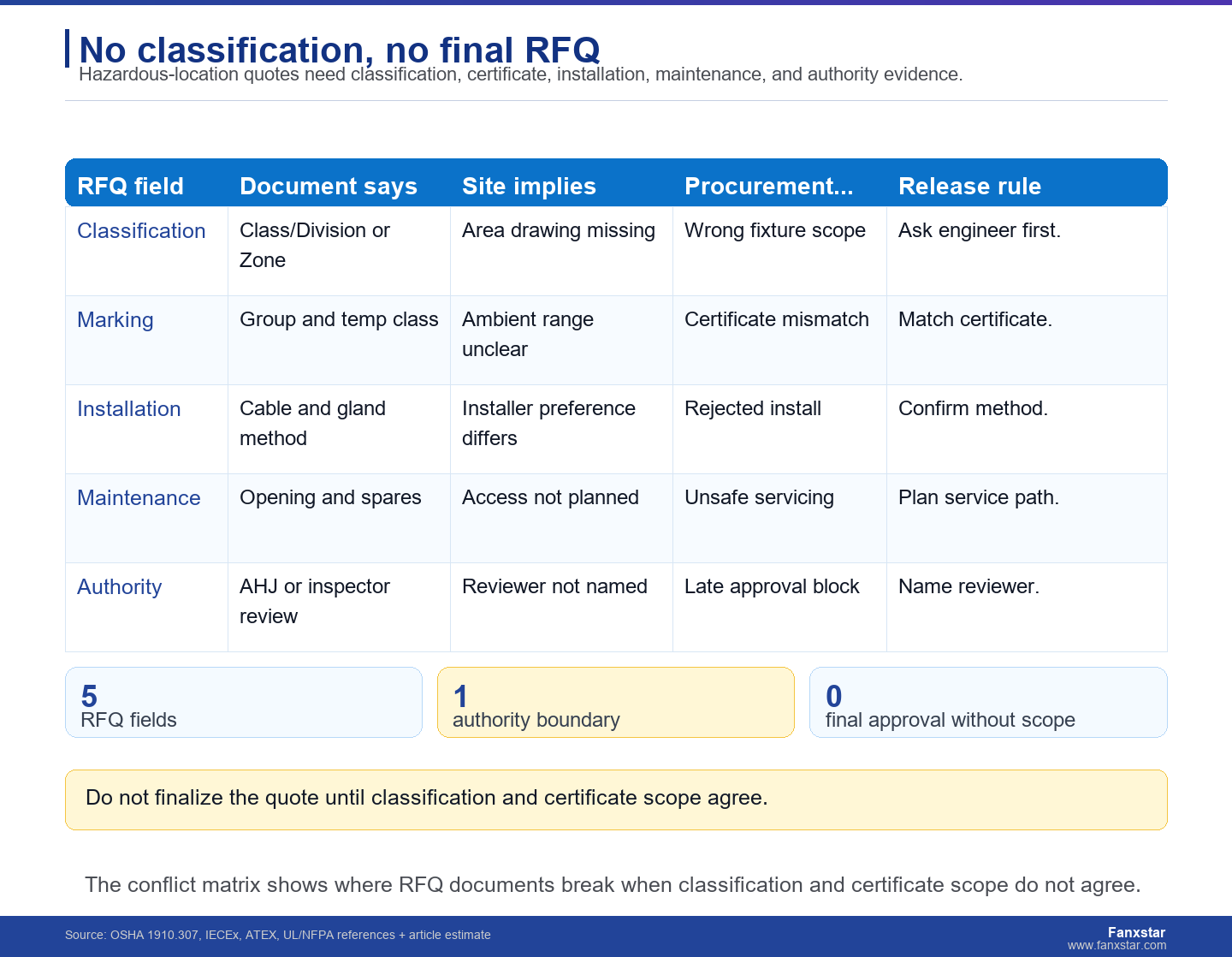
How To Turn The Site Requirement Into Supplier Evidence
Depth in hazardous location LED lighting procurement comes from proving the installation logic, not from adding more fixture descriptions. The buyer is working inside industrial classified locations where gas, vapor, dust, temperature, wiring, and maintenance conditions shape the equipment decision, where the wrong assumption can travel from the quotation into samples, drawings, purchasing, installation, and maintenance. Procurement teams can confuse rugged, waterproof, or emergency products with certified hazardous-location equipment when certificate scope is reviewed too late. A useful supplier brief makes that risk visible before the first price comparison.
Complete the classification, certificate system, group, temperature class, ambient range, and wiring method before requesting a model quote.
Start With The Condition That Can Falsify The Product Choice
The first review question is not whether certificate-scoped explosion-proof lighting, rugged weatherproof references, emergency route products, and ODM documentation support are available. It is which site condition would make a good-looking product unacceptable. That condition may be temperature, water path, cleaning chemistry, photoperiod, classified atmosphere, hygiene geometry, dimming behavior, route visibility, service access, or document traceability. If the condition is not written down, the RFQ invites every supplier to answer a different question.
A stronger brief writes one sentence for the failure mode and one sentence for the acceptance evidence. For example, the buyer should state what would count as a failed sample, what document would close the review, what operating condition must be shown on the datasheet, and which decision must be escalated to the engineer, quality team, farm operator, food-safety team, or authority having jurisdiction. This does not slow procurement; it removes the back-and-forth that happens when price is compared before the product has earned the right to be compared.
Translate Product Features Into Reviewable Gates
Feature lists are easy to misread because the same word can mean different things in different rooms. “Sealed” may mean splash resistance in one project, cleanability in another, and dust control in a third. “Emergency” may mean route recognition, backup duration, battery service access, or local testing responsibility. “Custom” may mean a harmless cable length change or a new optical, thermal, or certification burden. The procurement file should translate each feature into an acceptance gate.
The useful gates are practical: what condition is being controlled, what product evidence supports it, what sample behavior must be observed, what document must be archived, and what decision remains outside the supplier’s authority. Fanxstar can support certificate-scoped explosion-proof lighting, rugged weatherproof references, emergency route products, and ODM documentation support, but the buyer should still ask for one area-classification note, one certificate copy, one marking review, one installation instruction check, and one authority-review handoff. When those gates are separate, the supplier can give a clean yes, no, or “needs review” answer instead of burying uncertainty inside a quotation note.
Use A Scenario Estimate To Expose Hidden Coordination Cost
If 50 fixtures are quoted before certificate scope is checked and 20 percent need revision, the team reopens 10 line items after pricing, drawings, and delivery planning have already started. The number is an illustrative planning estimate, not a claim from a specific Fanxstar project. Based on our analysis of this scenario, its value is that it makes the hidden cost visible. Calculated from the scenario estimate, every repeated review minute becomes a real schedule burden once it is multiplied by fixture count. Data from the acceptance-gate table should therefore be reviewed before final supplier comparison. Research from the source matrix should stay attached to the RFQ so a low fixture price does not hide extra drawings, late certificate review, repeated sample changes, or a maintenance plan that should have been checked before ordering.
The buyer can reduce that cost by creating a small evidence table before supplier comparison. One column names the zone or use case. One column names the risk being controlled. One column names the required document or sample observation. One column names the person who can approve it. One column records whether the product is standard, ODM-modified, or not suitable. This table also helps Fanxstar keep ODM work disciplined: customization should solve the written constraint, not expand because the original requirement was vague.
Keep ODM Changes Inside A Controlled Path
ODM flexibility is valuable only when the change is tied to a measurable reason. A housing change should answer a material, sealing, cleaning, corrosion, or mounting problem. An optical change should answer a task-plane, biological, glare, aisle, or uniformity problem. A control change should answer dimming, sensor, emergency, photoperiod, or automation behavior. A document change should answer certification, quality, audit, or facility approval needs. Without that link, customization becomes a risk multiplier.
The safer path is to approve changes in layers. First select the closest standard platform. Then mark the exact gap that prevents acceptance. Then request one controlled adjustment. Then test the sample against the original gate. If the sample fails, record whether the failure came from the product, the site assumption, the installation detail, or the document pack. That record is what turns a specialty lighting project from trial-and-error into repeatable procurement.
Evidence Notes To Keep With The RFQ
The following evidence notes should stay with the RFQ rather than being scattered across emails. They give the buyer a compact way to connect third-party or official references with the local decision, while keeping the supplier claim inside its proper boundary.
- Regulatory or standards boundary: According to 29 CFR 1910.307 Hazardous classified locations, Hazardous location equipment must match the classified atmosphere and installation boundary. Use this source when the RFQ turns hazardous location LED lighting procurement into a product claim.
- Safety or operating requirement: According to IECEx system for explosive atmospheres, Certificate traceability matters before price comparison in explosive atmospheres. Use this source when the RFQ turns hazardous location LED lighting procurement into a product claim.
- Design evidence: According to European Commission ATEX equipment for explosive atmospheres, ATEX requirements are market and equipment-scope boundaries that buyers must verify. Use this source when the RFQ turns hazardous location LED lighting procurement into a product claim.
- Maintenance evidence: According to UL Solutions hazardous locations services, Class, Division or Zone, gas/dust group, temperature class, and marking scope must be compared. Use this source when the RFQ turns hazardous location LED lighting procurement into a product claim.
- Procurement evidence: According to NFPA codes and standards, Local electrical and life-safety code review remains outside supplier marketing claims. Use this source when the RFQ turns hazardous location LED lighting procurement into a product claim.
- Audit trail: According to OSHA illustrated glossary hazardous locations, Hazardous location vocabulary should be handled carefully and not replaced with generic waterproof language. Use this source when the RFQ turns hazardous location LED lighting procurement into a product claim.
The final commercial comparison should happen only after those notes are complete enough for review. Fanxstar can support product data and document routing, while final hazardous-area suitability depends on the buyer's classification basis and local authority review. That boundary is not a disclaimer at the end of the process; it is a buying rule at the beginning.
Related Fanxstar Guides
- Emergency and Hazardous Location LED Lighting Guide
- Battery Backup Options in Emergency LED Lighting
- Weatherproof LED Lighting For Harsh Sites
Hazardous Location RFQ Action Card
- Attach the area classification basis.
- State marking system and market.
- Request certificate and installation documents.
- Separate IP rating from hazardous approval.
- Route final fit to qualified local review.
Frequently Asked Questions
Is a weatherproof LED light acceptable in a hazardous location?
Not by default. Weatherproof or IP-rated fixtures address ingress protection. Hazardous location fixtures must match the classified atmosphere, certificate marking, group, temperature class, installation method, and local authority review.
What documents should procurement request first?
Request the area classification basis, certificate copy, marking details, datasheet, installation instructions, wiring or gland information, ambient range, temperature class, and maintenance instructions.
Can Fanxstar provide hazardous location LED lighting?
Fanxstar can support hazardous-location inquiries and documentation requests, but final product suitability must be checked against local hazardous location codes, certificate scope, project classification, and qualified engineering review.