Specialty LED lighting ODM is not a promise to make any lamp brighter; it is a way to make structure, optics, electronics, certification evidence, and service access work under a real environment constraint. Extreme-environment projects fail when buyers treat aquaculture, cleanroom, cold storage, data center, and emergency requirements as cosmetic product variations. A useful buyer guide starts with the constraint stack, then asks whether an existing platform can be adapted quickly enough to prove the risk before tooling or mass production.
That is where Fanxstar's platform-based specialty LED lighting ODM position matters most.
Key Takeaways
- Start with constraints: Name water, temperature, chemistry, spectrum, controls, certification, and service access before choosing a model.
- Use platforms first: An existing certified or proven family can lower sampling risk compared with starting from a blank housing.
- Make ODM evidence specific: A sample should prove one risk: optics, gasket, cable entry, battery, sensor, material, or certificate scope.
- Avoid generic OEM language: The buyer needs a path to a manufacturable specialty solution, not a broad catalog rewrite.
- Turn RFQ into a test: Define the sample pass condition before asking for price, MOQ, private label, or packaging.
Map The Constraint Stack Before Choosing A Platform
The right specialty LED platform is the one that can prove the limiting constraint fastest.
Fanxstar custom LED lighting ODM service should be evaluated through project constraints: environment, structure, optics, electronics, controls, certification evidence, packaging, and production repeatability. According to DOE solid-state lighting resources, LED performance belongs in a system view. For specialty procurement, that system is not only energy. It includes the room, tank, freezer, rack aisle, emergency route, or classified area where the product must survive and remain serviceable.
The first buyer mistake is to name the fixture before naming the constraint. A V40 aquaculture tube, A10 waterproof fixture, G1 cleanroom light, L1 data-center linear, and A8 emergency batten may all be specialty products, but they solve different limits. The RFQ should therefore begin with a one-sentence constraint claim: “the fixture must survive seawater exposure,” “the luminaire must avoid cleanroom ledges,” or “the emergency product must keep battery service outside a wet zone.” That sentence gives ODM work a target.
Environment Decides The First Product Family
Specification note: For specialty LED lighting ODM for extreme environments, the point behind “Environment Decides The First Product Family” should become a reviewable acceptance line. The RFQ should state the site condition, the product evidence, the sample observation, the approver, and the fallback if Fanxstar recommends a standard platform or ODM change. That prevents the risk of asking for a custom light too early from being hidden inside a general fixture preference, before the buyer has decided which environmental constraint should dominate the platform choice.
Aquaculture and algae applications begin with water, corrosion, spectrum, and sealing. Cold storage begins with low temperature, condensation, driver behavior, and service time. Cleanrooms begin with ceiling interface and cleanability. Data centers begin with load path and maintenance interruption. Emergency projects begin with route behavior, battery, and documentation. This is why a broad phrase such as industrial LED lighting is too weak for an extreme-environment RFQ. The first family should be chosen because it matches the dominant risk, not because it is the closest catalog photo.
Certification Evidence Is A Boundary, Not A Decoration
Specification note: For specialty LED lighting ODM for extreme environments, the point behind “Certification Evidence Is A Boundary, Not A Decoration” should become a reviewable acceptance line. The RFQ should state the site condition, the product evidence, the sample observation, the approver, and the fallback if Fanxstar recommends a standard platform or ODM change. That prevents the risk of asking for a custom light too early from being hidden inside a general fixture preference, before the buyer has decided which environmental constraint should dominate the platform choice.
IES, ISO, FDA, OSHA, IECEx, and other official or technical sources should be used as boundaries for claims. A lighting supplier should not claim that a fixture certifies a cleanroom, food plant, data center, or hazardous location. It can provide product evidence that helps the project team make a qualified decision. That distinction matters because specialty ODM often sits between the buyer application problem and the formal design or approval system. Clear evidence protects both sides.
Service Access Often Decides Lifetime Fit
Specification note: For specialty LED lighting ODM for extreme environments, the point behind “Service Access Often Decides Lifetime Fit” should become a reviewable acceptance line. The RFQ should state the site condition, the product evidence, the sample observation, the approver, and the fallback if Fanxstar recommends a standard platform or ODM change. That prevents the risk of asking for a custom light too early from being hidden inside a general fixture preference, before the buyer has decided which environmental constraint should dominate the platform choice.
Extreme environments punish maintenance shortcuts. A driver that is easy to reach in a normal warehouse can be difficult inside a freezer, controlled cleanroom, data hall, wet processing room, or emergency route. The buyer should ask where the driver sits, how the lens opens, whether special tools are needed, how the cable exits, and what happens if a sensor or battery fails. Those questions are not after-sales details. They are part of the first sample test.
Application Matrix For Extreme-Environment ODM
Specialty ODM becomes useful when each environment is translated into a sample proof.
| Environment | Dominant Constraint | ODM Proof To Request | Fanxstar Reference Direction |
|---|---|---|---|
| Aquaculture and algae | Water, corrosion, spectrum, cable sealing | Submersion or water boundary, material, spectrum target, connector plan | V10/V40/V80 aquaculture and algae lighting |
| Cold storage and food processing | Temperature, condensation, washdown, lens retention | Low-temperature range, ingress scope, cleaning assumption, service method | A14, A10, D3, A3-NA vapor-tight and waterproof platforms |
| Cleanroom and healthcare support | Ceiling interface, smooth surface, controlled-zone access | Mounting drawing, material note, cleaning boundary, non-medical disclaimer | G1/G2 cleanroom lighting references |
| Data center and warehouse | Load, controls, maintenance interruption, traffic pattern | Driver access, sensor zone, dimming logic, photometric layout | L1, B1, M4N, B4/A16S motion-sensor references |
| Emergency and hazardous projects | Battery, route, certificate scope, local approval | Battery documents, sign viewing, hazardous certificate review, wiring method | E5/E6, A8, C300E, hazardous-location inquiry path |
The table prevents a common ODM error: asking for customization without saying what must change. If the constraint is spectrum, do not start by changing the housing. If the constraint is cleaning, do not start with CCT. If the constraint is certificate scope, do not start with packaging design. The best sample is narrow enough to prove the most uncertain risk first.
Scenario Estimate: Platform Sampling Reduces Early Uncertainty
A fast sample is valuable only when it proves the right constraint.
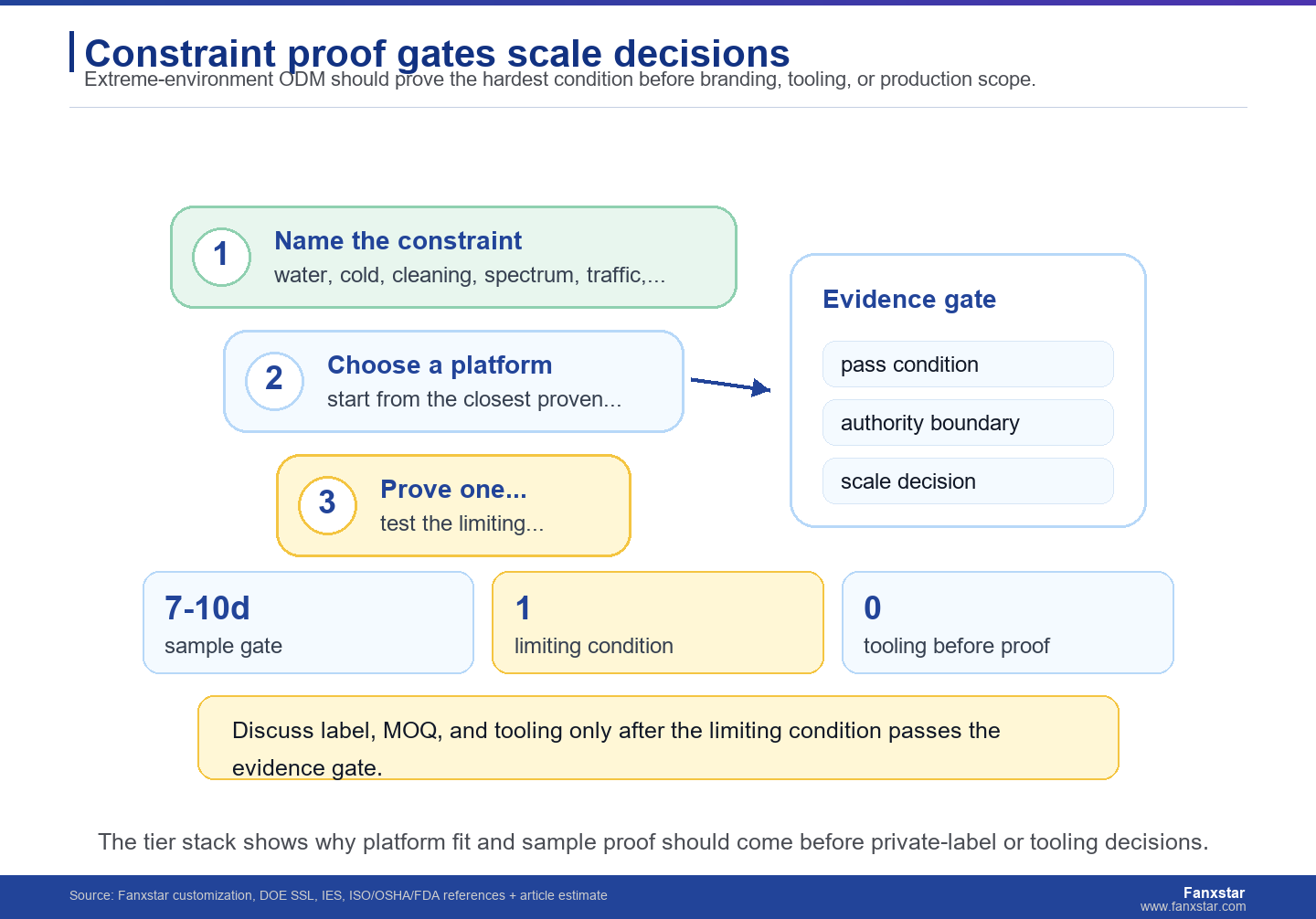
Fanxstar positioning supports first samples in 7-10 days for eligible platform-based customization. Use a conservative 10-day platform sample target and compare it with a 35-day blank-sheet or heavy-tooling path. The difference is 25 calendar days. That does not mean every project should avoid tooling. It means the buyer should test whether a platform can prove the core constraint before asking for a new body, private-label styling, or a larger tooling conversation.
The decision implication is practical. If an A10-style aluminum waterproof body can prove washdown and cable-entry assumptions, the buyer can postpone cosmetic changes. If a V40 aquaculture tube can prove water and spectrum behavior, the buyer can discuss length or connector changes later. If a G1 cleanroom platform can prove ceiling and cleaning detail, the buyer can make the validation conversation more concrete. Platform sampling is not a shortcut around engineering; it is a way to ask engineering questions sooner.
RFQ Checklist For Specialty LED Lighting ODM
A specialty ODM RFQ should read like a controlled test request.
Ask for application, country, environment, operating temperature, water or chemical exposure, dust or corrosion exposure, spectrum or CCT target, optics or beam angle, mounting method, cable entry, driver location, sensor or battery requirement, certification expectation, sample pass condition, branding requirement, MOQ target, packaging requirement, and target delivery window. Then mark which field is fixed, which field can adapt from an existing platform, and which field requires new engineering.
Relevant Fanxstar starting points include Fanxstar specialty LED grow lights, Fanxstar weatherproof LED lighting product platform, Fanxstar LED emergency lighting product range, and Fanxstar custom LED lighting ODM service. When the constraint stack is ready, buyers can contact Fanxstar for an ODM lighting quote with a testable brief.
How To Turn The Site Requirement Into Supplier Evidence
Depth in specialty LED lighting ODM for extreme environments comes from proving the installation logic, not from adding more fixture descriptions. The buyer is working inside cold, wet, corrosive, dusty, clean, agricultural, and classified zones where the environment changes the fixture failure mode, where the wrong assumption can travel from the quotation into samples, drawings, purchasing, installation, and maintenance. Buyers may ask for a custom light too early, before deciding which environmental constraint is allowed to dominate the platform choice. A useful supplier brief makes that risk visible before the first price comparison.
Rank the constraint stack before the industrial design work starts: exposure, thermal range, sealing, optics, controls, certification, and service access.
Start With The Condition That Can Falsify The Product Choice
The first review question is not whether weatherproof platforms, heavy-duty battens, grow-light variants, emergency products, cleanroom-ready luminaires, and ODM optical or sensor options are available. It is which site condition would make a good-looking product unacceptable. That condition may be temperature, water path, cleaning chemistry, photoperiod, classified atmosphere, hygiene geometry, dimming behavior, route visibility, service access, or document traceability. If the condition is not written down, the RFQ invites every supplier to answer a different question.
A stronger brief writes one sentence for the failure mode and one sentence for the acceptance evidence. For example, the buyer should state what would count as a failed sample, what document would close the review, what operating condition must be shown on the datasheet, and which decision must be escalated to the engineer, quality team, farm operator, food-safety team, or authority having jurisdiction. This does not slow procurement; it removes the back-and-forth that happens when price is compared before the product has earned the right to be compared.
Translate Product Features Into Reviewable Gates
Feature lists are easy to misread because the same word can mean different things in different rooms. “Sealed” may mean splash resistance in one project, cleanability in another, and dust control in a third. “Emergency” may mean route recognition, backup duration, battery service access, or local testing responsibility. “Custom” may mean a harmless cable length change or a new optical, thermal, or certification burden. The procurement file should translate each feature into an acceptance gate.
The useful gates are practical: what condition is being controlled, what product evidence supports it, what sample behavior must be observed, what document must be archived, and what decision remains outside the supplier’s authority. Fanxstar can support weatherproof platforms, heavy-duty battens, grow-light variants, emergency products, cleanroom-ready luminaires, and ODM optical or sensor options, but the buyer should still ask for one constraint map, one platform shortlist, one sample acceptance sheet, one test evidence pack, and one change-control note for every custom feature. When those gates are separate, the supplier can give a clean yes, no, or “needs review” answer instead of burying uncertainty inside a quotation note.
Use A Scenario Estimate To Expose Hidden Coordination Cost
If five sample rounds are planned but two are spent discovering basic exposure limits, a six-week sample calendar can lose roughly 40 percent of its useful engineering time before performance tuning begins. The number is an illustrative planning estimate, not a claim from a specific Fanxstar project. Based on our analysis of this scenario, its value is that it makes the hidden cost visible. Calculated from the scenario estimate, every repeated review minute becomes a real schedule burden once it is multiplied by fixture count. Data from the acceptance-gate table should therefore be reviewed before final supplier comparison. Research from the source matrix should stay attached to the RFQ so a low fixture price does not hide extra drawings, late certificate review, repeated sample changes, or a maintenance plan that should have been checked before ordering.
The buyer can reduce that cost by creating a small evidence table before supplier comparison. One column names the zone or use case. One column names the risk being controlled. One column names the required document or sample observation. One column names the person who can approve it. One column records whether the product is standard, ODM-modified, or not suitable. This table also helps Fanxstar keep ODM work disciplined: customization should solve the written constraint, not expand because the original requirement was vague.
Keep ODM Changes Inside A Controlled Path
ODM flexibility is valuable only when the change is tied to a measurable reason. A housing change should answer a material, sealing, cleaning, corrosion, or mounting problem. An optical change should answer a task-plane, biological, glare, aisle, or uniformity problem. A control change should answer dimming, sensor, emergency, photoperiod, or automation behavior. A document change should answer certification, quality, audit, or facility approval needs. Without that link, customization becomes a risk multiplier.
The safer path is to approve changes in layers. First select the closest standard platform. Then mark the exact gap that prevents acceptance. Then request one controlled adjustment. Then test the sample against the original gate. If the sample fails, record whether the failure came from the product, the site assumption, the installation detail, or the document pack. That record is what turns a specialty lighting project from trial-and-error into repeatable procurement.
Evidence Notes To Keep With The RFQ
The following evidence notes should stay with the RFQ rather than being scattered across emails. They give the buyer a compact way to connect third-party or official references with the local decision, while keeping the supplier claim inside its proper boundary.
- Regulatory or standards boundary: According to DOE solid-state lighting, LED performance should be discussed at system level rather than as isolated brightness. Use this source when the RFQ turns specialty LED lighting ODM for extreme environments into a product claim.
- Safety or operating requirement: According to IES standards, Lighting decisions should be application-specific and evidence-driven. Use this source when the RFQ turns specialty LED lighting ODM for extreme environments into a product claim.
- Design evidence: According to ISO 14644-1 cleanrooms and associated controlled environments, Cleanroom claims must respect controlled-environment scope. Use this source when the RFQ turns specialty LED lighting ODM for extreme environments into a product claim.
- Maintenance evidence: According to FDA Food Code 2022, Food and washdown language should stay inside physical-facility and sanitation boundaries. Use this source when the RFQ turns specialty LED lighting ODM for extreme environments into a product claim.
- Procurement evidence: According to OSHA warehousing hazards and solutions, Warehouse and logistics lighting must respect traffic and worker-visibility risks. Use this source when the RFQ turns specialty LED lighting ODM for extreme environments into a product claim.
- Audit trail: According to IECEx system for explosive atmospheres, Hazardous-area language must be tied to recognized certificate scope. Use this source when the RFQ turns specialty LED lighting ODM for extreme environments into a product claim.
The final commercial comparison should happen only after those notes are complete enough for review. Fanxstar can support ODM design, tooling discussion, optics, CCT, sensors, and samples, but the buyer must define the site constraint and acceptance evidence before customization expands. That boundary is not a disclaimer at the end of the process; it is a buying rule at the beginning.
Related Fanxstar Guides
- Specialty Agriculture, Aquaculture, and Biotech LED Lighting
- Cold Storage and Food Processing LED Lighting Guide
- AI Data Center and Smart Warehouse LED Lighting
ODM Sample Action Card
- Name the hardest environment constraint.
- Pick the nearest proven platform.
- Define one sample pass condition.
- Separate product evidence from code approval.
- Move styling and packaging after risk proof.
Frequently Asked Questions
What makes specialty LED lighting ODM different from normal OEM?
Specialty ODM starts with application constraints such as water, cold, cleanability, spectrum, emergency backup, or certification scope. Normal OEM or private-label work may focus mainly on branding, packaging, or minor product variation.
Does every extreme-environment project need a new mold?
No. Many projects should test an existing platform first, especially when the main uncertainty is optics, sealing, cable entry, driver access, sensor integration, or document scope. New tooling is useful only when platform adaptation cannot prove the requirement.
What should a buyer send for a first Fanxstar ODM review?
Send application, environment, exposure, target market, required documents, installation method, sample pass condition, target quantity, branding needs, and the constraint that must be proven first.