Key Takeaways
-
Superior Color Fidelity: High-CRI (90+) lighting ensures that workers can distinguish subtle differences in materials and finishes, critical for quality control.
-
Occupational Health: Flicker-free and low-glare designs significantly reduce eye strain and headaches, supporting long-term productivity.
-
Enhanced Safety: Improved visual clarity allows for faster detection of hazards, spills, and color-coded warning signs.
-
Operational Efficiency: Modern LED solutions like the Fanxstar Trilamp series provide up to 185 lm/W, cutting energy costs while improving light quality.
-
Durability: Industrial-grade fixtures with high IK/IP ratings are essential for the vibration and dust typical in precision environments.
Precision workshops demand an environment where every detail is visible. The transition from standard illumination to professional-grade high-CRI LED lighting is not just an aesthetic choice; it is a fundamental upgrade in operational capability. By providing a light spectrum that closely mimics natural daylight, these fixtures enable workers to perform tasks with a level of accuracy that was previously impossible under conventional industrial lights. According to research on visual ergonomics, optimized lighting directly correlates with increased worker satisfaction and a measurable decrease in manufacturing errors.
The Technical Necessity of High-CRI Solutions
Defining Color Rendering in Precision Contexts
The Color Rendering Index (CRI) measures a light source’s ability to reveal the true colors of objects. For tasks involving textile printing, metal finishing, or intricate assembly, a low CRI can lead to “metamerism,” where colors look identical under workshop lights but appear vastly different in daylight. Fanxstar’s 90+ CRI options ensure that the R9 value (saturated red) is sufficiently high, which is often the weakness of budget LED chips. This technical advantage is crucial for identifying heat-tinted metals or specific wire insulation colors.
|
Application Area |
Minimum CRI Requirement |
Recommended CRI for Precision |
|---|---|---|
|
General Storage |
70 |
80 |
|
Assembly Lines |
80 |
90 |
|
Quality Inspection |
90 |
95+ |
|
Paint & Finishing |
90 |
98+ |
Visual Comfort and Cognitive Load
In high-pressure environments, the cognitive load on workers is intense. Poor lighting adds to this burden by forcing the brain to “fill in the gaps” of poorly rendered details. Professional LED solutions utilize stable drivers to eliminate the invisible stroboscopic flicker that causes neurological fatigue. This creates a calmer, more focused workspace where concentration remains high throughout the shift.
Fanxstar’s Leading High-CRI Product Lines
Trilamp A8 and A12 Series: The Industrial Standard
Designed for the rigors of heavy industry, the Trilamp A8 and A12 series combine color accuracy with extreme durability. Featuring an aluminum chassis for optimized heat dissipation, these fixtures maintain their CRI and lumen output for over 70,000 hours. The A12 series, in particular, is engineered for large-scale facilities where reliability and minimal maintenance are paramount.
DX Downlight Family: Localized Precision
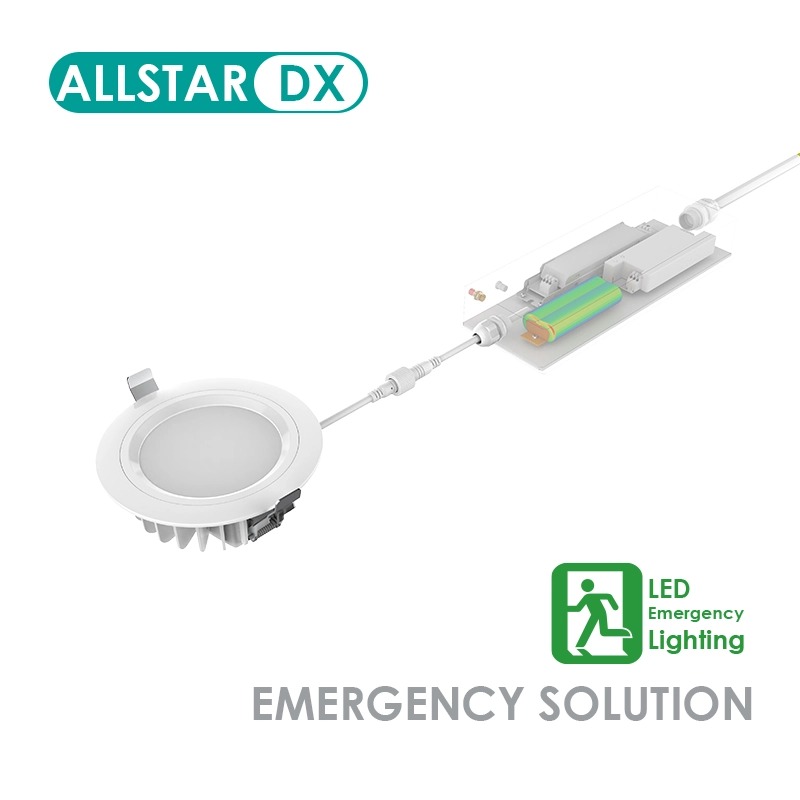
For fixed workstations and maintenance benches, the DX Downlight family (D1, D2H, D3-LT) provides concentrated, high-CRI illumination. With IK10 impact protection, these lights are resilient against the accidental strikes common in mechanical environments. They are the ideal choice for assembly lines where components are small and visual fidelity is the primary driver of quality.
|
Product Model |
Max CRI |
Impact Rating |
Luminous Efficacy |
|---|---|---|---|
|
Trilamp A12 |
90+ |
IK08 |
Up to 160 lm/W |
|
A3 Low-Glare |
90+ |
IK08 |
Up to 185 lm/W |
|
DX Downlight |
90+ |
IK10 |
Up to 140 lm/W |
|
Batman B1 |
85+ |
IP40 |
Shadow-Free Design |
Batman B1: Shadow-Free Innovation
The Batman B1 series utilizes a unique “No-Shadow” optical design. By spreading light homogenously without the use of internal lenses that create hotspots, it ensures that workers are never blinded by reflections off metallic surfaces. This is an indispensable feature for workshops dealing with polished metals or glass components.
Operational Excellence through Advanced LED Technology
Optimizing CCT for Productivity
Correlated Color Temperature (CCT) is the second pillar of professional lighting. While warm light (3000K) is suitable for hospitality, precision workshops thrive in the 4000K to 5000K range. This “cool white” light simulates the midday sun, suppressing melatonin production and keeping workers alert. Research suggests that the right CCT can improve task performance by as much as 20% in detailed manufacturing environments.
Energy Efficiency and ROI
The transition to high-CRI LEDs is as much a financial decision as it is a safety one. Modern LEDs consume up to 75% less energy than fluorescent alternatives and significantly more than incandescent bulbs. When factoring in the reduced heat emission—which lowers air conditioning costs—the return on investment (ROI) for a facility-wide upgrade is often achieved within 18 to 24 months.
“High-quality lighting does not just illuminate a space; it defines the limit of what a worker can achieve. By removing visual barriers, we empower precision.”
Implementation Strategy: Installation and Placement
To maximize the benefits of high-CRI lighting, placement is key. Avoiding “cavern effect”—where the ceiling is dark and the floor is bright—is essential for spatial awareness. We recommend a uniform grid layout supplemented by task lighting at individual workbenches. Regular maintenance, including cleaning the diffusers every six months, ensures that dust buildup does not degrade the lumen output or color quality.
Frequently Asked Questions
Why is 90 CRI better than 80 CRI for my workshop?An 80 CRI light is standard for offices, but it often distorts red and deep blue tones. In a workshop, a 90+ CRI light provides the fidelity needed to spot hairline fractures, subtle corrosion, or specific color-coded electronic components that would look gray under lower-quality light.
Do high-CRI lights use more electricity?In the past, there was a trade-off between CRI and efficacy. However, modern Fanxstar LEDs use advanced phosphor technology to achieve high CRI without significant loss in lumens per watt, ensuring you get both accuracy and efficiency.
How does low-glare lighting protect safety?Glare causes “discomfort glare” and “disability glare.” The latter can momentarily blind a worker when they look at a reflective tool or surface. Low-glare fixtures (UGR < 19) use micro-prismatic diffusers to scatter light safely, preventing these dangerous moments.
Is 5000K the best color temperature for all tasks?5000K is excellent for alertness and detail. However, for inspection of highly reflective surfaces, some facilities prefer 4000K to slightly soften the contrast. Fanxstar offers adjustable CCT options to meet these specific preferences.
How long do professional high-CRI LEDs last?Most Fanxstar industrial fixtures are rated for 50,000 to 100,000 hours. In a typical 40-hour work week, this translates to over 20 years of service, drastically reducing the lifetime cost of maintenance.